REVIEW · PARIS
Paris Latin Quarter & Left Bank – History Walk (Small Group Tour)
Book on Viator →Operated by Visit the Hidden Paris · Bookable on Viator
Paris’s Left Bank is at its best when you look past the famous cafés and follow the older layers underneath. This private walk links a church with parts dating to 990, a revolutionary passage, Roman ruins, grand gardens, and the final resting place of France’s great thinkers.
I like the private format, which lets your guide adjust the pace and spend more time on the subjects you care about. I also like the tablet presentations, especially the photos, videos, and 3D models used to explain the Roman baths and arena. The main drawback is that this is a brisk two to two-and-a-half-hour walk, and some monument entrances are not included.
In This Review
- Key points to know before you book
- Why this Left Bank walk works
- Saint-Germain-des-Prés and the church of 990
- Cour du Commerce Saint-André and revolutionary Paris
- Roman baths at Les Thermes de Lutèce
- Luxembourg Gardens, statues, and the Medici Fountain
- The Pantheon and France’s national memorial
- St. Étienne-du-Mont and its unusual rood screen
- Arènes de Lutèce and the end near Place de la Contrescarpe
- What the private format is worth at $85.98
- Pace, weather, and practical planning
- Who should book this Paris history walk
- Should you book it?
- FAQ
- How long does the tour last?
- What time does the tour begin?
- Where does the tour begin?
- Where does the tour end?
- Is the tour private?
- Are entrance fees included?
- Can I cancel for a full refund?
Key points to know before you book
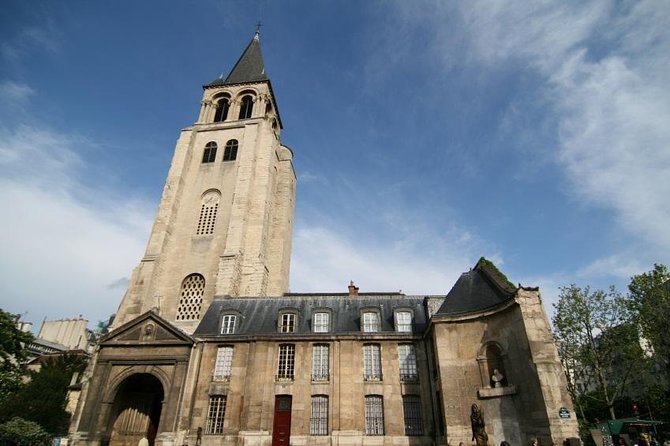
- Saint-Germain-des-Prés begins the story: Start inside one of Paris’s oldest churches, then continue through a charming neighborhood and a local food market.
- Revolutionary Paris appears in a narrow passage: Cour du Commerce Saint-André connects you with Danton, Marat, Robespierre, Franklin, Jefferson, and Napoleon.
- Roman Paris gets visual help: The guide uses a tablet, videos, and 3D models to explain the Baths of Lutetia and the Arènes de Lutèce.
- The private group is capped at 10 people: You can ask questions and move at your own pace instead of keeping up with a large crowd.
- The route finishes near Place de la Contrescarpe: You end in the Latin Quarter, a useful spot for continuing your own walk or stopping for food.
- The price is $85.98 per person: That makes the tour most appealing to couples, families, or small groups who value a private guide and focused commentary.
Why this Left Bank walk works
This is not a greatest-hits bus tour. It is a walking lesson in how Paris grew from Roman settlement to medieval church town, revolutionary hotbed, royal garden district, and national memorial.
The route covers a lot of ground, but the sights are tied together by the guide’s explanations. You are not simply looking at a church, then a garden, then a ruin. You are learning why each place matters and how the Left Bank changed over time.
The guide is bilingual and serves only your party, with a maximum of 10 people. That small scale matters in Paris, where a guide can easily lose a large group in a busy street or crowded square. You can ask about architecture, politics, religion, food, or daily life, and the commentary can be adjusted to your interests.
Ellen is one guide associated with this experience. Her use of an iPad has been particularly praised for adding historical images and detail to the walk. The guide’s tablet is not just for showing pretty pictures. It is used to explain construction, vanished buildings, and Roman sites that can be difficult to understand from scattered stones alone.
The tour begins at 11 a.m. and lasts about two to two-and-a-half hours. The listed time at each stop is short, but the walk between sites gives the experience its shape. Plan for steady movement rather than long periods of sitting.
You can also read our reviews of more walking tours in Paris



Saint-Germain-des-Prés and the church of 990
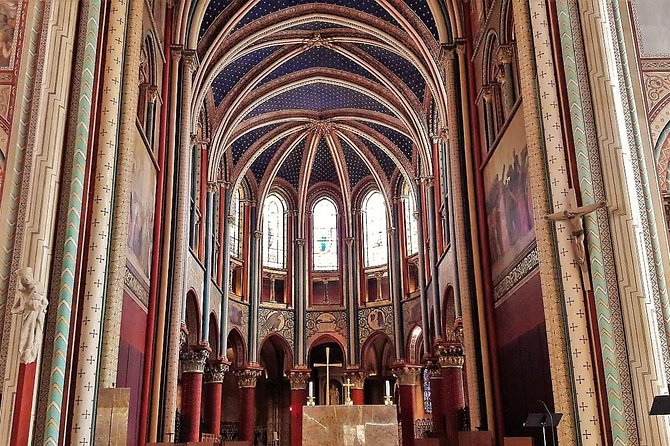
Meet at the Benedictine Abbey of Saint-Germain-des-Prés, at 3 Place Saint-Germain-des-Prés. The church is the first major stop and gives you an immediate sense of how old this part of Paris is.
Parts of the church date from around 990, making it the oldest church in Paris according to the tour description. That claim needs a little care, since different sources define oldest by founding date, surviving structure, or continuous use. Still, the age of the building is the point: you are starting in a place that reaches back far beyond the modern café culture of Saint-Germain.
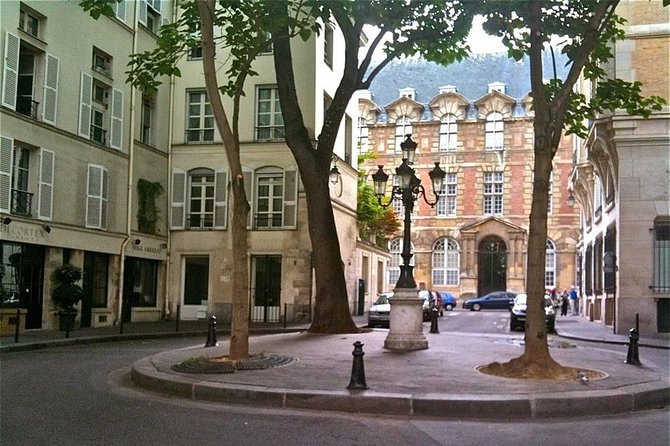
You first tour the church itself, then move into the neighborhood. The stop includes one of Paris’s charming squares and a local food market. This is a smart opening because it joins grand religious history with ordinary urban life. You see where people worshiped, then where they shop and gather today.
The church visit is listed at about 20 minutes, though the guide may use part of that time to answer questions. If church interiors matter to you, tell the guide early. The private format makes that sort of adjustment possible.
Cour du Commerce Saint-André and revolutionary Paris
The next stop is Cour du Commerce Saint-André, one of Paris’s old passages. It is a compact place, but it carries a large political story.
Danton, Marat, and Robespierre lived in this area during the years of the French Revolution. The passage helps put faces and addresses to a period that is often taught as a list of dates and battles. Here, the Revolution becomes local and personal. Political arguments happened in streets, cafés, and homes much like these.
You also see the city’s oldest café, now operating as a restaurant. Benjamin Franklin and Thomas Jefferson were associated with this world, as were philosophers such as Voltaire. Napoleon is reputed to have left his hat behind when he could not pay his bar bill, a small and amusing story amid heavier political events.
The stop lasts about 10 minutes. That is enough for an introduction, but not enough for a long café break or a full restaurant visit. Food and drinks are not included, so treat the market and café references as part of the setting, not as a tasting tour.
Roman baths at Les Thermes de Lutèce
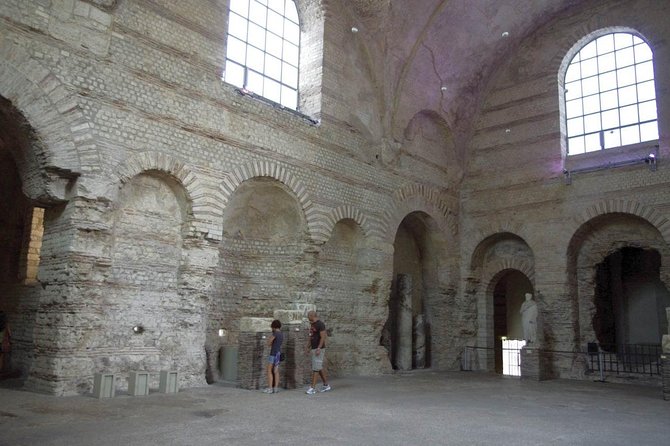
The Baths of Lutetia at Cluny provide one of the clearest reminders that Paris was already an important settlement in Roman times. The remains are not a complete Roman spa waiting for you to wander through on your own. Their value comes from understanding what the structure was, how it was built, and where it fit into the ancient city.
This is where the guide’s visual material becomes especially useful. Videos, photographs, and 3D models show the baths in a way that bare walls and foundations cannot. You can compare the surviving remains with a reconstruction and picture the scale and purpose of the complex.
The stop is scheduled for about 10 minutes, and an admission fee is not included. Ask the guide what access is planned on your date and be ready for the possibility that your visit focuses on the exterior or on a paid area. The important point is the interpretation. Without it, Roman ruins can be hard to read.
Luxembourg Gardens, statues, and the Medici Fountain
Luxembourg Gardens offer a change of pace. After narrow historic passages and ancient masonry, you reach one of Paris’s most pleasant public parks.
The garden contains 110 statues, including a working model of the Statue of Liberty. It also includes Luxembourg Palace, built in 1612 and now used by the French Senate, along with the Medici Fountain, built in 1630.
The guide spends about 10 minutes here, so expect an overview rather than a full tour of every statue and path. That short visit can still be useful because you learn what to look for before continuing. If you want time to sit by the fountain, explore the statue collection, or simply enjoy the park, plan to return after the tour.
This is also one of the route’s practical strengths. You are not confined to churches and museums. The gardens show how Paris’s grand spaces serve as places for leisure, politics, art, and daily routines.
You can also read our reviews of more historical tours in Paris






The Pantheon and France’s national memorial
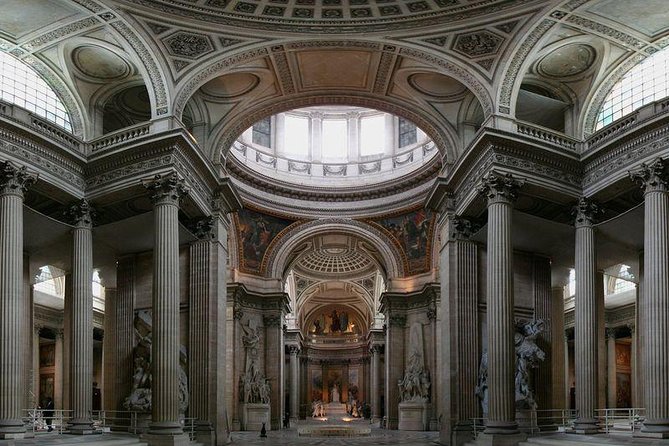
The Pantheon is viewed from the route, with time to discuss its role as a mausoleum for France’s notable figures. The tombs include philosophers such as Voltaire, Diderot, and Rousseau, writers such as Victor Hugo, Alexandre Dumas, and Antoine de Saint-Exupéry, and scientists including Pierre and Marie Curie.
The guide also explains Foucault’s pendulum, the famous demonstration that shows Earth’s rotation. It is a good example of the kind of detail that makes this walk more than a photo stop. The Pantheon is not only a grand building. It is a statement about which thinkers, writers, and scientists France chooses to honor.
Only about five minutes are scheduled here, and entry is not included. If you want to see the interior, tombs, or pendulum at length, you will need a separate visit and an admission ticket. For this tour, the Pantheon works as a compact lesson and a landmark along the walk.
St. Étienne-du-Mont and its unusual rood screen
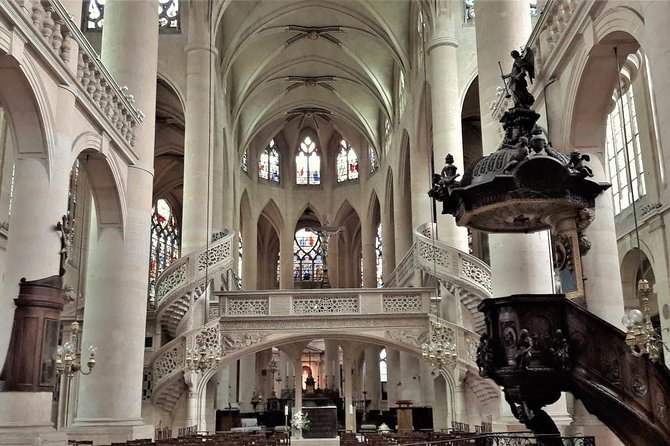
St. Étienne-du-Mont is one of the more rewarding church stops on the route. The church is known for its Baroque decoration and its 30-foot-wide carved stone rood screen, described here as the largest in France.
The guide points out the screen and other Baroque details inside the church. This is a place where a good explanation helps. You may notice the elaborate forms and carvings on your own, but the guide can direct your eye to what makes the church unusual.
About 10 minutes are planned here, and admission is free. As with any active place of worship, the visit operates under the church’s conditions. Dress respectfully and be prepared for the possibility that access or timing can change.
Arènes de Lutèce and the end near Place de la Contrescarpe
The walk ends at the Arènes de Lutèce, another Roman remnant. The site once served a public purpose in ancient Lutetia, and the guide uses video and other visual material to explain its construction and history.
The listed stop lasts about five minutes. That is enough to understand the site’s place in Roman Paris, but not enough for a long independent exploration. The official end point is Place de la Contrescarpe in the Latin Quarter, a convenient area for continuing your day.
You might finish with a meal, walk farther through the Latin Quarter, or make your way toward another Left Bank sight. Since the tour ends away from the starting church, wear comfortable shoes and keep your afternoon plans flexible.
What the private format is worth at $85.98
At $85.98 per person, this is not the cheapest way to walk through the Left Bank. The value depends on how much you want from the guide.
For a couple, family, or small group, the price buys a private historian guide, flexible pacing, and a route that joins several different periods of Parisian history. The tablet material adds something you would not get from simply reading plaques or following a self-guided map.
The price is harder to justify if you mainly want entry to the Pantheon or Roman baths. Monument and museum fees are not included, and food and drinks are also extra. You are paying primarily for interpretation and personal attention, not for a bundle of admissions.
The group limit is 10 people, but the tour is described as private for you and your party. That makes it especially useful if you want to ask frequent questions, have children who need a slower pace, or prefer to focus on architecture rather than political history.
Pace, weather, and practical planning
This is an outdoor walking experience in all weather. Bring an umbrella when rain is likely, warm clothing in winter, bottled water in hot weather, and solid walking shoes.
One published experience took place during a heatwave. The sites remained worthwhile, but the conditions made the walk harder. Paris can feel hot on paved streets, and there may not be much time to stop and recover between points. If the forecast is severe, ask the guide about pacing and carry water.
The meeting point is near public transportation at Saint-Germain-des-Prés. The end point is Place de la Contrescarpe. Children must be with an adult, and most people can take part. Service animals are allowed.
All customers must sign a liability waiver before the walk begins. The guide has stated that they are fully vaccinated, and the tour is operated by a bilingual guide.
You receive confirmation when booking. Free cancellation is available up to 24 hours before the 11 a.m. start time for a full refund. Changes or cancellations inside that window are not accepted for a refund, and the tour requires a minimum number of participants to operate.
Who should book this Paris history walk
I would choose this tour if you want context more than a checklist. It suits first-time visitors who want an introduction to the Left Bank, as well as returning visitors who have seen the main sights but want to understand the Roman and revolutionary layers.
It is a good fit for people who enjoy churches, architecture, political history, and visual explanation. The tablet presentations should help you if ancient ruins are difficult to picture from their remains.
Families may also like the mix of stories. Roman arenas, revolutionary characters, Napoleon’s unpaid café bill, and Foucault’s pendulum give the guide several ways to keep younger minds engaged. Still, the route moves on foot, so children need to manage a two-hour-plus outing.
I would hesitate if your main goal is a slow food walk, a full museum visit, or extended time inside the Pantheon. The schedule touches many places, but it does not give you long at any one monument. You should also budget separately for any entrance fees you choose to pay.
Should you book it?
Book this walk if you want a private, story-led introduction to Saint-Germain-des-Prés and the Latin Quarter, with a guide who can connect Roman ruins, revolutionary streets, churches, gardens, and national memorials.
The strongest reason to choose it is the combination of personal attention and visual support. Ellen’s iPad-based explanations show how effective that approach can be, particularly at the Roman sites. The main tradeoff is the price, along with short stops and extra admission costs.
For a focused overview of the Left Bank, it offers a useful first look. For a slow afternoon spent inside monuments, choose a longer private tour or plan return visits after the walk.
FAQ
How long does the tour last?
The tour lasts approximately two to two-and-a-half hours.
What time does the tour begin?
The start time is 11 a.m.
Where does the tour begin?
It begins at the Église de St Germain des Prés, 3 Place Saint-Germain des Prés, Paris.
Where does the tour end?
It ends at Place de la Contrescarpe in the Latin Quarter.
Is the tour private?
Yes. It is a private tour for you and your party, with a maximum of 10 travelers.
Are entrance fees included?
No. Entrance fees to museums and monuments are not included. Food and drinks are also excluded.
Can I cancel for a full refund?
Yes. You can cancel at least 24 hours before the local start time for a full refund. Cancellations or changes made less than 24 hours before the start are not accepted for a refund.