REVIEW · BAYEUX
Half-Day Tour of Juno Sector with a Professional Guide
Book on Viator →Operated by Normandy Spearhead Tours · Bookable on Viator
The most powerful part of this tour comes at Beny-sur-Mer Canadian War Cemetery, where the story of Juno Beach becomes personal among 2,049 graves. I like the smart route, which pairs German defenses at Longues-sur-Mer with Canadian landing sites, and I like the private format, which gives your group of up to four room to ask questions and pause when needed.
The main drawback is time. Four hours is enough for a sharp introduction to the Juno sector, but not enough for every beach, museum, bunker, or battlefield site nearby. The price of $662.75 per group is also a serious outlay for two people, though it becomes more reasonable when split among four.
In This Review
- Key points to know before booking
- Why this four-hour route works
- Longues-sur-Mer: German guns still facing the sea
- Arromanches: understanding the Mulberry B harbor
- Graye-sur-Mer and the cost of the Juno landing
- Bernières-sur-Mer and Canada House
- Beny-sur-Mer: the quietest and most emotional stop
- What the private price means
- Timing, pickup, and practical planning
- Who will get the most from this tour
- Should you book the Juno Sector half-day?
- FAQ
- How long does the tour last?
- Where does the tour take place?
- Is pickup available at Bayeux train station?
- Is this a private tour?
- What language is the tour offered in?
- What is included in the price?
- Is lunch included?
- How much does the tour cost?
- What can I see at Longues-sur-Mer?
- Can most people participate?
Key points to know before booking
- Original German naval guns at Longues-sur-Mer: Three of the battery’s four 150-millimeter guns remain in place, along with the surrounding bunkers.
- Mulberry B at Arromanches: You can see the remains of the artificial harbor that carried about 22 percent of the supplies used by Anglo-Canadian forces during the campaign.
- A direct look at Canada’s D-Day landing: Graye-sur-Mer and Bernières-sur-Mer bring the Juno story down to specific units, beaches, and buildings.
- A Churchill AVRE tank on the beach exit: This surviving armored vehicle marks the route used during the assault.
- A quiet cemetery visit: Beny-sur-Mer Canadian War Cemetery contains 2,049 graves, including many Canadians killed on D-Day and during the Battle of Caen.
- Private English-language touring: Pickup and drop-off at Bayeux train station can be arranged, and only your group participates.
Why this four-hour route works
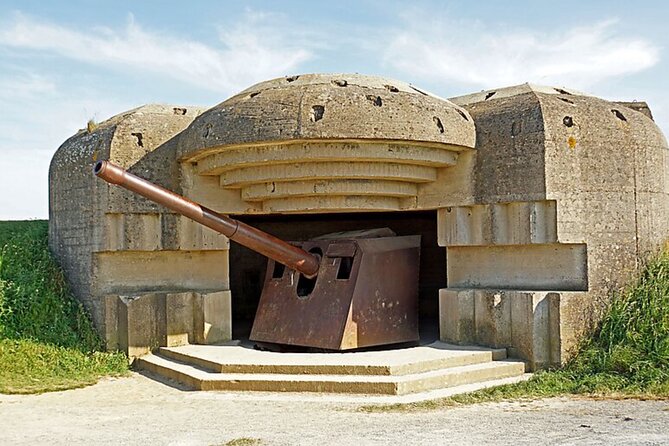
Normandy’s D-Day coast is spread across a large area. If you try to see it alone in a short visit, it is easy to collect scenic viewpoints without understanding how the sites connect. This tour gives you a compact chain of places: German coastal artillery, an Allied supply harbor, two Juno Beach landing areas, and a Canadian cemetery.
I like that the route does not focus only on one side of the battle. At Longues-sur-Mer, you begin with the German fortifications. By the time you reach Graye-sur-Mer and Bernières-sur-Mer, you are looking at the Canadian assault and the cost of taking the shore.
The private setup matters here. Your group can ask for clarification without worrying about slowing down a bus full of people. A guide can also adjust the conversation to your interests, though the tour still follows a set four-hour schedule.
The guide’s role is especially important at sites such as the cemetery. One particularly useful detail from the tour experience is the guide’s care with a family search: when a guest was looking for a grandfather’s grave, the guide suggested stopping for flowers and allowed a quiet moment at the grave. That tells you what kind of help matters in Normandy. Facts are useful, but judgment and sensitivity matter just as much.
You can also read our reviews of more guided tours in Bayeux

Longues-sur-Mer: German guns still facing the sea
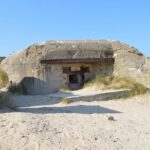
The first stop is Batterie Allemande de Longues-sur-Mer, also known as WN 48. This was one of the important parts of Hitler’s Atlantic Wall, the chain of German coastal defenses built along the occupied European coast.
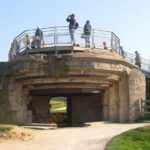
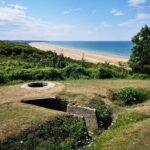
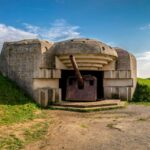
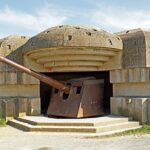
The battery is unusually direct. Three of the four original 150-millimeter guns remain in place. You are not simply looking at a plaque or a reconstructed wall. You can see the naval guns inside their concrete positions and examine the bunkers that protected the battery crew and equipment.
Allow about an hour here. That is a generous share of a four-hour tour, and it makes sense. The site needs explanation if you want to understand how the battery was built, what its guns were meant to do, and how the fortification fit into the D-Day operation.
I would pay close attention to the relationship between the guns and the coastline. The point is not just that German artillery occupied this spot. The battery was part of a larger defensive system designed to control movement along the shore and make an Allied landing more difficult.
This stop also gives you the physical side of wartime history. Concrete bunkers and heavy guns communicate scale in a way that photographs rarely can. If you prefer museums and personal stories, the site may feel spare. If you want to see military engineering up close, it is one of the strongest stops on the route.
Arromanches: understanding the Mulberry B harbor
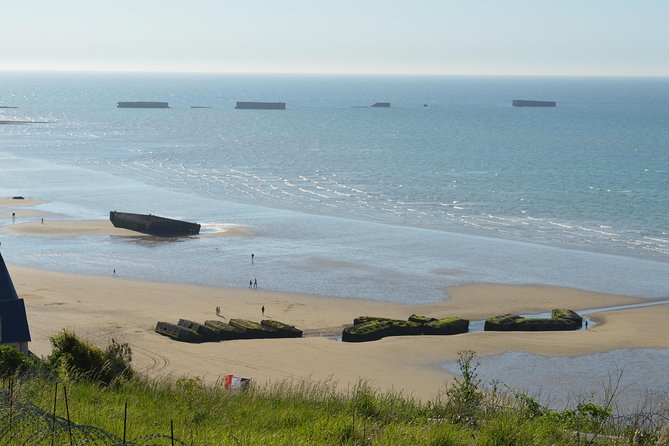
At Arromanches, the focus shifts from defense to logistics. After D-Day, the Allies needed a way to bring in fuel, ammunition, food, vehicles, and other supplies without waiting to capture a major port. The answer was the Mulberry harbor, an artificial port assembled off the Normandy coast.
Mulberry B served the Anglo-Canadian forces. About 22 percent of the supplies required by those forces during the campaign came through this harbor alone. That figure helps you understand why Arromanches mattered. The invasion was not won only on the beach. It also depended on keeping men and equipment supplied after the landing.
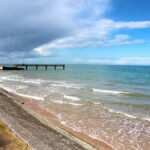
You will have about 45 minutes here. Remnants of the harbor remain visible along the seafront, giving the guide something solid to point toward while explaining how the project worked.
This is a good place to connect engineering with battlefield results. A beach landing can succeed in the first hours and still fail if supplies cannot follow. Arromanches shows how the Allies solved that problem under wartime pressure.
The limitation is that the stop is short. You will not have time to treat Arromanches as a full museum visit as well as a guided coastal stop. If the artificial harbor is your main interest, you may want a separate visit on another day. On this route, it works best as a focused part of the larger Juno story.
Graye-sur-Mer and the cost of the Juno landing
Graye-sur-Mer marks Mike Sector, the westernmost part of Juno Beach. The Royal Winnipeg Rifles assaulted this section on D-Day, and the first wave suffered a casualty rate similar to Omaha Beach.
That comparison gives the stop its force. Popular accounts sometimes make Juno sound like a relatively easy Canadian landing. Graye-sur-Mer corrects that impression. The Canadian assault faced serious danger, and the cost was high from the first minutes.
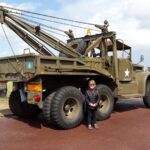
The beach exit is marked by a Churchill AVRE tank, one of the specialized armored vehicles known as Hobart’s Funnies. The tank remains in place as a physical reminder of the equipment used to help troops move through the defenses and off the beach.
You have about 45 minutes here. That is enough time for the guide to explain the sector, the Royal Winnipegs, and the role of the tank. It is not enough to cover every unit or tactical movement connected with Juno Beach, so listen for the main thread: troops had to cross an exposed shore, breach German defenses, and push inland under fire.
I find this stop valuable because it makes the beach more than a broad strip of sand. The name Mike Sector identifies a particular assault area. The tank and the beach exit help you picture how the landing moved from the water toward the village.
Bernières-sur-Mer and Canada House
Bernières-sur-Mer brings you to Nan White sector and one of the best-known landmarks in the Canadian area, Canada House. The building is linked with the Queen’s Own Rifles, who carried out the assault there.
The battalion suffered the highest casualty rate among the Canadian units involved in the attack. That fact changes the way you look at an ordinary-looking building. Canada House is not simply a pleasant coastal landmark. It helps anchor the story of the men who fought through this part of the town.
Bernières also connects the Canadian assault with French Canada. La Chaudière Regiment landed here, and it was the only French-speaking Canadian unit at Normandy on D-Day. That detail adds a human and national layer to the visit without requiring a long lecture.
The stop lasts about 45 minutes. You should expect the guide to explain the landing sector, the Queen’s Own Rifles, Canada House, and La Chaudière Regiment. The benefit of a private guide is that you can ask how these units fit into the wider Canadian operation.
The limitation is similar to Graye-sur-Mer. You receive a concentrated explanation rather than a full study of the town. If your family connection is tied to a particular regiment, tell the guide early. The supplied information does not identify the guide by name, but the experience shows that the guide can respond thoughtfully to personal research.
A few more Bayeux tours and experiences worth a look

Beny-sur-Mer: the quietest and most emotional stop
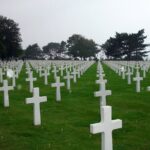
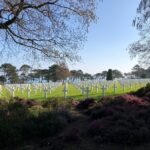
The final stop is Beny-sur-Mer Canadian War Cemetery, also called Beny-Reviers Cemetery. It was the first of two Canadian cemeteries established in Normandy after the war, and it contains the graves of 2,049 men.
Among those buried here are most of the 359 Canadians killed on D-Day, men who died during the Battle of Caen, and some of the 156 Canadians murdered during the summer of 1944 by members of the 12th SS Division.
The cemetery receives about 45 minutes, which is a useful amount of time. You can walk among the graves, listen to the explanation, and take a quiet moment without rushing through the site.
This is where the tour’s structure pays off. You have already seen the defenses and landing beaches. At the cemetery, you confront the human result. The names and dates narrow the war from a huge operation to individual lives.
If you are searching for a relative, bring the person’s full name and any details you have. The guide may be able to help you look, and the guide’s response to one family grave search showed real care. Flowers were suggested for the visit, and the guest was given privacy at the grave. That is a small service, but in a place like this it can mean a great deal.
Please treat the cemetery as a place for reflection, not a quick photo stop. The private format helps, since your group can set a respectful pace. Still, the tour has a schedule, so tell the guide before the visit if a family memorial is your main reason for booking.
What the private price means
The listed cost is $662.75 for the group, with up to four people included. That means the price is about $165.69 per person for four people, about $220.92 each for three, or $331.38 each for two. For one person, it is a very expensive half-day.
The value is strongest for four people who want a private guide and private vehicle arrangement rather than a larger group outing. Families and friends can share the cost while keeping the discussion focused on their interests.
You also avoid the work of linking five sites across the coast in a short period. Pickup and drop-off at Bayeux train station are available by request, which is useful if Bayeux is your base and you are arriving or departing by rail.
Bottled water is included. Lunch is not, and the four-hour schedule does not include a meal. Plan to eat before or after the tour rather than expecting a restaurant stop during it.
The price is harder to justify if you are a solo visitor, if you have a full day available for independent touring, or if you want extensive time inside museums. It makes more sense when you value an efficient route, personal questions, and an English-language guide who can explain the military and personal sides of the sites.
Timing, pickup, and practical planning
The tour lasts approximately four hours. Available start times are listed from 8:30 AM to 1:30 PM and from 2:00 PM to 6:30 PM, Monday through Sunday, during the stated operating period of July 7, 2022 through November 26, 2026.
Because each stop has a planned time, do not expect a flexible full-day battlefield study. Longues-sur-Mer receives one hour, while Arromanches, Graye-sur-Mer, Bernières-sur-Mer, and Beny-sur-Mer each receive about 45 minutes.
Pickup and drop-off at Bayeux train station can be arranged on request. The area is also near public transportation, though the tour itself is designed as a private guided activity rather than a self-guided train and bus outing.
Confirmation is sent within 48 hours of booking, subject to availability. The booking is non-refundable and cannot be changed after purchase, so check your dates and group size carefully before paying.
The experience is offered in English. Most people can participate, but the supplied details do not provide specific information about wheelchair access, vehicle type, or walking distances. If you have mobility needs, ask the provider before booking.
Who will get the most from this tour
I would choose this tour if you have only half a day and want the Canadian sector explained in a clear sequence. It suits first-time Normandy visitors who want more than a beach photograph but do not have time for a full multi-day study.
It is also a strong choice for families with a Canadian connection. Bernières-sur-Mer, the Queen’s Own Rifles, La Chaudière Regiment, and Beny-sur-Mer create several openings for family research. A private guide can give more attention to a name, unit, or grave than a large scheduled group normally can.
Military-history fans will appreciate Longues-sur-Mer and the Churchill AVRE tank. Engineering-minded visitors will get the most from Arromanches and the Mulberry B harbor.
I would look elsewhere if your priority is a long museum visit, extensive time at every Juno Beach sector, or the lowest possible price. This is a tightly planned introduction, not a complete Normandy battlefield program.
Should you book the Juno Sector half-day?
Book it if you want an efficient, private route that joins German defenses, Allied supply work, Canadian landings, and a cemetery visit in four hours. The guide’s strongest contribution is not just factual explanation. It is the ability to connect the sites and handle personal moments with care.
The best value comes with four people sharing the $662.75 group price. If you are traveling alone, compare the cost with a larger group tour. If you are researching a Canadian relative, the private format may justify the premium, especially if Beny-sur-Mer is central to your plans.
This tour gives you a focused look at Juno and its surrounding sites. It will leave you with questions for a longer visit, which is exactly what a good half-day tour should do.
FAQ
How long does the tour last?
The tour lasts approximately four hours.
Where does the tour take place?
The tour is based in Bayeux and visits Longues-sur-Mer, Arromanches, Graye-sur-Mer, Bernières-sur-Mer, and Beny-sur-Mer Canadian War Cemetery.
Is pickup available at Bayeux train station?
Yes. Pickup and drop-off at Bayeux train station can be arranged upon request.
Is this a private tour?
Yes. Only your group participates, with a maximum of four people.
What language is the tour offered in?
The tour is offered in English.
What is included in the price?
Bottled water is included.
Is lunch included?
No. Lunch is not included.
How much does the tour cost?
The price is $662.75 per group of up to four people.
What can I see at Longues-sur-Mer?
You can see three of the four original 150-millimeter German guns still in place, along with the World War II bunkers of the battery.
Can most people participate?
Yes. The available information states that most people can participate. Specific accessibility details are not provided, so ask the provider if you have particular mobility requirements.