REVIEW · DIJON
Dijon City Self Guided Walking Tour through Smartphone App
Book on Viator →Operated by Tourific · Bookable on Viator
A phone-led stroll through Dijon beats guesswork. This self-guided smartphone tour stitches together standout landmarks with clear narration, and I really like that you can use offline access once it’s downloaded. You get a route that feels logical on foot, from scientific tributes to Burgundy power and then back to everyday Dijon cravings.
The two things I like most: the English audio + written guide feel practical, with explanations that don’t pile on so many facts you tune out. My other favorite is the calm pacing at each stop, so you can pause, look around, and still keep moving. One consideration: you’ll cover a lot of ground for a 2-hour target, and there’s a serious stair climb at Tour Philippe Le Bon.
In This Review
- Key highlights worth your attention
- Why this Dijon self-guided walk works
- Price and time: what $8.47 buys you
- Pl. Darcy and the science-meets-art start
- Porte Guillaume to François Rude Street: gates, reliefs, and style shifts
- Maille, wine harvesters, and the indoor market you’ll want seconds of
- Notre-Dame, the Black Madonna, and why symbols matter
- The owl: a small statue with big local storytelling
- Hôtel de Vogüé tiles and Saint Michael’s mixed styles
- The Palace of the Dukes and the power that shaped Dijon
- Tour Philippe Le Bon: the 316 steps and Golden Fleece legacy
- Cathédrale Saint-Bénigne and its stained glass + crypt
- Gingerbread at Mulot and Petitjean, then Roman-era Dijon
- Practical tips so the app feels smooth on foot
- Who this self-guided Dijon walk suits best
- Should you book this Dijon walking tour?
- FAQ
- How long is the Dijon smartphone walking tour?
- What does the tour cost and what language is it in?
- Do I need internet to use the tour while walking?
- Where do I start and where do I end?
- What’s included with the mobile ticket?
- Is there a time window for the ending museum stop?
- What if I don’t like the tour?
Key highlights worth your attention

- Offline-ready audio and maps so you’re not stuck hunting for signal.
- GPS-style guidance with images to help you spot each stop fast.
- Easy-to-follow narration that stays informative without turning into a lecture.
- Dijon mustard and gingerbread stops built into the walking plan.
- Big-name Burgundy sights plus smaller symbols like the owl and the Black Madonna.
- A route capped at 20 people, even though it’s self-guided.
Why this Dijon self-guided walk works

This is the kind of city walk I enjoy because it’s on your schedule. You start outside on Pl. Darcy, then move through a sequence of sights without waiting for a group’s pace. The smartphone app keeps things tidy: it guides you to where to look and gives you the story while you’re standing there.
I also like that it’s not just about big buildings. Dijon has symbols everywhere, and this route points you to some of the quieter landmarks too—like the owl legend, the Black Madonna connection, and the “Polar Bear in its Stride” statue tied to François Pompon. You’ll end up seeing more than a photo-hunt list.
You can also read our reviews of more walking tours in Dijon


Price and time: what $8.47 buys you

At $8.47 per person for about 2 hours, this is strong value if you’re the type who actually stops to read and listen. You’re getting a full 1-year access pass on iOS and Android, so if you return to Dijon later (or want to repeat the walk with fresh eyes), the app stays useful.
Just be ready for reality: the walking time includes time spent listening at each stop. Even with a brisk pace, you may feel like you’re closer to a longer afternoon stroll than a strict two-hour sprint. The app’s design helps, but you still have to climb stairs and pause to take in what you’re hearing.
Pl. Darcy and the science-meets-art start
Your walk begins at Darcy Square (Pl. Darcy, 21 Pl. Darcy, 21000 Dijon). This opening sets the tone in a smart way: one of the first ideas you’ll meet is the connection between Dijon and Henry Darcy, a name tied to science and engineering.
Right nearby, the tour guides you to the symbolic “Polar Bear in its Stride” statue and links it to François Pompon’s legacy in Dijon. Even if you’re not a sculpture person, it’s a good start because it trains your eyes. Instead of just looking at stone, you learn what the artist wanted you to notice.
Porte Guillaume to François Rude Street: gates, reliefs, and style shifts

Next up is Porte Guillaume, a former medieval gateway that later became a triumphal arch honoring historical figures. What makes this stop click is the way the narration connects time periods: you’re looking at architecture that has been repurposed, layered, and reinterpreted rather than frozen in one era.
Then the route moves into François Rude Street, where you get a visual mix of medieval and Renaissance architecture close together. That matters on a walking tour. It’s easy to get lost in dates when you jump between distant sites, but here you’re watching style changes unfold street by street.
Bareuzai Square also fits this theme. You’ll hear the story behind the iconic wine-harvester statue, a local character piece that feels different from the grand monuments. This is the kind of detail that makes Dijon feel lived-in rather than museum-only.
Maille, wine harvesters, and the indoor market you’ll want seconds of

If you like food history, the route doesn’t tease you—it delivers. You’ll stop at the Maille boutique, described as the birthplace of Dijon mustard, and you’ll also learn about the artisanal production process. Dijon mustard can feel like a souvenir topic, but this framing makes it feel like a craft and a local tradition.
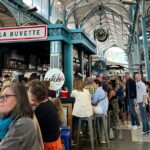
From there, you keep following the food thread into the historic indoor market. The narration connects it to Gustave Eiffel’s genius, which gives you a reason to care about the building itself, not just the stalls. This is the moment when the walk turns practical: you’ll be thinking about what to taste next instead of just what to see.
The route also sets you up to notice how Dijon’s food culture isn’t an afterthought. It’s part of daily life and local identity, and the market scene gives you that feeling in real time—without needing a formal food tour.
You can also read our reviews of more guided tours in Dijon


Notre-Dame, the Black Madonna, and why symbols matter

At Notre-Dame, you’ll get a guided moment focused on miracles, Gothic charm, and symbols—especially the Black Madonna. This stop is about interpretation, not just architecture. You’re encouraged to look for meaning in the details that might otherwise slide past.
This is where the app shines for me: it slows you down in the right places. You don’t just move on because the next location is scheduled. You pause, look, listen, and connect what you’re seeing to the legends that locals have passed along for centuries.
The owl: a small statue with big local storytelling

Then comes a lighter, funnier stop in spirit: Dijon’s beloved owl. The tour treats it like a question you’re meant to explore—talisman, tribute, or something else. That uncertainty is part of why it works. It keeps the story human and local rather than overly explained.
You’ll see how a tiny sculpture can carry a whole set of traditions. It’s also a great reset after churches and monumental buildings, because the owl stop is quick, visual, and memorable.
Hôtel de Vogüé tiles and Saint Michael’s mixed styles

Your next architecture hit is the Hôtel de Vogüé, a Renaissance gem described as being adorned with Burgundy’s glazed tiles. This is the kind of stop where visuals do half the work. The narration helps you look for the tilework style and understand why it became such a defining Burgundy feature.
From there, you’ll head to Saint Michael’s Church, which is presented as a unique mix of Gothic and Renaissance styles. You’ll also hear the story of Saint Elisabeth of the Trinity, whose faith continues to touch hearts. Even if you’re not religious, it’s a meaningful way to understand why places like this last.
The Palace of the Dukes and the power that shaped Dijon
Now the walking route gets serious—politics, money, and clout. You’ll explore the Palace of the Dukes of Burgundy, framed as a symbol of wealth and power that rivaled the French monarchy. This matters because Dijon didn’t just have pretty buildings; it had rulers with ambition, and that ambition shaped what you can still see today.
As you move through this section, try to think of the palace as more than a backdrop. The app nudges you to connect architecture to influence. You’ll understand why this city became a magnet for attention in the Burgundy region.
Tour Philippe Le Bon: the 316 steps and Golden Fleece legacy
The next big payoff is the Tour Philippe Le Bon. You’re guided to climb 316 steps for views, plus you’ll learn about the legacy of Burgundy’s most powerful duke and the Order of the Golden Fleece.
This is the one part where I’d call out a practical consideration up front. If stairs tire you quickly, plan your pacing and don’t rush the narration. The app can guide you along the way, but the climb itself is still your responsibility.
The reward is built into the structure of the experience: you’re earning a higher viewpoint, and the tour ties the physical effort to the historical weight of what you’re seeing.
Cathédrale Saint-Bénigne and its stained glass + crypt
After the tower, the route returns to spiritual and artistic detail with the Cathédrale Saint-Bénigne. The focus here is a Gothic masterpiece with stained glass, intricate carvings, and a centuries-old crypt.
What I like about how this is handled is balance. It’s not only about impressive visuals. You also get a guided approach to the crypt and the idea that the cathedral holds layers—spiritual, architectural, and historical—in the same footprint.
If you like churches, this stop will feel like a satisfying payoff. If you usually skim churches, the crypt and stained-glass attention point can help you slow down without getting lost.
Gingerbread at Mulot and Petitjean, then Roman-era Dijon
The route ends with a sweet-and-ancient double feature. First, you’ll step into the Mulot and Petitjean Gingerbread Factory, where the narration highlights a tradition of over two centuries tied to Dijon’s gingerbread.
Then you finish at Musée Archéologique de Dijon (end point: 7 Rue Dr Maret, 21000 Dijon, France). The museum stop is framed through Burgundy’s ancient past, with artifacts ranging from prehistoric tools to Roman burial monuments. It’s a great way to end: you go from medieval and Renaissance power down into earlier foundations of the region.
The museum’s opening hours listed for this experience are 9:00 AM–7:00 PM, Monday through Sunday, across the date range shown. If you’re timing the walk to land near closing, it’s worth planning the sweet stop carefully.
Practical tips so the app feels smooth on foot
This tour is designed to be straightforward, but a few habits make it better.
- Use headphones (or share one earbud) so you can hear the audio while you walk. The narration is meant to be listened to at the stop, not at full speed.
- Download the tour first for offline access, then test that your map and audio both work before you step away from Wi‑Fi.
- Pay attention to the images used to identify stops. Dijon has plenty of beautiful streetscapes, and the visuals help you confirm you’re in the right place quickly.
- Keep an eye on pacing around the tower. The climb is the longest physical commitment on the route, and it can stretch your timeline.
One more practical note: since the experience includes a defined start and end point, treat it like a one-direction walk. It’s not meant to be a bounce-around buffet.
Who this self-guided Dijon walk suits best
This is a great fit if you want structure without babysitting. I’d recommend it for you if you like architecture, symbols, and cultural stories, but you don’t want to sit through a long guided lecture.
It’s also a good choice for people who enjoy food culture in context. Dijon mustard (Maille) and gingerbread (Mulot and Petitjean) aren’t random add-ons here. They’re placed where the city’s identity is easy to feel.
Should you book this Dijon walking tour?
If you’re thinking about booking, I’d say yes if these points match your style: you want a self-guided walk, you like audio that keeps moving, and you want a route that connects major monuments with everyday Dijon food traditions.
Skip it or plan differently if you need a lighter day. Between the number of stops and the 316-step climb at Tour Philippe Le Bon, the route can feel like more than a simple stroll.
Finally, I like that you’re not taking a gamble blind. You get a 100% satisfaction guarantee, plus the tour is available in English with both audio and written guidance.
FAQ
How long is the Dijon smartphone walking tour?
The duration is approximately 2 hours, and that time includes walking between stops and listening to the information at each location.
What does the tour cost and what language is it in?
The price is $8.47 per person, and it’s offered in English.
Do I need internet to use the tour while walking?
No. Once you download the tour, you have offline access so you can use the audio and navigation without an internet connection.
Where do I start and where do I end?
You start at Darcy Square (21 Pl. Darcy, 21000 Dijon) and end at 7 Rue Dr Maret, 21000 Dijon, at the Musée Archéologique de Dijon.
What’s included with the mobile ticket?
You get audio and a written guide, plus images to identify stops and an in-app interactive map for navigation.
Is there a time window for the ending museum stop?
The listed opening hours are 9:00 AM to 7:00 PM, Monday through Sunday.
What if I don’t like the tour?
There’s a 100% satisfaction guarantee. If you don’t love the tour, you can write to request a full refund.
If you want, tell me your walking pace (slow, average, fast) and whether stairs are an issue, and I’ll suggest how to sequence the day around the tower and the museum.