REVIEW · DIJON
Dijon: Historic Guided Walking Tour
Book on GetYourGuide →Operated by Blackbuck Travels · Bookable on GetYourGuide
Dijon in two hours is plenty. This historic guided walking tour strings together key sights like Place de la Libération, the Palace of the Dukes, and Dijon’s big Gothic-to-Renaissance story in a tight loop. I like that it mixes landmark history with street-level details you’d otherwise miss.
Two things I really enjoy: you get a clear architectural mix (Gothic and Renaissance side by side), and you’ll also get mustard culture at the legendary Maille shop. It’s the kind of tour where you walk away with practical context, not just photos.
One consideration: entrance fees aren’t included, so plan on paying for any museum time you choose to go inside (the big museum stop sits within the ducal palace).
In This Review
- Key takeaways before you go
- A fast, focused intro to Dijon’s Gothic-to-Renaissance mix
- Place Darcy meeting point: start at the edge of the old story
- Porte Guillaume and Rue de la Liberté: architecture you can read while walking
- Place de la Libération: local meeting spot, royal name turned history
- Tour Philippe le Bon: climb for the panorama and the power story
- Church of Our Lady (UNESCO): Good Hope, the Black Virgin, and the owl touch
- Palais des Ducs de Bourgogne and the Musée des Beaux-Arts
- Eglise Saint-Michel: a Renaissance façade mixed with Gothic
- Price and pacing: what $455 means for your group
- Who should book this Dijon walking tour
- Should you book this Dijon Historic Guided Walking Tour?
- FAQ
- How long is the Dijon Historic Guided Walking Tour?
- Is this tour private, and how many people can be in a group?
- What languages are offered for the live guide?
- Are entrance fees included for the museum or churches?
- What is the cancellation policy?
- Is there an option to reserve now and pay later?
Key takeaways before you go

- A private 2-hour loop through Dijon’s historic core, paced for a comfortable walk
- Gothic + Renaissance contrasts, from façades to towers and church details
- Tour Philippe le Bon includes a chance for big panorama views after climbing 316 steps
- UNESCO Church of Our Lady (Our Lady of Good Hope / Black Virgin) plus the Jacquemart and the owl superstition
- Ducal Palace to Fine Arts Museum time, with entry fees likely extra
- Maille mustard stop built into the experience, not just a casual mention
A fast, focused intro to Dijon’s Gothic-to-Renaissance mix

Dijon is one of those cities where the buildings do a lot of talking. This tour is built to help you read the city quickly—where power sat, how streets shifted over time, and why certain landmarks look the way they do.
In just two hours, you’ll cover a sequence of highlights that explain Dijon’s evolution. I like that the route is logical: gates and streets first, then the city’s symbols of rule and faith, and finally a church façade that plays with style.
And because it’s a private group, the guide can tailor how much you linger—perfect if you like stopping for details. You’ll still finish with plenty to do on your own afterward, since you’ll know the center of town far better than you would from a random stroll.
You can also read our reviews of more walking tours in Dijon


Place Darcy meeting point: start at the edge of the old story

The tour kicks off around Place Darcy, where you’ll find the starting landmark you’ll use as your “map key”: Porte Guillaume. Even before the walk really gets going, this is a smart opener because it frames the whole city as layered—old underneath newer monuments.
Porte Guillaume sits on remains of a much older, 12th-century gate. The current gate itself dates from the 18th century, built as a tribute to the Prince de Condé, governor of Burgundy. That single detail—new structure honoring an older one—sets you up to notice layers again and again on the rest of the route.
If you’re the type who likes to understand what you’re seeing, this start does that fast. If you’re chasing only photo ops, the gate still works because it’s dramatic and easy to orient yourself from.
Porte Guillaume and Rue de la Liberté: architecture you can read while walking

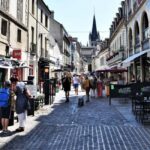
After Porte Guillaume, you’ll move onto Rue de la Liberté, a shopping street that feels like a guided version of “just wander around Dijon.” The point here isn’t the stores—it’s the architecture you pass while you’re walking.
You’ll pick up snapshots of how the town center grew and dressed itself. Along the way, you’ll see Place François-Rude and buildings from the 15th century such as La Maison aux Trois Visages (the House of Three Faces) and the old hotel Millière.
This stretch is also where the tour’s food-and-culture beat fits in: you’ll get to discover the legendary Maille shop. If you like mustard as more than a condiment, this stop can be satisfying because it ties a famous Dijon product to place and identity—exactly what makes regional specialties fun to learn about.
Practical note: this part is a lot of looking up. Bring good shoes and be ready to pause, because those façades reward slow attention.
Place de la Libération: local meeting spot, royal name turned history

Next comes Place de la Libération, which functions like a town center living room for locals. What makes it interesting on a guided walk is the name-shift story: until 1782, it was called Place Royale, a name meant to amplify the power of King Louis XIV.
Today there’s an equestrian statue of the king on the square. That’s a small detail, but it helps you see how political messaging can be literally built into public space—and how later generations keep or replace symbols depending on the era.
You’ll also get a sense of where the city’s “street life” and “monument life” meet. For me, that matters because Dijon isn’t only about grand buildings; it’s about the way people use them.
Tour Philippe le Bon: climb for the panorama and the power story
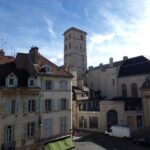
Then you’ll reach Tour Philippe le Bon, Dijon’s defining tower views. It rises 45 meters above the center of town, and it was built between 1450 and 1460—initially as a watchtower, then turned into a symbol of the Dukes of Burgundy’s authority. At one point, it even served as an astronomical tower for a few years.
Architecturally, it mixes Classical and Renaissance styles, which is a handy example of how this city doesn’t follow one uniform “look.” It’s also a good place to hear how a tower can serve practical jobs, then become political theater.
The climb is real: you’ll take a spiral staircase of 316 steps for a panorama over the heart of Dijon. If stairs are a challenge, you should consider whether you want to do the climb or ask the guide about your options.
This is one of the best stops for value in a short tour. Without it, you’d still see the historic center. With it, you understand where everything sits relative to everything else.
You can also read our reviews of more guided tours in Dijon


Church of Our Lady (UNESCO): Good Hope, the Black Virgin, and the owl touch
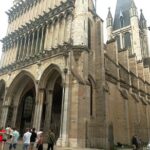
Now you’re in UNESCO territory: the Church of Our Lady, a UNESCO World Heritage Site. The façade is famous for a “flatness” that’s unusual within French Gothic architecture, and that contrast is exactly the kind of thing a guide helps you notice.
Inside the story is the statue of Our Lady of Good Hope, formerly known as the Black Virgin. That’s not a simple “religious art” stop—it’s part of Dijon’s identity, and it has staying power in local belief and legend.
Two other Dijon symbols show up here too: the Jacquemart and the owl. The owl is tied to a superstitious habit: people caress the worn statue with their left hand, hoping their wish will come true. You don’t need to buy into the belief to enjoy the ritual—watching it play out tells you something about how the past stays in the present.
This stop is also a good reason to choose a guided walk over self-guided wandering. The church is impressive, but it can be easy to miss the meaning if you don’t know what you’re looking for.
Palais des Ducs de Bourgogne and the Musée des Beaux-Arts

After the church, you’ll step into the power center: the Palais des Ducs de Bourgogne—often described as the Palace of the Dukes (and Estates of Burgundy). Today it functions as the town hall area and also houses the Musée des Beaux-Arts de Dijon.
What makes this stop more than just an exterior photo is the connection between the building and the collections. The museum sits inside one of the former ducal palace spaces, so even when you’re walking from room to room, you’re still inside the political architecture that once framed Burgundy’s authority.
The Musée des Beaux-Arts is described as one of the largest and oldest museums in France, with collections among the richest in the country. That’s a big claim, but it’s backed by the fact that this museum is integrated into a major landmark—so you get context without needing to travel out of the historic center.
Important practical point: the tour includes the guided experience, but entrance fees aren’t included. If you want full museum time, budget accordingly. If you decide to only see the palace from outside areas, you can still benefit from the history and orientation the guide provides.
Eglise Saint-Michel: a Renaissance façade mixed with Gothic
To close the route, you’ll finish at Eglise Saint-Michel, a 16th-century church known for its Renaissance façade. What makes it special is the mix of styles: you get a blend of Gothic and Renaissance elements, with Italian influence in the design language.
This finish works because it echoes what you’ve been learning all along. The tour starts with a gate that shows layered time. It moves through towers and churches where style shifts signal changes in power, taste, and belief. Then Saint-Michel lands the idea on one façade you can study before you head off to dinner.
If you’re the kind of traveler who likes one last “wow” moment, this is it. It also gives you an easy place to orient yourself for your next steps in Dijon, since the historic center stays walkable.
Price and pacing: what $455 means for your group
The price is $455 per group for up to 20 people, with the tour lasting 2 hours. That pricing setup can be good value if you’re traveling with a group and can fill most of the spots.
At full group capacity (20 people), that works out to roughly $23 per person—which is strong for a private guided walk in a compact historic core. If you’re a smaller group, the per-person cost rises, but you still gain something hard to replace on your own: clear, efficient sequencing of sights and explanations that help the architecture make sense.
Pacing is also part of value. In particular, guides like Fred, Kelly, and Simon have been praised for being engaging and for keeping a tempo that lets everyone see the key pieces without feeling rushed. That matters most on short tours, when time is tight and you want the guide to manage the flow for you.
Two helpful planning tips:
- Wear shoes that handle uneven old-street walking.
- If you’re planning museum time inside the ducal palace, keep a little extra budget ready for entrance fees.
Who should book this Dijon walking tour
This tour is a great match if you want:
- A short, guided orientation to Dijon’s historic core
- Architectural storytelling across Gothic and Renaissance styles
- A mix of cultural landmarks plus a practical food stop at Maille
It also suits couples or friends who want a private guide without committing to a full day. If you’re visiting Dijon between bigger regions (like wine country days), this can be a smart “get your bearings fast” move.
If you’re traveling with limited mobility, the tower stop includes a climb tied to 316 steps. That doesn’t mean the tour is wrong for you—it just means you should think ahead about your comfort level and ask the guide how the timing will work for your group.
Should you book this Dijon Historic Guided Walking Tour?
Yes—if you want Dijon to make sense quickly. This is one of those tours where the time-to-understanding ratio is excellent: you go gate to tower to UNESCO church to ducal palace, and each stop explains the next one. The Maille stop also adds a very Dijon flavor that turns the walk into more than monuments on a checklist.
I’d book it especially if:
- you like architecture and want real context for Gothic and Renaissance details
- you want a private guide who can keep the pace steady and the explanations clear
- you’re planning to spend time in the center after the tour and want a strong mental map
If your top priority is lots of museum hours inside, you may find the 2-hour structure a bit tight—especially since entrance fees aren’t included. In that case, you can still use this walk as the best possible prelude, then extend your museum time on your own with the guide’s orientation.
FAQ
How long is the Dijon Historic Guided Walking Tour?
It lasts about 2 hours.
Is this tour private, and how many people can be in a group?
It’s a private group experience. The price is listed per group up to 20 people.
What languages are offered for the live guide?
The live tour guide speaks English and French.
Are entrance fees included for the museum or churches?
No—entrance fees are not included.
What is the cancellation policy?
You can cancel up to 24 hours in advance for a full refund.
Is there an option to reserve now and pay later?
Yes, you can reserve now & pay later.