REVIEW · DIJON
Dijon Signature Walk: Gothic Landmarks & Ducal Grandeur
Book on Viator →Operated by BlackBuck Travels · Bookable on Viator
Dijon hits different when you walk it. This private Signature Walk strings together the city’s best-known landmarks in the historic center, with just enough context to make the stones feel alive. You’ll start under Porte Guillaume’s proud arch, move along the pedestrian core, and end with Renaissance-Gothic drama at Eglise Saint-Michel.
What I like most is the pairing of big-picture orientation with specific, eye-level details. You’ll get your bearings fast—Rue de la Liberté, Place de la Liberation, and the ducal power center—plus standout sights like the UNESCO-listed Church of Our Lady of Dijon with the Jacquemart clock and the owl carving. One thing to consider: it’s a real walking tour with about 90–120 minutes on foot, so comfy shoes are non-negotiable.
Key points that matter before you go
- Private group, 2 hours: it’s designed as a focused intro to Dijon rather than a long marathon.
- Gothic + ducal power in one route: you’ll connect churches, civic buildings, and the heart of Burgundy’s authority.
- Tower views at Tour Philippe le Bon: the top comes with panoramic payoff after 316 steps.
- Great for culture and history: the stops are chosen for architectural storytelling you can actually see.
- Smart pacing for first-time visitors: the walk moves through the center so you leave with a map in your head.
In This Review
- Why This Walk Works as Your First Dijon Plan
- The Route Starts With Porte Guillaume: Your Symbolic Front Door
- Rue de la Liberté: The Pedestrian Spine Into Old Dijon
- Place de la Liberation: Louis XIV in the Middle of Things
- Tour Philippe le Bon: The 316-Step Payoff for Views
- Church of Our Lady of Dijon: Gothic Mastery Up Close
- Palais des Ducs de Bourgogne: The Dukes’ Residence Meets the City
- The Grand Finale at Eglise Saint-Michel
- Price and Value: What $444.32 Really Buys You
- Who This Tour Suits Best (And Who Might Want Something Else)
- Quick Planning Tips So You Don’t Lose Time
- Should You Book the Dijon Signature Walk?
- FAQ
- How long is the Dijon Signature Walk?
- Is this tour private?
- What language is the tour offered in?
- Where does the tour start?
- Where does the tour end?
- How much walking should I expect?
- What major sights are included?
- Is the Tour Philippe le Bon climb part of the experience?
- What is included in the price?
Why This Walk Works as Your First Dijon Plan

If Dijon is your first stop in Burgundy, this tour is an efficient way to learn how the city is put together. It’s not just a list of landmarks. It’s a guided route that follows how people would have moved through power, prayer, and civic life—then lands you at viewpoints and major façades you’ll recognize later when you wander on your own.
I also like that it’s private. That means your guide can slow down, answer real questions, and adjust for your group’s pace. In the feedback I saw, the guide is also described as accommodating with kids, and even working a stop for sorbet into the day—small detail, big payoff when you’ve got younger travelers with you.
The route has a tight time frame, so it’s best for people who want “learn a lot, see a lot” without spending a whole day commuting between places.
The Route Starts With Porte Guillaume: Your Symbolic Front Door

Your walk begins at 2 Pl. Darcy, at Porte Guillaume. This 18th-century triumphal arch sits on the footprint of an older 12th-century gate, which is a neat reminder that Dijon’s center has been reworked for centuries, not invented yesterday. The arch was built in tribute to the Prince de Condé, governor of Burgundy, so from the start you’re looking at architecture tied to authority—not just decoration.
What to watch for here is how the arch frames your transition into the historic center. Once you’re standing under it, you can feel the shift from modern city rhythm into older, more formal streets and squares. If you tend to forget directions when you arrive somewhere new, this first stop gives you an anchor.
Quick practical note: since the tour starts at Place Darcy, you’ll want to arrive a few minutes early so you don’t start rushing.
You can also read our reviews of more walking tours in Dijon


Rue de la Liberté: The Pedestrian Spine Into Old Dijon

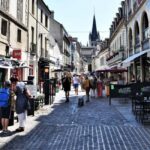
Next you head along Rue de la Liberté, Dijon’s main pedestrian street. This section matters because it’s the connective tissue of the old town—elegant architecture, old façades, and a natural “walk-and-look” flow.
As you go, the tour points out buildings that help you read the city in layers. You’ll pass landmarks that include Place François-Rude, plus 15th-century architecture such as Maison aux Trois Visages and the Hôtel Milliere. Even if you don’t memorize dates, you’ll come away knowing what style period you’re looking at and why it’s there.
If you like streets as much as buildings, this is the part that feels easiest. It’s not a sprint between stops; it’s built for steady viewing.
Place de la Liberation: Louis XIV in the Middle of Things
You continue to Place de la Liberation, the historic heart of Dijon. It used to be called Place Royale, named in honor of Louis XIV. Today, the square is known as a gathering place centered around his equestrian statue.
This stop gives you something most “architecture-only” tours miss: a public square isn’t just a photo spot. It’s where daily life and major moments share the same geometry. The statue becomes your reference point for understanding how civic pride and monarchy were staged in stone.
If your group needs a bathroom break, this is the moment to plan for it. Squares like this tend to be the easiest places to step away briefly and then rejoin.
Tour Philippe le Bon: The 316-Step Payoff for Views

Near the square is Tour Philippe le Bon, a 45-meter tower built between 1450 and 1460. It started as a watchtower and later became a symbol of ducal authority. That history is what makes the climb feel more meaningful than just “exercise with stairs.”
The top is reached by 316 steps, and after that you’re rewarded with panoramic views of the city. Even if you’re not a big “look-out-from-a-tower” person, I think this is one of the most satisfying moments of the walk because you get spatial context for everything you just saw.
Consideration: if you’re traveling with someone who has trouble with stair-heavy spots, decide ahead of time how you’ll handle the climb. The tour description highlights the tower view as a reward after climbing, so it’s part of the intended experience.
Church of Our Lady of Dijon: Gothic Mastery Up Close

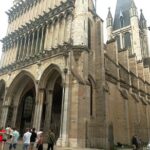
One of the most memorable stops is the Church of Our Lady of Dijon, part of UNESCO-listed heritage. It’s a major French Gothic landmark, and it’s distinctive enough that once you’ve seen it, it’s hard to forget.
The highlights here are very concrete and specific:
- a flat façade
- the statue of Our Lady of Good Hope
- the Jacquemart clock
- a famous owl carving
That mix of religious iconography plus mechanical timekeeping makes the church feel both ceremonial and human. The Jacquemart clock is especially worth looking for because it adds movement and personality to the stone-and-stained-glass stereotype people expect from Gothic churches.
If you’re the kind of traveler who likes details more than scale, this stop is a win. You’ll have plenty to point at and talk about while you’re moving between parts of the city.



Palais des Ducs de Bourgogne: The Dukes’ Residence Meets the City

After the church, you reach the Palais des Ducs de Bourgogne, often described as the Palace of the Dukes and Estates of Burgundy. Today it houses the town hall and the Musée des Beaux-Arts de Dijon, and that mix of civic and museum use is part of why the building still matters.
Here’s the architectural story the tour helps you see:
- The oldest part is a Gothic palace built in the 14th and 15th centuries.
- The façade you’ll look at is classical, from the 17th century.
- The complex includes multiple areas and remains very well preserved.
- It became an important landmark alongside the Eglise of Notre-Dame.
This stop works because the palace isn’t presented as a single style. It’s presented as a timeline you can walk through. Even if you don’t go inside the museum, the exterior alone gives you enough to understand why Dijon became a key stage for Burgundy’s ducal authority and the estates that shaped regional decisions.
Practical note: since it also relates to the town hall and museum, the area can be busy at certain times. Your guide’s timing helps you avoid feeling like you’re stuck waiting.
The Grand Finale at Eglise Saint-Michel

The tour concludes at Eglise Saint-Michel, a 16th-century church known for a striking façade that blends Renaissance elements with Gothic features and Italian artistic influence. That blend is what makes it a satisfying ending point: by the time you arrive, you’ve already seen Gothic dominance and ducal civic grandeur, so the style mix feels like a natural evolution rather than a sudden left turn.
Think of this finale as the payoff for your walking loop. You finish with a façade that rewards a last slow look—one more chance to connect what you’ve seen in Dijon to the broader European art shifts from Gothic to Renaissance.
Price and Value: What $444.32 Really Buys You

The price for this private experience is $444.32 per group, up to 15 people, and the tour runs about 2 hours. On a per-person basis, it can look steep if you’re traveling solo or as a couple. But as a private booking for a group, it often becomes reasonable—especially when you’re comparing it to the cost of buying multiple separate admissions plus the time you spend trying to piece together a route yourself.
You also get a mobile ticket and English-language guiding. That matters because Dijon’s architecture is best understood with someone pointing out what you’re actually looking at—like the owl carving and Jacquemart clock on Our Lady of Dijon, or the why behind Porte Guillaume’s dedication.
If you’re traveling as a small group—friends, a family with kids, or a study-abroad cohort—this format tends to feel like good value. It’s a guided “orientation and highlights” package, not a vague stroll.
Who This Tour Suits Best (And Who Might Want Something Else)
This is a great fit if you want a first intro to Dijon and you like history that you can see. The route is built for people interested in culture and architecture, not just quick scenery.
It’s also a strong choice for:
- families who want a guided structure (the guide is noted as accommodating kids)
- first-time visitors who don’t want to spend hours planning
- groups who prefer private pacing over joining a larger group tour
It may feel less ideal if:
- you have limited tolerance for extended walking
- your group wants a museum-focused day rather than a walking-and-look day
- you’re hoping for a super-long itinerary (this is about 2 hours, not a full-day deep dive)
Quick Planning Tips So You Don’t Lose Time
Here’s how I’d prep so the walk feels smooth:
- Bring comfortable shoes. The walking time is about 90–120 minutes.
- Wear layers. Weather can change in open squares and around stone façades.
- Keep your expectations realistic: this is an intro route with major highlights, not every church and every museum in Dijon.
- If your group includes kids, it’s worth asking the guide about food breaks since a sorbet stop has been part of past pacing.
Also, pay attention to the end point on your plan. The tour lists a conclusion at Eglise Saint-Michel de La Garde-Adhémar (in the details). If your confirmation shows a different exact address within Dijon, follow that version so you aren’t walking to the wrong Saint-Michel.
Should You Book the Dijon Signature Walk?
I’d book it if you’re the type of traveler who wants to understand what you’re looking at. The route stitches together the city’s ducal center, its Gothic landmark church, and a panoramic tower climb, with enough story to make independent wandering afterward easier.
Skip it only if your main goal is lounging in cafés and doing minimal walking. This tour is built around movement, and the best moments come when you’re paying attention to façades, symbols, and street connections.
If you want a practical, high-return way to get your bearings in Dijon, this is a solid choice.
FAQ
How long is the Dijon Signature Walk?
The tour lasts about 2 hours.
Is this tour private?
Yes. It’s a private guided tour, and only your group participates.
What language is the tour offered in?
The tour is offered in English.
Where does the tour start?
It starts at 2 Pl. Darcy, 21000 Dijon, France.
Where does the tour end?
The tour ends at Église Saint-Michel de La Garde-Adhémar (26700 La Garde-Adhémar, France) as listed in the tour details.
How much walking should I expect?
Expect 90–120 minutes of walking, so plan on comfortable shoes.
What major sights are included?
Key stops include Porte Guillaume, Rue de la Liberté, Place de la Liberation, Tour Philippe le Bon, the Church of Our Lady of Dijon, the Palais des Ducs de Bourgogne, and Eglise Saint-Michel.
Is the Tour Philippe le Bon climb part of the experience?
The panoramic views come after climbing 316 steps.
What is included in the price?
A private guided tour is included. Gratuities and refreshments are not included.