REVIEW · COLMAR
Colmar Self Guided Tour with Mobile Application
Book on Viator →Operated by Tourific · Bookable on Viator
Colmar can feel like a movie set of canals and half-timbered streets, and this self-guided audio walk is a smart way to understand why. You’ll use a mobile app with audio and a written guide to move from landmark to landmark, including Unterlinden Museum’s Isenheim Altarpiece area, Bartholdi fountains, and photo-perfect canal scenes like Little Venice. I really like that the app setup is built for independence: it includes an interactive map and you can listen more than once for a 1–2 hour outing.
Two things I especially love: first, the narration keeps you on track with images to identify stops, so you’re not squinting at buildings wondering if you’re in the right spot. Second, the route is designed for a relaxed pace—you can pause for photos or linger at the viewpoints without waiting on a group. One consideration: this tour is intentionally from the outside only, and some of the stop descriptions can feel wordy if you prefer quick, no-nonsense walking directions.
The big idea is simple. If you want Colmar’s highlights with less planning stress—and you’re okay keeping your feet moving while you learn from the street—this one fits well.
In This Review
- Key highlights you’ll feel right away
- Why a self-guided audio walk works so well in Colmar
- Price and time: what $6.72 buys you
- Starting at Rue Kléber: getting oriented fast
- Underlinden Museum area: the Isenheim Altarpiece (and the free museum teaser)
- House of Heads: 106 masks and a hotel built into the story
- Dominican Church (12th century): austere architecture and the Madonna of the Rose Bush
- Pfister House (15th century): dragon-scale turrets and Renaissance art
- Maison Alsacienne de Biscuiterie: sweet aromas in a historic 16th-century “skyscraper”
- Koifhus (14th century) Old Customs House: Gothic meets Renaissance
- Schwendi Fountain: Bartholdi, a Tokay vine, and pinot gris arriving in Alsace
- Covered Market (19th century) and the canal districts: where to snack and slow down
- Little Venice: the photo moment and the canal-side mood shift
- Square of the Six Black Mountains and Roesselmann’s Fountain
- Fountain of Admiral Bruat: four continents and Colmar’s maritime link
- Champ de Mars finish: Europe’s largest wooden horse carousel
- What to watch for before you go (the stuff that affects your enjoyment)
- Should you book this Colmar self-guided audio tour?
- FAQ
- Where does the tour start?
- How long does the Colmar self-guided tour take?
- What’s included with the mobile application?
- Is there a human guide with this tour?
- Do I need internet during the tour?
- Can I visit the stops inside buildings?
- What language is the guide in?
- What’s the refund policy if I change my mind?
Key highlights you’ll feel right away

- Offline-ready navigation so you can keep going even if your phone’s data is spotty.
- Audio + written guide in English, with images to confirm each stop.
- Major sights, outside view only, including Bartholdi landmarks and the canal districts.
- A short time commitment (about 1 to 2 hours) that works even on a tight schedule.
- Photo-friendly route, built around viewpoints, fountains, markets, and bridges.
- Free-choice museum time nearby, since Unterlinden Museum’s entrance is listed as free for the Isenheim Altarpiece stop.
Why a self-guided audio walk works so well in Colmar

Colmar is compact, but it’s the kind of compact that can trick you. One corner looks like a postcard, and suddenly you’ve spent 40 minutes wandering without learning what you’re seeing. This format solves that problem with gentle structure. You get a mobile ticket, then follow the stops with an app that includes audio and text.
I like that the tour doesn’t demand a big commitment. You’re not locked into a full half-day like some guided city tours. Instead, you get a curated loop of the places most people come to Colmar for, delivered in short chunks you can control.
And Colmar rewards attention. A fountain’s statue pose matters. A half-timbered facade isn’t just decoration—it’s part of the story of trade, city pride, and the people who lived here.
You can also read our reviews of more guided tours in Colmar


Price and time: what $6.72 buys you

At $6.72 per person for an audio-led self-guided walk, this isn’t about paying for a person’s time. You’re paying for the route content: the map, the audio, and the wayfinding support that helps you move efficiently between the highlights.
The other value piece is the time. With an estimated 1 to 2 hours, you can fit it into a day that already includes markets, lunch, or another attraction. That matters in Colmar, because the best moments often happen when you have freedom afterward—especially along the canals and around the market area.
One practical note: the “about” in 1 to 2 hours depends on how often you pause for photos and how long you prefer at each stop. If you treat it like a guided stroll with light reading, you’ll likely land in the shorter end.
Starting at Rue Kléber: getting oriented fast

Your walk starts at 7 Rue Kléber, 68000 Colmar, and it ends in the Champ de Mars park area (the details point to Parc du Champ de Mars and also mention Parc de la Pétrusse). I recommend you open your app before you leave and download the tour for offline use. The tour data is designed so you can go without internet once it’s downloaded.
You’ll also want to be ready for phones to be phones. Bring a charged battery. Use screen brightness you can read outdoors. And if you tend to drain battery fast, consider a portable charger—this kind of walking tour lives and dies on your screen.
The app also includes images and an interactive map, which is a big deal in Colmar. Some buildings look similar at street level, and having visual confirmation helps you get your bearings quickly.
Underlinden Museum area: the Isenheim Altarpiece (and the free museum teaser)
The first stop focuses on Unterlinden Museum and its revered Isenheim Altarpiece by Matthias Grünewald. Even though the tour keeps you outside, the storytelling sets you up to understand what you’re looking at nearby.
Why this works: the Isenheim Altarpiece is not just art trivia. It’s one of those works that explains the intensity of Northern Renaissance art—dark realism, emotion, and symbolism you might miss if you only saw it described in a sentence later.
The listing also notes that museum entrance is free. Here’s the practical approach: if you want the full experience, you can treat the audio stop as a prelude and step inside on your own time. The tour itself, however, is designed around seeing the area and learning from outside.
Consideration: if you hate museum detours and want everything strictly outside, just follow the audio at the street-level stops and resist the urge to wander in.
House of Heads: 106 masks and a hotel built into the story
Next up is the House of Heads, a 16th-century Renaissance standout in Colmar. The big visuals are the 106 expressive masks, plus a crown-like Bartholdi sculpture. Today it’s home to a 5-star hotel and a Michelin-starred restaurant—so the building isn’t just preserved, it’s actively used.
This is a great stop for two reasons. One, you’ll see the kind of Renaissance playfulness that doesn’t need explanation once you notice the faces. Two, it shows how old Colmar doesn’t only sit in the past. It continues to function, earn, and attract attention.
Tip for your visit: take a slow walk around the facade. Masks repeat, but each one has its own expression. If you move too fast, you miss the humor and personality the building is built on.
A few more Colmar tours and experiences worth a look


Dominican Church (12th century): austere architecture and the Madonna of the Rose Bush
From Renaissance theatrics you shift to medieval gravity at Colmar’s 12th-century Dominican Church. The stop highlights the mix of austere architecture and rich symbolism, including Schongauer’s Madonna of the Rose Bush.
Even if you don’t step inside during the tour, this is useful knowledge. It changes how you read the building from the outside. You stop seeing it as just another old church facade and start noticing how the design choices communicate seriousness and meaning.
Practical note: churches are often quiet. If you’re timing your visit with photos, keep your voice down and respect that this is a real place, not a set.
Pfister House (15th century): dragon-scale turrets and Renaissance art
The tour then points you to the Pfister House, a 15th-century building known for dragon-scale turrets and Renaissance art. This is the kind of architecture that looks slightly unreal until you realize: yes, someone actually built it on purpose.
From a street-view tour perspective, it’s a perfect match. You can spot details without committing to any indoor time. And it gives you a contrast to the more solemn church stop—Colmar’s architecture ranges from symbolic to theatrical within a few minutes’ walk.
If you like to photograph, this is a good stop to stop moving for a moment and reframe. Find an angle that shows the turret texture and the surrounding facade, not just one close-up detail.
Maison Alsacienne de Biscuiterie: sweet aromas in a historic 16th-century “skyscraper”
Next: Maison Alsacienne de Biscuiterie, described as a historic 16th-century skyscraper where traditional Alsatian biscuit treats wait for you. The tour calls out the aromas and sweet delights, which is exactly what makes this stop worth timing.
Why it’s valuable on a walking tour: this is where the city becomes smell-and-taste practical. Even if you don’t buy anything, you get a feel for what Alsace food culture is about—traditional recipes and local flavors.
I’ll be honest: if you’re strict about sticking to the app schedule, this is the stop where you might lose track of time. But that’s also the point of Colmar. Let yourself have one small indulgence so the rest of the walk feels earned.
Koifhus (14th century) Old Customs House: Gothic meets Renaissance
You’ll then reach Koifhus, Colmar’s 14th-century Old Customs House. The focus here is its mix of Gothic and Renaissance architecture, plus the idea of panoramic views from the house’s storied steps.
This is the “city brain” stop. Colmar didn’t become Colmar just because the buildings are pretty. Trade mattered. Customs mattered. Wealth and civic pride built the structures you’re seeing now.
Practical advice: if the area offers viewpoints where you can safely look over the town, take the extra minute. It helps you connect the earlier canal scenes to the way the town was laid out for commerce.
Schwendi Fountain: Bartholdi, a Tokay vine, and pinot gris arriving in Alsace
The tour includes the Schwendi Fountain, a Bartholdi bronze statue of Lazarus von Schwendi holding a Tokay vine. The story ties this landmark to the arrival of pinot gris grapes in Alsace, blending art, history, and viticulture in one place.
This is a great example of why Bartholdi sculptures are more than decorative. He used public art to teach people. Even if you’re not thinking about wine right now, knowing the grape reference turns the statue into a cultural clue.
If you’re traveling with wine lovers, this stop will land. If you’re not, it still works because you’ll understand the symbol: agriculture, trade, and identity.
Covered Market (19th century) and the canal districts: where to snack and slow down
After the fountain, the route shifts to the 19th-century Covered Market, described as a riverside treasure with architecture worth looking at and a bounty of Alsatian delicacies and crafts.
Then you move into the Fishmongers’ District, where half-timbered houses line the canal. The walking story here is how the area once thrived with fishermen and traders—so when you see those facades, you can picture the daily motion behind them.
This pairing is practical. Markets make you hungry. Canals make you curious. Together they keep your attention active without adding extra distance.
My advice: don’t turn this into a shopping sprint. Pick one item to sample or carry, then keep walking. You’ll enjoy the sights more when you’re not stuck comparing prices with dripping ice cream hands.
Little Venice: the photo moment and the canal-side mood shift
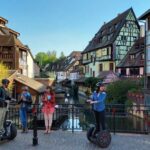
The tour highlights Little Venice in Colmar, where pastel-hued, half-timbered houses line enchanting canals. It’s pitched as the ultimate photo opportunity, and honestly, it’s hard to resist.
What I like about including this after the market and fishmongers area: by the time you reach Little Venice, you’ve already learned how Colmar’s canal life worked. The scenery isn’t only pretty now. It’s meaningful.
If you want better photos, give yourself a small window of time. Stand in one spot and check the background. Then take a few steps and compare. Colmar rewards that tiny bit of effort.
Square of the Six Black Mountains and Roesselmann’s Fountain
Next is the Square of the Six Black Mountains. This stop connects Colmar’s past to the Zum Schwarzenberg inn, and it also includes Bartholdi’s Roesselmann Fountain, honoring a local hero who defended the city’s independence.
This is another “why the city looks like this” stop. Instead of only focusing on architecture, it also frames Colmar as a place that fought for itself and remembered its people.
Practical tip: when you see a fountain with a named hero, slow down. Read the basic story from the audio. Then look at the statue placement and surrounding space. Public monuments are designed to be seen from specific angles.
Fountain of Admiral Bruat: four continents and Colmar’s maritime link
The tour ends its Bartholdi sequence with the restored Fountain of Admiral Bruat. You’ll learn about the admiral gazing toward new horizons, surrounded by allegorical figures of four continents, tying into Colmar’s maritime legacy.
If you’ve mainly associated Bartholdi with famous statue work, this stop broadens that view. It reminds you that civic art traveled with big ambitions, not just local decoration.
Photo tip: move around the fountain area once. Many fountains look flat from one angle. The allegorical figures often pop more once you’re slightly off-center.
Champ de Mars finish: Europe’s largest wooden horse carousel
Your walk concludes at Champ de Mars park. The standout feature here is Europe’s largest wooden horse carousel, and the stop also notes Bartholdi’s first public monument.
This ending matters more than it seems. After a string of architectural stops and symbolism, the park gives you a place to reset. It’s also a good point to decide what you want next—linger for photos, grab a snack, or just wander the surrounding lanes without a schedule.
If you still have energy, I’d use this as your “free time” anchor. The tour ends, but the city doesn’t. Colmar is at its best when you stop treating every block like a task.
What to watch for before you go (the stuff that affects your enjoyment)
This tour has a clear philosophy: outside viewing only. That’s helpful because it keeps the route moving and avoids ticket lines. But it’s not the right match if you expected frequent interior wandering.
Also, because it relies on audio and written narration, the experience can feel heavier if you prefer quick prompts. You’ll get the most enjoyment by using it like this: listen, look around, take photos, then move on.
Finally, think about your walking style. The listing suggests moderate physical fitness and that all stops are reached on foot. The route is short, but you will still be on your feet.
Should you book this Colmar self-guided audio tour?
Book it if you want a low-stress way to learn Colmar’s highlights in 1 to 2 hours, especially if you like having an app guide you can replay and use offline. It’s also a good pick when you’d rather control the pace—pause for pictures at Little Venice, spend a little longer by the market, then keep going.
Skip it (or at least temper expectations) if you’re hoping for lots of inside building time. The tour keeps you outside by design, and if your ideal walking tour is minimal narration with constant forward motion, you may find the audio/text guidance a touch heavier than you want.
FAQ
Where does the tour start?
The tour starts at 7 Rue Kléber, 68000 Colmar, France.
How long does the Colmar self-guided tour take?
The duration is about 1 to 2 hours.
What’s included with the mobile application?
You get a mobile ticket, 1-year access on iOS and Android, audio and written guide, images to identify stops, and an interactive map. You also get offline access after the tour is downloaded.
Is there a human guide with this tour?
No. There is no human tour guide on site.
Do I need internet during the tour?
No. Once you download the tour, it includes offline access, so you can use it without an internet connection.
Can I visit the stops inside buildings?
All stops are visited from outside only, without entering any locations.
What language is the guide in?
The tour is offered in English.
What’s the refund policy if I change my mind?
You can get a full refund with free cancellation if you cancel at least 24 hours before the experience start time.