REVIEW · PARIS
Historic Paris Walking Tour
Book on Viator →Operated by Walkative! TOUR · Bookable on Viator
Seven stops, zero map stress. In about 2½ hours, this guided walk threads together Paris icons in a way that still leaves room for photos and just enough time to take it all in. I like that the local guide handles the routing so you can focus on the sights, and I like how often you pause so the day never feels like a sprint.
One thing to consider: this is a short, tight-paced meeting-walk setup, so being on time matters. If there’s a route disruption (like a parade closure), late arrivals can mean you miss the group and the meeting spot can get tricky. The good news is the guide is usually at the meeting point within about 10 minutes, but you’ll still want to show up early and stay flexible on busy days.
In This Review
- Key highlights at a glance
- Why this Paris walking route is such a good fit
- Price and value: what you’re really paying for
- The pacing, group size, and logistics that matter
- Start at Hôtel de Ville: Paris’s civic center and a great first anchor
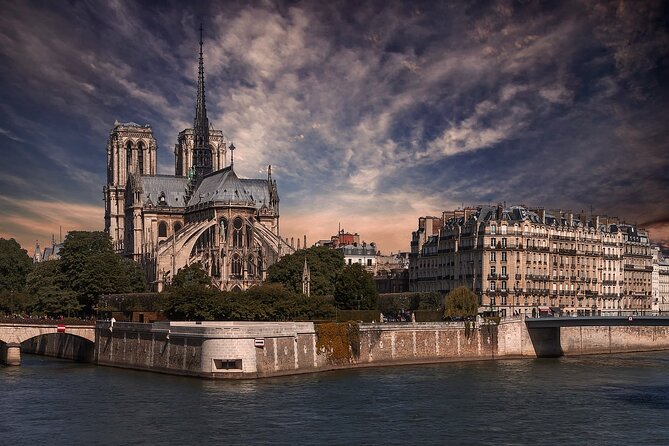
- Notre-Dame: French Gothic details in a focused stop
- Sainte-Chapelle: when stained glass takes over the mood
- The Louvre without the overwhelm
- Seine views: Pont des Arts for romance, Pont Neuf for time
- Pont des Arts
- Pont Neuf
- Tuileries Gardens: end gently, not abruptly
- The guide experience: what to expect from the narration
- Weather and comfort: dress like Paris can change its mind
- Who should book this tour (and who should skip it)
- Should you book the Historic Paris Walking Tour?
- FAQ
- How long is the Historic Paris Walking Tour?
- Where does the tour start?
- Where does the tour end?
- Is the tour offered in English?
- What is included in the tour price?
- Are food and drinks included?
- Is a mobile ticket used?
- Does the tour run in bad weather?
- What is the maximum group size?
- What is the cancellation policy?
Key highlights at a glance
- A 2½-hour route that fits cleanly into a packed Paris schedule
- Skip map reading: the guide leads so you never feel lost
- Seven big-name landmarks, mostly treated as quick, satisfying stops
- Regular photo breaks along the way, especially around the Seine
- Small-ish group size with a maximum of 40 people
- English mobile ticket for easy check-in
Why this Paris walking route is such a good fit
This is the kind of tour that makes sense when your Paris days already have plans stacked up. You get a true walking experience, not a long sit-and-listen session, and you cover landmark-to-landmark without spending half the morning figuring out which turn comes next.
The real value is how the guide structure helps you use your time. When you’re walking between Hôtel de Ville, Notre-Dame, Sainte-Chapelle, and the Louvre area, you can stop often enough to look up, frame photos, and actually absorb the vibe. It’s also paced like a “keep it moving, but don’t rush” day, which is ideal when you don’t want to waste precious hours waiting in lines or stuck trying to translate your way across a map.
You can also read our reviews of more walking tours in Paris



Price and value: what you’re really paying for
At $26.49 per person, the price may look small compared with big museum tours, and that’s because you’re paying mainly for two things: a local expert guide and a carefully built narrative that connects the sights.
You’re also not paying for food and drinks on this one, so if you’re hungry you’ll want to plan a meal elsewhere. Still, the route includes stops where admission is listed as free, so the day stays budget-friendly once you’ve booked.
In my eyes, the biggest part of the value is friction reduction. Paris can be confusing when you’re juggling neighborhoods, street layouts, and crowds. Here, the guide is basically your anti-stress tool: you show up, check in with a mobile ticket, and then you let them lead.
The pacing, group size, and logistics that matter

This walk runs about 2 hours 30 minutes and follows a clear start-to-finish flow: it begins at Hôtel de Ville (75004) and ends near the Tuileries Gardens (75001). That’s helpful because it shapes your day. You’re not bouncing back to where you started; you can continue your sightseeing after the tour near the Louvre/Tuileries zone.
The group max is 40 people, which keeps it from feeling like a stadium migration. You’ll still experience normal Paris crowd conditions at major landmarks, but the format is made for moving on foot together.
A few practical notes from the tour details:
- Mobile ticket is used for entry/check-in.
- It runs in all weather, so pack accordingly.
- Moderate physical fitness is recommended. Expect walking and standing at stops.
- Children must be accompanied by an adult.
- Service animals are allowed.
- It operates in English.
Also, there’s a special note tied to payment: booking is part of a pay-what-you-wish setup, where what you pay covers the reservation fee and the guide’s payment. If you want a smaller, private-style experience, you can ask and they’ll help organize it.
Start at Hôtel de Ville: Paris’s civic center and a great first anchor
The walk begins at Hôtel de Ville, Paris’s city hall. Even if you’re not into civic architecture, this is a smart starting point because the building’s Renaissance-style facade gives you immediate visual context for how Paris organized itself and presented authority through design.
You get a short stop—about 20 minutes—but that’s exactly right. This isn’t a “stand and memorize” kind of stop. It’s a good time to:
- look at the facade details,
- orient yourself geographically for the rest of the day,
- and grab early photos before crowds tighten.
One small tip: since it’s the first stop, this is where I’d focus my attention the most. If you spend your energy here on understanding the setting, the later stops make more sense.
Notre-Dame: French Gothic details in a focused stop
Next up is Notre-Dame, the iconic French Gothic cathedral. You’re there for about 20 minutes, and that limited time changes how you should approach it. Instead of trying to see everything, you’re best off doing a quick “scan”:
- notice the vertical lines and scale,
- pick out one or two facade details to study,
- and then step back for wider views and photos.
Notre-Dame works well on a walking tour because it’s recognizable from far away. Even if you’re not going inside for a long visit, the exterior alone is a strong “Paris moment.” The guide’s narration should help you connect architectural choices to the era they came from.
If you’re the type who likes religious art and architecture, you’ll probably want more time here on your own later—but for a tour-length route, the pacing is right.
You can also read our reviews of more historical tours in Paris






Sainte-Chapelle: when stained glass takes over the mood
After Notre-Dame, you’ll reach Sainte-Chapelle, often experienced as a sudden shift in atmosphere. The highlight is the soaring stained glass, which turns light into something almost story-like.
Again, the stop is about 20 minutes, so think of this as a “see it and feel it” moment rather than a deep, slow study. The guide’s commentary helps you notice patterns you might otherwise miss, like how the windows frame scenes and how the building design supports that effect.
This stop also balances your day. Notre-Dame gives you scale; Sainte-Chapelle gives you light and detail. Together, they make your walk feel like more than just moving between famous names.
The Louvre without the overwhelm
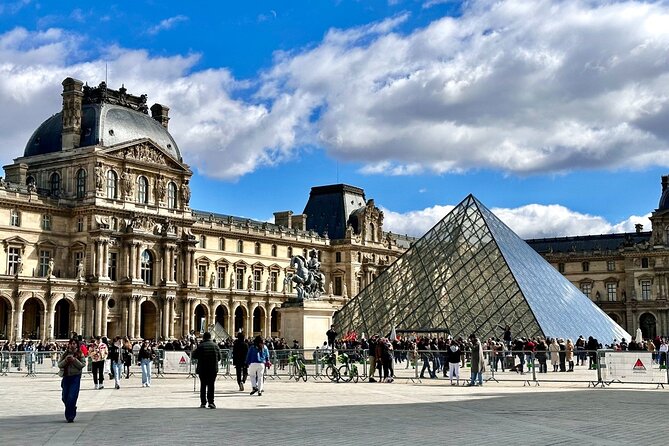
Then comes the Louvre Museum area, with about 20 minutes allocated for the stop. Here’s the key: on a walking tour like this, you shouldn’t expect a full museum experience. Instead, you’re using this time to get the setting, the iconic architecture, and a sense of what the Louvre is before you decide how you want to spend your time later.
Even if you don’t plan to go inside that day, the Louvre location is a strong checkpoint in your route:
- it’s a major landmark you can spot easily,
- it’s a natural transition point to the Seine bridges and gardens,
- and it helps you frame your next moves near Tuileries.
If you want to add one extra Louvre step, a smart move is to plan a return visit on a different day when you can choose one wing or one theme. This walking stop helps you decide what to chase later.
Seine views: Pont des Arts for romance, Pont Neuf for time
Now the tour moves into the best kind of sightseeing: Seine River scenery with quick, photogenic pauses.
Pont des Arts
At Pont des Arts, you’re there for about 20 minutes. The bridge is known for its romantic ambiance and panoramic views of the river, and it’s a perfect mid-route break. Use this time to:
- take wide photos where you can see both the water and the city lines,
- pause long enough to notice the angles between buildings,
- and let the guide’s storytelling connect the river to Paris’s movement and trade.
Pont Neuf
Then you’ll walk to Pont Neuf, also about 20 minutes. This one adds a different kind of value: it’s the oldest bridge spanning the Seine in Paris, and it has a timeless feel. Where Pont des Arts is all about atmosphere and views, Pont Neuf gives you that longer-time perspective—how a city keeps key connections in place even as everything around them changes.
This section of the walk is where the route really shows its strength. You’re not just seeing landmarks; you’re seeing how Paris connects neighborhoods and how water shaped the city’s geography.
Tuileries Gardens: end gently, not abruptly
Your tour ends near the Jardin des Tuileries with about 30 minutes here. This is a great finish because it gives your legs and attention a softer landing.
The Tuileries Gardens sit between the Louvre Museum area and Place de la Concorde, and it’s a nice place to regroup after the more intense landmark stops. It also gives you an easy on-ramp for whatever you want to do next:
- keep wandering toward the Louvre area,
- head toward central sights from Place de la Concorde,
- or just sit for a while and recharge your brain.
For me, finishing in a garden makes the whole experience feel complete. You started at a civic building, went through Gothic architecture, hit the museum icon, and then came down to calm space with classic Parisian garden geometry.
The guide experience: what to expect from the narration
The tour includes a thorough constructed narrative delivered by a local expert guide. That matters because Paris landmarks can become a blur if you just read a sign and move on. With narration, you get a storyline—why these buildings are connected in time, how the city shaped them, and what details deserve a second look.
The feedback you’ll want to keep in mind is that guide styles can vary. Some guides hit a great balance of humor and history, while others may talk more than you’d expect. If you prefer short, punchy explanations, I’d suggest keeping your own focus tight: choose one or two details to watch for at each stop so you don’t feel stuck waiting for the next point.
Also, a practical reality: this is a walking format with a defined end and start. If you’re even a little late, you can run into issues. The tour team has indicated guides are usually within about 10 minutes at the meeting point, so arriving early is your safest move, especially around busy events.
Weather and comfort: dress like Paris can change its mind
The tour operates in all weather conditions, which is standard for city walking. What you can do to make it work better:
- wear layers you can adjust quickly,
- bring a light rain option if the forecast looks shaky,
- wear shoes you’re comfortable standing and walking in for hours.
You’re likely to do the full route without long breaks, so comfort is worth prioritizing. If you show up prepared, the tour feels smooth and fun instead of tiring.
Who should book this tour (and who should skip it)
Book it if:
- you want a time-efficient, guide-led way to see major landmarks in one morning/afternoon block,
- you like walking and want photo-friendly stops,
- you’d rather spend your time learning from someone local than deciphering streets and histories on your own.
Skip it or choose something else if:
- you want a long, in-depth museum day (the Louvre stop is not that kind of visit),
- you’re very sensitive to being on a fixed schedule,
- you have trouble arriving on time at a meeting spot and moving with the group.
If your goal is a smooth, classic Paris “greatest hits” walk that you can build on afterward, this one fits nicely.
Should you book the Historic Paris Walking Tour?
I think it’s a strong pick for many first-timers and busy schedules because it pairs famous landmarks with a guide-led flow that keeps you from getting stuck in map-and-crowd frustration. The value is especially good when you compare the modest price to a route that covers Hôtel de Ville, Notre-Dame, Sainte-Chapelle, the Louvre area, and two major bridges, ending in the Tuileries.
Just plan like a pro: show up early, wear comfortable shoes, and don’t count on long freeform wandering inside any one stop. If you want a guided “connect the dots” experience that ends in a relaxed garden setting, this tour is worth your time.
FAQ
How long is the Historic Paris Walking Tour?
The tour lasts about 2 hours 30 minutes.
Where does the tour start?
It starts at Hôtel de Ville, 75004 Paris, France.
Where does the tour end?
It ends next to the Tuileries Gardens, 75001 Paris, France.
Is the tour offered in English?
Yes, it is offered in English.
What is included in the tour price?
You get a thoroughly constructed narrative and a local expert guide.
Are food and drinks included?
No, food and drinks are not included.
Is a mobile ticket used?
Yes, the tour uses a mobile ticket.
Does the tour run in bad weather?
Yes, it operates in all weather conditions, so you should dress appropriately.
What is the maximum group size?
The tour has a maximum of 40 travelers.
What is the cancellation policy?
You can cancel for a full refund up to 24 hours in advance. If you cancel less than 24 hours before the start time, the amount paid is not refunded.