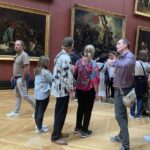
Paris looks polished today, but this walk brings its wartime scars into view. From Porte Dauphine and Avenue Foch to the Champs-Élysées and Place de la Concorde, you follow the city through German occupation, Resistance efforts, and liberation in 1944.
I like the private format because you can keep the discussion focused on WWII rather than sharing time with a large group. I also like the physical setting: Gestapo offices, German-frequented cafés, the Arc de Triomphe, and bullet holes at Concorde give the history a clear address. The main drawback is price. At $366.88 per person, this is costly for three hours unless your group discount or shared private booking makes the total easier to justify.
In This Review
- Key points to know before booking
- Why this private WWII walk feels different from a standard Paris tour
- Starting at Porte Dauphine and Avenue Foch
- Walking down the Champs-Élysées
- Place de la Concorde and the marks of liberation
- What the three-hour format gives you
- Is $366.88 per person a fair price?
- Who should book this walk?
- My call: book it for the history, not just the sights
- FAQ
- How long is the WWII walking tour?
- What time does the tour begin?
- Where does the tour meet?
- Where does the tour finish?
- Is the tour private?
- What language is offered?
- What places are included on the route?
- Is a ticket required to enter the sights?
- Can I cancel for a full refund?
- Is the tour suitable for someone with limited mobility?
Key points to know before booking
- Avenue Foch opens the story: Learn why Parisians called it avenue des Boches and where the Gestapo operated.
- Resistance figures take center stage: Hear about Pierre Brossolette, his arrest, and his tragic fate.
- Major Paris landmarks become wartime evidence: The route includes the Arc de Triomphe, Champs-Élysées, and Place de la Concorde.
- The guide shapes the experience: Vincent Lauferon is praised for making complex WWII events clear and engaging.
- The walk ends with a major moral question: At Le Meurice, the story turns to General von Choltitz and the order to destroy Paris.
- Plan for three hours on foot: The tour starts at Porte Dauphine at 9:30 a.m. and ends at Place de la Concorde.
Why this private WWII walk feels different from a standard Paris tour
Many Paris walks use monuments as their main subject. This one uses them as evidence. You are not simply passing the Arc de Triomphe or strolling down the Champs-Élysées. You are looking at how those places functioned during German occupation and how the city’s public spaces were used for control, propaganda, resistance, and celebration.
That focus makes the tour best for someone who already has a strong interest in World War II, the French Resistance, or 20th-century European history. It is also a good fit if you have seen the classic Paris sights before and want a more serious reason to walk through them again.
The private setup matters here. WWII history can lead to detailed questions about people, military decisions, politics, and individual acts of courage. With only your group, you can spend more time on the subjects that interest you. You also avoid the stop-and-start rhythm that often comes with a large public group.
The experience is offered in English. Vincent Lauferon is named as one of the guides, and the strongest praise centers on his ability to explain the period and connect ordinary streets with major events. The guide’s role is especially important on a history walk, since much of the meaning comes through explanation rather than through museum displays or preserved interiors.
You can also read our reviews of more walking tours in Paris

Starting at Porte Dauphine and Avenue Foch
The meeting point is Porte Dauphine, at 75016 Paris, with a 9:30 a.m. start. The area is near public transportation, which makes the beginning practical, although you should allow time to find the exact meeting point at the metro station and arrive ready to walk.
The opening subject is occupied Paris from 1940 to 1944. Avenue Foch provides a powerful starting point because it was associated with the German military and security presence. During the occupation, Parisians referred to the avenue as avenue des Boches, a pointed insult that reflected the anger and humiliation of the time.
The route discusses the Gestapo offices located in this part of Paris. That detail changes how the grand avenue feels. What may first appear to be an elegant residential stretch becomes a place linked to interrogation, arrests, and fear.
You also hear about Pierre Brossolette, a major French Resistance figure, including his arrest and tragic end. This is one of the tour’s more personal threads. Instead of keeping the story at the level of generals and governments, the walk brings in the people who took enormous risks inside an occupied city.
The tour also introduces Carl Heinrich von Stülpnagel and his connection to Operation Walkyria. The subject adds a German perspective to the walk, particularly the internal opposition to Hitler and the consequences faced by those involved. You get a sense of how the occupation was not a simple story of one unified side, but a period filled with competing loyalties, military decisions, and dangerous attempts to change the course of the war.
Because the walk takes place outdoors, the guide’s explanation does much of the work. You will not be moving through a preserved wartime headquarters or a dedicated WWII museum on this route. The value comes from standing in the actual streets while the guide explains what happened there.
Walking down the Champs-Élysées
From the Avenue Foch area, the route continues toward the Champs-Élysées. This is one of Paris’s most famous avenues, but during the occupation it also served German propaganda purposes. The contrast is striking: a grand public boulevard that now represents shopping, cafés, and Parisian ceremony was once used to project the power of the occupying regime.
You look at the restaurants, cafés, and cinemas associated with German officers and visitors, including Fouquet’s and Maxim’s. These names give the occupation a social setting. War is not only fought at a front line. It also changes who can use a city’s best addresses, who is welcomed inside, and how public life is displayed.
This part of the walk should appeal to you if you like history tied to everyday places. A café is easier to remember than a date in a textbook. Seeing where German personnel spent time helps explain the social geography of occupied Paris, even if the buildings and businesses have changed over the years.
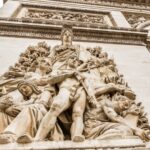
The Champs-Élysées also brings the Arc de Triomphe into the story. The monument is one of Paris’s most recognizable sights, and its position at the western end of the avenue makes it a natural point of reference. Here, the monument is not treated only as a photo stop. It becomes part of the wartime setting, helping you picture how German power was displayed along the avenue and how the Liberation later transformed that same public space.
The route is a walking experience, not a coach tour. That gives you a closer look at the streets and lets the history unfold in sequence. The tradeoff is simple: you need to be comfortable walking for roughly three hours, with outdoor conditions that may include rain. A light rain did not stop one completed tour, but you should still dress for Paris weather and wear shoes suited to city walking.
Place de la Concorde and the marks of liberation
The walk ends at Place de la Concorde, one of the grandest open spaces in central Paris. Here the subject shifts toward liberation and the visible traces of fighting. Bullet holes dating from the Liberation can be seen at the square, giving the final part of the tour a physical detail that photographs and lectures cannot quite replace.
The bullet marks are small reminders of a large event. They do not turn the square into a preserved battlefield, but they help you understand that the Liberation was a real conflict in the streets of Paris. The route ends with that tension still present: the city was freed, but not without violence, uncertainty, and loss.
A little farther along, the story reaches Le Meurice. This is where the fate of Paris may have been debated during the final days of the occupation. General Dietrich von Choltitz, the German governor of Paris, is linked to Hitler’s order to destroy the city and his refusal to carry it out.
That episode gives the tour a strong closing question. Paris survived, but the outcome was not guaranteed. The story asks you to consider the power of one official’s decision, the pressure of military orders, and the terrible possibility that major landmarks and entire neighborhoods might have been destroyed.
The ending at Concorde is also practical. You finish in a central part of Paris rather than returning to Porte Dauphine, so you can continue sightseeing from there. The tour does not include a return transfer, and the end point is the Place de la Concorde area.
What the three-hour format gives you
Three hours is enough time to create a clear narrative without taking up an entire day. You move through one connected section of the city, starting in the west and finishing near the center. The route has a beginning, middle, and end: occupation at Avenue Foch, German propaganda and social life along the Champs-Élysées, then Liberation and the fate of Paris at Concorde and Le Meurice.
The format also limits the amount of ground covered. You will not see every WWII location in Paris, and this is not a full survey of the city’s wartime museums, prisons, or Resistance headquarters. Instead, you get a focused walk built around prominent streets and landmarks.
That focus is a strength if you prefer depth over a long list of stops. It is less suitable if you want to visit interiors, examine artifacts, or cover many neighborhoods. The information supplied for the tour does not include museum admissions or interior visits, so you should book it for the guided outdoor interpretation.
A private tour can also work well for families or small groups with different levels of interest. The group can ask questions and move at a shared pace. Still, the subject includes arrest, occupation, resistance, and tragic deaths, so it may not suit young children or anyone looking for a light introduction to Paris.
You can also read our reviews of more guided tours in Paris


Is $366.88 per person a fair price?
At $366.88 per person, this is a premium experience. The price is difficult to defend if you are comparing it with a basic group walking tour or a self-guided route using a guidebook. Three hours is not a long time, and the tour does not list entry to a museum or other paid attraction.
The value improves if you are splitting the private experience with a group and qualify for the stated group discount. A private guide is most useful when your group has a serious interest in WWII and wants to ask detailed questions. It is also valuable if you prefer a personal conversation to a large group where the guide must keep moving.
I would not choose this tour simply because you want to see the Champs-Élysées. You can visit that avenue freely. I would choose it because you want the historical explanation attached to places you might otherwise walk past without noticing.
The price also buys a fixed three-hour appointment, an English-speaking WWII specialist, and a route that links several important sites. That can be worthwhile during a short Paris stay, especially if you want one concentrated morning rather than several hours of independent research.
Who should book this walk?
I would recommend it most strongly to:
- WWII enthusiasts who want occupied Paris and the French Resistance at the center of their sightseeing.
- Repeat visitors to Paris who have already seen the major monuments and want a new way to read familiar streets.
- Private groups willing to share the cost and take advantage of a more personal format.
- History-minded couples and families with older children who can handle serious wartime subjects.
- Visitors who enjoy walking and discussion more than museums or vehicle-based tours.
I would be more cautious if your main goal is a relaxed introduction to Paris, a short photo walk, or an indoor activity. The subject is dark, the price is high, and the physical format requires three hours on foot.
The tour requires a moderate level of physical fitness. Service animals are allowed, and the starting point is near public transportation. Confirmation is provided when you book. Free cancellation is available if you cancel at least 24 hours before the start time. Changes or cancellations made inside that window are not accepted for a refund.
My call: book it for the history, not just the sights
Book this private walk if the words occupied Paris, French Resistance, and Liberation matter more to you than checking off monuments. The best parts are the links between famous places and lesser-seen wartime details: the Gestapo presence near Avenue Foch, Pierre Brossolette’s fate, German use of the Champs-Élysées, bullet holes at Concorde, and von Choltitz’s decision at Le Meurice.
Skip it if $366.88 per person feels too steep for an outdoor three-hour tour, or if you want a broad introduction to Paris. For the right small group, though, the private setting and strong WWII focus can turn a familiar walk through western Paris into a serious, memorable history lesson.
FAQ
How long is the WWII walking tour?
The tour lasts approximately three hours.
What time does the tour begin?
It starts at 9:30 a.m.
Where does the tour meet?
The meeting point is Porte Dauphine, 75016 Paris.
Where does the tour finish?
The walk ends at Place de la Concorde, 75008 Paris.
Is the tour private?
Yes. Only your group participates in the private tour.
What language is offered?
The tour is offered in English.
What places are included on the route?
The route includes Avenue Foch, the Champs-Élysées, the Arc de Triomphe, Place de la Concorde, and the area around Le Meurice.
Is a ticket required to enter the sights?
The tour information lists admission as free. It describes an outdoor walking route rather than paid interior entry.
Can I cancel for a full refund?
Yes, if you cancel at least 24 hours before the experience start time. Cancellations or changes made less than 24 hours before the start time are not refunded or accepted.
Is the tour suitable for someone with limited mobility?
A moderate level of physical fitness is required because this is a three-hour walking tour. Service animals are allowed, and the route is near public transportation.