REVIEW · PARIS
Paris Champs-Élysées 2-Hour Private Walking Tour
Book on GetYourGuide →Operated by Paris in person private tours · Bookable on GetYourGuide
The Champs-Élysées is more than a shopping street. This private walk shows you how a former park of bars and modest theaters became one of Paris’s grandest addresses. I like the private format, which lets you ask questions, and the way the route connects Roman mythology, Napoleon, 19th-century Paris, and modern city life.
I also like the balance between famous monuments and smaller cultural clues, including the old drinking spots linked with Picasso and other artists. The main drawback is the short two-hour schedule: you see many important places, but most stops are viewed from outside rather than explored at length.
In This Review
- Key points
- Why this two-hour walk works well in Paris
- Finding the red canvas tote at Place de la Concorde
- From royal planning to the modern Champs-Élysées
- Grand Palais and Petit Palais, two very different museum façades
- Avenue Montaigne and Ladurée bring the tour into modern Paris
- Picasso’s drinking dens and the less polished side of Paris
- Reaching the Arc de Triomphe and Napoleon’s Paris
- What you get for $176 per person
- Timing, weather, languages, and access
- Who should book this Champs-Élysées walk
- FAQ
- Where does the tour begin?
- How will I identify the guide?
- How long does the walking tour last?
- Is the tour private?
- Which languages are available?
- Is the tour wheelchair accessible?
- Does the tour operate in bad weather?
- Are food and drinks included?
- Can I cancel for a full refund?
- Should you book this private Champs-Élysées tour?
Key points
- A private two-hour route: You walk at the pace of your own group with a live guide.
- A strong start at Place de la Concorde: Meet by the obelisk and begin among some of Paris’s grandest urban views.
- Both sides of the Champs-Élysées: Learn how the avenue shifted from a simple park to a symbol of luxury and power.
- The Grand Palais and Petit Palais: See two landmark exhibition buildings that now operate as museums.
- A finish at Napoleon’s Arc de Triomphe: The tour ends with one of Paris’s most imposing monuments.
- Rain or shine access: The walk operates in all weather and is wheelchair accessible.
Why this two-hour walk works well in Paris
Paris can feel like a city of separate monuments. You see an obelisk here, a palace there, then find yourself on a famous avenue without quite understanding how the pieces fit together. This tour gives you a clear thread through one of the city’s most recognizable areas.
You begin at Place de la Concorde and walk toward the Arc de Triomphe. Along the way, your guide explains how the avenue connects to French royal planning, Roman mythology, Napoleon, the 19th century, and the Paris you see today.
That historical sweep is the main value. You are not simply ticking off the Champs-Élysées, Grand Palais, and Arc de Triomphe. You are learning why this route became important and how its character changed over time.
The walk is also private. That matters in central Paris, where a large group can make a simple explanation hard to hear. With your own guide, you can ask for more detail about architecture, Napoleon, cafés, shopping, or the changing social life of the avenue.
The tour has a 4.8 rating from three reviews, and the clearest praise is practical: it works as an introduction to Paris and a useful first activity at the beginning of a visit. That makes sense. The route gives you a broad orientation without taking up half a day.
You can also read our reviews of more walking tours in Paris


Finding the red canvas tote at Place de la Concorde
The meeting point is in front of the obelisk at Place de la Concorde. Look for a guide carrying a red canvas tote bag. This is a helpful detail in a large, open square where several groups may be gathering.
Place de la Concorde is a fitting starting point. It is a neoclassical masterpiece of planning and architecture, with broad views in several directions. The square is not just a pretty opening scene. It helps you understand Paris as a planned capital, built to frame monuments, avenues, and political power.
The Luxor Obelisk gives the square its most obvious focal point. Your guide uses the area to introduce the relationship between ancient symbolism and French public design. You may also hear how the square connects to the turbulent periods of French history, though the supplied tour details do not promise a full treatment of every event associated with the site.
The Hôtel de Crillon is another key sight here. Its grand façade helps set the tone for the rest of the walk, where monumental buildings and luxury addresses appear side by side.
Give yourself enough time to reach the meeting point before the scheduled start. The tour lasts only two hours, so arriving late could mean missing the opening explanation and the first part of the route.
From royal planning to the modern Champs-Élysées
The Champs-Élysées is often called the most beautiful avenue in the world. That title is grand, and the tour does not ask you to accept it without context. Instead, it looks at how the avenue grew from a much simpler setting.
The route explains that this area was once a plain park with bars and third-rate theaters. That contrast is one of the most interesting parts of the experience. The avenue’s current image of luxury stores, polished façades, and major celebrations can hide its less glamorous past.
You will hear about the avenue’s link with Roman mythology. This adds a layer that many quick sightseeing walks skip. The name Champs-Élysées refers to the Elysian Fields, the resting place of blessed souls in ancient Greek and Roman tradition.
The guide also connects the avenue with Napoleon. The emperor’s influence is central to the route, especially as you approach the Arc de Triomphe. This gives the walk a useful political thread: the boulevard is not only a place for shopping and people-watching, but also a stage for national identity and military memory.
The best way to approach this section is to focus on the changes. Paris did not receive the modern Champs-Élysées all at once. The tour presents the avenue as a place that shifted with the city around it, from a rougher entertainment district to a prestigious address in modern Paris.
Grand Palais and Petit Palais, two very different museum façades
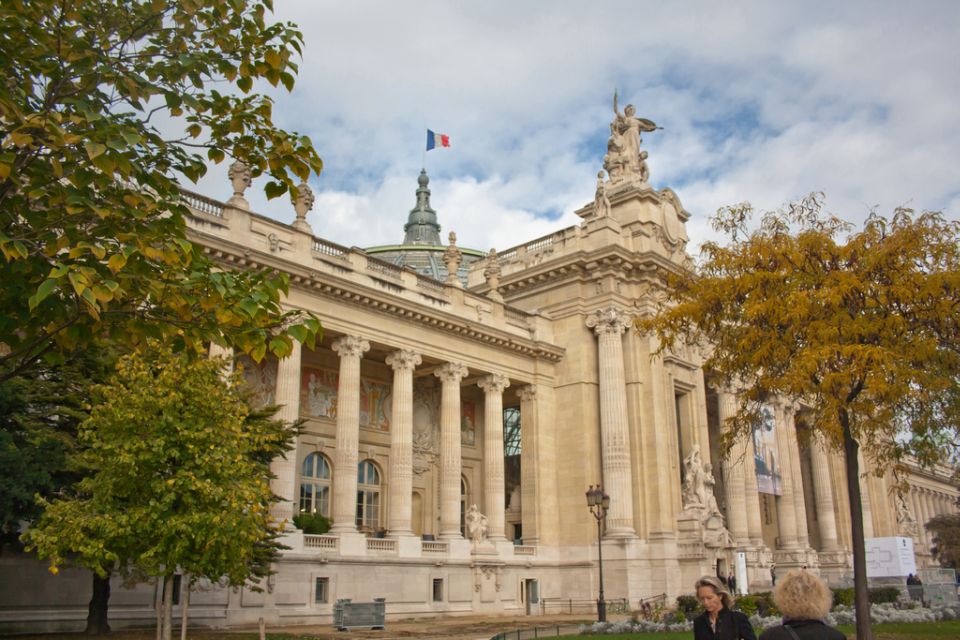
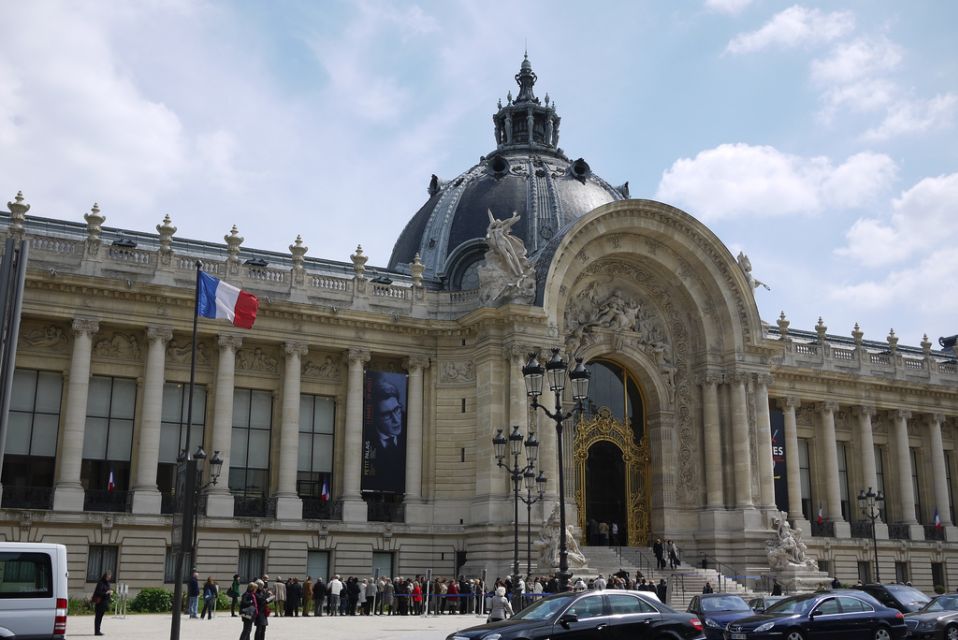
The Grand Palais and Petit Palais are among the most rewarding architectural stops on the route. Both are now museums, but even if you do not enter, their exteriors make the walk worthwhile.
The Grand Palais is known for its monumental scale and glass-covered design. The building was made for major public exhibitions and remains one of the grandest structures along this part of Paris. Its name can make it sound like a traditional royal residence, but its role is more closely tied to art, culture, and public display.
The Petit Palais provides a useful contrast. It is smaller in scale, though still highly decorated and formal. Together, the two buildings show how Paris used architecture to project confidence and cultural importance.
This is also where the private guide format helps. You can ask which details to look for instead of trying to absorb every column, sculpture, and decorative feature on your own. The tour does not include museum admission, so consider this a guided exterior visit rather than a museum tour.
If you want to see the collections inside either museum, plan that for another time. Two hours is enough for the avenue and its major sights, not for a proper museum visit as well.
Avenue Montaigne and Ladurée bring the tour into modern Paris
Avenue Montaigne adds a different mood to the route. The Champs-Élysées is famous for its scale and public spectacle, while Avenue Montaigne is closely linked with high-end fashion and luxury shopping.
This part of the walk helps you see the contrast between Paris as a ceremonial capital and Paris as a modern style center. You may not be shopping, but the street still offers a useful look at the city’s commercial identity.
Ladurée is another recognizable stop. The macaron shop gives the walk a touch of Parisian food culture without turning the experience into a tasting tour. Food and drinks are not included, so any macarons, coffee, or other purchases are at your own cost.
That arrangement keeps the price clear, but you should know what you are paying for. This is a guided walking experience, not a food tour. Ladurée is included as a place of interest, not as a guaranteed tasting stop.
You can also read our reviews of more private tours in Paris





Picasso’s drinking dens and the less polished side of Paris
One of the more unusual promises of the route is its look at the favorite drinking dens of Picasso and other artists. This detail helps move the walk away from a simple procession of monuments.
The Champs-Élysées is now associated with luxury brands and major tourist sights, but its past included bars, theaters, and more ordinary nightlife. Hearing about the places linked with artists gives you a glimpse of the avenue as a social setting, not just a ceremonial one.
The information provided does not name the specific drinking establishments or promise entry into them. You should expect stories and exterior references rather than a bar crawl. Still, this is a useful part of the tour because it adds human character to a route dominated by monuments.
I especially like this kind of context on a short city walk. A building can be impressive, but a story about who spent time nearby often makes the place easier to remember.
Reaching the Arc de Triomphe and Napoleon’s Paris
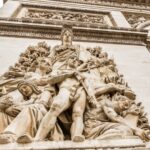
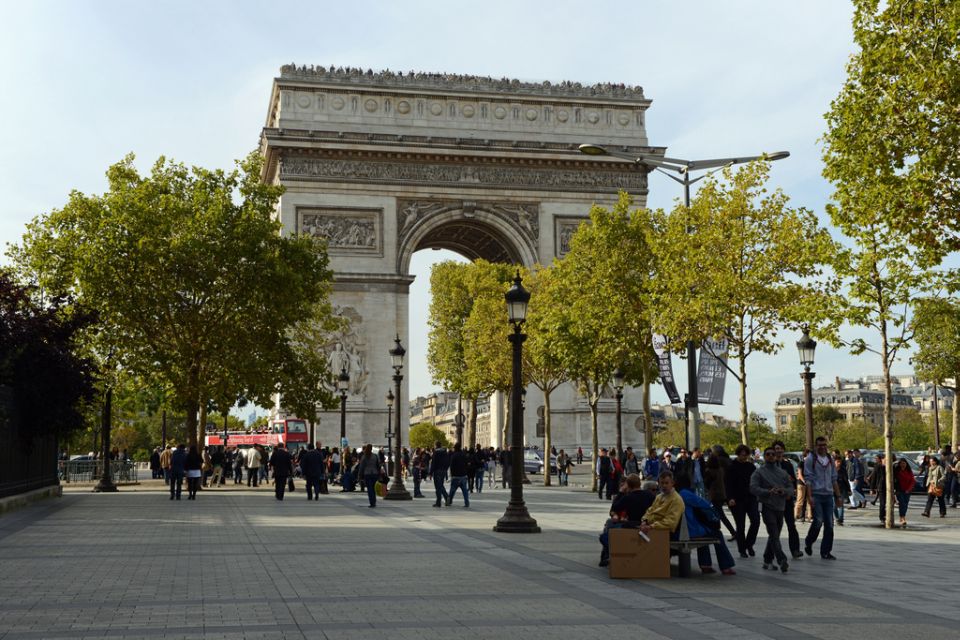
The route builds toward the Arc de Triomphe, a monolithic monument to Napoleon. It is one of Paris’s strongest visual finishes, and the approach lets you see how the avenue leads toward a symbol of military ambition and national pride.
The monument was commissioned to honor the French army and Napoleon’s victories. The tour’s focus is on its connection with the emperor and the wider development of Paris. You should not expect a detailed interior visit, since the included service is the guide and the listed route centers on seeing the principal sites.
The Arc also gives the walk a strong sense of direction. You begin with the ordered grandeur of Place de la Concorde and finish with a monument designed to dominate its surroundings. Between them, the avenue passes through architecture, shopping, culture, and stories of Parisian social life.
Be aware that traffic and the broad road system around the Arc de Triomphe can make this area less relaxed than the opening square. The monument is impressive, but it is also a busy urban junction. Your guide can help you understand the view and the setting, even if the final stop feels more crowded and intense than the earlier parts of the walk.
What you get for $176 per person
At $176 per person, this is not a budget walking tour. The price makes the most sense for people who value a private guide and want a focused introduction without joining a large group.
The cost is harder to justify if you only want a quick list of sights. You can walk along the Champs-Élysées independently, take photographs of the Grand Palais and Arc de Triomphe, and read basic information for far less money.
The private format changes the calculation. You are paying for a guide who can organize the route, connect the sites, answer questions, and adjust the explanation to your group. That is especially useful if you are visiting Paris for the first time or want a family-friendly introduction with a flexible conversation.
The tour may also work well for a small group with mixed interests. One person can ask about Napoleon, another about architecture, and another about fashion or cafés. The guide can respond without the fixed rhythm of a large public group.
Still, keep the limits in mind. Admission tickets, food, and drinks are not included. The experience lasts two hours, and the listed route contains several major sights. You receive a guided overview, not an in-depth museum visit or a full historical study of every monument.
Timing, weather, languages, and access
The tour is offered in English, French, and Serbo-Croatian. It is a private group activity, so only your party joins the guide rather than a mixed public group.
The walk operates rain or shine. Paris weather can change quickly, so wear shoes suitable for walking and bring protection from rain when the forecast looks uncertain. The tour details do not specify a covered alternative or a rescheduling plan for bad weather.
The experience is wheelchair accessible. Because this is an outdoor walking route through major city streets and public spaces, you may still want to confirm any personal mobility needs when booking, especially if you require particular assistance.
Free cancellation is available up to 24 hours before the tour for a full refund. You can also reserve now and pay later, which gives you some flexibility while arranging a Paris schedule.
Who should book this Champs-Élysées walk
I would recommend this tour to a first-time Paris visitor who wants a compact introduction to the city’s grand western axis. It is also a good choice if you prefer asking questions rather than listening quietly in a large group.
The route suits people who enjoy architecture, urban planning, Napoleon, fashion, and the social stories behind famous streets. It also works well as a first-day activity, since it introduces several major landmarks and helps you get your bearings quickly.
You may want another option if you are mainly interested in going inside museums, eating macarons, or spending a long time at the Arc de Triomphe. Those activities are not included in the two-hour walk.
I would also think carefully about the price if you are traveling alone. The private rate is easier to justify for a couple, family, or small group that can share the cost. Solo visitors may prefer a public walking tour or self-guided route unless personal attention is especially important.
FAQ
Where does the tour begin?
The meeting point is in front of the obelisk at Place de la Concorde.
How will I identify the guide?
Your guide will be carrying a red canvas tote bag.
How long does the walking tour last?
The tour lasts two hours.
Is the tour private?
Yes. It is offered for a private group.
Which languages are available?
The live guide can conduct the tour in English, French, or Serbo-Croatian.
Is the tour wheelchair accessible?
Yes, the activity is listed as wheelchair accessible.
Does the tour operate in bad weather?
Yes. Tours operate rain or shine.
Are food and drinks included?
No. Food and drinks are not included in the tour price.
Can I cancel for a full refund?
Yes. You can cancel up to 24 hours in advance for a full refund.
Should you book this private Champs-Élysées tour?
Book it if you want a polished introduction to one of Paris’s grandest routes and value having your own guide. The strongest parts are the private format, the clear two-hour structure, and the mix of famous buildings with less expected stories about artists, bars, theaters, and the avenue’s earlier life.
Skip it if you want extensive museum time, included food, or the cheapest possible way to see the Champs-Élysées. At $176 per person, the value lies in the personal attention and historical connections, not in the number of admission tickets included.
For a first visit, especially at the start of your Paris stay, this is a sensible way to meet the city’s monumental side before setting off on your own.