REVIEW · BAYEUX
From Bayeux: Omaha Beach, Cemetery, and Pointe du Hoc Tour
Book on GetYourGuide →Operated by HQ COMPANY TOUR · Bookable on GetYourGuide
Omaha Beach is only one part of this four-hour Normandy tour, but the combination of the beach, cemetery, and Pointe du Hoc gives you three very different ways to understand D-Day. You see the open shore where American troops came under fire, the rows of graves at Colleville-sur-Mer, and the scarred ground where Rangers climbed the cliffs.
I like the tour’s small group size of seven and its tight route from Bayeux. I also like the balance between guided explanation and quiet time on your own, especially at the cemetery. The main drawback is pace: four hours is enough for a meaningful introduction, but not enough for every major Normandy site.
- Omaha Beach in 40 minutes: Hear how the battle unfolded while standing on one of the most important D-Day beaches.
- The Normandy American Cemetery for one hour: Walk among the graves, take in the setting, and pay your respects without being rushed through.
- Pointe du Hoc with its bomb craters and bunkers: See a battlefield preserved in a stark, physical way.
- A van ride from Place de Québec: The route includes about 85 minutes of transport, so you cover a lot without arranging your own car.
- English-speaking guides and headsets: Guides including Chloë, Sophie, Mickael Patin, and Yannick have led tours with maps, photographs, and clear explanations.
- Rain-or-shine touring: Comfortable shoes and rain gear are essential, and the route is not suitable for people with mobility impairments.
In This Review
- Three D-Day sites, three different kinds of understanding
- The drive from Bayeux sets the scene
- Omaha Beach: wide open ground and hard questions
- The American Cemetery: one hour for respect and reflection
- Pointe du Hoc: bomb craters and the Ranger assault
- Why the small group and headset matter
- What the $102 price gives you
- Who should book this half-day Normandy tour?
- Practical advice before you leave Bayeux
- Should you book it?
- FAQ
- How long does the tour last?
- Where does the tour start and finish?
- What language is the tour conducted in?
- How many people are in the group?
- Is hotel pickup included?
- What should I bring?
Three D-Day sites, three different kinds of understanding
This tour works because each stop answers a different question. At Omaha Beach, you consider the scale of the assault and the exposed ground. At the cemetery, the human cost becomes personal. At Pointe du Hoc, the craters and ruined defenses show the force of the fighting in a way that a book cannot.
You begin at Place de Québec in Bayeux, looking for the vehicle marked HQ Company Tour. The group is capped at seven people, which matters here. A guide can answer questions, adjust the pace a little, and use the headset system so you can hear clearly near open sites and in a busy group setting.
The tour lasts four hours, including the rides between stops. That makes it a good choice if you have only a morning or afternoon in Normandy. It also means you need to accept a focused visit rather than a full study of the invasion. You will not see every beach, museum, or German battery in the region.
The drive from Bayeux sets the scene
The first van ride takes about 30 minutes. That is not wasted time. It moves you from Bayeux toward the coast and gives the guide room to explain the setting before you arrive at the battlefield.
Because the group is small, you can ask questions during the ride. Some guides use maps and wartime photographs to connect the modern road to the events of June 6, 1944. Chloë is noted for carrying a book of photographs and a map, while Mickael Patin has been praised for linking military events with local life and asking questions that encourage you to think about the sites rather than simply collect facts.
The exact guide depends on the date, so you should not book expecting one particular person. Still, the guide team has a clear role: explain what you are seeing, keep the route moving, and leave space for the emotional weight of the places.
You can also read our reviews of more tours and experiences in Bayeux.
Omaha Beach: wide open ground and hard questions
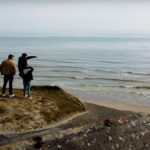
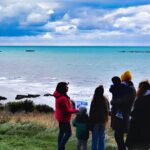
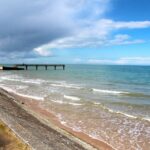
The Omaha Beach stop lasts about 40 minutes, with a guided visit. The beach is broad and open, and that openness helps you understand the difficulty faced by the troops. There are few visual barriers between the water and the land beyond, so the distance between landing point and defensive positions becomes part of the lesson.
Your guide can point out the ground and explain how the battle developed. You will hear about the assault, the German defenses, and the pressure placed on American troops as they tried to move inland. The value of having a guide here is not simply the number of dates you hear. It is the chance to connect the physical setting with decisions made under fire.
Forty minutes is enough to look, listen, and ask questions. It is not enough to wander far along the shore or build a full picture of every unit involved. If you want extended beach time, a museum visit, or a slower walk, plan a separate half-day or full-day outing.
You should also expect the weather to affect this stop. The tour runs in rain or shine, and an exposed beach offers little shelter. Bring rain gear even if the forecast looks kind in Bayeux. Comfortable shoes will help, though the route is not designed for people with mobility impairments.
The American Cemetery: one hour for respect and reflection
A short five-minute van ride takes you to the Normandy American Cemetery at Colleville-sur-Mer. This is the emotional center of the tour for many people, and the one-hour stop gives you more than a quick photograph from the entrance.
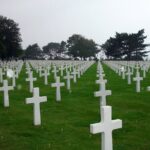
The cemetery was inaugurated in 1956 and is operated by the American Battle Monuments Commission. Its ordered rows of white markers create a very different feeling from the open beach. Here, the battle is no longer an operation shown on a map. Each marker represents a person.
The guided portion helps you understand the cemetery and its connection to the Normandy campaign. Afterward, you have free time to walk, pause, and take in the setting at your own speed. That division is important. A guide can give the place context, but no commentary is needed for every minute.
One especially useful detail is the possibility of seeing the flag lowering ceremony if the timing matches your visit. A guide named Yannick has been praised for making sure a group saw it, and the moment can be deeply moving. The schedule may not always align, so treat it as a welcome possibility rather than a promised part of the tour.
You may find this stop more demanding than the beach. The quiet and the number of graves can make the human cost feel immediate. Give yourself permission to step away from the group for a few minutes during the free time, while keeping an eye on the time so the van can leave as scheduled.
Pointe du Hoc: bomb craters and the Ranger assault
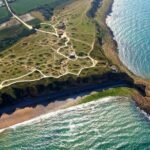
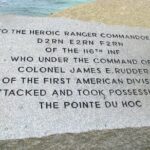
The next ride takes about 20 minutes, bringing you to Pointe du Hoc. This headland is associated with James Rudder’s Rangers, who climbed the cliff under heavy fire to attack a German coastal battery.
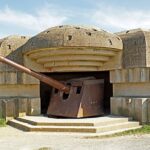
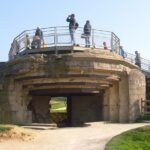
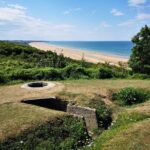
The site remains a World War II battlefield. You can see concrete bunkers and hundreds of bomb craters, giving the stop a physical quality that differs from the cemetery and beach. The ground itself records the violence of the bombardment. It is not a polished memorial site where every rough edge has been removed.
The guided visit lasts about 50 minutes. Your guide explains why Pointe du Hoc mattered and how the Rangers reached the battery. Maps and photographs can be especially useful here because the present-day ruins do not explain themselves. A clear account helps you understand the military problem, the terrain, and the risks involved.
Watch your footing and follow the guide’s directions. The tour is not suitable for people with mobility impairments, and uneven ground is part of what makes the site so revealing. Rain can also make outdoor footing less comfortable, so sturdy shoes and rain gear are sensible choices.
Pointe du Hoc may be the most visually striking stop, but it is not necessarily the easiest. The craters and bunkers invite exploration, yet the schedule allows less than an hour. You will get a strong introduction, not a leisurely survey of every position.
Why the small group and headset matter
A group of up to seven gives this tour a more personal feel than a large coach excursion. You can hear the guide’s explanation, ask a follow-up question, and stay connected without spending the day waiting for dozens of people to regroup.
The included headsets are useful at outdoor sites. Wind, distance, and uneven group spacing can make it hard to hear a guide on a beach or near a bunker. Here, you can look at the site while still following the explanation.
The guides also appear to vary in style. Chloë uses a book of photographs and a map. Sophie has been praised for being warm and clear while giving visitors time to absorb each stop. Mickael Patin combines battlefield knowledge with observations about local life, and Yannick has been noted for giving the right balance of explanation and independent time.
That variety is worth keeping in mind. The exact personality of your guide cannot be guaranteed, but the structure gives the guide room to do more than recite a script. The strongest part of the experience is likely to be the conversation between the prepared explanation and your own questions.

What the $102 price gives you
At $102 per person, this is not the cheapest way to see Normandy. The price includes a licensed guide, headsets, and transport between Bayeux and three major sites. For someone without a car, that convenience carries real value.
You avoid arranging roads, parking, and the distances between Omaha Beach, the cemetery, and Pointe du Hoc. You also avoid spending your limited time trying to orient yourself at places where the story is not always obvious from signs alone.
The value is strongest if you have only one short window in Normandy. In four hours, you see three important locations and return to the same meeting point in Bayeux. A self-drive visit can offer more freedom, but it requires planning and a designated driver. A larger coach tour may cost less, but a seven-person group gives you better access to the guide.
Food and drinks are not included, and hotel pickup and drop-off are not included either. You need to reach Place de Québec and find the vehicle with the HQ Company Tour sign. Factor that into your schedule, especially if you are staying outside central Bayeux.
Who should book this half-day Normandy tour?
I would choose this tour if you want a clear first look at the American sector and prefer explanation to independent research. It suits families, couples, and small groups who want to see the major sites without committing a full day.
It also works well for people staying in Bayeux without a rental car. The transport is simple, the route is efficient, and the small group limits the usual delays.
Teenagers can follow the tour too, especially when the guide uses photographs, maps, and questions rather than a long lecture. The subject is serious, but the format gives younger visitors something concrete to see and consider.
I would look elsewhere if you need step-free access, extended beach walks, a museum visit, or a detailed study of American units and equipment. You might prefer a full-day tour for Utah Beach, Sainte-Mère-Église, the Airborne Museum, or additional German positions, but those sites are not part of this four-hour route.
Practical advice before you leave Bayeux
Wear comfortable shoes. Pointe du Hoc includes uneven outdoor ground, and even the beach can be tiring if you are not dressed for walking.
Bring rain gear. The tour runs in all weather, and the coast can feel very different from the streets of Bayeux. A light waterproof layer is more useful than hoping the forecast stays clear.
Leave time before and after the tour if you want a calm start and finish. The activity begins and ends at Place de Québec, and the stated schedule includes the return van ride.
The cancellation policy is flexible: you can cancel up to 24 hours in advance for a full refund. You can also reserve now and pay later, which helps if your Normandy plans are still shifting.
Should you book it?
Book this tour if you want three essential American D-Day sites in one well-organized morning or afternoon, with a licensed English-speaking guide and a group limited to seven. The strongest reasons are the efficient transport, the cemetery’s full hour, and the preserved bunkers and craters at Pointe du Hoc.
Skip it if you want a slow, all-day exploration or have mobility limits. At $102, the tour earns its price through transport, interpretation, and time saved, not through a long list of stops. For a focused introduction from Bayeux, it is a thoughtful and practical choice.
FAQ
How long does the tour last?
The tour lasts four hours, including the drives between Bayeux, Omaha Beach, the Normandy American Cemetery, Pointe du Hoc, and the return meeting point.
Where does the tour start and finish?
It starts and finishes at Place de Québec in Bayeux. Look for the vehicle with the HQ Company Tour sign on the front.
What language is the tour conducted in?
The live tour guide speaks English, and headsets are provided so you can hear the guide clearly.
How many people are in the group?
The tour is limited to seven participants, making it a small-group experience.
Is hotel pickup included?
No. Hotel pickup and drop-off are not included. You need to meet the vehicle at Place de Québec.
What should I bring?
Bring comfortable shoes and rain gear. The tour runs rain or shine, and it is not suitable for people with mobility impairments.