REVIEW · PARIS
Paris: Louvre Museum Entry Ticket and Garden Walking Tour
Book on GetYourGuide →Operated by ExperienceFirst · Bookable on GetYourGuide
The best part of this Louvre experience happens before you enter the museum. You walk from the Pyramid through the Tuileries Garden, under the Arc de Triomphe du Carrousel, and along the grand axis that links the Louvre with the Champs-Élysées. The outdoor tour gives the palace a clear setting instead of dropping you straight into a maze of galleries.
I like the short, focused walk and the freedom to explore the Louvre at your own pace. I also like the practical help from guides such as Denise, Sagar, Paula, and Sanya, who have been praised for clear explanations, humor, and useful Paris tips. The main drawback is that the advertised skip-the-line access may still involve a security or entry queue, and you receive no guided tour inside the galleries.
In This Review
- Key points at a glance
- Why start with the Louvre outdoors?
- Meeting the guide at the Pyramid
- The Louvre Pyramid and Cour Napoléon
- Walking beneath the Arc de Triomphe du Carrousel
- The Tuileries Garden in every season
- Entering the Louvre with a timed ticket
- What to see once you are on your own
- Adding the Seine cruise
- Is $51 a fair price?
- Who should book this Louvre experience?
- Practical advice for a smoother visit
- Final recommendation: a smart introduction, not a complete Louvre tour
- FAQ
- Where does the Louvre and Tuileries tour start?
- How do I find the guide?
- Which Metro station is closest?
- What language is the tour conducted in?
- How long does the experience last?
- Is the Louvre ticket included?
- Is the Louvre portion guided?
- Does skip-the-line mean there is no waiting?
- Is the Seine cruise included?
- What should I bring?
Key points at a glance
- A four-hour Louvre plan: Begin outdoors with a guide, then spend the rest of your visit inside the museum independently.
- The Tuileries provides context: Flowers, statues, ponds, and palace views help you understand how the Louvre fits into central Paris.
- The Arc de Triomphe du Carrousel is part of the route: You pass beneath this royal-looking monument before reaching the museum courtyard.
- Timed entry is included: Your guide gives you the Louvre ticket for entry after the walking portion.
- The inside visit is self-guided: You choose the paintings, sculptures, and departments that matter most to you.
- A Seine cruise is optional: You can add a narrated cruise, valid for one year from your tour date.
Why start with the Louvre outdoors?
The Louvre can feel overwhelming before you even see a painting. Its courtyards, wings, entrances, and long corridors are spread across a huge former palace. This experience begins by showing you the setting, so the museum feels less like a giant building and more like the center of Paris’s historic axis.
Your guide explains how the Louvre connects with the Tuileries Garden, the Arc de Triomphe du Carrousel, the Cour Napoléon, and the roughly two-mile Axe Historique. That background matters because the museum was not designed as an isolated art box. It sits within a grand sequence of gardens, monuments, palace spaces, and views stretching west through Paris.
The walking portion is not a full historical tour of every nearby building. It is a useful introduction lasting part of the four-hour experience, with time left for the museum. That balance suits you if you want a little orientation but do not want a long lecture before facing the Mona Lisa crowds.
A few more Paris tours and experiences worth a look



Meeting the guide at the Pyramid
The meeting point is the statue of Louis XIV on horseback in front of the Louvre Pyramid entrance, near 10 Place du Carrousel. Look for a guide holding an orange or yellow ExperienceFirst sign.
The closest Metro stop is Palais Royal Musée du Louvre on Lines 1 and 7. From there, allow about five minutes to walk to the statue. The Pyramid area can be busy and confusing, so arrive early enough to identify the statue and sign without rushing.
The guides work in English. Names reported for this experience include Denise, Sagar, Paula, Austin, Sanya or Sania, Laura, and Sugar, but your guide will depend on the date. The strongest guide feedback centers on clear English, lively storytelling, good humor, and practical recommendations for the rest of a Paris visit.
One useful detail: a late arrival can create real trouble. One party missed the group at the meeting point, although the guide later sent directions and the operator emailed the museum tickets. Do not count on that rescue. Have the meeting address ready, and keep your phone available.
The Louvre Pyramid and Cour Napoléon
The Pyramid is your first photo stop and the visual gateway to the museum. From here, your guide begins explaining the surrounding Cour Napoléon, the broad courtyard that gives you the classic Louvre view.
This is a good place to ask basic orientation questions. Which wing contains the collection you want? Where do you enter? How much time should you give to the museum? The guide does not lead you through the artwork later, so use this outdoor introduction to gather advice before you separate.
The courtyard also helps you appreciate the Louvre’s scale. You see the contrast between the old palace façades and the modern glass Pyramid. That mixture is one reason the museum can feel confusing at first, but it is also part of what makes the setting memorable.
Walking beneath the Arc de Triomphe du Carrousel
The route continues to the Arc de Triomphe du Carrousel, a smaller monument near the Louvre. You pass beneath it as kings and imperial processions once did, at least in spirit. Your guide explains why the arch matters and how it relates to the palace and the long westward view.
This is a short stop, but it gives the walk a strong sense of place. You are not merely heading from a meeting point to an entrance. You are following the ceremonial route between the Louvre and the Tuileries.
The arch is also a helpful photo stop before you enter the museum. If you enjoy architecture and city planning, this part may interest you as much as the garden itself. If your only goal is the artwork, you may find the outdoor explanations less essential, but they do not take up the whole day.
The Tuileries Garden in every season
The Tuileries Garden is the heart of the walking tour. You stroll among flowerbeds, statues, paths, and ponds while the guide explains the garden’s place beside the former palace.
The garden gives you a needed change of pace before the Louvre. Instead of standing in an indoor queue or rushing toward famous paintings, you get open air and room to look around. The flowers and ponds are especially pleasant in good weather, while the statues give the guide natural stopping points for stories about the area.
This tour runs rain or shine, so dress for the forecast. There is no promise of shelter during the outdoor portion. Bring comfortable shoes and a coat or umbrella if needed, since the walk takes place outside before the museum visit.
The route is wheelchair accessible, which is helpful, though outdoor conditions and crowds can still affect how easily you move. The experience does not include food or drinks, so plan a snack or meal before or after the tour rather than expecting a break during it.
You can also read our reviews of more walking tours in Paris






Entering the Louvre with a timed ticket
After the garden and nearby landmarks, your guide provides a timed-entry ticket to the Louvre. The ticket is the practical core of the booking, especially if you are visiting Paris on a short schedule and have not arranged museum admission separately.
The phrase skip the line needs careful reading. This experience uses a separate entrance and a timed ticket, but entry is not guaranteed to mean walking straight through. A queue of roughly 35 to 40 minutes has occurred, with security and access controls still affecting the process.
That does not make the ticket useless. The Louvre is one of Paris’s hardest museum visits to organize at busy times, and having a timed reservation can be valuable. Just do not buy this expecting a private doorway with no waiting.
Once inside, the guided portion ends. Your ticket lets you explore the galleries independently, and the activity finishes at the Louvre. You will need to manage your own route, reading, breaks, and return plans.
What to see once you are on your own
The Louvre is far too large for one visit. You cannot see everything in a few hours, so choose a short list before you enter. The guide can help you decide what to prioritize, but this is not an inside tour with a fixed route.
You might focus on the museum’s famous masterpieces, including the Mona Lisa, or choose a department that interests you more. One useful piece of advice from the guides is to prepare around 24 key works if you have limited time. That kind of plan is more realistic than trying to cover every corridor.
The self-guided format has a clear advantage. You can move quickly through rooms that do not interest you and linger where you want. Families, independent art lovers, and repeat visitors may prefer that flexibility to following a guide through a set sequence.
The tradeoff is that you receive no guided explanation inside the exhibitions. If you want detailed interpretation of individual paintings or help finding the major works, bring your own museum plan or audio resource. The outdoor guide prepares you for the building, but the art portion belongs to you.
Several strong guide assessments single out Sagar for funny, detailed explanations and stories connected to the Mona Lisa. Denise has been praised for clear English and for adjusting timing around questions. Paula is described as energetic and helpful with Paris recommendations. These qualities can make the introduction enjoyable, but guide assignment is not fixed, so book this for the format rather than a specific person.
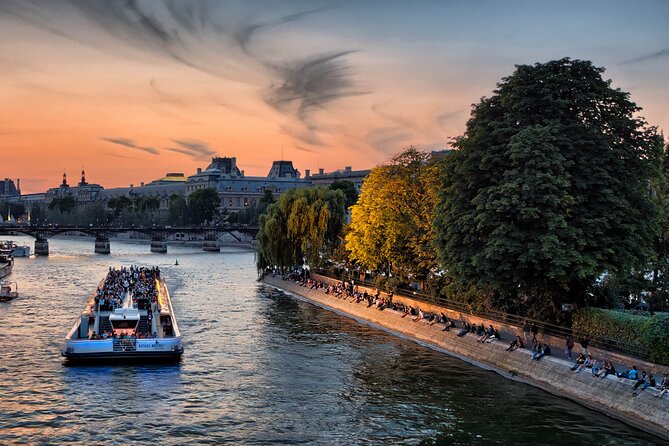
Adding the Seine cruise
You can upgrade the booking with a narrated Seine River cruise. The cruise is an add-on, not part of every version of the experience, so check the option you select.
The unusual advantage is flexibility: the cruise is valid for one year from your tour date. You do not have to squeeze it into the same afternoon, which lets you use it on another day when the weather or your schedule suits a river ride better.
The cruise is a good choice if you want another broad view of Paris after seeing the Louvre area from street level. It also adds value for a first visit, since the river offers a different way to connect the city’s major sights. If your time in Paris is already packed, the basic Louvre and garden option may be enough.
Is $51 a fair price?
At $51 per person, this is not the cheapest way to see the Louvre. You are paying for three things: the live outdoor guide, the Tuileries orientation, and a timed museum ticket arranged for you.
The value depends on your planning style. If you already have a Louvre reservation and understand the entrances, you may prefer to buy admission alone and explore independently. If you are visiting at the last minute, have only a day or two in Paris, or want help making sense of the area, the extra cost can be worthwhile.
I especially see value here for first-time visitors who might otherwise spend too long figuring out where to go. The guide connects the Pyramid, Cour Napoléon, Arc de Triomphe du Carrousel, Tuileries, and museum entrance in one clean sequence. That makes the visit feel organized without locking you into a guided gallery route.
The price does not include food or drinks, and the cruise costs extra. It is also non-refundable, so confirm the date and starting time before booking. The overall rating is 4.2 from 326 ratings, which suggests a generally positive experience with some real variation in expectations, especially around the meaning of skip-the-line access and the amount of time available inside.
Who should book this Louvre experience?
I would choose this tour if you want a short introduction to the Louvre district followed by independent museum time. It works well for first-time visitors, people booking close to their Paris dates, and anyone who likes historical context but dislikes being led from painting to painting.
It is also a good fit if you want the Tuileries to be part of your Louvre day. The garden is not just a path to the entrance, and the guide helps you notice its design, statues, ponds, and connection to the wider city.
Families and mixed-interest groups may appreciate the self-guided ending. One person can spend time with paintings while another moves on, within the limits of the museum’s access rules.
I would look elsewhere if you want a specialist art guide inside the galleries, a guaranteed zero-wait entrance, or a small private experience. This is an outdoor orientation plus independent admission, not a full museum tour.
Practical advice for a smoother visit
- Arrive early at the Louis XIV statue, not merely at the Louvre Pyramid.
- Look for the orange or yellow ExperienceFirst sign.
- Use Palais Royal Musée du Louvre station on Metro Lines 1 or 7, then allow about five minutes on foot.
- Bring your passport or ID card, as identification is required.
- Wear shoes suited to several hours of walking and museum floors.
- Check the weather because the garden walk continues in rain.
- Decide on a short list of Louvre highlights before entering.
- Ask the guide for help with your museum plan and Paris recommendations.
- Treat skip-the-line as timed access through a separate entrance, not a guarantee of no queue.
- If you add the Seine cruise, remember that it remains valid for one year from the tour date.
Final recommendation: a smart introduction, not a complete Louvre tour
Book this experience if you want the Louvre to make sense before you enter it. The Tuileries walk, royal arch, Pyramid, and Cour Napoléon provide the setting, while the timed ticket removes much of the admission-planning work.
Just set the right expectations. You may still wait, the guide does not accompany you through the artwork, and four hours is not enough to conquer the entire museum. For a first visit with limited Paris time, that combination of orientation and freedom is sensible. For art-focused visitors who want detailed gallery commentary, choose a tour that stays inside.
FAQ
Where does the Louvre and Tuileries tour start?
It starts at the statue of Louis XIV on horseback in front of the Louvre Pyramid entrance. The nearest address is 10 Place du Carrousel.
How do I find the guide?
Look for a guide holding an orange or yellow ExperienceFirst sign.
Which Metro station is closest?
Palais Royal Musée du Louvre is the closest station. It is served by Metro Lines 1 and 7 and is about a five-minute walk from the meeting point.
What language is the tour conducted in?
The live guided tour is conducted in English.
How long does the experience last?
The listed duration is four hours. Check availability for the starting times offered on your date.
Is the Louvre ticket included?
Yes. The experience includes a timed-entry ticket to the Louvre Museum.
Is the Louvre portion guided?
No. After the outdoor tour, you explore the Louvre galleries at your own pace. The guide does not provide an inside guided tour of the exhibits.
Does skip-the-line mean there is no waiting?
No. The experience uses a separate entrance and timed access, but you may still encounter a queue for security or entry.
Is the Seine cruise included?
Only with the option that includes the cruise. The add-on is valid for one year from your tour date.
What should I bring?
Bring a passport or ID card. Since the tour runs rain or shine, weather-appropriate clothing is also sensible.