REVIEW · LYON
Lyon’s History and Must-Sees with a Local! (English Walking Tour)
Book on Viator →Operated by Quentin Dubourg · Bookable on Viator
Lyon’s best introduction may be a walk that links its secret passageways to its biggest stories. Quentin Dubourg takes you from the medieval cathedral through Renaissance Vieux Lyon, past the Saône and its wartime courthouse, and onward to Place Bellecour. Along the way, you get Roman beginnings, local food, World War II, and a literary connection to The Little Prince.
I like the strong mix of history and local life, especially the traboules, Lyon’s famous passageways, and the explanation of bouchon cooking. I also like that the tour ends in the city center, close to restaurants and transport. The main consideration is its brisk 1-hour-45-minute schedule, which gives you a useful overview but not much time for long interior visits.
In This Review
- Key points to know before you book
- A smart first walk through Lyon
- Saint-Jean Cathedral and Lyon’s Roman beginning
- Vieux Lyon, Renaissance streets, and the traboules
- Rue du Bœuf and the story of Lyon’s food
- The Saône and Lyon’s difficult wartime past
- Place des Jacobins and Lyon today
- Hôtel-Dieu, from hospital to shopping center
- Place Bellecour and Saint-Exupéry’s Lyon connection
- Quentin’s guiding style and group feel
- Price, timing, and practical value
- Who should book this Lyon walking tour
- Should you book Quentin’s Lyon walk?
- FAQ
- Who leads the walking tour?
- How long does the tour last?
- What time does the tour begin?
- Where does the tour start?
- Where does the tour end?
- What places are included?
- Does the tour include food or admission fees?
- How many people can join?
- Is the tour available by mobile ticket?
- Can I cancel for a refund?
Key points to know before you book
- Quentin Dubourg leads the walk in English, bringing together jokes, city history, and practical local tips.
- The route connects seven major stops, from Saint-Jean Cathedral in Vieux Lyon to Place Bellecour.
- Traboules and Renaissance streets give the tour a sense of Lyon that a bus ride cannot provide.
- Food is part of the story, with bouchons, Mère Brazier, and Paul Bocuse included along Rue du Bœuf.
- World War II history has real weight here, including Jean Moulin and Klaus Barbie’s trial.
- The $4.64 price is unusually low, but tipping is encouraged if you feel the tour earned it.
A smart first walk through Lyon
This is the sort of tour I would choose near the start of a Lyon stay. It gives you a broad map of the city without asking for a full day, and it links sights that can otherwise feel disconnected.
You begin at Place Saint-Jean at 2:00 pm and finish at Place Bellecour. That direction works well. You start in Lyon’s oldest-feeling quarter, then move toward the central Presqu’île, ending in a spot where you can continue on foot to restaurants and other parts of town.
The tour lasts about 1 hour and 45 minutes. That is enough time to get your bearings and hear several major stories, but you should think of it as an orientation walk, not a detailed museum tour. The stops are free, and the focus is on outdoor explanation, city streets, and a few interior glimpses.
The group can include up to 20 people. That is still small enough for a personal walking experience, though you should not expect the intimacy of a private guide. The low price also matters: at $4.64 per person, the tour costs less than many short city walks. Quentin asks you to tip what you feel the experience was worth, so the final amount is partly in your hands.
You can also read our reviews of more walking tours in Lyon
Saint-Jean Cathedral and Lyon’s Roman beginning
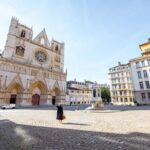
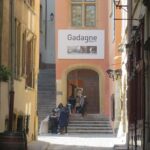
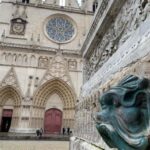
The first stop is Cathédrale Saint-Jean-Baptiste de Lyon, where Quentin sets the city in a much older frame. He explains Lyon as Lugdunum, the Roman capital of the Gauls, before discussing the Basilica of Fourvière and taking you inside the cathedral.
This opening gives you useful context. Lyon is not simply a pretty French city with old streets. Its importance reaches back to the Roman Empire, and the cathedral area helps show how different periods sit close together.
The planned visit here takes about 10 minutes. That is enough for an introduction and a look inside, but not enough for a full architectural study. If religious buildings are a major reason you travel, you may want to return on your own later and give the cathedral more time.
I like starting here because the guide begins with the city’s foundations rather than rushing straight to photo stops. You get a reason to care about the streets that follow.
Vieux Lyon, Renaissance streets, and the traboules
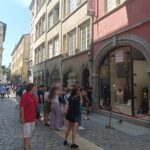
The longest part of the walk is through Vieux Lyon, with about 30 minutes in the old town. This is the heart of the experience for many people. The quarter was mainly built during the Renaissance, and Quentin uses its streets to explain how Lyon developed and to point out details you could easily miss alone.
The highlight is the traboules. These passageways run through or between buildings and have long been part of Lyon’s built character. Passing through several of them changes the feel of the walk. Instead of only looking at grand façades, you get a sense of how people moved through the city’s older quarters.
The tour promises secret details and lesser-known stories, but the exact passageways can vary. Access to some traboules can also depend on local conditions, so it is best to see them as part of a guided street experience rather than a guaranteed list of particular interiors.
This portion should suit first-time visitors and repeat visitors alike. If you have already seen the main squares, a guide who knows the old quarter can help you notice small architectural features and connect them to larger events. The walk is also likely to be the most entertaining section for children, since moving through passageways gives the history a physical element.
Wear comfortable shoes. The tour is on foot, and the old town is the kind of place where you will want to look up, turn into side streets, and keep pace with the group.
Rue du Bœuf and the story of Lyon’s food
Rue du Bœuf brings the conversation to Lyon’s culinary culture. Quentin explains the bouchons, the traditional restaurants associated with the city, along with some of their recipes and customs.
This is a valuable stop because food in Lyon is not just a list of dishes to order later. The bouchon tradition helps explain how the city sees itself and why Lyon is often called France’s gastronomic capital. Quentin also brings in Mère Brazier and Paul Bocuse, two figures who helped carry Lyon cooking to a wider audience.
The stop lasts about 10 minutes. That means you will hear the story and get useful context, but you should not expect a tasting or a full meal. If you are planning dinner after the walk, this is a good moment to ask Quentin for local suggestions, since the tour description specifically promises insider tips.
I like this kind of food stop because it gives you more than a restaurant recommendation. You learn what makes a bouchon different in spirit and why Lyon’s food identity matters. Just remember that the tour fee does not include food or drinks.
The Saône and Lyon’s difficult wartime past
At the historic Palais de Justice de Lyon, the route turns serious. You see the Saône and hear about Lyon during World War II, when the city played an important role in the Resistance.
Quentin discusses Jean Moulin, a central figure in the French Resistance, and Klaus Barbie, the Gestapo chief who was tried in this courthouse more than 30 years later. The subject adds weight to the walk. Lyon’s past is not only Roman ruins, elegant squares, and celebrated cooking. It also includes occupation, resistance, and the later pursuit of justice.
The planned time here is about 10 minutes. That is enough to introduce the people and setting, but the topic is too large for a full account in one short stop. If this period is especially important to you, treat the tour as a starting point for further visits and reading rather than a complete lesson.
I appreciate the inclusion of this part of Lyon’s story. It prevents the walk from becoming a simple parade of attractive buildings. It also shows how a courthouse can hold meaning long after the events that made it important.
You can also read our reviews of more historical tours in Lyon



Place des Jacobins and Lyon today
The walk then reaches Place des Jacobins and nearby squares in the renovated part of the city. Quentin uses this area to discuss the Lyon built in the 19th century for wealthier residents, then shifts toward what it is like to live in Lyon today.
This change in time period keeps the route moving. You have gone from Roman Lugdunum to Renaissance Vieux Lyon, then to wartime Lyon, and now to the city’s later urban growth and present-day life.
The stop lasts about 15 minutes, making it one of the longer pauses after Vieux Lyon. It offers a useful contrast between the older quarter and the grander central streets. You also hear about daily life, not just monuments.
I like tours that leave room for this kind of present-day context. A city is easier to understand when you hear how its neighborhoods changed and how people use them now. Still, this section is more conversational than landmark-focused, so anyone wanting nonstop major sights may find it less dramatic.
Hôtel-Dieu, from hospital to shopping center
At Grand Hôtel-Dieu, Quentin introduces a building that served as a major hospital for centuries and has since been converted into a shopping center.
The stop is brief, about 10 minutes, but the change in use makes the building worth seeing. It gives you a clear example of how Lyon handles old structures in a modern city. You can look at the building’s past and present at the same time, instead of treating history as something sealed away.
Because the site is now a mall, the visit is not presented as a full hospital museum experience. You should expect an explanation of its role and a look at the impressive building, not an extended tour of medical history.
This is another place where Quentin’s local knowledge adds value. Without context, you might simply pass through a handsome complex while shopping or looking for a café. With the story, the building becomes part of Lyon’s long civic life.
Place Bellecour and Saint-Exupéry’s Lyon connection
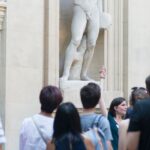
The tour ends at Place Bellecour, one of Lyon’s main central squares. Quentin shares some lesser-known details about the square, then finishes with the statue honoring Antoine de Saint-Exupéry, the Lyon-born author of The Little Prince.
That final literary link is a nice touch. Saint-Exupéry is known around the world, yet the connection can be easy to miss if you only visit Lyon’s standard sights. Ending with him gives the walk a memorable final note and brings the city into the modern cultural world.
Place Bellecour is also a practical ending point. You are in the Presqu’île, which makes it easy to reach other parts of Lyon. If you want dinner, several restaurants are within a few minutes on foot.
The final stop takes about 10 minutes. As with the other stops, it is an introduction rather than an in-depth visit. You can stay in the area afterward if you want more time for photographs, food, or a second look at the square.
Quentin’s guiding style and group feel
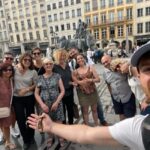
Quentin’s strongest quality appears to be his ability to mix facts with humor. The tour is designed to be lively and social, and the feedback attached to the experience repeatedly highlights his energy, charm, jokes, and ability to bring the group together.
That matters on a walking tour. Lyon offers plenty of information, but a guide who can connect buildings to stories makes the time pass quickly. The comments also point to Quentin’s ability to explain how history relates to the place where you are standing, rather than reciting dates without context.
The English presentation is useful for international visitors, and the tour welcomes people of different ages. A maximum of 20 people keeps the group from becoming enormous, though the experience will still have a shared-group feel.
You should also know what this is not. It is not a private tour, a food tasting, or a ticketed attraction visit. It is a low-cost guided walk built around storytelling, local details, and a fast look at Lyon’s main quarters.
Price, timing, and practical value
At $4.64 per person, this is an exceptional price for nearly two hours with a local guide. Since the tour depends on tips, I would budget for a tip if Quentin gives you the lively, useful introduction promised by the format.
The walk starts at 2:00 pm. That timing leaves your morning free for Fourvière, a market, a museum, or a relaxed breakfast. It also places you in central Lyon in time for an evening meal after the tour.
You receive a mobile ticket, and confirmation is provided when you book. The meeting point is Place Saint-Jean, Pl. Saint-Jean, 69005 Lyon, and the ending point is Place Bellecour, Pl. Bellecour, 69002 Lyon. The route is near public transportation.
Free cancellation is available up to 24 hours before the start time. Changes or cancellations made less than 24 hours ahead are not accepted, and the amount paid is not refunded.
Most people can participate, and service animals are allowed. The supplied details do not promise a fully step-free route, so if you need specific mobility arrangements, confirm those before booking.
Who should book this Lyon walking tour
I would recommend this walk if you want a fast, affordable introduction to Lyon with a human voice. It suits first-time visitors who need a city overview, couples and families who prefer stories to formal lectures, and repeat visitors who want to find traboules and lesser-known details.
It is also a good fit if you care about several subjects at once: architecture, food, wartime history, literature, and modern city life. Few 1-hour-45-minute walks cover all of those themes.
You may want something else if you prefer long museum visits, an in-depth Roman archaeology tour, or a dedicated food tour with tastings. The short stops mean you will receive a broad picture rather than exhaustive detail.
Should you book Quentin’s Lyon walk?
Book it if you value personality, strong storytelling, and a route that covers more than the postcard views. The traboules, bouchon history, Resistance stories, Hôtel-Dieu, and Saint-Exupéry ending give the walk a good range, while the central finish makes the rest of your day easy to plan.
I would especially choose it early in a Lyon visit, then use Quentin’s local tips to decide where to eat and what to revisit. At $4.64, with tipping optional but encouraged, the financial risk is low. Just arrive ready to walk, keep your expectations focused on an overview, and allow extra time afterward if you want to explore the cathedral, old town, or Place Bellecour at your own pace.
FAQ
Who leads the walking tour?
The tour is led by Quentin Dubourg, a local English-speaking guide.
How long does the tour last?
The walk lasts approximately 1 hour and 45 minutes.
What time does the tour begin?
The scheduled start time is 2:00 pm.
Where does the tour start?
The meeting point is Place Saint-Jean, Pl. Saint-Jean, 69005 Lyon, France.
Where does the tour end?
The tour ends at Place Bellecour, Pl. Bellecour, 69002 Lyon, France.
What places are included?
The route includes Saint-Jean Cathedral, Vieux Lyon, Rue du Bœuf, the historic Palais de Justice, Place des Jacobins, Grand Hôtel-Dieu, and Place Bellecour.
Does the tour include food or admission fees?
The listed stops have no admission charge, but the experience does not include food or drinks.
How many people can join?
The maximum group size is 20 people.
Is the tour available by mobile ticket?
Yes. A mobile ticket is provided, and confirmation is received at the time of booking.
Can I cancel for a refund?
Yes. You can cancel at least 24 hours before the start time for a full refund. Cancellations and changes made less than 24 hours before the start are not accepted or refunded.