REVIEW · PARIS
Latin Quarter Paris Guided Walking Tour Semi-Private 12ppl Max
Book on Viator →Operated by Babylon Tours Paris · Bookable on Viator
Two smart neighborhoods, one guided walk.
This Latin Quarter Paris guided walking tour links the oldest heart of the city on Île de la Cité with the book-and-brain Left Bank so you stop seeing landmarks as random dots. I like that it stays semi-private (max 12 people), so your guide can answer questions without racing the group.
I especially like the mix of big-ticket Paris icons and the quieter “how did people live here” stops. You’ll hear stories that connect the Sorbonne world of students and thinkers with writers tied to the area, plus you’ll spend time at Shakespeare and Company rather than just snapping photos and moving on.
The main drawback to plan for is the pace and walking time. It’s about 2.5 hours with a moderate fitness level, and it’s not recommended for people using wheelchairs or with walking limitations. Also, several major sites on your route are exterior views only or require separate admission.
In This Review
- Key highlights worth marking on your map
- Starting on Île de la Cité: where Paris begins
- Notre-Dame Cathedral from the outside: still worth your time
- Saint-Michel fountain: when Paris uses symbolism in public spaces
- Shakespeare and Company: literature in the middle of the real city
- Two old churches on the way: Saint-Julien-le-Pauvre and Saint-Séverin
- Musée de Cluny area: Roman baths under a medieval-museum umbrella
- Sorbonne and the Latin Quarter: why this area shaped French ideas
- Pantheon exterior: a church turned mausoleum
- Luxembourg Gardens: your planned break from the street
- Extra sights if timing allows: Saint-Étienne du Mont and Philip II’s wall
- Semi-private pacing: what the small group actually buys you
- Price and value: is $59.69 per person a fair deal?
- What to bring (and what might slow you down)
- Should you book the Latin Quarter and Île de la Cité walk?
- FAQ
- How long is the Latin Quarter Paris guided walking tour?
- What is the maximum group size on this semi-private tour?
- Is the tour offered in English?
- Where does the tour start and where does it end?
- Does the tour include admission tickets for Notre-Dame or the Panthéon?
- Is Musée de Cluny included in the price?
- Does the tour run in bad weather?
- What walking level do I need?
- What if the minimum number of participants is not met?
- Is hotel pickup included?
Key highlights worth marking on your map
- Île de la Cité first, then the Left Bank: start in Paris’s oldest settlement and shift into Latin Quarter culture.
- Big-name sights, small stops: Notre-Dame and the Panthéon from the outside plus churches and Roman remnants.
- Shakespeare and Company is the anchor: one of the most famous bookstores in the world, minutes from Notre-Dame.
- A school-and-students neighborhood: Sorbonne University shows why this area shaped French ideas.
- Architectural layers on one route: from Gallo-Roman bath remnants near Cluny to medieval city walls.
- Guides with personality: guides like Jay, Eden M., Hugo, and Francois are praised for keeping the walk relaxed and lively.
Starting on Île de la Cité: where Paris begins

Your tour meets in the Cité area (Paris 4th), on Île de la Cité, the oldest settlement in Paris. Before you even hit the crowds, you’re set up for the right mental picture: this island was once Lutetia, a Roman city that grew into what became today’s Paris.
The first phase is about orientation. You’ll spot highlights around the Seine island, then the route aims you toward Notre-Dame Cathedral for an exterior look. This matters because Notre-Dame is one of those places people think they already know—until they hear the story behind the stones and shapes.
A quick practical note: since it’s a walking tour, you’ll want shoes that handle uneven sidewalks and lots of curb-hopping. The route is designed to keep moving, but it also includes multiple short stops so you’re not just marching for 2.5 hours straight.
You can also read our reviews of more walking tours in Paris



Notre-Dame Cathedral from the outside: still worth your time
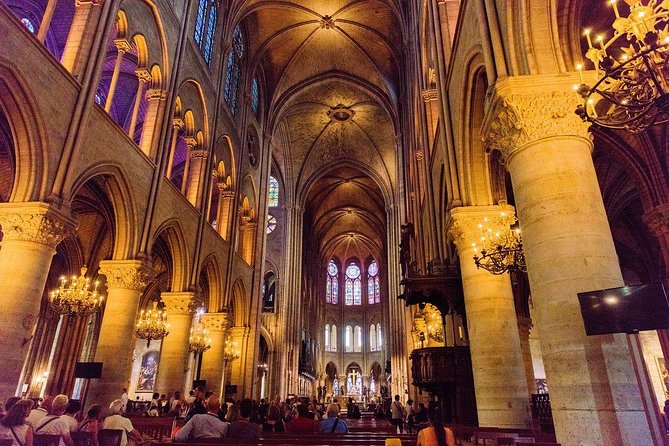
Notre-Dame is listed as exterior only, with about 15 minutes here. Even without entry, you’ll get a focused view of why it’s famous: it’s a major Gothic cathedral of the Middle Ages, known for size, antiquity, and architectural interest.
This stop is a good reset. You’ll be close enough to appreciate details, but you won’t burn time in queues or deal with the stress of getting through security for an all-day cathedral plan. If you do want inside time, you’ll need to plan for separate admission since it’s not included, and the tour itself doesn’t promise indoor access.
Saint-Michel fountain: when Paris uses symbolism in public spaces
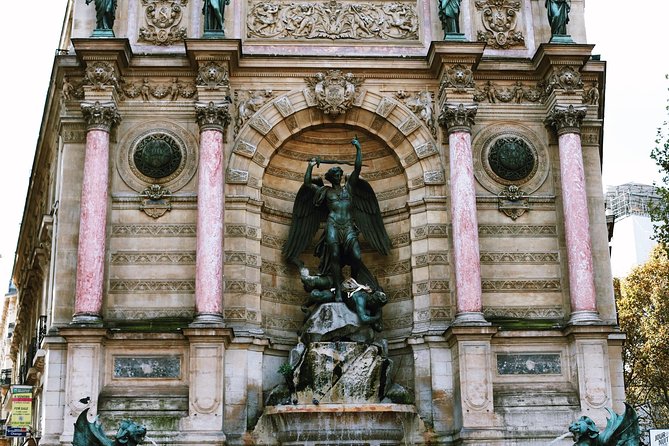
Next you pass by the Fontaine Saint-Michel, a Haussmann-era monumental fountain commissioned under Napoleon III. It shows the archangel Michael vanquishing the Devil—a clear reminder that Parisian design often carries moral and cultural storytelling right in the street.
This is the kind of stop I like because it’s easy to overlook when you only look for grand buildings. A fountain like this helps you understand how the city’s leaders used public art to communicate big ideas, not just decorate plazas.
Shakespeare and Company: literature in the middle of the real city
Then comes Shakespeare and Company, a bookstore that’s famous worldwide and tied to Paris’s literary scene from the Beat Generation through the 1950s and 60s. It’s also close enough to Notre-Dame that it feels like a natural next step, not a detour.
You’ll get about 15 minutes at this stop. The time you have is perfect for:
- browsing shelves without rushing
- soaking up the atmosphere
- asking the guide questions that you might not think of when you’re staring at architecture
Some guides add extra touches here, like a short reading moment while you’re at the bookstore. Even when you don’t catch that, the place itself does the storytelling. The walls feel like they belong to writers, not just tourists.
Two old churches on the way: Saint-Julien-le-Pauvre and Saint-Séverin

The walking rhythm slows slightly with smaller religious stops, and that’s where a guide earns their pay. You’ll see Eglise Saint Julien le Pauvre (about 10 minutes) and Eglise Saint-Severin (about 10 minutes).
Both are presented as some of the city’s older church buildings still used for worship. That “still used” detail is key. These aren’t just museum shells. They give you a sense of continuity—how the Left Bank kept shaping daily life long after the earliest chapters of Paris history.
If you like architecture and street-level history, these are smart stops. They’re also a good way to cool down from the bigger sightseeing moments without losing the historical thread.
You can also read our reviews of more guided tours in Paris






Musée de Cluny area: Roman baths under a medieval-museum umbrella
After the churches, the route heads toward the Musée de Cluny, also known as the National Museum of the Middle Ages. You’ll get around 10 minutes on this approach. Tickets aren’t included, so think of this as an exterior and area stop rather than a full museum visit.
Still, the setting is worth it: the museum includes remnants of third-century Gallo-Roman baths and it houses collections from the 1st to the 15th centuries. That range matters because it shows how often Paris built new life on old bones. When your guide points out what sits under what, it changes how you look at the city afterward.
If you want to enter, you’ll need separate planning. Security and access rules at major sites can also affect indoor time, and the tour notes that some attractions can’t be visited from inside due to increased measures.
Sorbonne and the Latin Quarter: why this area shaped French ideas
Now you’re in the neighborhood that gives this tour its name. You’ll head toward La Sorbonne (about 10 minutes). The key idea is simple: this wasn’t just a school; it became an epicenter of knowledge, with a history closely tied to how French universities took shape.
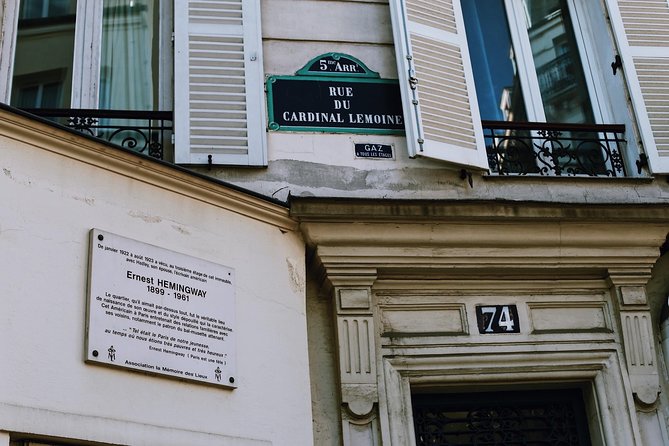
The Latin Quarter is often described as “intellectual,” but the real value here is getting a guided explanation of why it developed that way. You’ll hear stories of famous thinkers and writers linked to the area, including names like F. Scott Fitzgerald and Ernest Hemingway—a reminder that Paris attracts ideas the way it attracts artists.
This stop also helps you make sense of the Left Bank’s identity. When you connect schools, publishers, cafés, and neighborhoods, Paris starts to feel like a system instead of a list.
Pantheon exterior: a church turned mausoleum
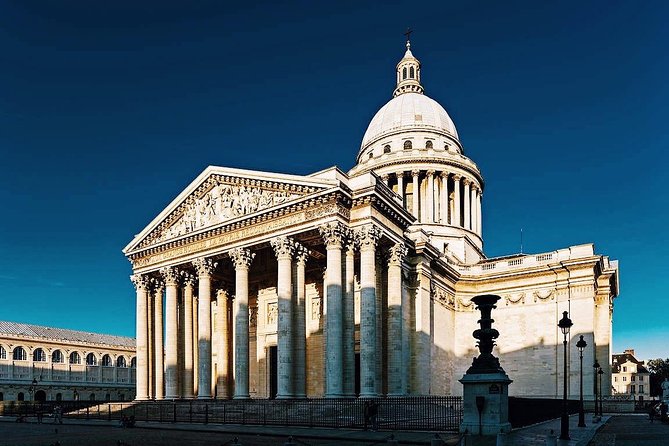
Next is the Pantheon (about 15 minutes), again listed as exterior only. It began as a church dedicated to St Genevieve, then it functions as a secular mausoleum. The tour focuses on that transformation and the notable French citizens associated with it.
You’ll hear about remains such as Voltaire and Rousseau, which gives the building a political and philosophical angle, not just an architectural one. If you’re curious how France mixes religion, revolution, and state identity, this is a great payoff stop—without needing to spend extra time inside.
Luxembourg Gardens: your planned break from the street
After the heavier history stops, you’ll reach Luxembourg Gardens (about 15 minutes). The gardens sit on the edge between Saint-Germain-des-Prés and the Latin Quarter, and they were created in 1612 at the initiative of Queen Marie de Medici.
It’s also noted that the gardens were inspired by the Boboli Gardens in Florence. Even if you’ve never been to Florence, you’ll get the idea: Paris didn’t just copy architecture; it adapted it to its own city needs and leisure culture.
This is the kind of pause that keeps a walking tour from turning into a long grind. Use the short time to reset your brain, grab water if you need it, and look at how the garden’s edge meets the streets around it.
Extra sights if timing allows: Saint-Étienne du Mont and Philip II’s wall
If you have time, the tour includes St. Etienne du Mont (about 10 minutes). This church has a shrine of St Geneviève and the tomb of Jean Racine. It’s a nice literary-leaning follow-up after Shakespeare and Company, especially if you like the way Paris keeps tying culture back to specific sites.
You’ll also pass by the Wall of Philip II Augustus (about 10 minutes), described as the oldest city wall in Paris. The wall was built during struggles involving Philipp II of France and the Anglo-Norman House of Plantagenet, and it was intended to protect the capital as the king left for the Third Crusade.
These two are “quick picture” stops. They work best if you keep a travel habit: look up, then look down. A city wall reads differently when you see it in relation to streets and buildings that grew after it.
Semi-private pacing: what the small group actually buys you
The tour is semi-private with a maximum of 12 people. That number matters in Paris. With smaller groups, you’re less likely to get pulled around by crowd flow, and your guide can move at a pace that feels more like sightseeing with a friend than being processed by a machine.
From what I’d expect given the guide style on this route, the best runs feel relaxed even though it’s a solid 2.5 hours. Several guides on this tour line get praised for staying upbeat, keeping things easy to follow, and using tools like photos and maps to help you picture what you’re hearing.
Also, your tour runs rain or shine, and the route may adjust if there are national celebrations. When that happens, the tour promises you’ll still see the highlights, just via an alternative path.
Price and value: is $59.69 per person a fair deal?
At $59.69 per person for about 2.5 hours, you’re paying for something you can’t replicate well on your own: organized sequencing plus a guide to connect the dots between Roman roots, medieval churches, university history, and modern literary culture.
Here’s where you should be clear-eyed about value:
- Major sites on your route are mainly exterior views (Notre-Dame and the Pantheon).
- Musée de Cluny is not included, and entry isn’t part of your ticket.
- The tour is not a museum crawl; it’s a neighborhood story walk.
If you want “one guide, many layers,” this price can make sense—especially when you split it across a small group. If your top priority is spending hours inside big attractions, you’ll probably want to pair this with a separate entry-focused plan.
Gratuities are optional. Since the tour runs with a professional guide, I treat tips as a simple way to say thanks if the guide kept the pace fair and answered your questions well.
What to bring (and what might slow you down)
This tour notes a few practical requirements. You should have:
- Comfortable shoes (lots of walking, short stops)
- A bottle of water
- An umbrella if rain is likely, plus a hat for summer
It also says no large bags or suitcases. Keep your daypack compact and easy to manage.
One logistics detail that’s easy to overlook: you’re asked to provide a mobile phone number (with country code). That’s not glamorous, but it helps the team coordinate your mobile ticket and day-of updates.
And if you’re relying on public transit, you’re fine since it’s described as near public transportation. Hotel pickup and drop-off are not included, so I’d plan on a quick taxi or Uber to the meeting area.
Should you book the Latin Quarter and Île de la Cité walk?
Book it if:
- you want a guided, story-driven way to see both Île de la Cité and the Latin Quarter
- you like history that ties culture, universities, and writers together
- you’d rather spend 2.5 hours getting connected than wandering without a plan
Skip or rethink it if:
- you need wheelchair-friendly access or have significant walking limitations
- you’re mainly chasing inside access to museums and cathedrals, since key stops here are exterior only and some attractions require separate admission
My simple take: this is the sort of tour that helps Paris make sense fast. You’ll come away with a clearer map in your head—Roman-to-medieval-to-modern—plus a few stops (especially around literature and the Sorbonne area) that feel uniquely Paris, not generic.
FAQ
How long is the Latin Quarter Paris guided walking tour?
It runs for about 2 hours 30 minutes.
What is the maximum group size on this semi-private tour?
The group is capped at 12 people maximum.
Is the tour offered in English?
Yes, it is offered in English.
Where does the tour start and where does it end?
It starts at Cité 75004 Paris, France and ends in the Latin Quarter, Paris.
Does the tour include admission tickets for Notre-Dame or the Panthéon?
No. Notre-Dame Cathedral is listed as exterior only with admission not included, and the Pantheon is also exterior only with admission not included.
Is Musée de Cluny included in the price?
No. The Musée de Cluny stop is listed, but admission is not included.
Does the tour run in bad weather?
Yes. The tour runs rain or shine.
What walking level do I need?
You should have a moderate physical fitness level. It is not recommended for people with walking disabilities or for anyone using a wheelchair.
What if the minimum number of participants is not met?
If the minimum is not met, the tour will not run and you’ll be offered an alternative date or a full refund.
Is hotel pickup included?
No. There is no hotel pickup or drop-off. Getting there by taxi or Uber is recommended.