REVIEW · CARCASSONNE
Unusual guided tour of Carcassonne at the time of the Builders
Book on Viator →Operated by Epok'Tour · Bookable on Viator
Carcassonne is easy to admire from the outside: towers, walls, gates, and pointed roofs make it feel like a storybook fortress. This tour gives the place a more human scale by putting you beside a 13th-century builder in the year 1269, when major construction was reshaping the city.
I like two things right away. First, the costumed guide and historical objects give children something to watch and handle mentally, not just another wall to photograph. Second, the tour connects building work with political change, Catharism, and ordinary life, so you get more than a list of dates. The main consideration is pace: 75 to 90 minutes on medieval lanes may feel short if you want a full architectural tour.
In This Review
- Key points at a glance
- Carcassonne in 1269, Seen Through a Builder’s Workday
- Starting at Porte Narbonnaise
- Through the Lanes of La Cité
- Catharism, Politics, and Ordinary Life
- A Costumed Guide Who Keeps the Story Moving
- Why the $22.93 Price Makes Sense
- The Family Factor, With a Few Practical Limits
- Ending Near Saint-Nazaire Basilica
- What I Like Most, and What I Would Watch
- Cancellation and Booking Details
- Should You Book This Carcassonne Tour?
- FAQ
- Where does the tour begin?
- Where does the tour end?
- How long does the experience last?
- Is the tour suitable for children?
- How many people can join the tour?
- Can I cancel for a full refund?
Key points at a glance
- Meet at Porte Narbonnaise: The tour begins at one of Carcassonne’s most impressive entrances, with the guide arriving in character.
- See the city through a builder’s eyes: The focus is on the great construction period, not only on kings, battles, and monuments.
- A lively family choice: The format is designed for adults and children over six, with stories, objects, and an interactive approach.
- Small maximum group: The tour allows up to 25 people, a useful limit for a guide-led walk through narrow lanes.
- Ends near Saint-Nazaire Basilica: You finish inside the fortified city, close to one of its major landmarks.
- Strong value at $22.93: For about an hour and a quarter to an hour and a half, the price is reasonable if you want an introduction with character.
Carcassonne in 1269, Seen Through a Builder’s Workday
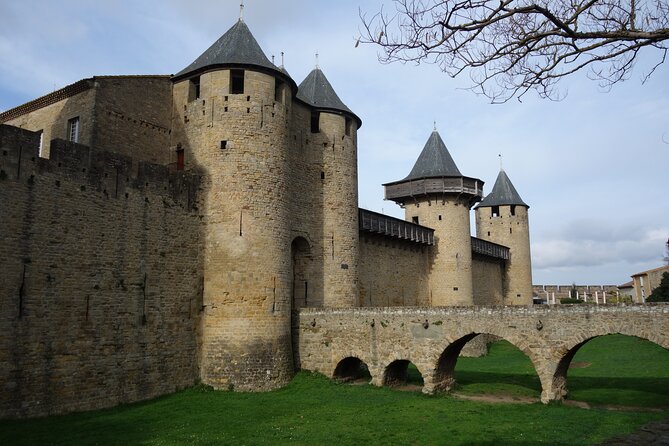
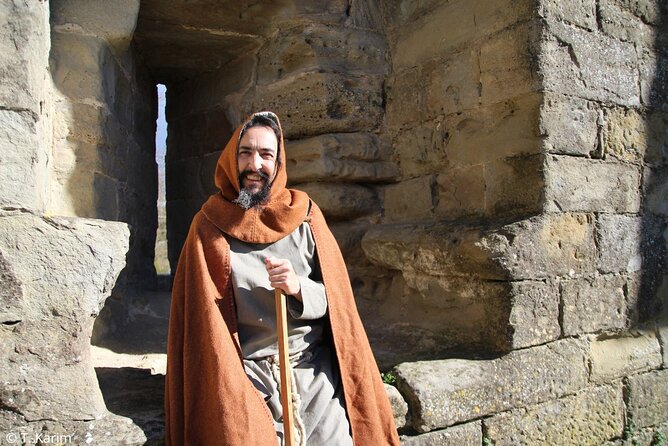
The clever idea here is simple: instead of treating Carcassonne as a finished monument, the tour presents it as a working medieval city. Your guide, identified as Master Guilhem, represents a builder whose family trade has tied him to the city for generations.
That viewpoint changes the questions you ask. Who planned the walls? How did construction affect daily routines? Which powers controlled the city? How did religious conflict shape the region? The tour uses the builder’s role as a doorway into these subjects.
The historical setting is 1269. That date places you in the period of major construction and political reorganization. You are not simply walking through old streets. You are being asked to picture a place still being altered, defended, governed, and lived in.
I especially like this approach for first-time visitors. Carcassonne can overwhelm you with stonework and postcard views, yet the details of daily life can slip away. A character-led guide helps tie the physical setting to people who worked, worshipped, traded, and raised families there.
The format also avoids making history feel like a lecture. The use of objects and a costumed character gives the guide tools for storytelling. That matters with younger children, who may not stay engaged through a long explanation of medieval politics.
You can also read our reviews of more guided tours in Carcassonne



Starting at Porte Narbonnaise
Meet at Porte Narbonnaise, the grand entrance to the fortified city. This is a practical starting point because you begin beside one of Carcassonne’s major defensive gateways rather than wasting the tour finding the historic center.
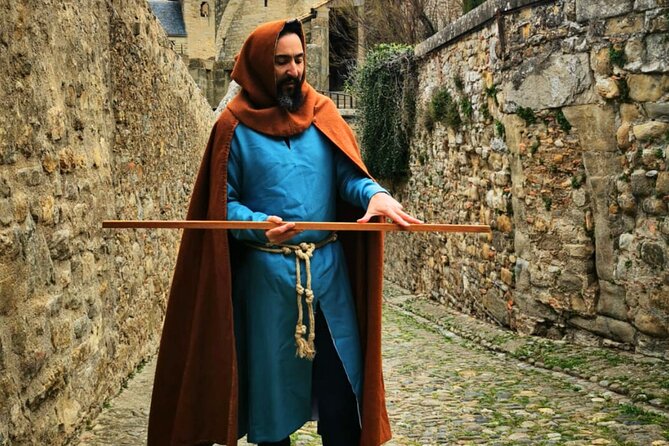
The first ten minutes are used for the meeting and opening of the story. Your guide is expected to arrive in costume and set the scene in 1269. That first exchange matters: it establishes the role of Master Guilhem and explains why a builder is showing you around.
Porte Narbonnaise also gives you an immediate sense of scale. Even before the walk begins, you are surrounded by defensive architecture. The gate helps make the transition from modern sightseeing to the medieval setting feel natural.
The meeting point is listed as Porte Narbonnaise, 11000 Carcassonne. Check the exact spelling and location on your mobile ticket before setting out, especially if you are arriving by public transportation or approaching the city from outside the walls.
There is no separate admission charge for this stop. The tour price covers the guided experience, while the historic setting itself is part of the city visit.
Through the Lanes of La Cité

Most of the experience takes place inside La Cité, where you follow the guide through lanes and alleys for roughly 1 hour and 20 minutes. The route is not presented as a long march from monument to monument. It is a guided look at the city as a place of work and construction.
Expect the guide to connect visible buildings and streets with the people who created and used them. The builder’s point of view should help you notice practical questions that a standard sightseeing walk can miss: how construction changed the city, how power was reorganized, and what life was like for ordinary residents.
The wording of the tour promises an interactive visit, supported by historical objects. That makes this a good option if you want participation rather than a guide speaking continuously while the group trails behind.
The narrow lanes are part of the charm, but they can also affect the experience. A group of up to 25 people is not enormous, yet it is large enough that you may need to stay close to the guide. If you are visiting with children, keep them within sight when the group moves between stops.
The walk lasts about 75 to 90 minutes in total. That range is worth noting. The exact length may depend on the pace of the group and the interaction along the way. Plan on roughly an hour and a half, but do not schedule another activity at the exact end time.
Catharism, Politics, and Ordinary Life
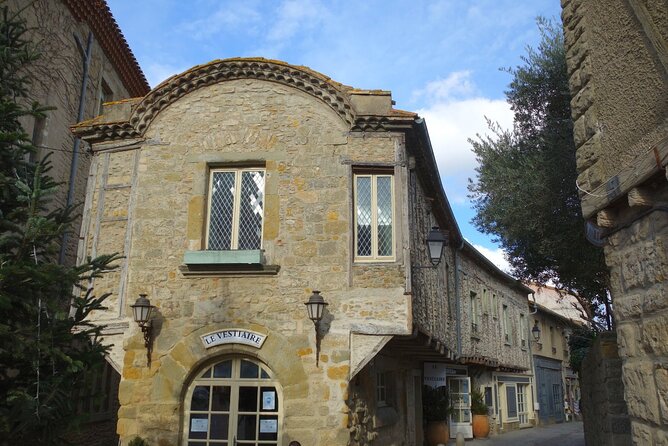
Carcassonne is often reduced to castles and walls. This tour adds two important layers: the changing balance of political power and the story of Catharism.
The tour description does not promise a specialist academic treatment, so you should think of these subjects as part of a broad historical portrait. You will get context for the period, not necessarily a full study of every religious or political dispute.
That balance is useful. If you are new to southern France, references to Catharism can otherwise feel detached from the streets around you. A guide speaking in character can place those issues within the city’s social and political world.
The daily-life angle may be the most appealing part. Walls are impressive, but people make a place memorable. The tour aims to show how a builder’s work connected with the city around him, including the pressures created by construction and shifting authority.
I would choose this experience for anyone who wants history told through a person rather than through a monument list. It should work particularly well for families, since the story has a clear central character and physical objects to support the explanations.
A Costumed Guide Who Keeps the Story Moving
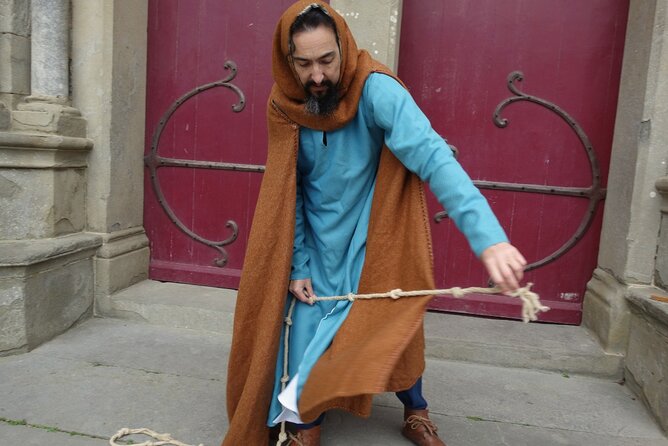
The guide is the heart of this experience. Master Guilhem is presented as a builder from a family trade, and the costume helps establish that role from the opening meeting.
The available feedback repeatedly praises the character work and the storytelling. One comment specifically refers to Thomas, describing the stories and legends as exceptional, while another thanks Thomas for making the family visit informative. The tour information names Master Guilhem, so you should confirm the guide’s name when booking or at the meeting point if that detail matters to you.
That name difference does not necessarily signal a problem. It may reflect the character name and the guide’s real name, or a change in the person leading the tour. Still, it is a useful detail to keep in mind.
The strongest pattern in the feedback is clear: the costumed role, unusual angle, and family appeal are the main reasons this tour earns attention. Several comments describe it as a different way to see the city, with both adults and children learning without noticing the time.
That is a valuable quality in Carcassonne. A standard walk can become tiring when every stop adds another date or architectural term. Here, the character gives the visit a thread to follow.




Why the $22.93 Price Makes Sense
At $22.93 per person, this is not the cheapest way to look around Carcassonne. You can walk through the fortified city without paying for a guide. The question is what the fee adds.
You are paying for a costumed interpreter, a planned route, historical objects, and a focused story lasting about 1 hour and 30 minutes. For a family of four, the total is more noticeable, but the price can still compare well with other guided city activities because it is long enough to provide real context without taking half a day.
I see the best value for visitors who would otherwise wander through La Cité without understanding the construction period. If you already have a detailed private guidebook, know the medieval history well, or prefer to explore alone, the added value may be smaller.
The maximum group size of 25 helps protect the experience from becoming completely impersonal. It is not a private tour, and the lanes may feel crowded at times, but the limit is reasonable for a character-led walk.
The high rating of 4.9 from nine ratings is encouraging, though the sample is small. I would treat it as a sign that the format is working well, not as proof that every guide and every departure will feel identical.
The Family Factor, With a Few Practical Limits
This experience is intended for adults and children over six. That age guidance is useful because the storytelling depends on children being able to follow a character and engage with historical ideas.
Families may appreciate the unusual approach. Instead of asking children to admire defensive walls in silence, the guide gives them a person and a role to follow. The objects add another layer of interest.
The tour is also suitable for most participants, and service animals are allowed. It is near public transportation, which makes the meeting point easier to reach than a remote countryside site.
The main limitation is that this is a walking experience through a medieval city. The supplied details do not specify accessibility conditions for every lane or surface, so anyone with mobility concerns should check directly before booking.
Children under six are not included in the stated age range. If your family includes younger children, ask the provider before reserving rather than assuming they can join.
Ending Near Saint-Nazaire Basilica
The tour ends near the Basilica of Saint-Nazaire, at Place Saint-Nazaire inside La Cité. This is a useful finish because you remain in the historic center rather than being returned to the outer entrance.
You can use the ending to continue exploring on your own, visit the basilica if it is open, or simply pause after the walk. The location also makes it easy to connect the guided experience with the rest of your time in Carcassonne.
The end point is not the same as the start. That sounds minor, but it matters when planning your day. You should not leave a bag, arrange a pickup, or meet companions at Porte Narbonnaise unless you allow time to walk back.
Because the experience ends near a major landmark, it works well as an opening activity. You get an introduction to the city first, then continue at your own pace with a better sense of what you are seeing.
What I Like Most, and What I Would Watch
I like the tour’s clear personality. Master Guilhem is not a generic narrator. He gives the walk a human center and lets you see construction as a lived occupation.
I also like the mix of subjects. The tour is not limited to architecture. Politics, Catharism, legends, and daily life all have a place, which gives the city more meaning than its famous silhouette alone.
The strongest praise is aimed at the storytelling and the way the guide holds both adult and child interest. That is difficult to achieve, and it makes this a smart pick for a family day in Carcassonne.
The main caution is the short format. In 75 to 90 minutes, you cannot expect every major building, wall, and historical period to receive equal attention. You should book this for an engaging introduction, not as a complete study of the fortified city.
Group size is another modest consideration. Up to 25 people is manageable, but it may limit personal questions and make it harder to hear if you drift to the back. Stay near the guide, especially in busy lanes.
Cancellation and Booking Details
You receive confirmation when booking, and the ticket is mobile, so you can keep the reservation on your phone. Free cancellation is available up to 24 hours before the start time for a full refund.
Cancellations or changes made less than 24 hours before the start are not accepted for a refund. The experience also requires a minimum number of participants. If that minimum is not met and the tour is canceled, you are offered another date or experience, or a full refund.
The tour is booked, on average, 20 days ahead. That does not guarantee that every date sells out, but it suggests you should not leave planning until the last minute if your schedule is fixed.
Should You Book This Carcassonne Tour?
Book it if you want a story-led introduction to La Cité, especially if you are visiting with children over six. The cost is fair for a costumed guide, historical objects, and a focused walk that connects the buildings with medieval work, politics, religion, and daily life.
I would also recommend it for adults who have already seen photographs of Carcassonne and want a fresh angle. The builder’s viewpoint makes the familiar walls feel less like scenery and more like part of an active city.
Skip it if you want a long, highly detailed architectural tour, a private guide, or complete freedom to stop whenever you wish. For most first-time visitors, though, this is an appealing way to spend 90 minutes, then continue exploring near Saint-Nazaire Basilica with a clearer sense of the people behind the stone.
FAQ
Where does the tour begin?
The tour begins at Porte Narbonnaise in Carcassonne, France.
Where does the tour end?
It ends near the Basilica of Saint-Nazaire at Place Saint-Nazaire inside La Cité.
How long does the experience last?
The visit lasts approximately 1 hour and 30 minutes, with the stated walking portion taking about 1 hour and 20 minutes. The full visit is described as lasting 1 hour and 15 minutes to 1 hour and 30 minutes.
Is the tour suitable for children?
Yes. It is designed for adults and children over six years old.
How many people can join the tour?
The maximum group size is 25 participants.
Can I cancel for a full refund?
Yes. You can cancel at least 24 hours before the start time for a full refund. Cancellations or changes made less than 24 hours before the start are not refunded.