REVIEW · STRASBOURG
Strasbourg Historic Two-Hour Walking Tour with Local Guide
Book on Viator →Bookable on Viator
Two hours is enough to fall for Strasbourg. This walking tour is a fast, friendly introduction that hits the major sights and adds a few you can easily miss. First-timer friendly and run in English, it helps you get oriented without turning the day into a museum marathon.
I especially like the tight route that layers big monuments with classic neighborhood scenes. You get a view-first approach at the cathedral and key historic buildings, plus time at canal-side squares. The only real catch: several stops are outside only, and entry to places like the cathedral, Maison Kammerzell, and Palais Rohan isn’t included.
In This Review
- Key Points Worth Knowing Before You Go
- Why This Two-Hour Strasbourg Walk Works
- Meeting at the Strasbourg Christmas Tree Landmark
- Place Kléber: Strasbourg’s Main Square at Two Different Moods
- Notre-Dame de Strasbourg: The 142-Meter Tower and Rose Window from the Outside
- Maison Kammerzell: Half-Timbered Drama Across from the Cathedral
- Palais Rohan: Prince-Bishops in Classicist Stone
- Place du Marché aux Cochons de Lait by the Ill River
- Barrage Vauban: The Defensive Dam and the Best Views Toward Petite France
- Loop Back to Place Kléber, Then Head for Gutenberg Square
- La Petite France: Timbered Canals and the Classic Strasbourg Finale
- The Guide Makes the Tour: Stefania and Laila’s Style
- Price and Ticket Reality: What You’re Getting for $22.93
- Best Timing, Weather, and What to Bring
- Who Should Book This Tour (and Who Might Skip It)
- Should You Book This Strasbourg Historic Two-Hour Walking Tour?
- FAQ
- How long is the Strasbourg historic walking tour?
- What is the price per person?
- Is the tour offered in English?
- Where does the tour start and where does it end?
- Is a mobile ticket used for this tour?
- Are entrance tickets included for the cathedral and other indoor sites?
- How large is the group?
- Do I need good weather for the tour?
- What is the cancellation window?
- How is the tour confirmation handled?
- Are service animals allowed and is it suitable for most people?
Key Points Worth Knowing Before You Go
- Two hours, max 30 people: a small group pace that works well when you have limited time
- English guide and mobile ticket: easier planning and less fuss at the meeting point
- Cathedral tower and rose window from outside: you still get the big visual payoff without spending the full day inside
- Barrage Vauban terrace views: an outdoor climb that pays off with wide angles toward Petite France
- Petite France at the end: you finish in the most romantic streets, so it feels like a grand finale
- Guides named Stefania (Stef) or Laila: people rave about lively delivery and clear sound even in rough weather
Why This Two-Hour Strasbourg Walk Works
If Strasbourg is on your list, two hours is a smart way to test-drive the city. I like tours like this because you leave with a mental map. You also get enough landmarks to plan the rest of your stay with confidence.
This one is also built for reality. It doesn’t ask you to guess what you’re looking at. A local guide connects the dots between Gothic stone, half-timbered façades, and the river defenses that shaped the old town.
The route is compact, and that matters. You spend your time where the sights actually are, instead of burning energy on long transfers.
You can also read our reviews of more walking tours in Strasbourg
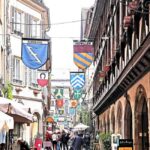

Meeting at the Strasbourg Christmas Tree Landmark
You’ll start at the Sapin de Noël de Strasbourg at 15 Rue des Grandes Arcades. That address is right in the historic core area, so you’re already close to the best walking streets.
This starting point is practical for another reason. It’s easy to spot, which reduces the usual morning scramble of finding a tour group in a dense old-town web of streets.
You’ll end in Petite-France. That’s a strong finish because the neighborhood’s canals and timbered buildings naturally look good at the end of a walk, when you’re ready to slow down.
Place Kléber: Strasbourg’s Main Square at Two Different Moods
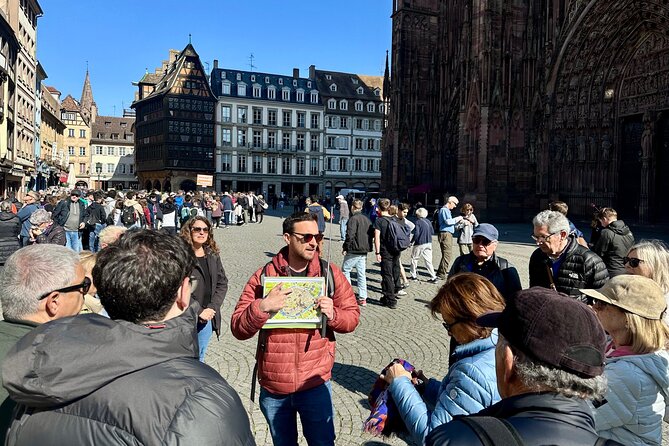
You begin at Place Kléber, the city’s central square and a good orientation stop. You’ll get a quick introduction to why this area matters before heading into the older parts of town.
Then you circle back to Place Kléber later for a second look. That second stop helps you compare the square’s role across time: it’s both a modern city hub and a symbolic center (including the famous General Kléber statue).
If you’re visiting around the holidays, the area takes on an extra layer. The huge Christmas tree is installed here, and it becomes a local meeting point as much as a tourist photo moment.
Notre-Dame de Strasbourg: The 142-Meter Tower and Rose Window from the Outside
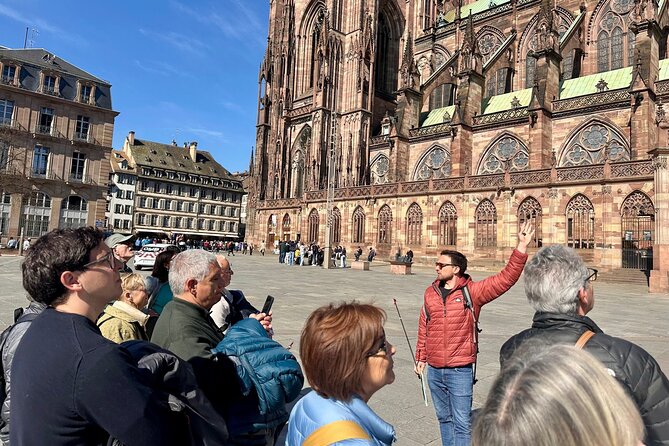
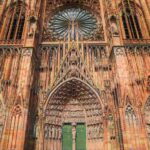
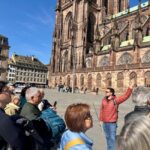
The big cathedral stop is Cathedrale Notre Dame de Strasbourg. Even from outside, it’s hard not to stare. The tower reaches 142 meters, and it was considered the tallest in the world for centuries. That single detail tells you why the façade feels like a statement, not just a building.
Here’s what you’ll likely notice: the front is covered with sculptures that tell biblical stories, and the central rose window brings color and geometry into the mix. Another eye-catcher is the pink sandstone, which shifts tone depending on daylight. It’s the kind of detail your photos don’t always capture, but your eyes will get.
Practical note: cathedral admission isn’t included on the tour. You’re seeing it as a guided exterior moment, which is often the best use of time when you only have two hours. If you want interior access, plan that separately.
Maison Kammerzell: Half-Timbered Drama Across from the Cathedral
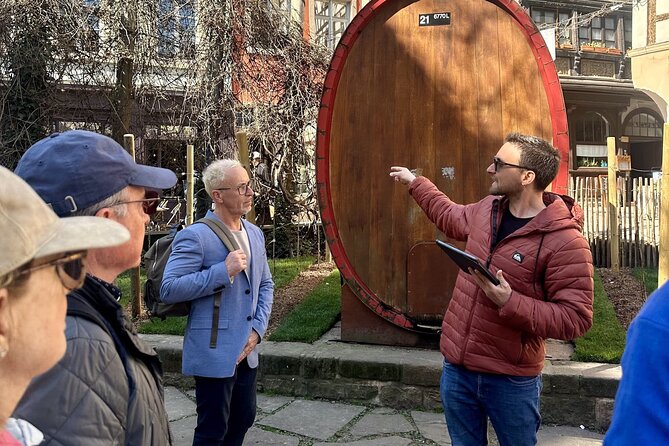
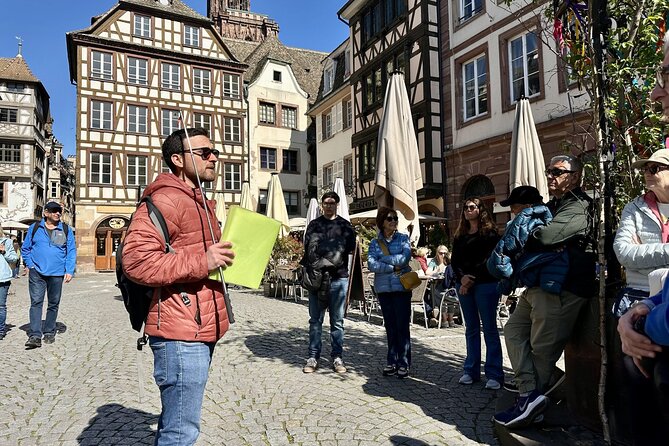
Just across from the cathedral sits Maison Kammerzell, a 15th-century house that feels theatrical. The half-timbered look and heavy decoration are the headline: carved wood sculptures, stained glass windows, and high, pointed ceilings.
This stop works because it connects two worlds. The cathedral projects power through scale and stone detail, while Maison Kammerzell shows prosperity in domestic architecture. Together, they help you understand how Strasbourg mixed grand public buildings with wealthy private design.
Like the cathedral, admission isn’t included. That doesn’t ruin the stop, though. The exterior character is strong enough that even a short pause gives you something to hang onto.
You can also read our reviews of more guided tours in Strasbourg



Palais Rohan: Prince-Bishops in Classicist Stone
Next up is Palais Rohan, an 18th-century classicist building that once served as a residence for prince-bishops. This is a useful contrast stop.
The cathedral is Gothic and sculpted to the max. Palais Rohan is more symmetrical, more controlled, and more sober. From the outside you can still spot carved stone details and wide windows that hint at an aristocratic past.
Again, admission isn’t included. If you’re the type who wants to step inside every important building, you may want to add Palais Rohan later. But as a visual lesson, it’s excellent because it teaches you how power and architecture can look very different on the same street grid.
Place du Marché aux Cochons de Lait by the Ill River
This small cobbled square sits along the Ill River, with pastel-hued buildings hugging the edges. The view angle is part of the value here: you can look toward Rohan Palace and see the tourist boats that glide across the canals.
This stop is the kind of break that makes the whole tour feel more human. After big façades and monument scale, it’s nice to shift to riverside texture and street-level atmosphere.
It’s also a good place to take a breath and check your bearings. You’re still walking, but the pace feels less like a checklist.
Barrage Vauban: The Defensive Dam and the Best Views Toward Petite France
One of the most satisfying moments is Barrage Vauban, a 17th-century defensive structure. From the outside, it looks like an arched dam, letting water pass while controlling flooding.
The star move is what you can do from there. You can climb to the terrace, and the views are the payoff: wide angles toward Petite France and the towers of the covered bridge area.
This stop gives you something that the cathedral can’t: a sense of how the city protected itself and shaped the waterways that still define it today.
Loop Back to Place Kléber, Then Head for Gutenberg Square
When the tour returns to Place Kléber, it shifts again into an urban-life feel. Shops and classic buildings frame the square, and the giant central location makes it easy to imagine everyday Strasbourg.
Then you head to Place Gutenberg, dedicated to the inventor of the printing press. The statue in the center anchors the story, while the surrounding mix of neoclassical buildings and half-timbered houses shows how different eras can live side by side.
If you’re there during the holiday season, you might see a Christmas wheel and a lively market set up in the area. Even outside of that time, it’s a useful stop for spotting how the city’s “modern heart” and old-town streets connect.
La Petite France: Timbered Canals and the Classic Strasbourg Finale
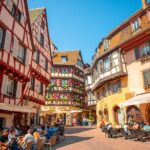
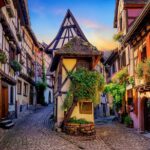
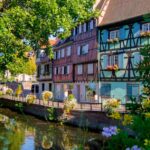
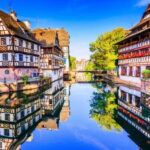
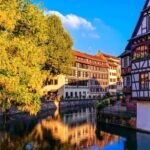
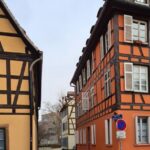
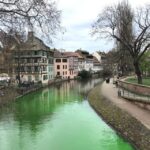
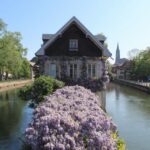
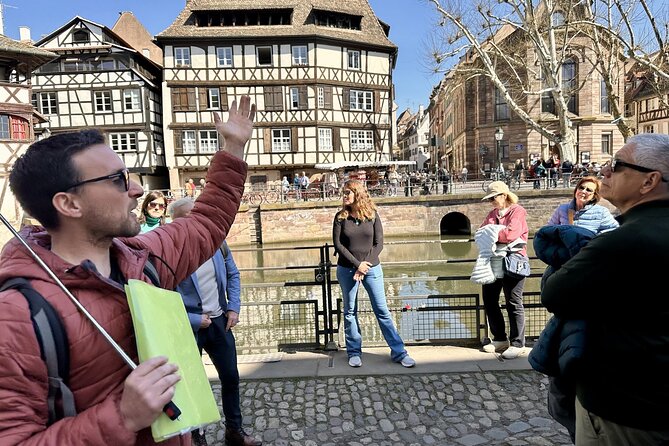
At the end, you arrive in La Petite France, Strasbourg’s most picturesque neighborhood. This is where the city’s story becomes instantly readable: half-timbered houses, sloping ceilings, flowery balconies, and canals that cut through the scene.
It looks storybook because it has always been practical. The neighborhood historically housed workers like millers, tanners, and fishermen, which explains why the canals mattered so much. The charm is real, but it’s grounded in how people lived.
You’ll mostly experience Petite France from the outside on this tour, but that’s a good match for a two-hour format. You finish with enough visual impact to want more, especially if you plan a slower return later with more time to walk along the water.
The Guide Makes the Tour: Stefania and Laila’s Style
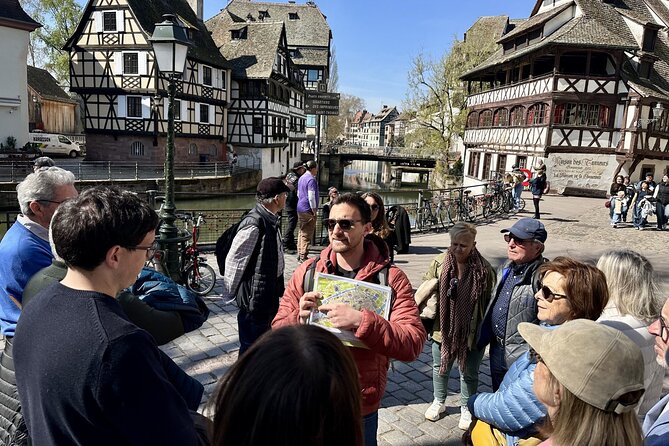
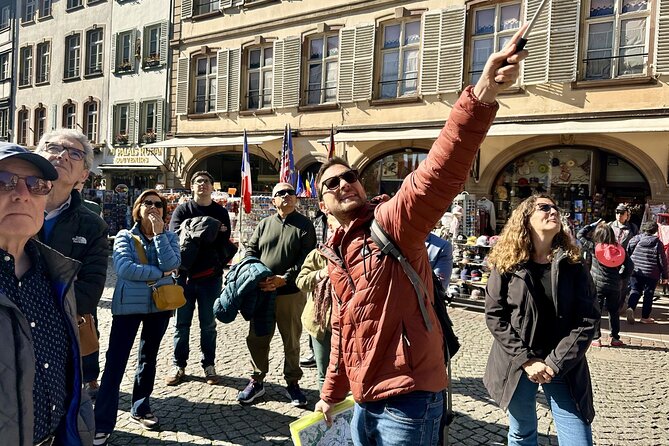
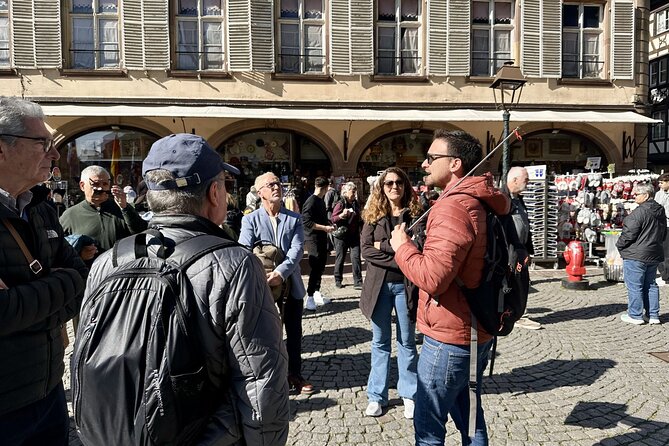
A walking tour lives or dies by its guide, and this one has a track record of strong personalities. People highlight guides such as Stefania (often called Stef) and Laila (sometimes spelled Leila). The common thread: clear delivery, friendly humor, and a way of making details stick.
One standout theme is how guides handle the full group. There are mentions of guides remembering names after an early introduction, which helps the walk feel personal instead of like a lecture.
Weather can also test any outdoor plan. Even when conditions turn windy or rainy, it’s noted that a sound system helps keep instructions and stories clear. That matters in Strasbourg because the streets and squares can funnel wind.
Price and Ticket Reality: What You’re Getting for $22.93
At $22.93 per person for about two hours, this tour is good value if your goal is orientation plus major sights. You pay for guided time with a tight route, and you get outside viewing of signature landmarks that otherwise take some planning to see efficiently.
Here’s the practical ticket breakdown to keep in mind:
- Not included: Cathedral Notre Dame de Strasbourg, Maison Kammerzell, and Palais Rohan
- Admission ticket free: the square and viewpoint stops like Place Kléber, Place du Marché aux Cochons de Lait, and Barrage Vauban (as a guided outdoor viewing experience)
So think of this as a guided “greatest hits plus smart context” walk. If you want indoor time at those three major stops, you’ll need to add it later with separate tickets.
Best Timing, Weather, and What to Bring
This experience is marked as needing good weather. If the weather is poor, you’ll be offered another date or a full refund, which is exactly what you want for a walking-focused plan.
Plan for variable skies. Strasbourg can swing between chilly and damp, and squares like Place Kléber can get gusty. Wear shoes you can walk in for the full two hours, and bring a light layer even if the forecast looks decent.
For photos, you’ll get multiple “pause points” that work well for quick shots: cathedral façade, half-timbered details, and the Barrage Vauban terrace view toward Petite France. If you’re picky about shots, arrive early enough to settle your framing at Place Kléber.
Who Should Book This Tour (and Who Might Skip It)
This tour fits best if you:
- are in Strasbourg for the first time and want a fast orientation
- like architectural details but don’t want to spend hours buying separate entry tickets
- prefer an English guide and a small group pace (up to 30 people)
You might skip it or plan something else if:
- you want to spend most of your time inside major sites rather than seeing them from outside
- you’re planning a long museum-style day with deep interior visits
Should You Book This Strasbourg Historic Two-Hour Walking Tour?
If you want an efficient way to understand Strasbourg, I’d book it. The route is short enough to fit cleanly into a busy schedule, yet it covers the big visuals that make the city recognizable: Notre-Dame’s façade, timbered neighborhoods, and the river story at Barrage Vauban.
Also, you’re not locked into one vibe. You get a mix of grand monuments and human-scale squares, and the finish in Petite France feels like a natural reward.
If your priority is indoor visits only, you’ll need extra planning for cathedral, Maison Kammerzell, and Palais Rohan. But for most first-timers, this is a smart start. It helps you see the city clearly first, then decide where you want to slow down later.
FAQ
How long is the Strasbourg historic walking tour?
It runs for about 2 hours.
What is the price per person?
The price is $22.93 per person.
Is the tour offered in English?
Yes, it’s offered in English.
Where does the tour start and where does it end?
It starts at Sapin de Noël de Strasbourg, 15 Rue des Grandes Arcades, Strasbourg, and ends in Petite-France.
Is a mobile ticket used for this tour?
Yes, you’ll receive a mobile ticket.
Are entrance tickets included for the cathedral and other indoor sites?
Admission is not included for Cathedrale Notre Dame de Strasbourg, Maison Kammerzell, and Palais Rohan. Other stops on the route are listed as free.
How large is the group?
The tour has a maximum of 30 travelers.
Do I need good weather for the tour?
Yes. The experience requires good weather. If it’s canceled due to poor weather, you’ll be offered a different date or a full refund.
What is the cancellation window?
You can cancel for a full refund up to 24 hours in advance.
How is the tour confirmation handled?
Confirmation is received at the time of booking.
Are service animals allowed and is it suitable for most people?
Service animals are allowed, and most travelers can participate. It’s also near public transportation.