REVIEW · PARIS
Private Battlefields Tour in Argonne from Paris in Van (2/7 travelers)
Book on Viator →Operated by ADRIAN ROADS · Bookable on Viator
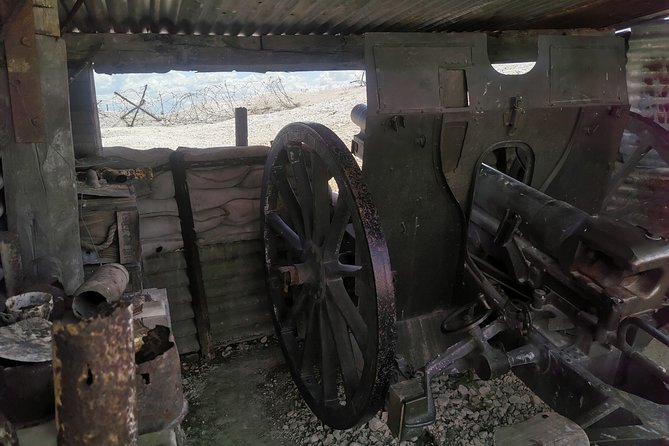
The most powerful part of this long day is the way the Argonne battlefield still shows its scars. At La Main de Massiges, trenches cut through a hill pocked with shell holes. At Vauquois, huge mine funnels reveal how soldiers fought underground as well as above it. These are not polished museum displays. You walk across ground shaped by the war.
I like the small private group, capped at six people, and the chance to travel with Régis, your driver and guide. I also like the range of stops: trench remains, a memorial with a broad view, a cemetery, a personal museum, and the village where Louis XVI was arrested. The main drawback is the length. With a 6:00 am start and 13 to 14 hours on the road, this is a serious day out, not a light excursion from Paris.
In This Review
- Key points to know before booking
- Why the Argonne deserves a full day from Paris
- La Main de Massiges and the shape of the trenches
- Montfaucon’s 234 steps and the American offensive
- Meuse-Argonne American Cemetery in Romagne
- Romagne 14-18 and the soldier’s everyday life
- Varennes-en-Argonne, from royal arrest to wartime liberation
- Butte de Vauquois and the war underground
- The 6:00 am departure and long minivan day
- Who should book this Argonne tour
- Should you book it?
- FAQ
- How long does the Private Battlefields Tour in Argonne take?
- What time does the tour begin?
- How many people can join the private tour?
- Is pickup available in Paris?
- Is lunch included?
- Is admission to the Romagne 14-18 Museum included?
- Does the tour visit an American military cemetery?
- Can I cancel for a full refund?
Key points to know before booking
- La Main de Massiges gives you a direct look at trench warfare, with shell holes and surviving defensive lines.
- Régis guides a private group of up to six, allowing more room for questions and family military research.
- Montfaucon’s memorial requires a climb of 234 steps when the observation platform is open.
- The Meuse-Argonne American Cemetery contains 14,246 graves, making it one of the day’s most solemn stops.
- Romagne 14-18 adds human detail through thousands of objects found around the battlefield.
- Lunch is not included, so plan for the long day before leaving Paris.
Why the Argonne deserves a full day from Paris
Paris is an easy base for museums, monuments, and First World War memorials in the city. The Argonne is different. It takes time to reach, but the distance is part of the story. You leave the capital before dawn and spend the day in a rural part of northeastern France where the fighting of 1914 to 1918 reshaped hills, villages, and forests.
This tour focuses on the French and American campaigns in the Argonne sector. Régis explains the battles that took place between 1914 and 1918, including the American Meuse-Argonne Offensive that began on September 26, 1918, and continued until the Armistice on November 11.
The private format matters here. A battlefield visit can raise very specific questions, especially if you are looking for a relative’s unit or grave. One especially useful part of Régis’s service is his willingness to help with that kind of search. He helped one couple find the grave of a husband’s great-grandfather at the Meuse-Argonne Cemetery.
The price is $462.73 per person. That is a substantial cost, but it covers private transportation from Paris, a dedicated driver and guide, and a very long day in a comfortable, air-conditioned minivan. At two people, the experience costs about $925.46 in total. For a full group of six, the per-person rate offers better value because the vehicle and guide cost are shared across the group.
I would compare this with the cost and effort of arranging a rental car, fuel, navigation, parking, and separate visits to several remote sites. The tour is not cheap, and lunch costs extra, but the private vehicle and guiding make the price easier to justify for people with a strong First World War interest.
You can also read our reviews of more private tours in Paris


La Main de Massiges and the shape of the trenches
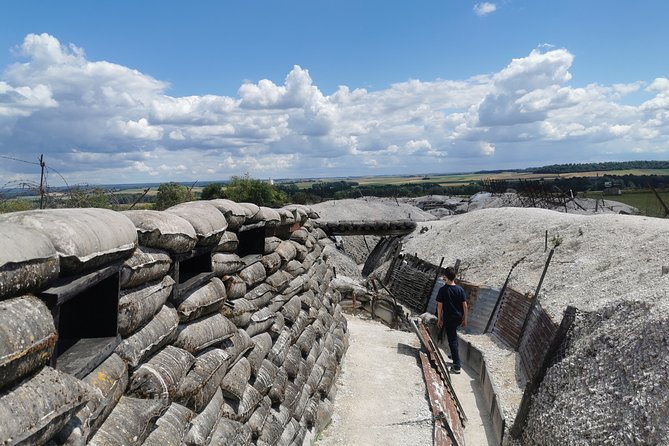
The first major battlefield stop is La Main de Massiges. The name refers to the shape of the natural height, whose ridges formed a series of defensive positions. After the German retreat in early September 1914, German forces dug in here. French troops reached the position on September 13 during the counteroffensive that followed the First Battle of the Marne.
The site saw repeated fighting between 1914 and 1918. Around 25,000 French soldiers were killed, wounded, or reported missing in the Massiges sector, with German losses estimated at roughly the same number.
What makes the visit effective is the ground beneath your feet. You walk among trenches and hundreds of shell holes. The scene has been described as lunar, and that is a fair way to prepare yourself for it. The hill does not present a neat line of preserved walls. Instead, it shows how artillery tore apart a defensive position.
You get about an hour here, with no admission charge. Wear sturdy shoes and expect uneven ground. The site is best for people who want to see how soldiers lived and fought in the open, rather than simply read dates on a memorial.
The drawback is that exposed battlefield terrain can be hard to interpret without a guide. Trenches may look like shallow ditches, and shell holes can blend into the contours of the hill. Régis’s explanations give the site its military meaning.
Montfaucon’s 234 steps and the American offensive
Montfaucon Monument is one of the clearest places to understand the scale of the American offensive. The monument faces the former front line of the First American Army as its attack began on September 26, 1918.
The memorial is a solid granite Doric column topped by a statue representing Liberty. It rises more than 60 meters above the ruins of the old village. Inside, an engraved map explains the operation and pays tribute to the American troops who served in the area.
The observation platform can be reached at certain times by climbing 234 steps. The climb is a real part of the stop, not a minor detail. At the top, you can look across much of the ground taken during the offensive, helping connect the map and the military movements to the actual terrain.
The stop lasts about 40 minutes and admission is free. If the platform is open, you will need enough time and energy for the stairs. The tour description gives two different figures in its material, 200 steps in the overview and 234 in the detailed stop information. I would plan for the more demanding number.
Montfaucon works especially well after Massiges. At the first site, you see the close, cramped world of trenches. Here, you gain a wider view of the offensive and the ground an army had to cross.
Meuse-Argonne American Cemetery in Romagne
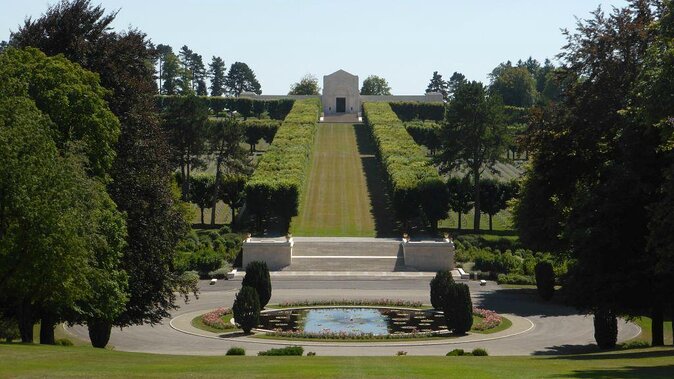
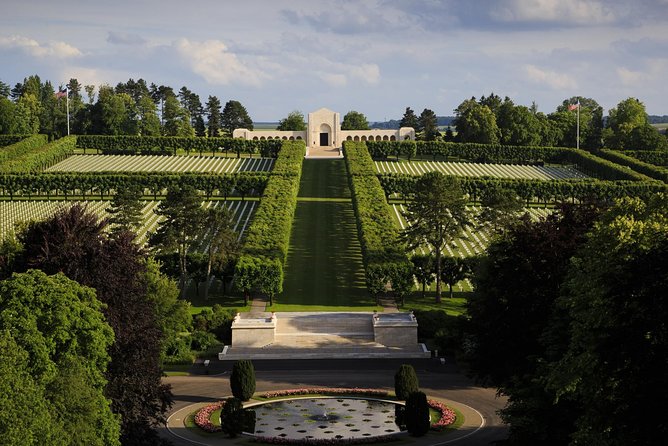
The Meuse-Argonne American Cemetery is the emotional center of the day. Located in Romagne-sous-Montfaucon, it covers 52 hectares and contains 14,246 graves of American soldiers who died during the Meuse-Argonne Offensive from September 26 to November 11, 1918.
The Romanesque memorial and chapel overlook the cemetery. A map of the offensive is engraved on one wall of the loggia, while another wall lists the names of 954 American soldiers whose remains were never identified.
I would allow yourself a quiet hour here. The scale can be difficult to grasp from a number alone. The rows of graves turn the offensive from a campaign on a map into thousands of individual deaths.
This stop also has special value if your family has a military connection. Régis helped locate a great-grandfather’s grave for one couple, so bring any family information you have if genealogy is part of your reason for booking. The information provided does not promise a genealogy service, but a private guide can offer more personal help than a fixed group schedule.
The cemetery is free to enter. It is also a place where the pace should slow down. You will have several other sites to see, but this is not a stop to rush through for a photograph.
Romagne 14-18 and the soldier’s everyday life
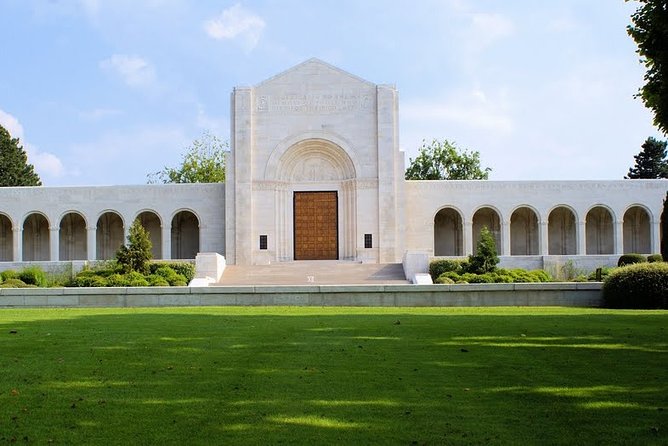
Romagne 14-18 changes the scale once again. Instead of viewing a battlefield from above or standing among rows of graves, you examine the small objects of military life.
The informal museum displays thousands of items found within about four kilometers of Romagne-sous-Montfaucon. Helmets, weapons, combs, coins, cutlery, and pocket watches show what soldiers carried, used, and lost.
The collection was assembled by Jean-Paul de Vries, who has searched for these objects since 1976. The point is not simply to display old equipment. Each object is tied to a personal story and helps explain daily life in the trenches.
This 40-minute stop is included in the tour price, unlike the other listed sites that have no admission charge. I find that worthwhile because it adds human detail after the cemetery. A weapon explains the fighting, but a comb or pocket watch hints at the ordinary person caught inside it.
The museum is informal, so do not expect a large national institution with a broad public program. That modest quality is part of its appeal. You are seeing a personal collection built from local finds, with the focus kept on the soldiers and the objects they left behind.
One especially unusual detail connected with the tour is the mention of the Pigeon Signal Corps. Régis’s interests extend beyond the most familiar parts of military history, which can help you see how communication and daily survival worked during the war.





Varennes-en-Argonne, from royal arrest to wartime liberation
Varennes-en-Argonne adds a different layer of French history. The village is known as the place where Louis XVI and the royal family were arrested after trying to reach troops loyal to the monarchy at Montmédy.
The First World War also left a mark here. German troops occupied the village at the start of the war, and it lay on or near the front line for much of the conflict. American forces liberated Varennes during the Meuse-Argonne Offensive on September 26, 1918.
You have about 30 minutes at this stop. That is enough for a brief look and for the historical connection, but not enough for a long village visit. The Pennsylvania Monument, on the heights above Varennes, commemorates Pennsylvania troops and was funded by the state in 1928.
This is a useful pause in the day because it connects three periods: the French monarchy, the German occupation, and the American offensive. If your main interest is battlefield archaeology, it may feel less intense than Massiges or Vauquois. If you enjoy seeing how one small place can carry several major stories, it earns its place on the route.
Butte de Vauquois and the war underground
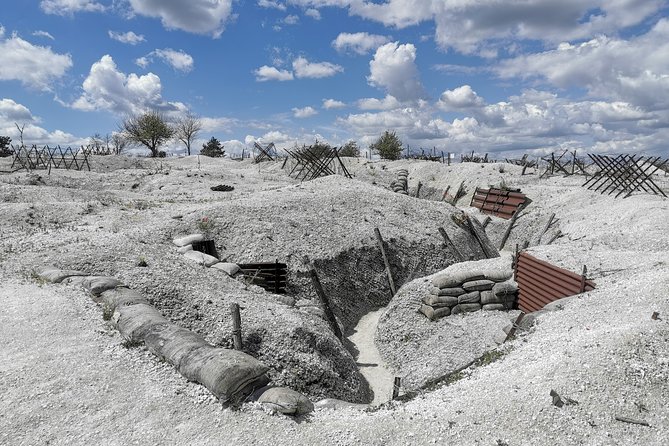
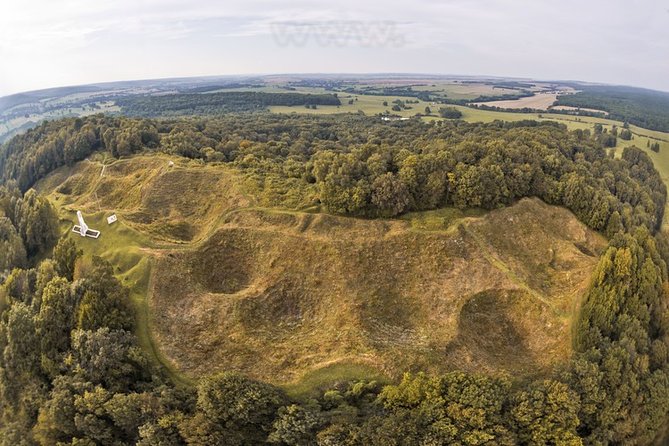
Butte de Vauquois is another major battlefield stop, and one of the most visually striking. The hill rises to about 290 meters and once served as an observation point for artillery. In autumn 1914, German forces turned the village at the summit into a fortress.
French and German troops dug trenches into the hill. More than 500 explosions reshaped the site, and the village was completely destroyed. Fighting over the ruins was especially intense from February to March 1915.
The underground war is what gives Vauquois its special character. Soldiers dug about 23 kilometers of galleries on several levels, reaching as deep as 100 meters. They tunneled beneath enemy positions and detonated mines, creating the enormous funnels that you can see at the top of the hill.
The visit lasts about an hour and admission is free. You should expect uneven outdoor ground and a site where the remains are fragmentary. The village itself is gone, but the damage makes the story plain.
Vauquois is a strong final battlefield stop because it shows that the First World War was not only a contest of artillery and infantry. It was also a slow underground struggle, fought with tunnels, mines, and countermines. The huge craters make that hard to forget.
The 6:00 am departure and long minivan day
The tour begins at 6:00 am and lasts roughly 13 to 14 hours. That early start is necessary if you want to cover the Argonne from Paris in one day, but it will shape your experience. Plan a simple morning and do not schedule another demanding activity for the evening.
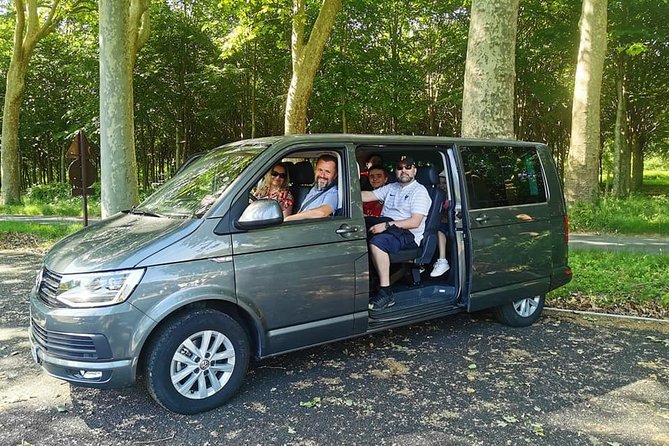
The vehicle is a private, air-conditioned minivan with space for a maximum of six people. Pickup is offered for customers at their residence in Paris and the Paris region. The small group gives you more flexibility than a large coach, and private transportation removes the need to manage rural roads between scattered sites.
There is no lunch included. You should account for that before departure, since the day includes several remote battlefield locations and a large amount of driving. The supplied details do not specify a restaurant or fixed meal stop, so ask about the lunch plan when booking or bring something suitable.
The tour is marked as suitable for most people and near public transportation, but the outdoor sites and the Montfaucon stair climb deserve attention. The hill at Massiges, the craters at Vauquois, and the 234 steps at Montfaucon are not the same as an easy city walk.
Free cancellation is available up to 24 hours before the start time. The experience requires good weather, and if poor weather cancels it, you are offered another date or a full refund. A minimum number of participants is also required, with the same choice of a different date, another experience, or a full refund if the tour is canceled for that reason.
Who should book this Argonne tour
I would choose this trip if you have a serious interest in the First World War, an American military connection, or family history tied to the Meuse-Argonne Offensive. The combination of battlefield remains, memorial architecture, graves, and personal artifacts gives you more than one way to understand the campaign.
It also suits a private group that wants to ask questions at its own pace. Régis is described as passionate about military history, and the tour includes less familiar subjects such as the Pigeon Signal Corps. That sort of detail can make a difference if you already know the basic story.
I would think twice if your interest in the war is casual, if you dislike long road days, or if you want plenty of free time in each village. This is a packed route with early departure, several outdoor stops, and no included lunch.
Should you book it?
Book this experience if the Argonne is a priority and you want the convenience of a private guide and minivan from Paris. The strongest reasons are the surviving trenches at Massiges, the mine funnels at Vauquois, the broad view from Montfaucon, and the deeply moving cemetery at Romagne.
The $462.73 price is easiest to justify for a group of four to six, or for people who place a high value on private guiding and family research. For two people, it is a costly day, but it saves you from organizing transport across a remote and scattered region.
The best way to approach it is to bring questions, family names, and enough energy for a full day. If you do, this tour can turn the First World War from a distant chapter into something you can see in the soil, the memorials, and the personal objects left behind.
FAQ
How long does the Private Battlefields Tour in Argonne take?
The tour lasts approximately 13 to 14 hours.
What time does the tour begin?
The scheduled start time is 6:00 am.
How many people can join the private tour?
The tour is private and uses a minivan for a maximum of six people.
Is pickup available in Paris?
Yes. Pickup support is offered at your residence in Paris and the Paris region.
Is lunch included?
No. Lunch is not included in the tour price.
Is admission to the Romagne 14-18 Museum included?
Yes. Admission to the Romagne 14-18 Museum is included.
Does the tour visit an American military cemetery?
Yes. It visits the Meuse-Argonne American Cemetery in Romagne-sous-Montfaucon, where 14,246 American soldiers are buried.
Can I cancel for a full refund?
You can cancel at least 24 hours before the experience start time for a full refund. Cancellations or changes made less than 24 hours in advance are not refunded or accepted.