REVIEW · PARIS
Paris: Notre Dame Exterior Walking Tour with Sainte Chapelle
Book on GetYourGuide →Operated by Exploring Tours and Services · Bookable on GetYourGuide
Notre Dame is the headline, but the real pleasure here is learning how the island around it shaped Paris. You view the cathedral from outside, then walk through Saint-Séverin, the Latin Quarter, Place Dauphine, and Pont Neuf before entering Sainte-Chapelle on your own.
I like the small group size, capped at 14, and the way the route links grand monuments with quieter streets. Guides such as Crystal, Laura, Sylvia, Monica, and Martine have been praised for clear storytelling, patience, humor, and practical tips. The main drawback is simple: you do not enter Notre Dame with the guide, and the Sainte-Chapelle line can still be long despite the timed ticket.
In This Review
- Key points at a glance
- Notre Dame is the starting point, not the whole show
- Saint-Séverin brings Gothic detail down to street level
- Île de la Cité explains how Paris grew
- Place Dauphine gives you a quiet pause
- Pont Neuf connects royal ambition with river views
- Sainte-Chapelle is the visual climax
- The optional Conciergerie ticket needs a careful look
- Small groups and guide quality shape the experience
- Is $81 a fair price?
- Timing, weather, and physical demands
- Who should book this Île de la Cité walk?
- Should you book it?
- FAQ
- Does the tour enter Notre Dame Cathedral?
- Is Sainte-Chapelle admission included?
- Is the Conciergerie included?
- Where does the tour begin?
- How long does the walking tour last?
- What languages are available, and is the tour accessible by wheelchair?
Key points at a glance
- Notre Dame from the best outside viewpoints: Hear about its Gothic design and post-fire reconstruction without entering the cathedral.
- A useful introduction to Île de la Cité: The walk explains why this small Seine island is tied to the beginnings of Paris.
- Three very different churches: Saint-Séverin, Notre Dame, and Sainte-Chapelle give you contrasting views of Gothic architecture.
- A peaceful stop at Place Dauphine: This elegant square offers a welcome change from the busy streets near Notre Dame.
- Pont Neuf with a story attached: See Paris’s first brick bridge and learn how King Henry IV shaped the area.
- Independent Sainte-Chapelle visit: Your guide gets you to the entrance and provides a timed ticket, then you explore the chapel at your own pace.
Notre Dame is the starting point, not the whole show
The tour begins at Hôtel de Ville, in front of the BASKET4BALLERS store at 11 Pl. de l’Hôtel de Ville. Look for a guide holding a GetYourGuide sign, and arrive five minutes early. The meeting point is easy enough once you are in the right place, but it can be confusing if signs or street displays change, so keep the exact store name handy on your phone.
From there, you walk toward Île de la Cité, the island in the Seine most closely linked with the origins of Paris. The first major stop is Notre Dame Cathedral, where your guide spends about 30 minutes discussing the exterior, Gothic details, and the work carried out after the 2019 fire.
This is a good way to see Notre Dame if you want context rather than a quick photograph. You can look closely at the facade, towers, stonework, and sculptural details while your guide points out technical features that are easy to miss on your own. The cathedral continues to command attention even while reconstruction work has shaped its recent story.
Be clear about the limits. This is an exterior tour of Notre Dame only. You will not enter the cathedral with the group, and admission inside is not included. If stepping into Notre Dame is your main reason for booking, choose a tour that specifically includes interior entry instead.
You can also read our reviews of more walking tours in Paris



Saint-Séverin brings Gothic detail down to street level
After Notre Dame, the route crosses into the Saint-Michel area and visits Saint-Séverin. You spend about 15 minutes inside this church, a fine example of Flamboyant Gothic style.
Saint-Séverin is a useful counterpoint to Notre Dame. Notre Dame is monumental and instantly familiar. Saint-Séverin feels more intimate, giving you a closer look at the decorative language of Gothic church design. Your guide explains the architecture while you see it in front of you, rather than trying to remember a list of dates and names.
This part of the walk has earned strong praise from people who enjoy church interiors and architecture. Guides Laura and Sylvia, among others, have been singled out for explaining churches clearly and making the details approachable. I especially like this stop because it adds substance to the outing. You are not simply moving from one famous photo stop to the next.
The route remains on foot, so wear shoes you can comfortably use for several hours. The walk is described as manageable, but it includes repeated stops and movement through several districts. If your group walks slowly, tell the guide early. One guide, Laura, has been praised for taking extra care with a slower party.
Île de la Cité explains how Paris grew
The Île de la Cité segment lasts roughly 30 minutes and is the historical center of the experience. Your guide connects the streets, buildings, churches, and bridges with the development of Paris.
This is where a good guide makes a real difference. You get visual clues as you walk, with the city itself acting as the lesson. Instead of hearing a long lecture in one place, you pick up the story through landmarks along the route. Several guides have been praised for adding small details and local stories that are difficult to get from a quick internet search.
You also pass through the Latin Quarter, Place Saint-Michel, and nearby shopping streets. These portions are shorter, around 15 minutes each, but they help you understand how the old religious and civic center connects with modern Paris.
The route is not a shopping tour, though there may be time to note places you want to return to. One guide offered useful suggestions for lunch, coffee, and shopping, and another showed a street with a range of food choices that became a good dinner stop later in the day. Treat these suggestions as a bonus, not the main purpose of the walk.
Place Dauphine gives you a quiet pause
Place Dauphine is one of the most appealing stops on the route. Built under King Henry IV, this triangular square feels calmer and more refined than the crowded approaches around Notre Dame and Saint-Michel.
You spend about 15 minutes here, taking photographs and hearing how the square fits into the story of the island. It is a good place to slow down and notice the scale of old Paris. The attraction is not one single monument. It is the combination of architecture, proportions, and the sense that the square was planned as part of a larger royal project.
I like this stop because it keeps the tour from becoming a checklist of major sights. You get time in a public space where local life and history overlap. The guide can also help you orient yourself, which is useful if you plan to continue exploring Île de la Cité after the tour.
Pont Neuf connects royal ambition with river views
The next major stop is Pont Neuf, described here as the first brick bridge built in Paris. It was another project associated with King Henry IV, and the bridge gives you attractive views along the Seine as well as a strong sense of how the island connects both banks of the city.
Your guide spends about 15 minutes on the bridge, with time for photographs and sightseeing. The stop works well after Place Dauphine because the two sites share a royal connection. You begin to see the island not as a collection of unrelated monuments, but as a place shaped by rulers, religious institutions, transport, and trade.
This is also one of the best parts of the walk for simple orientation. From the bridge, you can better understand the relationship between the Latin Quarter, Saint-Michel, Île de la Cité, and the Seine. If you are starting a first visit to Paris, that basic map in your head is valuable.






Sainte-Chapelle is the visual climax
The tour ends outside Sainte-Chapelle, where your guide gives you the timed admission ticket and explains how to enter. The guide does not continue through the chapel with you. Instead, you explore the monument independently, with an audio guide available at the entrance for an additional €3.
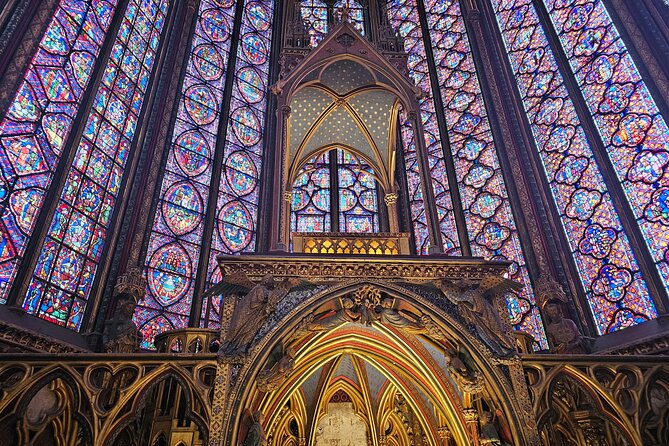
Sainte-Chapelle is the strongest reason to book this particular combination. Its Gothic architecture and stained-glass windows reward an unhurried visit. The chapel is compact compared with Notre Dame, but its visual effect is intense, especially when you take time to examine the glass rather than simply taking a few photographs and leaving.
The independent format has advantages. You can move at your own pace, linger over details, and avoid being tied to a group inside. It also means you should read a little about the chapel beforehand or rent the audio guide if you want more explanation. The walking guide’s historical background prepares you for the visit, but the final experience is self-directed.
A timed ticket does not guarantee instant entry. Security screening is required, and lines can build during peak season and national holidays. Plan for this possibility instead of scheduling a tight lunch reservation or another attraction immediately afterward.
You must bring a passport or identity card and a charged smartphone. Weapons, sharp objects, glass items, oversized luggage, and large bags are not allowed. Do not arrive carrying a suitcase or bulky day bag, since security restrictions are firm.
The optional Conciergerie ticket needs a careful look
Some booking options add entry to the Conciergerie. The route includes a photo stop and can allow about an hour for this second monument, but the ticket is only included if you select that option.
The guide does not provide a full guided visit inside the Conciergerie. You also face another security check before entering. That matters because the extra ticket adds cost without extending the guided portion in the same way as the walking tour.
I would choose the Conciergerie option only if you already want to see the building and have enough time for an independent visit. One person felt the extra charge was not worthwhile, describing the visit as mainly a stone building with a largely self-guided presentation. That is not a reason to skip it if the site interests you, but it is a good reason to check the price difference before paying for the add-on.
Small groups and guide quality shape the experience
The standard format is a semi-private walking tour for up to 14 people, with private and small-group options available. In practice, some departures have been much smaller. Couples and families have sometimes found themselves in groups of only two or a few people, creating the feel of a private walk without a full private-tour price.
That smaller scale matters in Paris. You can hear the guide more easily, ask questions without holding up a large crowd, and request a photo stop or clarification. It also helps when the guide needs to keep everyone together across busy streets.
The guides are the strongest part of the experience. Crystal has been praised for being upbeat, witty, prompt, and attentive, including helping a family find shade during extreme heat. Laura is repeatedly described as warm, patient, and strong at explaining history, art, and architecture. Sylvia, Monica, Martine, Martina, Anna, Gabriel, and Francois have also received praise for their presentations and personal attention.
The tone is generally conversational rather than stiff. Guides invite questions and adjust the discussion to the group. That makes a difference for families and teenagers, who may not stay interested in a long list of royal names. It also helps if you already know some Paris history and want to ask about architecture or city planning.
There are a few practical wrinkles. One group found the meeting point hard to identify, and another tour started late. A late arrival can shorten the walk, even though a guide may try to cover the main sights on a compressed schedule. Arrive on time, and use the store name and guide sign rather than relying on a vague view of Hôtel de Ville.
Is $81 a fair price?
At $81 per person, this is not the cheapest way to see Sainte-Chapelle. You are paying for a local guide, a planned route, a small group, and the timed chapel ticket. The value depends on how much help you want making sense of Île de la Cité.
I think the price is reasonable for a first Paris visit if you want history explained as you walk and prefer a smaller group. The tour covers several places in 2.5 to 3 hours, and the guide adds value at Saint-Séverin, Place Dauphine, and Pont Neuf, where a self-guided walk might become a quick photograph and little more.
The value is weaker if you mainly want entry to Sainte-Chapelle. In that case, a self-guided ticket may cost less and give you more freedom. The $81 price also does not include a guided Notre Dame interior visit, and the Conciergerie costs extra unless you choose the appropriate option.
Think of this as a walking history lesson with Sainte-Chapelle admission, not a complete Notre Dame tour. That description makes the price easier to judge.
Timing, weather, and physical demands
Allow the full three hours rather than assuming the walk will finish in 2.5 hours. The route includes several neighborhoods and monuments, plus the possibility of waiting at Sainte-Chapelle security.
Paris weather can change the feel of the walk. On hot days, shade and water matter, and guides may adjust stops when possible. On rainy days, the route can still work, but you will want a coat or umbrella and shoes with good grip. Comfortable shoes are essential in all conditions.
The tour is not suitable for wheelchair users according to the activity information. If anyone in your party has limited mobility, check carefully before booking. The route involves walking through streets, across public spaces, and into churches, so do not assume that a short stated duration means an effortless outing.
The tour is offered in English, French, Italian, and Spanish. If you are booking for a family, ask everyone to bring a charged phone, since the ticket and meeting details may be easier to manage digitally.
Who should book this Île de la Cité walk?
I would recommend it to first-time visitors who want a strong introduction to central Paris without spending half a day inside a museum. It suits people who enjoy stories about architecture, royal projects, churches, and the way a city developed over time.
Families can also do well here, especially with a guide who keeps the conversation lively and adds visual details. The small group format makes it easier to ask questions and take family photographs. People who dislike rigid group tours may appreciate that the Sainte-Chapelle portion is independent.
I would look elsewhere if your priority is entering Notre Dame with a guide, seeing the cathedral interior, or receiving a long guided explanation inside Sainte-Chapelle. I would also skip the Conciergerie add-on unless you specifically want that monument and are comfortable visiting it mostly on your own.
Book at least a day ahead if your schedule is tight, since timed entry and seasonal crowds can affect the Sainte-Chapelle portion. Free cancellation is available up to 24 hours before the start time, and you can reserve now and pay later, which helps if your Paris plans are still shifting.
Should you book it?
Book this tour if you want good city orientation, personal guiding, and Sainte-Chapelle in one outing. The best parts are the small group, the varied route, the stories around Saint-Séverin and Place Dauphine, and the chance to see Notre Dame up close from outside.
Skip it if the words Notre Dame make you expect interior access. For everyone else, this is a well-paced way to understand the island where Paris began, with one of the city’s most beautiful chapels waiting at the end.
FAQ
Does the tour enter Notre Dame Cathedral?
No. The Notre Dame portion takes place outside the cathedral and includes exterior views, photographs, and an explanation of its Gothic design and reconstruction. Interior Notre Dame admission is not included.
Is Sainte-Chapelle admission included?
A timed entry ticket for Sainte-Chapelle is included with the activity. You enter independently after the guide accompanies you to the entrance and gives you the ticket. An audio guide can be rented for €3.
Is the Conciergerie included?
Conciergerie admission is included only when you select the option that includes its ticket. A second security check is required, and the visit is not fully guided inside.
Where does the tour begin?
Meet at 11 Pl. de l’Hôtel de Ville, in front of the BASKET4BALLERS store. Look for a guide holding a GetYourGuide sign, and arrive five minutes before the scheduled start.
How long does the walking tour last?
The activity lasts about 2.5 to 3 hours, depending on the departure and timing at the monuments. The walk finishes at Sainte-Chapelle.
What languages are available, and is the tour accessible by wheelchair?
The tour is offered in English, French, Italian, and Spanish. The activity is not suitable for wheelchair users. Bring comfortable shoes, a passport or identity card, and a charged smartphone.