REVIEW · PARIS
Scandalous Paris, audioguided smartphone tour
Book on Viator →Operated by REWIND · Bookable on Viator
Paris has a polished romantic image, but South Pigalle tells a racier story. This smartphone tour follows the old world of courtesans, brothels, and cabarets, linking elegant squares with streets once known for pleasure, money, and scandal.
I like the freedom to pause for a coffee, browse a shop, or stop for a snack without losing your place. I also like the automatic audio triggers, which connect each story to the street where it happened. The main drawback is that this is not a live walking tour, so you will not have a guide beside you to answer questions or adjust the pace.
In This Review
- Key points to know
- Why South Pigalle tells a different Paris story
- Place Saint Georges and the making of New Athens
- Rue Saint-Georges and the women behind the scandal
- Rue Saint-Lazare and the lorettes
- Rue des Martyrs and Paris’s brothel economy
- Rue de Navarin and the names of famous clients
- Rue Frochot and the painters of Pigalle
- Rue Victor Massé and the French Cancan
- The Moulin Rouge, where the route reaches its finale
- How the smartphone format changes the experience
- Is $11.55 a fair price?
- Who should choose this Pigalle walk?
- Should you book Scandalous Paris?
- FAQ
- Where does the Scandalous Paris tour start?
- Where does the tour end?
- How long does the walking tour take?
- What locations are included?
- Is this a guided group tour?
- How does the audio guide work?
- Is the tour suitable for children?
- Can I cancel for a refund?
Key points to know
- A 60 to 90 minute route: Walk from Place Saint Georges through South Pigalle and finish near the Moulin Rouge.
- Stories begin automatically: GPS activates the commentary as you reach each location, with a map and directions to keep you moving.
- A candid subject: Expect frank stories about courtesans, brothels, erotic dance, and the social world around them.
- Eight stops with a clear theme: The route moves from the New Athens district to Rue Saint-Georges, Rue des Martyrs, Rue Frochot, and the Moulin Rouge.
- Good value for independent visitors: At $11.55 per person, the tour costs far less than most guided city walks, though you provide your own phone and transport.
- Best for adults and older teens: The experience is not recommended for anyone under 16.
Why South Pigalle tells a different Paris story
The walk begins at 28 Place Saint Georges, in the district once known as New Athens. This is a useful starting point because the tour does not open with the loudest or most obvious side of Pigalle. Instead, it begins among streets and squares shaped by wealth, artists, social ambition, and discreet pleasure.
The neighborhood changed in the 18th century as a fashionable district grew south of Pigalle. From there, the stories move into the 19th century and beyond, when Parisian courtesans, brothels, theaters, and cabarets helped give the area its provocative reputation.
I like this approach because the subject is tied to the streets themselves. You are not simply listening to a list of famous names while walking at random. The GPS commentary is designed to start at the place connected with each tale, giving the route a sense of order and purpose.
Still, keep your expectations clear. This is an audio-guided city walk, not a museum visit or theatrical performance. You will see ordinary Paris streets and exterior locations while the narration supplies the context. Much of the value comes from listening closely and noticing how the area looks today.
A few more Paris tours and experiences worth a look


Place Saint Georges and the making of New Athens
Place Saint Georges introduces the district’s transformation into what the tour describes as a paradise of pleasure. The square gives you the first sense of how a refined Paris neighborhood could sit close to a more openly libertine world.
This stop lasts about 15 minutes, making it one of the longer sections. That extra time suggests a broad opening chapter, with the guide setting up the social background before the route turns to individual women and notorious addresses.
For you, the stop works best as a slow orientation. Look at the square, follow the audio, and let the story establish the contrast between respectable appearances and private behavior. Since admission is free and the tour takes place outdoors, you are paying for the narration and route design rather than entry to a monument.
The meeting point is easy to identify by its full address, 28 Place St Georges, 75009 Paris. The tour runs daily during the stated operating period, with hours listed from 7:00 a.m. to 6:00 p.m. You can choose a start within that window, though daylight and the atmosphere of the neighborhood may affect which time feels most comfortable.
Rue Saint-Georges and the women behind the scandal
The second stop moves to Rue Saint-Georges for stories about courtesans who challenged the strict social rules of their time. The commentary is described as rather explicit, so this is not a sanitized history lesson.
That frankness is part of the appeal. Courtesans were not simply decorative figures in wealthy men’s lives. The tour presents them as women who could gain influence, money, freedom, and public attention in a society that placed tight limits on respectable women.
The stop lasts about 10 minutes. You should expect the focus to remain on storytelling rather than sightseeing. The street itself may not provide a dramatic visual payoff, but the location gives the subject a physical setting and keeps the route connected to the neighborhood.
I would listen with an open mind and avoid expecting every story to fit modern ideas about independence. The social world described here was unequal and often harsh. The entertainment value comes with a reminder that glamour and power did not erase the risks faced by the women involved.
Rue Saint-Lazare and the lorettes
At Rue Saint-Lazare, the tour introduces the lorettes, women associated with a freer and less respectable style of life. The commentary uses the phrase light morals, reflecting the judgmental language once applied to women who lived outside accepted social rules.
This is a short, 10-minute stop, but it adds an important layer to the route. Not every woman in the area occupied the same place in society. The tour distinguishes between different forms of companionship, sexuality, public reputation, and economic survival.
The route is strongest when it shows these gradations instead of treating all of Pigalle’s past as one blurry story of vice. You get a sense of a social system with its own labels and hierarchies.
Rue Saint-Lazare is also a practical point in the walk. After the more focused storytelling at Rue Saint-Georges, the route continues through a major neighborhood street before turning toward Rue des Martyrs. Follow the map rather than relying only on memory. The app includes live directions and GPS correction if you take a wrong turn.
Rue des Martyrs and Paris’s brothel economy

Rue des Martyrs is one of the key stops. The tour explains that Paris once had more than 700 brothels, many operating into the 20th century. These businesses were not only places of private pleasure. Regular visits could signal money, rank, and social importance.
The comparison to owning an expensive car today makes the point in plain language. Spending money at a well-known brothel could function as a public display of wealth. That detail helps you see the subject as part of urban business and status, not just private behavior.
This section lasts about 15 minutes, tied with the opening stop for the longest commentary. It is likely to carry much of the tour’s social explanation, including why these establishments mattered to the city’s image and to the men who used them.
You should remember that the route does not include admission to historic interiors. The experience takes place along public streets, and the former brothels are encountered as addresses and stories. If you want rooms, objects, or preserved interiors, you will need a separate museum or cultural visit.






Rue de Navarin and the names of famous clients

Rue de Navarin continues the brothel theme, with attention to historic establishments and their famous clients. This gives the tour a more personal angle. Instead of discussing an anonymous crowd, the audio connects the neighborhood with recognizable figures from Parisian public life.
The stop lasts around 10 minutes. Its appeal depends on how much you enjoy the human details of history: who went where, how reputations were built, and why certain addresses became known.
For me, this is also where the audio format makes sense. A live guide might need to speak loudly on a busy street, while a smartphone lets you control the volume and listen at your own pace. You can pause if you need to look at the map or catch a detail.
The tradeoff is simple. Your phone becomes the guide, map, ticket, and audio player all at once. Make sure you have the activation code sent after purchase and enough battery for the walk. The information provided does not promise a separate device or printed route, so plan to use your own smartphone.
Rue Frochot and the painters of Pigalle
Rue Frochot changes the focus from clients and courtesans to artists. Toulouse-Lautrec, Edgar Degas, and Pissarro lived in the neighborhood and painted its libertine entertainment spots.
This is one of the more interesting turns in the route. The district was not only a place where people sought pleasure. It was also a workplace and subject for artists who recorded the people, dances, and venues around them.
The audio raises the idea of early paparazzi, a playful way to consider what these painters were doing. They were not photographers chasing celebrities in the modern sense, but they did help fix the nightlife of the area in the public imagination.
This stop lasts about 10 minutes. It should appeal to you if you want the walk to connect social history with art. The route does not claim to be an art tour, so expect brief connections rather than detailed study of individual paintings.
Rue Victor Massé and the French Cancan
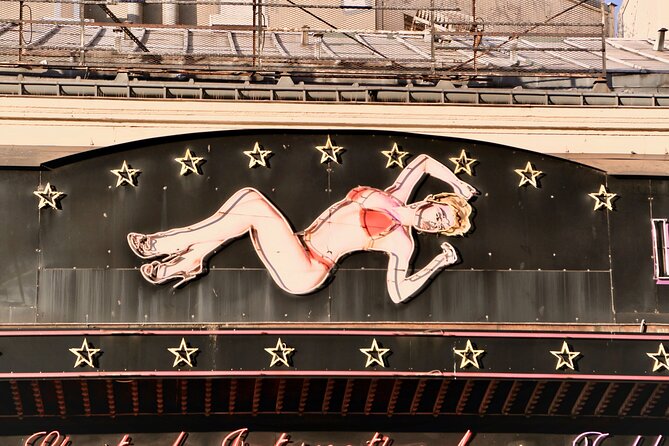
Rue Victor Massé brings in the French Cancan, an erotic dance that became part of Paris’s cabaret identity. The subject fits the route’s larger theme, but it also shows how performance helped turn private scandal into public entertainment.
The 10-minute commentary can help you understand why dance halls and cabarets mattered so much to the neighborhood. The French Cancan was not merely a dance step. It carried a reputation for daring movement, exposed legs, theatrical energy, and deliberate provocation.
This stop is likely to work best for visitors who enjoy cultural history with a little humor. The tour provider describes the tone as passionate and entertaining, and the positive feedback highlights the mix of useful information and humor. That balance matters here, since the subject could otherwise become either too solemn or too sensational.
The route remains entirely self-directed. You can stop to take photos, sit briefly, or replay a section, then continue when ready. The app is intended to resume where you paused, which is helpful if you want to give each street more than a passing glance.
The Moulin Rouge, where the route reaches its finale
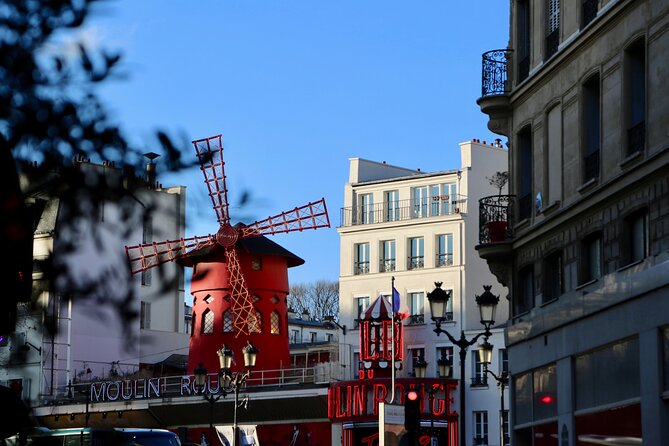
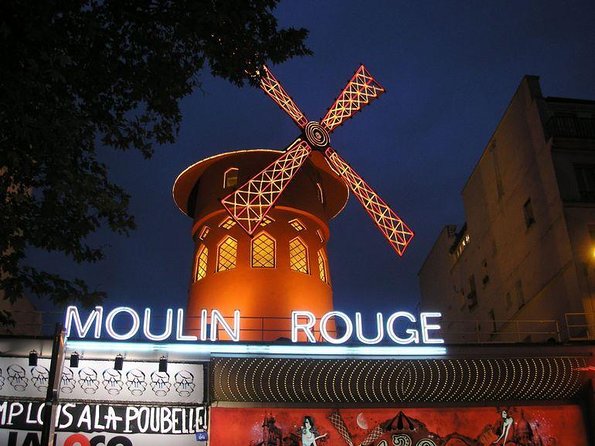
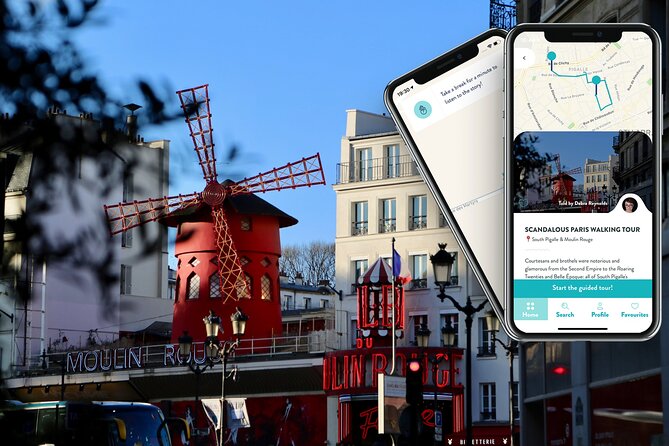
The final stop is the Moulin Rouge, at 46 Rue Pierre Fontaine. The tour ends near this famous cabaret, giving the walk a clear finish and a recognizable landmark.
The Moulin Rouge is the most famous name on the route, but it appears after the tour has already introduced the people, streets, artists, and dances that made Pigalle’s reputation. That order is useful. You reach the headline attraction with a better sense of the world that surrounded it.
The Moulin Rouge commentary lasts about 15 minutes. As with the other stops, the tour does not include a show or admission. You finish near the venue, not inside it, so plan separately if you want to attend a performance.
The ending also makes the walk convenient for continuing your evening in the area. Transport is not included, but the tour is near public transportation, and the route remains within the 9th arrondissement. The exact onward plan is yours to arrange.
How the smartphone format changes the experience
The audio commentary triggers automatically at the relevant locations. The app also includes a map, clear directions, and integrated geolocation that can guide you back if you stray from the route.
That setup removes much of the usual stress from a self-guided walk. You do not need to keep checking street names or guess which corner comes next. You can focus on the narration and the buildings around you.
I especially like the pause-and-resume feature. A fixed tour can be awkward when you want a drink, need a break, or find a shop worth entering. Here, you can stop and continue at the point where you paused.
There are limits. GPS-based audio depends on your phone working properly, and you are responsible for the device you use. The supplied information does not specify whether commentary can be downloaded for offline use, so I would check that point before setting out if your mobile data is limited.
The activity is private in the sense that only your group participates. It is not a shared walking group, but it is also not a personal guide service. You receive a guide in your pocket, not a person walking next to you.
Is $11.55 a fair price?
At $11.55 per person, this is a low-cost way to add a focused historical walk to your Paris plans. You are paying about the price of a casual meal or drink for a route that covers eight stops and up to 90 minutes of narration.
The value is strongest if you like exploring independently. You get a defined route, automatic commentary, directions, and the ability to set your own pace. You also avoid the higher cost of a private live guide.
The value is weaker if you want questions answered in real time, detailed discussion at every stop, or entry into historic sites. You should also factor in personal expenses and transport, which are not included.
The tour has a 4.5 rating from six published reviews, with praise focused on the interesting stories, the discovery of another side of Paris, and the humor in the presentation. That matches the experience’s main strength: it gives you a memorable theme and a practical way to follow it through the city.
Who should choose this Pigalle walk?
I would choose this tour if you want a short, adult-focused activity that fits around a larger Paris itinerary. It suits couples, friends, and solo visitors who prefer not to join a scheduled group.
It is especially good for you if:
- You enjoy social history more than formal monuments.
- You want to explore Pigalle beyond the Moulin Rouge sign.
- You like listening at your own speed.
- You appreciate a little humor with frank subject matter.
- You want a walk that can pause around meals, shopping, or photos.
- You have limited time and can spare one to one and a half hours.
I would skip it if you need a live expert, dislike explicit topics, or want substantial indoor sightseeing. The experience is also not recommended for anyone under 16.
Book with the timing in mind. Free cancellation is available if you cancel at least 24 hours before the start time. Cancellations or changes made within 24 hours are not refunded or accepted, based on local Paris time.
Should you book Scandalous Paris?
Book it if you want a reasonably priced, entertaining route through South Pigalle that goes beyond the usual cabaret photo stop. The best parts are the clear progression from New Athens to the Moulin Rouge, the stories about courtesans and brothels, and the freedom to walk without a fixed group schedule.
Do not book it expecting a traditional guided tour or access to historic interiors. Think of it as a well-planned audio walk with an adult theme, a map in your hand, and Paris streets as the setting. For $11.55, that is a sensible choice for independent visitors who want a fresh angle on one of the city’s most famous neighborhoods.
FAQ
Where does the Scandalous Paris tour start?
The tour starts at 28 Place St Georges, 75009 Paris, France.
Where does the tour end?
The route ends near the Moulin Rouge at 46 Rue Pierre Fontaine, 75009 Paris, France.
How long does the walking tour take?
The tour takes approximately one hour to one hour and 30 minutes.
What locations are included?
The route includes Place Saint Georges, Rue Saint-Georges, Rue Saint-Lazare, Rue des Martyrs, Rue de Navarin, Rue Frochot, Rue Victor Massé, and the Moulin Rouge.
Is this a guided group tour?
No. It is a self-guided experience on your own smartphone. Only your group participates, and the audio guide provides the commentary.
How does the audio guide work?
After purchase, you receive an email with activation code or codes. The commentary activates automatically at the relevant locations, while the app provides a map, directions, and geolocation support.
Is the tour suitable for children?
The experience is not recommended for anyone under 16 because it covers explicit subjects involving courtesans, brothels, and erotic entertainment.
Can I cancel for a refund?
Yes. You can receive a full refund if you cancel at least 24 hours before the experience start time. Cancellations or changes made less than 24 hours before the start time are not refunded or accepted.