REVIEW · PARIS
Private Paris City Night Sightseeing Tour
Book on Viator →Operated by Tour Up in Europe · Bookable on Viator
Paris at night feels cinematic. This private, 3-hour ride strings together the city’s biggest landmarks with air-conditioned comfort and a guide who can match the pace to what you care about most.
I especially like the hotel pickup setup. It saves time and hassle when you want to see more than one neighborhood after dark, and you get onboard WiFi plus bottled water for the ride between stops. One thing to weigh: the Eiffel Tower visit is optional in practice since tickets aren’t included, so you may need to plan for that decision.
This is a great fit if you want a smooth, custom night tour without rushing. You’ll get a lot of Paris in a short window, with quick stops that help you spot key details—then move on while the city looks its best.
In This Review
- Key things I’d mark on your planning map
- Why a 3-hour private night loop works so well
- Price and value: what you’re paying for (and what you’re not)
- Pickup and meeting: the easiest part, if you coordinate
- Champs-Élysées to Arc de Triomphe: Paris’s grand straight line at night
- Place de la Concorde and the Temple of Glory story you’ll remember
- Moulin Rouge to Montmartre views: night glamour with real-world details
- Île de la Cité and Notre-Dame: where the tour slows your brain down
- From Saint-Geneviève’s transformation to the Luxembourg Gardens unwind
- Left Bank and Saint-Germain-des-Prés: artsy Paris without trying too hard
- Hôtel des Invalides and Pont Alexandre III: monuments with a story of France
- Grand Palais, Petit Palais, and ending near the Eiffel Tower
- How to get the most from this tour (without burning your night)
- Should you book this private Paris City Night Sightseeing Tour?
- FAQ
- How long is the Private Paris City Night Sightseeing Tour?
- Is this tour private, and how many people are in a group?
- Do you offer hotel pickup?
- What’s included in the tour price?
- Are Eiffel Tower tickets included?
- What language is the tour offered in?
- Can I get a full refund if I cancel?
Key things I’d mark on your planning map

- Private group up to 2 people means you’re not stuck with someone else’s agenda
- Hotel lobby pickup makes a night tour feel far less complicated
- Air-conditioned vehicle + Wi‑Fi is a real quality-of-life upgrade in the evening
- Photo-friendly stops at the Arc de Triomphe axis, Montmartre, and the Trocadéro viewpoint
- Eiffel Tower tickets not included, so you control whether you go up
- Most stops are exterior and quick, so timing matters more than long museum visits
Why a 3-hour private night loop works so well

Paris at night has two moods: the relaxed one, and the one where you keep saying I should get a photo from here. This tour leans into both. In about 3 hours, you’re covering major sights across multiple areas, which is hard to do efficiently on your own—especially when it’s dark and you’re thinking about walking time.
The private format matters. You can slow down when the light hits the Arc de Triomphe, and speed up when you just want to get to the next view. That pace control is the real win here, because Paris nights can feel either magical or exhausting depending on how tightly your schedule is packed.
Also, this is built around a nighttime rhythm. You’re traveling in comfort in between stops, then using the pauses to make sense of what you’re seeing—so the city doesn’t just look pretty, it starts to click.
You can also read our reviews of more city tours in Paris

Price and value: what you’re paying for (and what you’re not)

The cost is $540.69 per group (up to 2). On paper, that can sound steep until you compare what you’d otherwise need: transport, a guide, and the added time costs of coordinating stops at night.
Here’s what you do get in the package:
- Private transportation in an air-conditioned vehicle
- Wi‑Fi on board and bottled water
- All fees and taxes included
- A mobile ticket for the experience
- Hotel pickup (contact the operator to coordinate)
What you do not get:
- Tips for the guide and driver
- Eiffel Tower tickets
So the practical way to look at the price is this: you’re paying to eliminate friction. Less waiting, fewer logistics headaches, and you see a lot of big-name Paris without spending that whole night zigzagging across town.
If you want Eiffel Tower access that involves an entry ticket, you’ll need to budget extra time and money. If you’re happy with the big view from the Trocadéro area and a quick exterior moment, then the overall spend becomes much easier to justify.
Pickup and meeting: the easiest part, if you coordinate

Pickup is from your hotel lobby. The key line here is simple: you coordinate pickup by contacting the operator directly. For a night tour, that small step is everything, since you’re meeting in the dark and you don’t want any last-minute confusion.
This experience also comes with a confirmation at booking time, and it uses a mobile ticket. Those details tend to reduce the usual chaos of arriving and figuring out where the guide is standing.
One note that’s worth respecting: if you book very close to the departure time, you might find it harder for a private provider to confirm pickup and timing. For the smoothest experience, give yourself a little cushion and message the operator early so your pickup point is crystal clear.
Champs-Élysées to Arc de Triomphe: Paris’s grand straight line at night
This tour is smart about beginning where Paris becomes instantly recognizable. You start with the Champs-Élysées, the nearly 2-kilometre historic avenue running from Place de la Concorde to the Arc de Triomphe. Even without lingering, the boulevard’s scale lands quickly when you see it under night lighting.
Then it’s Arc de Triomphe time. This monument honors those who fought and died for France during the French Revolution and the Napoleonic Wars, and you’ll see the names of French victories and generals inscribed on the inner and outer surfaces. Under the vault is the Tomb of the Unknown Soldier from the First World War.
Night makes this kind of monument easier to understand. During the day, it’s big but busy. At night, the lighting frames the structure and you can actually pick out the monument’s role in French memory.
Possible drawback: you won’t have the time you’d want for a long visit inside. This tour is about coverage and context rather than deep time in one single stop.
Place de la Concorde and the Temple of Glory story you’ll remember

Next up is Place de la Concorde, the largest square in Paris, about 18.8 acres (7.6 hectares). Historically, it was meant to glorify King Louis XV, but during the French Revolution, royals including Louis XVI were executed there. That contrast—glory first, then tragedy—helps you see the square with more depth than a quick photo.
Then you get a fascinating detour in idea and ambition: Napoleon decided a Temple of Glory should be built for his Grande Armée, with architect Pierre-Alexandre Vignon authorized to draw up plans. The description you’ll hear during the stop focuses on the shift toward a Greek-temple style, with building starting on what was planned as a beautiful structure.
This is the kind of context that turns a drive-by moment into something you’ll actually recall later when you walk around Paris again. It’s also a reminder that Paris’s monuments weren’t always the end result—sometimes they’re the outcome of changing political dreams.
You can also read our reviews of more private tours in Paris





Moulin Rouge to Montmartre views: night glamour with real-world details
Paris’s cabaret fame isn’t random, and the tour spells that out. The Moulin Rouge became world-famous largely because its founders, Charles Zidler and Joseph Oller, opened the cabaret on October 6, 1889. The idea was daring and extravagant, and the building’s legend has stuck around for over 130 years.
Then you head into Montmartre territory for one of the biggest payoff views of the night: the Sacré-Cœur area at the top of Butte Montmartre, sitting 130 metres above ground. From here, you get panoramic views across the city.
Sacré-Cœur’s look is distinctive: it’s in a Roman-Byzantine style, recognizable by its white exterior. Inside, the ceiling features the largest mosaic in France, about 480 m².
Practical note: don’t count on a long stop for interior details. This is a sightseeing tour format, so you’re using the timing to see what you can from viewpoints and quick pauses. If you want a long, slow Sacré-Cœur visit with full interior viewing, you’ll likely want a separate day plan.
Île de la Cité and Notre-Dame: where the tour slows your brain down

The tour spends time in Île de la Cité, the historical heart of Paris. In 508, Clovis I established his palace there. By the 12th century, it became a major religious center, including the home of Notre-Dame cathedral and the royal chapel of Sainte-Chapelle, plus the city’s first hospital, the Hôtel-Dieu. You’ll also hear about the Pont Neuf, noted as the oldest surviving bridge in the city.
Then it’s Notre-Dame de Paris, described as a masterpiece of Gothic architecture and the most visited monument in France. Construction began in the 13th century and finished in the 15th, and it was badly damaged during the French Revolution. You’ll hear about its 19th-century restoration by architect Viollet-le-Duc.
At night, Notre-Dame can feel less like a landmark you’ve seen in postcards and more like a structure with weight. The lighting helps you notice the cathedral’s massing and how it sits at the end of the island’s story.
Possible drawback: this part of the tour is about understanding, not extended time. If you want time to wander the island streets on foot, treat this as your orientation and then plan to come back later when you have daylight or a longer night.
From Saint-Geneviève’s transformation to the Luxembourg Gardens unwind

After Notre-Dame, the tour connects the revolution-era changes with another big theme: how religious spaces were reimagined. The tour references the Church of Saint Genevieve being transformed in 1791 by the National Constituent Assembly into a mausoleum for distinguished French citizens, modeled on Rome’s Pantheon.
Then you shift to the calmer side of Paris with Luxembourg Gardens. Garden creation began in 1612 when Marie de’ Medici—widow of King Henry IV—constructed the Luxembourg Palace as her residence. Today, the garden is owned by the French Senate, and it covers 23 hectares (56.8 acres).
What I like about this stop is the mix of visual and sensory details you can actually picture in your head even at night: lawns, tree-lined promenades, tennis courts, flowerbeds, and model sailboats on the octagonal Grand Bassin. You’ll also hear about the Medici Fountain, built in 1620.
Night reality check: gardens can be quieter and dimmer after dark. That’s not a bad thing—it just means you’ll get more of the shape and mood than the bright, flower-forward look you might expect in daytime.
Left Bank and Saint-Germain-des-Prés: artsy Paris without trying too hard
The tour points you toward the Left Bank, linked for centuries with intellectuals and memorable neighborhoods. Saint-Germain-des-Prés is highlighted as an area that draws visitors from around the world, and this stop is basically your chance to connect the dots between old Paris and the Paris people talk about today.
Even if your feet aren’t doing long walks here, the value is in the context. You’ll understand why the Left Bank became shorthand for books, cafés, and cultural conversation, not just a patch of charming streets.
Practical note: night tours like this move fast. If you’re the type who wants to linger with a coffee and people-watch, you might want a separate add-on day for the Left Bank.
Hôtel des Invalides and Pont Alexandre III: monuments with a story of France
Next comes Les Invalides area. The tour explains that in 1670, no foundation existed to house wounded and homeless veterans from wars for France. Louis XIV approved building the Hôtel Royal des Invalides because he worried about what would happen to soldiers afterward.
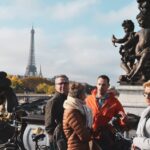
Then you’ll cross into bridge-country with Pont Alexandre III. The tour notes it was inaugurated for the 1900 Universal Exhibition and is classed as a historic monument. It’s described as emblematic because of its architecture and location—exactly the kind of bridge you want to see at night when lights make the details readable.
This section is a good reminder that Paris isn’t only about romance. It’s also about institutions, remembrance, and the way power is built into stone.
Grand Palais, Petit Palais, and ending near the Eiffel Tower
Late in the tour you’ll see the museum-and-exhibition side of Paris. The Grand Palais is highlighted as an iconic monument built for the Universal Exhibition in 1900 and dedicated by the French Republic to the glory of French art. It was designated a historic monument in 2000.
You also hear about the Petit Palais, built to be a lasting building that would become a permanent fine arts museum after the exhibition.
Then the tour sets you up for the Eiffel moment. The stop is Trocadéro, specifically Palais du Trocadéro, which is positioned on a slope on the northern bank of the Seine directly opposite the Eiffel Tower. The tour description adds an extra practical detail: its engineering is meant to give you ideal Eiffel tower framing for photos.
Finally, you reach the Eiffel Tower. You’ll get the key reality too: it’s the world’s most-visited monument with an entrance fee, with over 7 million people ascended it in 2022.
Here’s how to plan your decision about going up. Since Eiffel Tower tickets aren’t included, you’ll need to decide if the view from above is worth adding that ticket step to your night. If you’re just there for the big nighttime glow, the Trocadéro framing may be enough. If you want the full experience, plan to purchase tickets separately.
How to get the most from this tour (without burning your night)
A night sightseeing tour goes well when you prep for quick stops. I suggest you:
- Wear shoes you can walk in for short bursts, even if the main mode is car transport
- Bring a layer, since Paris evenings can feel cooler than you expect once the sun drops
- Decide early whether you want to go up the Eiffel Tower so you’re not deciding on the spot
Also, this is a private tour, which means you can bring your own interests. If you love monuments tied to French politics and revolution-era stories, you’ll get plenty of that. If you’re more into viewpoints and iconic silhouettes, you’ll also get what you came for, especially with Montmartre and Trocadéro.
If your guide happens to be someone like Nataly (a name that’s been associated with adaptable, personal guidance), that flexibility can make a big difference when the group wants to adjust timing on the fly.
Should you book this private Paris City Night Sightseeing Tour?
Book it if you want:
- A private night format that keeps pace flexible
- Big-name sights across multiple districts in about 3 hours
- The comfort of an air-conditioned vehicle, plus Wi‑Fi and hotel pickup
Skip it or consider a different option if:
- Eiffel Tower entry is a must for you and you don’t want the extra ticket step
- You’re hoping for long indoor visits at each stop, since this tour format is built for coverage and context
For most first-time visitors to Paris, this is a strong way to get your bearings fast while the city is at its most photogenic. You’ll leave with a clearer mental map of where everything sits and why it matters.
FAQ
How long is the Private Paris City Night Sightseeing Tour?
It runs for about 3 hours.
Is this tour private, and how many people are in a group?
Yes, it’s private. The price is for a group of up to 2.
Do you offer hotel pickup?
Yes. Pickup is from the hotel lobby, and you’re asked to contact the operator to coordinate pickup.
What’s included in the tour price?
Included are private transportation, Wi‑Fi on board, an air-conditioned vehicle, all fees and taxes, and bottled water.
Are Eiffel Tower tickets included?
No. Tickets to the Eiffel Tower are not included.
What language is the tour offered in?
The tour is offered in English.
Can I get a full refund if I cancel?
Yes. You can cancel for a full refund if you cancel at least 24 hours before the experience’s start time, and free cancellation is offered up to that point.