REVIEW · PARIS
3 day Private Omaha Utah Full D Day Mont Saint Michel by Mercedes
Book on Viator →Operated by Clewel Travel · Bookable on Viator
The most powerful part of this three-day journey is the way it connects the D-Day beaches with the people who fought there. You move from the Caen Memorial’s broad wartime story to Omaha Beach, Pointe du Hoc, Utah Beach, and Sainte-Mère-Église, where churches, bunkers, graves, aircraft, and personal objects make the events feel close and human.
I like the private Mercedes setup, especially for a route with long drives and many scattered sights. I also like the mix of serious history and lighter Norman pleasures: two nights in Bayeux, a stop at Mont Saint-Michel, time in Cabourg, and a Calvados tasting. The tradeoff is simple: this is a very busy tour, with early starts, long days, and limited free time at several sites.
In This Review
- Key points at a glance
- A fast, private road to Normandy
- Caen sets the stage for D-Day
- Arromanches and the machinery of invasion
- Omaha Beach, the cemetery, and Pointe du Hoc
- Utah Beach and a church turned field hospital
- Sainte-Mère-Église and the airborne night jump
- Mont Saint-Michel changes the mood
- Cabourg and a final taste of Normandy
- Who will get the most from this tour
- Should you book it?
- FAQ
- Where does the tour begin and end?
- How long is the tour?
- What vehicle is used?
- Is the tour private?
- What hotel arrangement is included?
- Are meals included?
- Which admissions are included?
Key points at a glance
- Two full days of D-Day sites: Visit Omaha and Utah beaches, Pointe du Hoc, the Normandy American Cemetery, Arromanches, Sainte-Mère-Église, and several excellent museums.
- Private Mercedes transport: Two or three people ride in a Mercedes E220, while groups of three to seven use a Mercedes minivan.
- A memorable night-jump simulation: The Airborne Museum’s C-47 experience recreates a nighttime parachute operation over Sainte-Mère-Église.
- Two nights in Bayeux: The overnight base cuts down on backtracking and gives the tour a more sensible rhythm.
- Mont Saint-Michel plus Calvados: Day three shifts from wartime history to medieval architecture, seaside Cabourg, and apple brandy.
- Strong personal service: Guides named Cyrus and David are specifically associated with attentive guiding, detailed explanations, and help at restaurants for visitors who do not speak French.
A fast, private road to Normandy
The tour begins with pickup at the entrance of your central Paris hotel. The scheduled start is around 7:00 a.m., with the first departure listed at 7:30, so confirm the exact pickup time when booking.
You travel in an air-conditioned Mercedes E220 business-class car for a party of two, or a Mercedes minivan for three to seven people. The drive to Caen takes about three hours, with one rest-area stop. That private setup matters here. Normandy’s major sights are spread across a large area, and you avoid the waiting, transfers, and fixed pace of a large coach.
The guide-driver format also gives you someone to explain the countryside and answer questions as you go. Past tour leaders include Cyrus and David. David is described as staying with the group at restaurants and helping with French-language needs, a small service detail that can make a long day easier.
The price is $2,454.57 per person. That is a serious sum, but it includes round-trip hotel transport from Paris, private vehicle service, a guide-driver or separate driver and guide, entrance fees, two hotel nights in Bayeux with breakfast, the Mont Saint-Michel Abbey, the Calvados tasting, and the listed museums.
Meals, drinks, tips, and souvenirs cost extra. The value is best for a small group that wants a private experience and would otherwise need to arrange several days of transport, hotels, museum tickets, and local guiding. For a solo visitor or a couple watching every euro, the price may feel heavy. Group discounts are offered, though the amount is not specified.
You can also read our reviews of more private tours in Paris


Caen sets the stage for D-Day
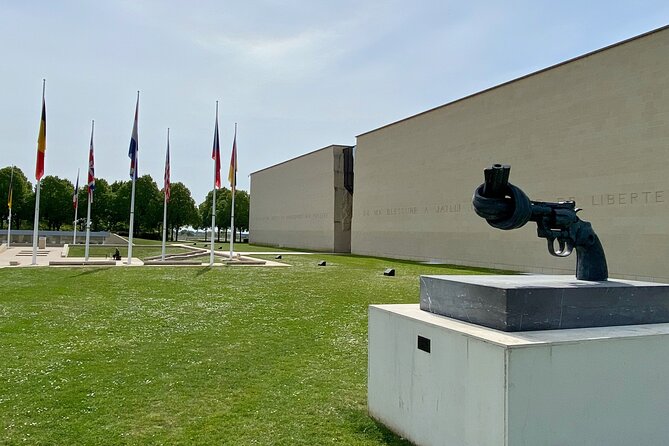
Your first major stop is the Caen Memorial and Museum, scheduled for about 10:30 to noon. This is a smart opening because it gives you the larger story before you reach the beaches.
The museum covers the Second World War and the Battle of Normandy, with attention to the personal lives of people caught in the conflict. A 19-minute film uses original wartime footage to explain the battle. I find this kind of introduction useful because the beach sites can otherwise become a blur of military names, dates, and heroic episodes.
You receive about 90 minutes here, including admission. That is enough for a focused visit, but not enough to examine every display at length. If you like museums and want time to read everything, the schedule may feel tight. If you prefer to learn the essentials before seeing the actual sites, the timing works well.
Arromanches and the machinery of invasion
After Caen, the vehicle reaches Arromanches-les-Bains in roughly 30 minutes. You have an hour for lunch and a look around town. Arromanches was part of the British Gold Beach sector and was chosen for one of the temporary Mulberry harbours built after the landings.
The scale of the harbour operation is striking. By June 12, the artificial harbour had helped bring 300,000 men, 54,000 vehicles, and 104,000 tons of supplies into Europe. Remains of the harbour can still be seen in the bay, giving you a clear sense of how the Allies moved equipment inland after securing the beach.
Next comes the Arromanches 360 circular cinema, perched above the bay. The film covers the first 100 days of the Battle of Normandy and uses the panoramic format to make the setting part of the presentation. You get about an hour here, including admission.
Lunch is not included, so plan to pay separately. The one-hour break is enough for a meal and a short look around, but not for a leisurely seaside stop.
Omaha Beach, the cemetery, and Pointe du Hoc
The Normandy American Cemetery at Colleville-sur-Mer is one of the emotional centers of the tour. It contains 9,387 American military graves, along with the Wall of the Missing listing 1,557 names.
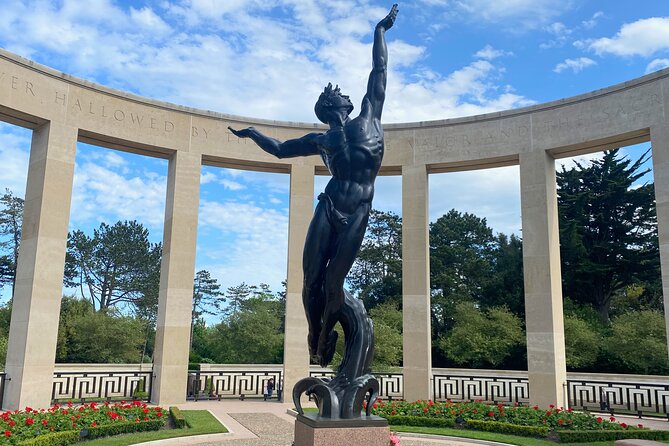
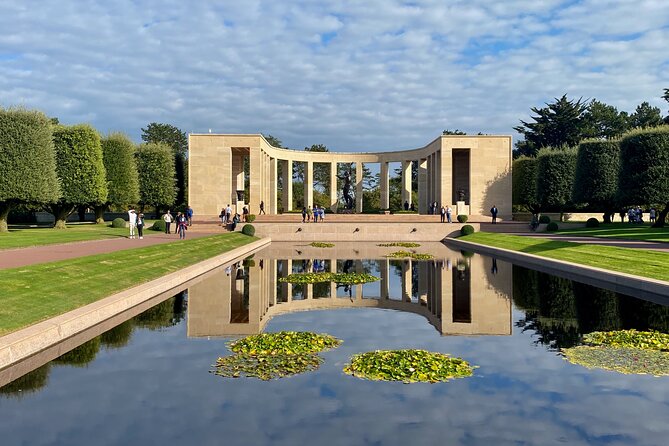
The cemetery overlooks Omaha Beach, and the setting is carefully maintained and quiet. You will see the memorial colonnade, the sculpture Spirit of American Youth Rising from the Waves, maps of military operations, and the visitor center museum. The position above the beach helps you connect the rows of graves with the difficult terrain below.
The schedule allows about 70 minutes. That gives you time to walk through the cemetery, visit the museum, and pause at the memorial. You may want to keep your pace measured here. It is easy to spend the whole visit reading names and still feel you have not seen enough.
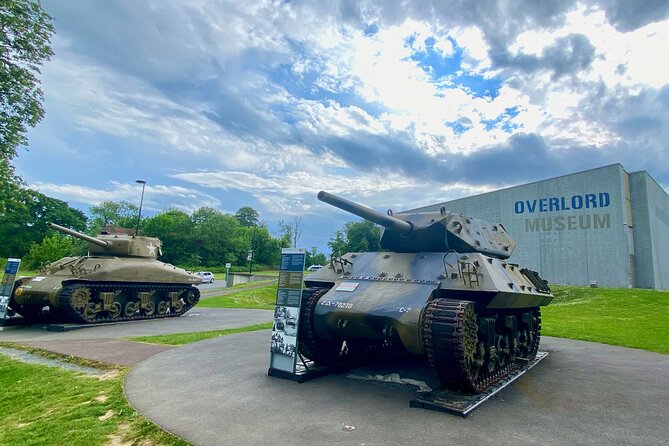
The nearby Overlord Museum follows at 4:15 p.m. and offers a different kind of history. Tanks, weapons, military vehicles, a V-1 missile, and personal belongings give the war a physical presence. The collection is particularly useful after the cemetery because it shifts your attention from sacrifice to the equipment and daily realities of combat.
The visit is short, about 30 minutes. You will need to move quickly, so treat it as a concentrated stop rather than a complete museum visit.
At Omaha Beach, the guide explains the landing and the enormous losses suffered by the 34,000 men who came ashore there. You have about 30 minutes on the beach. That is enough to walk, look toward the bluffs, and think through what the soldiers faced, but not enough for a long beach stroll.
The final stop is Pointe du Hoc, reached in about 15 minutes. The site’s concrete gun positions, bomb craters, and cliffs make it one of the most visually revealing places in Normandy. The German battery could fire toward both Omaha and Utah, and the 2nd Ranger Battalion’s assault to take it became one of the invasion’s best-known actions.
You have about an hour here. Wear shoes with a firm sole and watch your footing around the uneven ground and open bomb craters. The Ranger monument above the cliffs is a fitting end to the first day.
You then reach Bayeux around 7:00 p.m. The hotel is listed as three or four star, depending on the option chosen, with breakfast included. Two nights in the same town are a real advantage. You do not have to repack each morning, and Bayeux is a practical base for the western beaches.
Utah Beach and a church turned field hospital
Day two begins around 8:00 a.m. with a drive to Angoville-au-Plain. The small Church of Saint-Côme-et-Saint-Damien holds one of the tour’s most personal stories.
During the invasion, American medics Robert Wright and Kenneth Moore treated about 80 wounded combatants from both sides, along with one child. They used the church pews as hospital beds, and blood stains are still visible on the wood. When German soldiers entered and saw the medics treating the wounded without regard to nationality, they left and marked the door with a Red Cross.
The stop lasts only about 20 minutes. It is brief, but the church offers something the larger museums cannot: a small, intact place where compassion cut through the fighting.
Utah Beach follows at around 9:10 a.m. The beach is broad and open, making it easier to understand the geography of the landing. The American assault here involved 23,000 soldiers, and casualties were far lower than at Omaha, with 197 killed, wounded, missing, or captured according to the figures provided for the tour.
You get 50 minutes to see the beach and nearby monuments. The Utah Beach Landing Museum then takes two hours. Built over a former German bunker, it includes military vehicles, historical objects, and an original B-26 bomber. Only six B-26 aircraft remain, making that display a major draw even for visitors whose interest in military history is limited.
Two hours gives you time to take the museum seriously. It also creates a useful contrast with Omaha. The beaches are close in name but different in terrain, strategy, and outcome.
A few more Paris tours and experiences worth a look



Sainte-Mère-Église and the airborne night jump
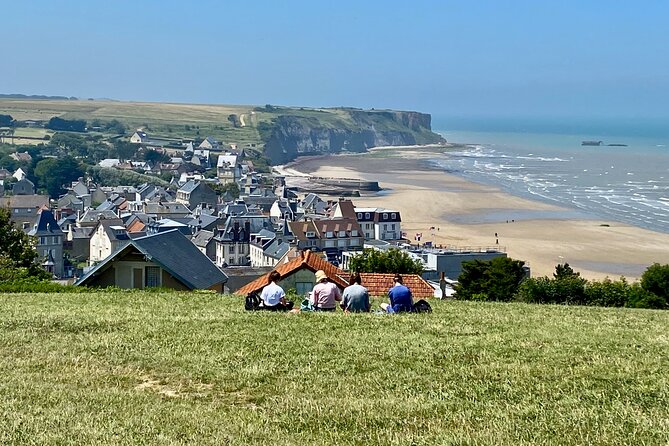
Sainte-Mère-Église is a short stop before lunch and the Airborne Museum. The town was captured by units of the U.S. 82nd and 101st Airborne Divisions in the early hours of June 6, making it one of the first liberated towns in the invasion.
Look up at the church steeple for the mannequin honoring John Steele, the paratrooper whose parachute caught on the tower. His story helped inspire The Longest Day, which was filmed in the village in 1961. You will also see Borne 00, marking the location where General Theodore Roosevelt Jr. landed and chose to lead the assault from there.
Lunch is taken in town, with about an hour before the museum visit. Food and drinks are not included. The stop is convenient because the Airborne Museum is within walking distance.
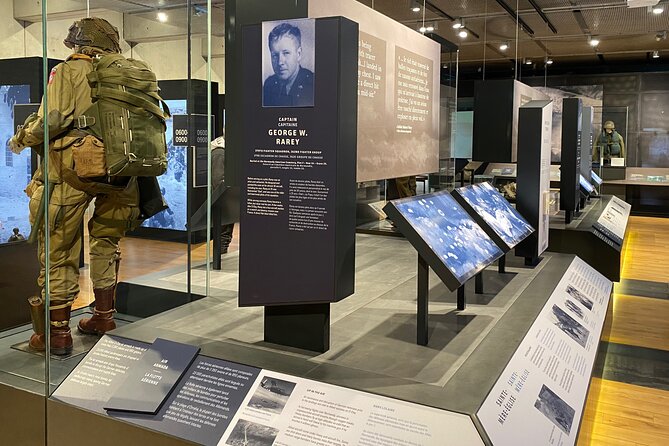
The museum is dedicated to the American paratroopers of the 82nd and 101st Airborne Divisions. Its five buildings include structures shaped like open parachutes, a WACO glider display, and an original C-47 aircraft surrounded by parachutes, mannequins, and staged scenes.
The C-47 section is especially effective because it places you inside the equipment used to carry troops into Normandy. The WACO building explains how gliders transported soldiers, vehicles, ammunition, and other supplies. Interactive screens add context without replacing the real aircraft and objects.
The final 30-minute experience is the D-Day Night Jumps simulation. You follow the nighttime preparation in England, board a C-47, drop into Sainte-Mère-Église, and experience the fighting that followed. It is a theatrical museum presentation rather than an actual jump, but it gives the airborne operation a strong sense of confusion and danger.
You return to Bayeux around 4:40 p.m. This day is still full, but it generally feels more varied than the first because the church, beaches, museum, town, and airborne displays each offer a different kind of experience.
Mont Saint-Michel changes the mood
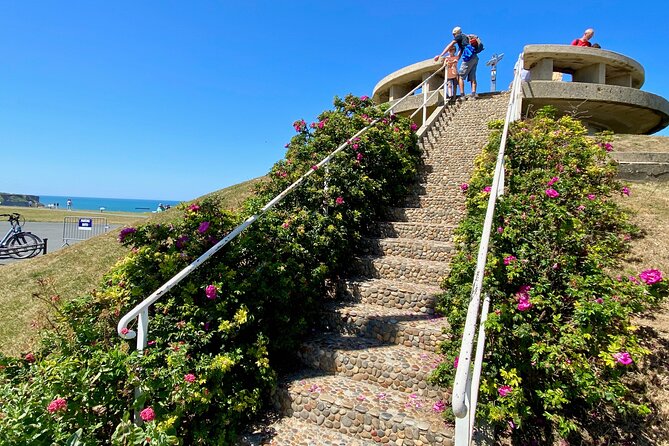
Day three leaves Bayeux around 8:00 a.m. for Mont Saint-Michel, with about 130 kilometers of driving and a stated travel time of roughly 90 minutes. The island and abbey provide a sharp change from the military sites.
The Benedictine Abbey is dedicated to Saint Michael the Archangel. The site was first settled in 709, and construction continued from the 700s through the 1200s. The medieval village, narrow streets, fortified setting, and views across the bay make this a very different kind of historic place.
The guide-driver leads you up through the village. The abbey visit lasts about three hours, usually with a guided visit organized by the abbey itself, or an audio guide if that timing is not available. Admission is included.
The long stop is welcome because Mont Saint-Michel is not a quick photo stop. You need time for the climb, the abbey rooms, the views, and lunch. The village streets can be steep and crowded, so comfortable shoes are important.
Lunch is on your own from 12:30 to 1:30 p.m. Keep an eye on the clock. The schedule allows only one hour before the vehicle leaves for Cabourg.
Cabourg and a final taste of Normandy
The drive to Cabourg takes about one hour and 45 minutes. You have roughly 75 minutes in town before continuing to Pont-l’Évêque.
Cabourg gives the final day a seaside pause after the concentrated history of Normandy. The provided schedule does not specify a guided activity there, so think of it as free time to walk and take in the town rather than a formal sightseeing visit.
The final stop is Calvados Père Magloire L’Experience. Here you learn how Calvados apple brandy has been made for centuries, then taste it with an explanation of the drink. This is a good closing note because it connects the visit to Normandy’s food and farming traditions, not only its battlefields.
The return drive to Paris takes about two and a half hours, with hotel drop-off listed around 8:00 p.m. That makes the last day long, especially after Mont Saint-Michel. You should avoid booking a tight evening train, flight, or dinner reservation.
Who will get the most from this tour
I would choose this tour if you want maximum coverage with minimal planning. It suits a family, couple, or small group that values private transport, wants a guide nearby, and has a strong interest in the D-Day invasion.
It is also a good fit if you want to combine Normandy’s wartime sites with Mont Saint-Michel without arranging separate trips. The two nights in Bayeux make the route more comfortable than returning to Paris after each day.
I would hesitate if you prefer slow museum visits, long meals, or free time in villages. The schedule is packed, and several stops last less than an hour. You will see a great deal, but you will not linger everywhere.
The private format can soften that drawback. A guide such as Cyrus may add extra stops when time and interest allow, and David’s attentive help with meals and French-language needs is useful for visitors who do not speak French. Still, extra flexibility should be treated as a possibility, not a guarantee.
Should you book it?
Book this three-day trip if the D-Day beaches are your main reason for visiting Normandy and you want the practical work handled for you. The strongest parts are the private Mercedes, Bayeux base, wide range of museums, and personal guiding around sites such as the cemetery, Pointe du Hoc, and Sainte-Mère-Église.
The price is justified mainly for a small group that will share the private vehicle and value included admissions, hotels, breakfast, and door-to-door service. If you want a leisurely holiday, choose a slower plan. If you want an intense, well-packed look at Normandy with Mont Saint-Michel and Calvados added, this tour makes a strong case.
Free cancellation is available up to 24 hours before the start time. Last-minute cancellations or changes made inside that period are not refunded or accepted.
FAQ
Where does the tour begin and end?
Pickup is offered at the entrance door of your hotel in Paris, with drop-off at your Paris hotel at the end of day three.
How long is the tour?
The experience lasts approximately three days. The first two days focus on Normandy’s D-Day sites, and the third includes Mont Saint-Michel, Cabourg, a Calvados tasting, and the return to Paris.
What vehicle is used?
Two or three people travel in a Mercedes E220 car. Groups of three to seven use a Mercedes minivan.
Is the tour private?
Yes. Only your group participates in the private activity.
What hotel arrangement is included?
The tour includes two nights in Bayeux in a three or four star hotel, depending on the option selected. Double rooms and breakfast are included.
Are meals included?
No. Meals and drinks are not included. Lunch breaks are provided in places such as Arromanches-les-Bains, Sainte-Mère-Église, and Mont Saint-Michel.
Which admissions are included?
Included visits cover the Caen Memorial and Museum, Arromanches 360, the Normandy American Cemetery visitor center, Overlord Museum, Utah Beach Landing Museum, Airborne Museum and its D-Day Night Jumps experience, Mont Saint-Michel Abbey, and the Calvados tasting experience.