REVIEW · PARIS
Paris: Montmartre Walking Tour with Sacré-Cœur Basilica
Book on GetYourGuide →Operated by THE PERFECT VACATION · Bookable on GetYourGuide
Montmartre gives you Paris with its sleeves rolled up. This two-hour walk moves from the Moulin Rouge through old artist hangouts, film locations, quiet squares, and steep lanes before finishing at Sacré-Cœur, where you can take in one of the city’s best views.
I like the mix of famous sights and smaller stops, especially Place Dalida and the Clos Montmartre vineyard. I also like that the walk ends at the basilica rather than rushing you through it with a guide. The main catch is the pace: two hours is short for so many stops, and Montmartre’s hills can make the route tiring.
In This Review
- Key points
- Starting at Blanche beside the Moulin Rouge
- Rue Lepic and the Amélie connection
- The I Love You Wall in Montmartre
- La Bateau-Lavoir and the artists’ Montmartre
- Place Dalida and one of the route’s best photo stops
- Moulin de la Galette and La Maison Rose
- Clos Montmartre, the vineyard in the city
- Lapin Agile and old Montmartre nightlife
- Place du Tertre before the basilica
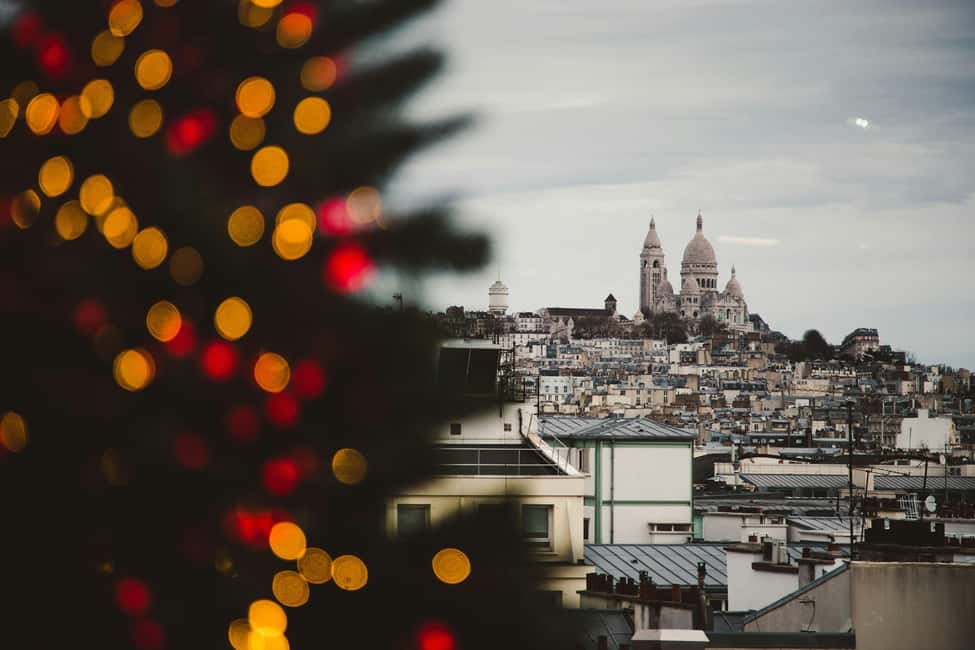
- Ending with Sacré-Cœur and the Paris view
- What two hours really gives you
- Price, pace, and practical value
- Who should book this Montmartre walk
- Should you book it?
- FAQ
- Where does the Montmartre walking tour begin?
- How long does the tour last?
- What language is the tour offered in?
- Does the tour include the inside of Sacré-Cœur Basilica?
- Is the Moulin Rouge show included?
- Are food and drinks included?
- How much uphill walking should I expect?
- Can I cancel the booking?
- Is payment required when booking?
Key points
- Start beside the Moulin Rouge: Meet at Blanche Metro station, Line 2, at 59 Boulevard de Clichy.
- Follow Montmartre’s artistic trail: See Van Gogh’s former home, La Bateau-Lavoir, Moulin de la Galette, and Lapin Agile.
- Pause at Place Dalida: Visit the house associated with the French singer and stop for photographs in the pretty square.
- See a working piece of village Montmartre: The Clos Montmartre vineyard still produces wine within Paris.
- Finish at Sacré-Cœur: Your guide leaves you at the basilica, giving you time to explore inside on your own.
- Plan for hills and cobbles: Comfortable shoes and weather-ready clothing will make a real difference.
Starting at Blanche beside the Moulin Rouge
Your meeting point is in front of Blanche Metro station on Line 2. Look for a guide carrying a flag with The Perfect Vacation logo. This is a useful starting point because the Moulin Rouge is only steps away, and the neighborhood changes quickly once you leave Boulevard de Clichy.
The Moulin Rouge is a photo stop rather than a cabaret performance. You pass the famous red windmill and hear how this part of Montmartre became linked with cabaret, music, and nightlife. If you want to attend a show, that requires a separate booking. This walk simply gives you the setting and the story.
Starting at Blanche also makes the tour easy to reach by public transport. Arrive a little early so you are not trying to identify the group while traffic, pedestrians, and Metro passengers swirl around the boulevard.
You can also read our reviews of more walking tours in Paris



Rue Lepic and the Amélie connection
From the Moulin Rouge, the route heads into Montmartre’s streets, including Rue Lepic. This is one of the neighborhood’s most enjoyable streets to walk because it leads uphill through shops, cafés, and everyday Paris scenes.
You pass Café des Deux Moulins, the café made famous by the film Amélie. The stop is brief, so do not expect a meal or a long sit-down break. Still, it is a fun place to connect a familiar movie setting with the real neighborhood around it.
The walk then points out the house where Vincent van Gogh once lived. The value here is not a museum visit. You are seeing a place connected with the artist’s Paris years while walking through the same district that attracted painters, writers, and performers. The guide’s explanation helps turn an ordinary-looking building into part of Montmartre’s creative story.
The I Love You Wall in Montmartre
The I Love You Wall, or Le Mur des Je t’aime, offers a change of mood. This public mural displays the words I love you in more than 250 languages. It is a short stop, but it gives you a clear photograph and a cheerful pause between the uphill streets.
I like this part of the route because it is easy to enjoy without needing a long explanation. You can look for a language you recognize, take a picture, and move on. Photography is encouraged, but you should still avoid blocking the group or treating nearby private property as part of the attraction.
The stop also works well for couples and families, though the tour is not presented as a special romance outing. It is simply one of those memorable Paris details that breaks up the more formal artistic and historical stops.
La Bateau-Lavoir and the artists’ Montmartre
La Bateau-Lavoir is one of the most important creative addresses on the route. This former artists’ studio became associated with Picasso and other artists who gathered and worked in Montmartre.
You should set your expectations properly. This is a historical stop and visit from the outside or along the route, not a full museum experience with extended indoor access. Its importance comes from the people linked with the building and the guide’s account of how artists shaped the area.
That distinction matters. Montmartre is full of places where the outside view is modest but the backstory is much larger. A guided walk is useful here because you would likely pass some of these addresses without knowing what happened there.
Place Dalida and one of the route’s best photo stops
The walk continues to the house associated with Dalida, followed by a stop at Place Dalida. The square is picturesque, and it gives you a quieter setting than the crowded streets closer to Sacré-Cœur.
Dalida remains a major French cultural figure, and this stop adds music and popular culture to a route otherwise centered on painters and old cabarets. I especially like the balance. You are not only hearing about famous artists from the early twentieth century. You are also seeing how a later French icon remains part of Montmartre’s identity.
This is a good place for photographs, but remember that the house is a private residence. Take pictures respectfully and follow the guide’s instructions about where to stand.





Moulin de la Galette and La Maison Rose
Moulin de la Galette is another reminder that Montmartre was once more rural and recreational than it appears today. The windmill was associated with a dance hall, and the name still carries the atmosphere of old neighborhood entertainment.
The stop is especially useful if you want to understand why painters found this district appealing. Montmartre offered windmills, gardens, inexpensive rooms, cafés, and social spaces, all within reach of central Paris. The tour does not turn this into a long lecture, but the route links the physical remains with that earlier way of life.
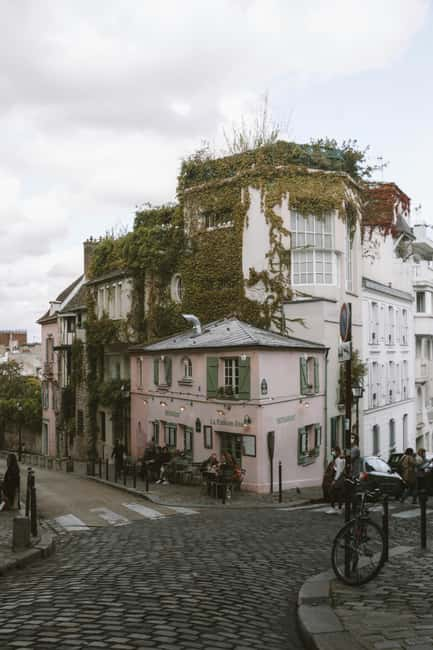
You also stroll by La Maison Rose, the pastel-pink café often painted by local artists. It is one of Montmartre’s most recognizable façades, so expect people to pause for pictures. The stop is a look from the route rather than a meal. Food and drinks are not included, and the tour keeps moving.
The schedule also includes passing a local restaurant. Treat this as part of the street route, not as a dining reservation. If you want to eat in Montmartre, plan it before or after the walk.
Clos Montmartre, the vineyard in the city
One of the more unusual stops is Clos Montmartre, a small vineyard still producing wine in Paris. It is easy to miss because it does not fit the usual picture of the capital. You are walking through a dense urban district, then suddenly learning about vines growing within the neighborhood.
The vineyard is passed on the tour rather than presented as a tasting visit. No wine, meal, or drink is included. Its value is the sense of contrast: Montmartre retains traces of a village past even while surrounded by one of Europe’s biggest cities.
This is also where the uphill walking can feel most noticeable. The route uses winding streets, and the terrain is not flat. Wear shoes with good support, and check the forecast before you leave. A wet day can make steep or cobbled streets less pleasant.
Lapin Agile and old Montmartre nightlife
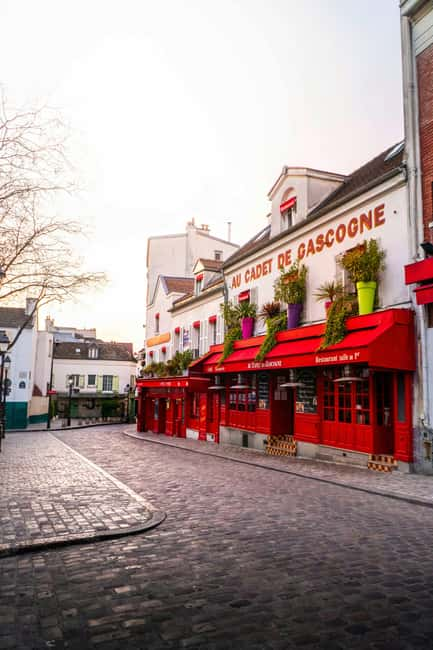
The route passes Lapin Agile Cabaret, one of the remaining links to traditional Montmartre nightlife. Like the Moulin Rouge, it is viewed as part of the neighborhood rather than included as a cabaret performance.
Lapin Agile helps round out the story. Montmartre was not shaped only by painters working alone. Cafés, cabarets, music, and informal gatherings helped create the district’s reputation. A guide can connect these places in a way that a simple photo walk cannot.
The route has several entertainment-related stops, but this is not a nightlife tour. You do not need to dress for a show, and there is no evening performance included. Think of it as a daytime look at the places that made Montmartre famous.
Place du Tertre before the basilica
The walk reaches Place du Tertre near the end. Artists gather here to sell work, making it one of the most recognizable squares in Montmartre. It can feel crowded, particularly when many people stop to browse portraits and paintings.
I like arriving here after the quieter lanes because you can see the contrast between local artistic tradition and a major sightseeing center. You may want to buy artwork, but the purchase is not part of the tour, and you should allow extra time if browsing matters to you.
Place du Tertre is also a useful point to pause and check your belongings. The tour information specifically advises keeping personal items secure. As in any busy city square, keep wallets, phones, and bags under control while you take pictures.
Ending with Sacré-Cœur and the Paris view
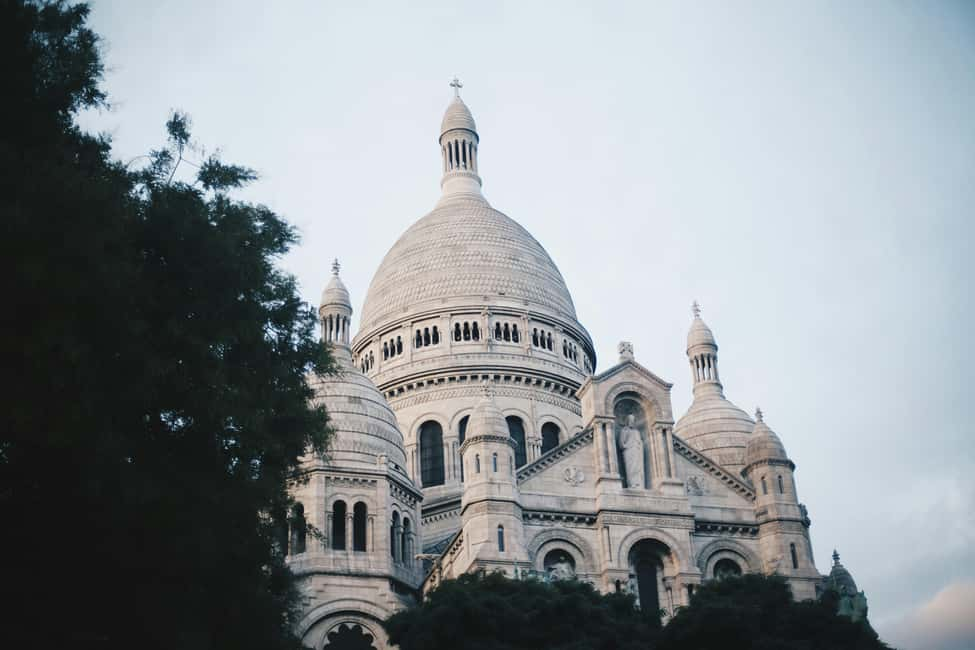
The tour finishes at the Basilica of the Sacred Heart, better known as Sacré-Cœur. The guide leaves you at the basilica and does not accompany you inside. This is an important detail when comparing this walk with tours that include a guided church visit.
The advantage is freedom. You can enter at your own speed and spend time looking around without a group waiting for you. The basilica is one of Paris’s most recognizable landmarks, and the open area around it offers broad views across the city.
The drawback is that the interior visit is self-guided. If you want detailed commentary about the basilica’s art, architecture, or religious history, you will need to read the available information on your own or arrange a separate visit. The tour’s main focus is Montmartre’s streets and stories, with Sacré-Cœur as the final landmark and viewpoint.
Because the guide does not stay with you, the ending is also practical. You can choose to visit the church, enjoy the view, take photographs, or continue exploring Montmartre. You are not locked into a group schedule after the final stop.
What two hours really gives you
Two hours is enough for a strong introduction, but not enough for long visits at every location. Most stops are brief, often about ten minutes in the supplied route outline. That keeps the experience lively, but it means you will usually pass by cafés, houses, windmills, squares, and cabarets rather than enter each one.
I see this as a good format if you want orientation on your first day in Paris. You get a route through the main sights, learn which streets deserve a slower return visit, and finish at a major landmark. It is less suitable if you want museum-style detail or long periods inside historic buildings.
The English-speaking guide is central to the experience. Perkin received particularly warm recognition for making a real effort and having information ready, while Pierre was also singled out as a strong guide. The overall rating is 4.5 from five recorded ratings, with the comments pointing to an interesting, well-filled walk and positive guide experiences. That is encouraging, though the sample is small, so I would not treat it as a guarantee of the exact same guide or pace.
Price, pace, and practical value
At $46 per person, this tour is priced as a guided neighborhood walk rather than a major attraction package. There are no included meals, drinks, cabaret tickets, or special-entry arrangements. You are paying mainly for the guide’s route, explanations, and the time saved finding the lesser-known addresses.
I think the price is fair if you want context and a clear path through Montmartre. The value is strongest for first-time visitors, people who enjoy film and art connections, and anyone who would rather not work out the neighborhood’s steep route alone.
It is less attractive if you already know Montmartre well or prefer to wander without a schedule. You can see several of the exterior sights independently, though you may miss the links between Van Gogh, Picasso, Dalida, the cabarets, and the vineyard.
Free cancellation up to 24 hours ahead and the reserve-now, pay-later option reduce the risk of committing early. Starting times vary, so check availability when booking. The tour is offered in English, and audio recording is not allowed. Alcohol and drugs are also prohibited.
Who should book this Montmartre walk
I would recommend it to you if you want a compact introduction to Montmartre with plenty of recognizable stops. It suits couples, solo visitors, families with older children, film fans, art lovers, and anyone who wants a guide to explain why this neighborhood matters.
You should think twice if hills are difficult for you. The experience is specifically not suitable for people over 95, and the route includes uphill walking. The two-hour length also means you need enough stamina to stay on your feet for most of the outing.
Bring comfortable shoes, dress for the weather, and keep your belongings secure. Photography is welcome, but private homes and residences deserve care. If you want time at Café des Deux Moulins, La Maison Rose, Place du Tertre, or Sacré-Cœur, plan a return visit or stay after the walk ends.
Should you book it?
Book this tour if you want Montmartre’s major sights tied together by a human guide rather than a self-guided map. The strongest reasons are the variety of stops, the specific focus on Van Gogh, Dalida, Picasso, cabaret culture, and the Clos Montmartre vineyard, plus the freedom to explore Sacré-Cœur after the guided portion.
Skip it if you want indoor access, a cabaret show, a meal, or a slow museum-level tour. At $46, it offers good value for neighborhood orientation and storytelling, but the short duration means you will see many places from the street. For most first-time visitors who can manage the hills, it is a sensible way to get your bearings in Montmartre before exploring the area at your own pace.
FAQ
Where does the Montmartre walking tour begin?
The tour begins in front of Blanche Metro station on Line 2, at 59 Boulevard de Clichy. The guide carries a flag with The Perfect Vacation logo.
How long does the tour last?
The guided walk lasts two hours. Starting times vary, so check availability when booking.
What language is the tour offered in?
The live tour guide speaks English.
Does the tour include the inside of Sacré-Cœur Basilica?
The guide finishes at Sacré-Cœur and does not accompany you inside. You can enter and explore the basilica on your own.
Is the Moulin Rouge show included?
No. The route passes the Moulin Rouge, but no cabaret performance or ticket is included.
Are food and drinks included?
No. Meals and drinks are not included. The tour passes cafés and a local restaurant, but it does not provide a dining stop.
How much uphill walking should I expect?
The route includes uphill walking through Montmartre’s winding streets. Comfortable shoes are recommended.
Can I cancel the booking?
Yes. You can cancel up to 24 hours in advance for a full refund.
Is payment required when booking?
You can reserve now and pay later, allowing you to hold a place without paying at the time of booking.