REVIEW · PARIS
Paris: La Défense Private Guided Tour
Book on GetYourGuide →Operated by TOUR FRANCE EXPERIENCE · Bookable on GetYourGuide
La Défense is Paris with the old rules set aside: skyscrapers, concrete, open space, and giant public art replace boulevards, mansard roofs, and church towers. The private format lets you shape the walk around architecture, history, or the strange sculptures scattered across the district.
I like the chance to see a side of Paris many visitors skip, and I like the tour’s close look at artworks such as the Red Spider and Cesar’s Finger. The main caution is the price, $217 per person for two hours, plus a low published score of 1.7 from three ratings. One verified booking from March 2024 specifically raised concerns about the guide’s audibility and walking pace.
In This Review
- Key points to know
- Why La Défense feels like another Paris
- Meeting beneath the Grande Arche
- Walking the two-hour La Défense route
- The open-air gallery and its odd characters
- Choosing art, architecture, or history
- What the low score means for your decision
- Is $217 per person fair?
- Who should book this private walk?
- Should you book the La Défense tour?
- FAQ
- How long does the La Défense private tour last?
- Where does the tour begin?
- How will I identify my guide?
- Where does the tour finish?
- Is the tour private?
- Which languages are available?
- Are transportation and entry tickets included?
- Can I choose the subject of the tour?
- Can I cancel for a full refund?
Key points to know
- The Grande Arche sets the tone: Begin beneath one of Paris’s most futuristic monuments.
- The route is private: You can ask for more art, architecture, or history rather than follow a fixed group script.
- Public art is part of the walk: Look for the Red Spider, Car on a Lamp-post, and Cesar’s Finger.
- The setting is unlike central Paris: Expect towers, broad paved spaces, greenery, and a working business district.
- The tour lasts two hours: That is enough for an introduction, but not a full study of La Défense.
- Clear communication matters: Bring comfortable shoes and confirm that your guide can speak clearly at a pace you can follow.
Why La Défense feels like another Paris
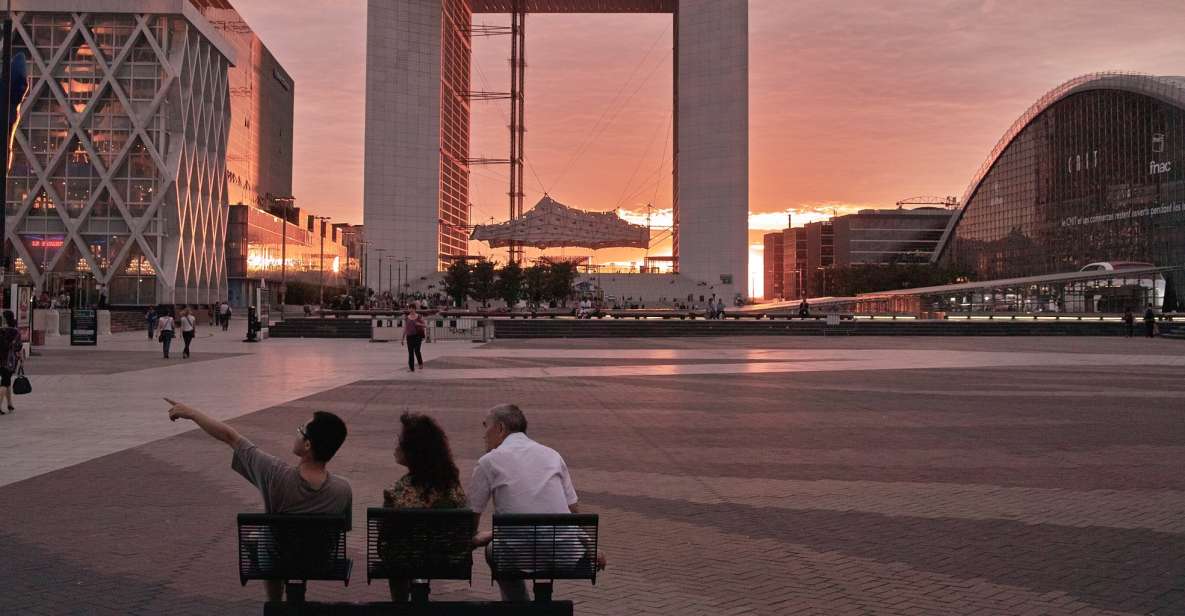
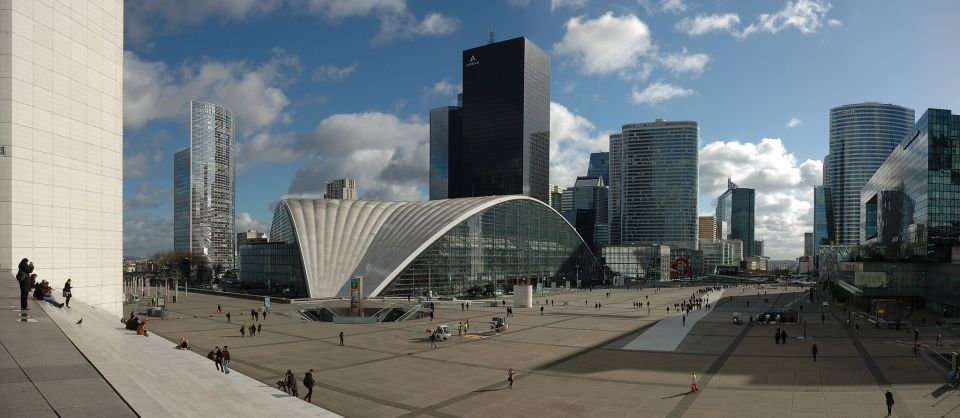
Paris is usually sold through limestone façades, café terraces, river views, and centuries-old monuments. La Défense offers almost none of that. Here, the city turns toward steel, glass, large geometric forms, and wide pedestrian spaces.
That contrast is the point. La Défense is the first business district of Europe, and the tour explains how it developed into a place where offices, monuments, public art, and planted areas share the same broad esplanade.
You can expect an urban setting designed for scale. Towers rise around open paved areas, while artworks appear in places where you might expect only office entrances or traffic infrastructure. The effect can feel austere at first, then playful when the sculptures come into view.
I would not book this walk expecting a prettified version of classic Paris. I would book it if you want to understand how the French capital expanded beyond its historic center and how modern architecture changed the city’s identity.
You can also read our reviews of more guided tours in Paris
Meeting beneath the Grande Arche
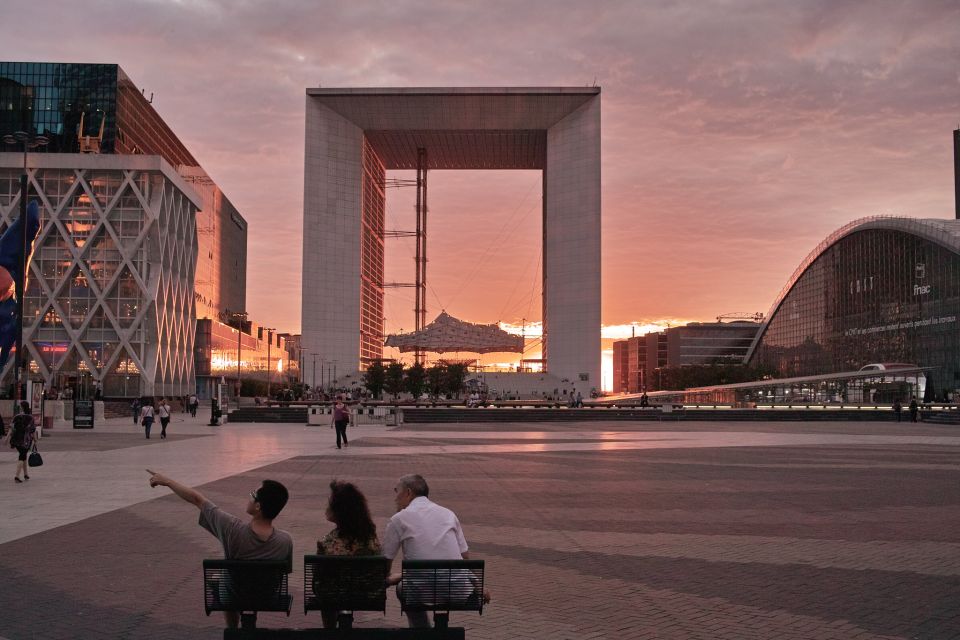
The walk begins outside La Défense metro station, on the square facing the Grande Arche. Your guide waits with a signboard bearing your name, and the tour returns to the same area at the end.
That fixed meeting point is useful. La Défense is large and can feel confusing when you first arrive, with several levels, office buildings, and open pedestrian routes. Meeting directly in front of the Grande Arche gives you a clear landmark to aim for.
Your first impression will likely come from the Grande Arche itself. Its huge, clean-lined form has a grand presence without the ornament you associate with the Arc de Triomphe. It is sleek, geometric, and deliberately futuristic.
The guide is meant to adjust the tour before you set off. Tell your guide if you care most about architecture, the district’s development, or public art. Since this is a private group, you have a better chance of spending time on the subjects that interest you instead of listening to a fixed talk meant for everyone.
The information provided does not name individual guides, so you cannot choose a particular guide in advance. The available guide languages are French, English, Spanish, Italian, German, Chinese, Portuguese, Russian, and Japanese.
Walking the two-hour La Défense route
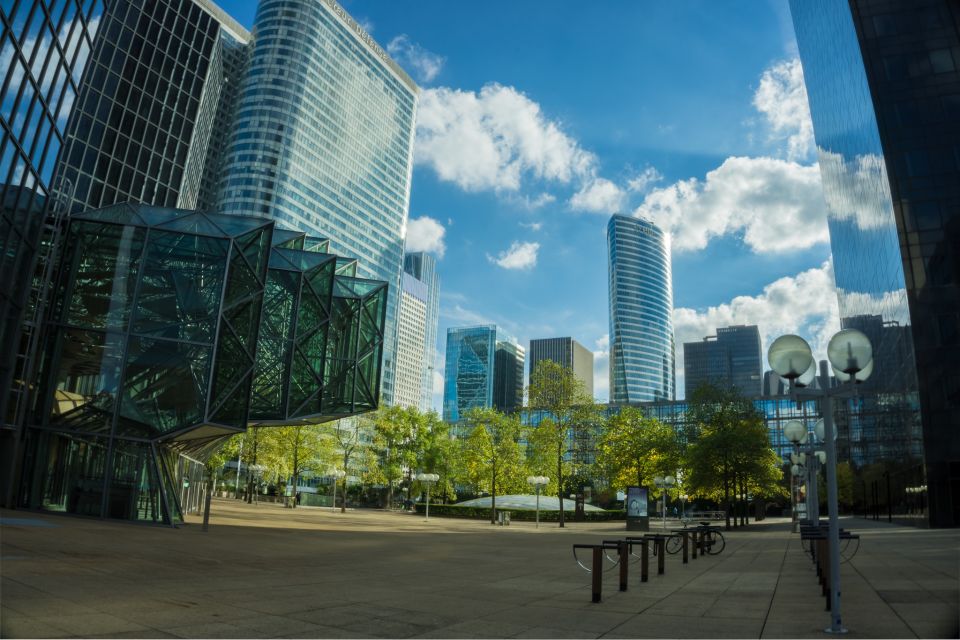
The main walk takes place around the La Défense esplanade. This broad pedestrian area combines hard surfaces with patches of greenery, giving the district a more open feel than its office towers might suggest.
The setting is easy to read as a statement about modern city planning. Instead of narrow streets leading to small squares, you move through a wide public space framed by tall buildings and large structures. The scale can make people feel small, but it also gives the art room to work.
You will not be riding between stops. Transportation is not included, and the experience is a walking tour from the metro meeting point. Comfortable shoes are essential, particularly if you are not used to spending two hours on paved surfaces.
The tour ends back at Agence SwissLife Paris La Défense, Frédéric Dieu, in the same general meeting area. That makes it easier to continue exploring La Défense afterward or return by metro without having to find a second meeting point.
Two hours is a sensible length for a first introduction. You can see the main public areas and several artworks without giving up half a day. The tradeoff is that the tour cannot cover every building, artwork, or chapter in the district’s development.
The open-air gallery and its odd characters
The most amusing part of the route is the collection of public artworks placed in the open. You might find yourself looking at the Red Spider, a large creature-like form that changes the feel of its surroundings. The Car on a Lamp-post is more comic and unexpected, turning an ordinary piece of street furniture into part of the art.
Cesar’s Finger gives the walk another memorable visual marker. These works help La Défense avoid becoming only a district of offices and corporate towers. They also give your guide useful points for explaining how art can shape public space.
I like this part of the tour because the objects are not hidden in a museum. You encounter them while walking through the district, often with the towers and esplanade behind them. The setting creates a useful question: should public art blend into a city, or should it interrupt your expectations?
You should keep your expectations practical. The supplied information does not promise entry into galleries, museums, or skyscrapers. The art is viewed outdoors, and entry tickets are not included. If you want indoor access to a particular building, ask about it before booking, since the activity is described as a walking tour only.
Choosing art, architecture, or history
The ability to change the focus is the strongest reason to consider the private format. You can ask for a route that gives more attention to the sculptures, a closer look at modern building design, or an explanation of how La Défense grew into Europe’s first business district.
An architecture-focused walk should suit anyone curious about the district’s clean shapes, high-rise forms, and relationship between open ground and tall buildings. You may find the discussion more useful if you already have a basic interest in modern design, since the district can otherwise seem like a collection of large office blocks.
A history-focused version gives the area more context. La Défense is not simply a newer part of Paris placed beside the old city. It represents a major shift in how the capital handled business, transport, public space, and monumental design.
An art-focused route is likely the easiest choice for a mixed group. The Red Spider, Car on a Lamp-post, and Cesar’s Finger offer clear visual stops, and the unexpected forms can keep younger visitors engaged. You can still ask questions about the district while moving from one installation to the next.
The private group arrangement also helps if your party has different interests. One person can ask about building design while another asks why a sculpture was placed in a particular spot. The benefit is less about luxury and more about control over the conversation.
You can also read our reviews of more private tours in Paris





What the low score means for your decision
The published rating is 1.7 from three ratings, so you should treat this as a caution rather than a minor footnote. There is not enough feedback to establish a broad pattern, but the score is plainly weak.
One verified booking from the Netherlands, dated March 14, 2024, described difficulty understanding the guide and a pace that did not suit the group. That matters on a walking tour. If you cannot hear the explanation or the guide moves too quickly, the private format loses much of its value.
I would handle this risk directly. At the start, ask the guide to speak clearly, pause at each artwork, and keep the walking pace comfortable. If you are booking in a language other than your first language, make sure the selected language is correct and that everyone in your group can follow it.
There is no named guide to request, and the supplied information does not promise a particular level of specialist expertise. That does not mean the tour will be poor, but it does mean you should book for the flexible format and unusual setting rather than assume a polished museum-style lecture.
Is $217 per person fair?
At $217 per person, this is an expensive two-hour walk. You are paying for a private guide and a route shaped around your interests, not for admission to a monument, transport, food, or a full-day excursion.
The price can make sense for a small group that values private attention. If several people share one booking, the guide can adapt the discussion to your questions and keep the route focused. The value is strongest when you care about La Défense in particular and would not get much from a general group walk.
For a solo visitor or a couple, the calculation is harder. You could see the esplanade and exterior public art without paying for entry, though you would miss the guide’s context and the chance to build a custom route. With the low published score and the communication concern, the price deserves careful thought.
Free cancellation up to 24 hours before the start gives you some flexibility, and you can reserve now while paying later. Those booking terms reduce financial risk if your Paris plans are still changing, but they do not change the underlying value question.
I would compare this tour with your own interests. If the Grande Arche, modern public art, and the history of Europe’s first business district are high on your list, a private explanation may be worthwhile. If you mainly want famous Paris sights, spend the money elsewhere.
Who should book this private walk?
I would recommend it most to visitors who have already seen some of central Paris and want a sharp change of scenery. It also suits repeat visitors, students of architecture, photographers interested in large urban forms, and families who find traditional monuments less engaging.
The tour can work well for a group with a clear subject in mind. Ask for art if you want visual surprises, architecture if you want to read the buildings, or history if you want the district placed in the story of Paris.
It is less suitable if you need a slow, highly polished tour with guaranteed communication quality. The March 2024 complaint about audibility and pace is especially important for older participants, people with hearing difficulties, or anyone who needs frequent stops. The activity data does not provide accessibility details, so ask the provider before booking if that is a concern.
It is also a poor fit if you want interiors or entry to the Grande Arche. The supplied details include no entry tickets and describe an outdoor walking route. You will be seeing the monument and artworks from public spaces.
Should you book the La Défense tour?
Book this if you want Paris to surprise you. The Grande Arche, broad esplanade, skyscrapers, and odd public sculptures offer a useful counterpoint to the city’s classical center. The private setup lets you spend your two hours on the subject you actually care about.
I would hesitate at $217 per person unless you are traveling with a group or have a strong interest in modern Paris. The low 1.7 score and the specific concern about hearing the guide make communication worth confirming before payment.
For the right audience, this is a focused introduction to a part of Paris that many people never see. For everyone else, the cost is high for a short outdoor walk with no admissions included.
FAQ
How long does the La Défense private tour last?
The tour lasts two hours.
Where does the tour begin?
Your guide waits outside La Défense metro station, on the square facing the La Défense Grande Arche.
How will I identify my guide?
The guide will have a signboard with your name on it.
Where does the tour finish?
The walk returns to Agence SwissLife Paris La Défense, Frédéric Dieu.
Is the tour private?
Yes. It is offered for a private group.
Which languages are available?
The available languages are French, English, Spanish, Italian, German, Chinese, Portuguese, Russian, and Japanese.
Are transportation and entry tickets included?
No. Transportation and entry tickets are not included.
Can I choose the subject of the tour?
Yes. You can ask to focus more on public art, architecture, or history.
Can I cancel for a full refund?
Yes. You can cancel up to 24 hours in advance for a full refund.