REVIEW · PARIS
Montmartre Walking Tour Cultural Charm and Tasty Treats
Book on Viator →Operated by TOUR TRIP · Bookable on Viator
Montmartre is where Paris feels most like a stage set, but this walk gives the neighborhood some useful context. You move from the Moulin Rouge and the movie-famous Café des 2 Moulins to old artists’ haunts, a surviving windmill, and the white dome of Sacré-Cœur. The stories about Van Gogh, Picasso, Renoir, and Toulouse-Lautrec are the main draw.
I like the compact two-hour route, which covers a lot without taking half your day. I also like the mix of famous sights and smaller streets, especially Place Émile Goudeau and the Wall of Love. The main consideration is the uphill walking on cobblestones, and the advertised end point is a little unclear: the route finishes at Sacré-Cœur, while the booking details say the activity ends back at the meeting point.
In This Review
- Key points at a glance
- Why this Montmartre walk works
- Starting by the Moulin Rouge
- Rue Lepic and the Café des 2 Moulins
- Moulin de la Galette and Montmartre’s old windmills
- Place des Abbesses and the Wall of Love
- Rue des Abbesses and the artists’ streets
- Place Émile Goudeau and the Bateau-Lavoir
- Saint-Pierre de Montmartre, one of Paris’ oldest churches
- Place du Tertre and the working art scene
- Sacré-Cœur and the view across Paris
- What the two-hour timing really means
- Who should book this Montmartre tour?
- Should you book it?
- FAQ
- How long does the Montmartre Walking Tour last?
- How much does the tour cost?
- What sights are included?
- Is admission included?
- Where does the tour begin?
- How large is the group?
- Can I cancel for a refund?
Key points at a glance
- The artists’ Montmartre: Follow streets tied to Van Gogh, Picasso, Modigliani, Renoir, and Toulouse-Lautrec.
- A useful two-hour sampler: See ten major places without committing to a full-day tour.
- A real neighborhood walk: Cafés, shops, portrait artists, old lanes, and small ateliers shape the experience.
- A strong final view: The steps of Sacré-Cœur give you one of Paris’ best city panoramas.
- Small-group size: The tour is limited to a maximum of 20 people, with a local professional guide.
- Good booking flexibility: Free cancellation is available up to 24 hours before the start time.
Why this Montmartre walk works
Montmartre can be confusing on a first visit. Its streets climb, twist, and change character quickly. One minute you are beside the Moulin Rouge, with traffic and bright signs all around you. Soon after, you are on a quieter lane lined with cafés, painted façades, and old houses.
That change is the point of the tour. Instead of treating Montmartre as one photo stop at Sacré-Cœur, the walk shows how the neighborhood developed its artistic identity. You hear about painters who lived and worked here, see places linked to their daily lives, and get a sense of why this hill attracted artists for so long.
At $40.48 per person, the cost is reasonable for a guided walk of about two hours. You are paying for a guide’s local storytelling rather than entry to an attraction. Since the stops are outdoor sights with free admission, the value depends heavily on the quality of the guide and the amount of useful context provided.
The maximum group of 20 is worth noting. That is not a private walk, but it is still more manageable than a large coach-style group. You should be able to hear the guide more easily, though Place du Tertre and the steps around Sacré-Cœur can be crowded and noisy.
You can also read our reviews of more walking tours in Paris



Starting by the Moulin Rouge
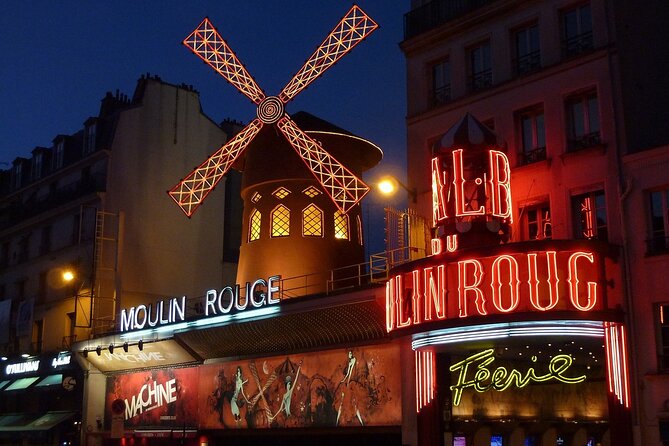
The walk begins at Cœur Sacré, 5 Rue Saint-Éleuthère, in the 18th arrondissement. The first listed stop is the Moulin Rouge, the famous cabaret associated with the can-can and Montmartre’s late-night artistic scene.
You get about ten minutes here, enough for an introduction rather than a full visit. The Moulin Rouge is best understood from the outside on this tour. There is no cabaret performance or admission included, so set your expectations accordingly.
The guide’s job at this stop is to connect the bright red windmill sign with the old bohemian character of the district. That context matters. The building is not just a well-known Paris photograph. It represents the entertainment side of Montmartre, where performers, artists, and nightlife helped shape the area’s public image.
The setting is busy and urban, so this is not the quietest part of the walk. Still, it gives you a lively opening before the route turns uphill toward the older streets.
Rue Lepic and the Café des 2 Moulins
Rue Lepic leads you away from the cabaret and into a more traditional Montmartre setting. The street has cafés and shops, making it a pleasant place to watch the neighborhood shift from nightlife district to residential hill town.
One stop is the Café des 2 Moulins, known for its appearance in the film Amélie. Film fans will recognize the connection, while others can simply enjoy seeing one of the district’s better-known cafés. The tour does not include a meal or a scheduled café break, so you should not count on sitting down here during the walk.
This part of the route is also where the uphill nature of Montmartre becomes clearer. You are walking rather than being driven from one sight to the next. That gives you a better feel for the streets, but it also means you should wear comfortable shoes and be ready for slopes and uneven paving.
Moulin de la Galette and Montmartre’s old windmills
Le Moulin de la Galette is one of the more distinctive stops because it points to a side of Montmartre that is easy to miss. The neighborhood once had several windmills, and this is identified as Paris’ last-standing windmill.
The guide explains how the site influenced artists such as Renoir and Van Gogh. That connection helps you read Montmartre as a place where ordinary scenes became artistic subjects. Cafés, dance halls, mills, and street life all found their way into paintings.
You spend roughly ten minutes here, so the stop will be brief. Do not expect a museum visit or a long examination of the windmill’s interior. Its value comes from the story and the setting, especially if you are interested in how artists turned local life into art.
Place des Abbesses and the Wall of Love
Place des Abbesses brings you to one of Montmartre’s most recognizable public spaces. The Abbesses Metro station is known for its Art Nouveau entrance, a small but worthwhile detail for anyone interested in Paris architecture.
The square also gives you a chance to see the neighborhood as a living part of Paris rather than only as an open-air art museum. Shops, cafés, and passing residents share space with people following tours and taking photographs.
From there, the route continues to Le Mur des Je t’aime, or the Wall of Love. This mural presents the words I love you in more than 300 languages. It is a simple idea, but it makes a good short stop and a popular photo backdrop.
The Wall of Love is not a grand monument. Its appeal is personal and visual. You can take a few minutes to look for a language you recognize, then move on without losing much time. The stop adds a softer note to a route otherwise shaped by cabarets, painters, churches, and grand views.






Rue des Abbesses and the artists’ streets
Rue des Abbesses offers some of the best walking on the route. You pass boutiques, cafés, and streets connected with artists who lived and worked in Montmartre.
The important thing here is the pace. A guided walk can point out details you might pass without noticing, such as an old building linked to an artist or a lane that retains the neighborhood’s village-like feel. The supplied information does not name the individual guide, so you cannot choose a particular guide when booking. What you can expect is a local professional leading the group through this section and explaining its artistic connections.
This is also a good place to pause mentally and compare Montmartre with central Paris. The grand avenues and formal monuments feel far away. The streets are smaller, and the experience depends more on atmosphere than on one major object.
Place Émile Goudeau and the Bateau-Lavoir
Place Émile Goudeau is a key stop for people who want more than postcard scenery. It marks the site of the Bateau-Lavoir, a former artists’ residence and studio associated with Picasso and Modigliani.
You are not visiting a working studio or a museum here. The value is historical context. The guide helps explain how artists shared space, exchanged ideas, and created work in a neighborhood that was then known for affordable rooms and an unconventional social life.
This is one of the strongest parts of the walk for art lovers. It moves the story away from famous names on a list and toward the places where creative work actually happened. You see how a modest square can carry an important role in the story of modern art.
The stop lasts about ten minutes. That is enough for an introduction, but anyone with a strong interest in Picasso or Modigliani may want to return later and spend more time exploring Montmartre independently.
Saint-Pierre de Montmartre, one of Paris’ oldest churches
Église Saint-Pierre de Montmartre offers a change of mood. The church dates to the 12th century and is one of the oldest in Paris.
After the cafés and artists’ addresses, this stop brings you into the older religious side of the hill. The contrast is useful. Montmartre is not only a 19th and 20th-century artists’ quarter. Its story reaches much further back.
The visit is listed as a ten-minute stop, so the guide’s treatment will likely be an introduction rather than a long church tour. If you want to study the church in detail, note its place on the route and consider returning when you have more time.
Place du Tertre and the working art scene
Place du Tertre is the most openly artistic stop on the walk. Portrait painters and street artists display their work here, continuing a tradition that has made Montmartre famous.
This is also one of the most crowded sections of the neighborhood. You may need to stay close to the guide as people stop for photographs, browse artwork, or sit at nearby cafés. The square can feel touristy, but it remains an important part of Montmartre’s identity.
I like this stop because it shows the difference between artistic history and present-day artistic commerce. The square is not a preserved moment from Picasso’s time. It is a working public place shaped by today’s artists, visitors, cafés, and street activity.
If you are tempted to buy a portrait or artwork, remember that this tour is moving on a schedule. You may have to return on your own later. The ten-minute stop is enough to take in the atmosphere, not to shop at length.
Sacré-Cœur and the view across Paris
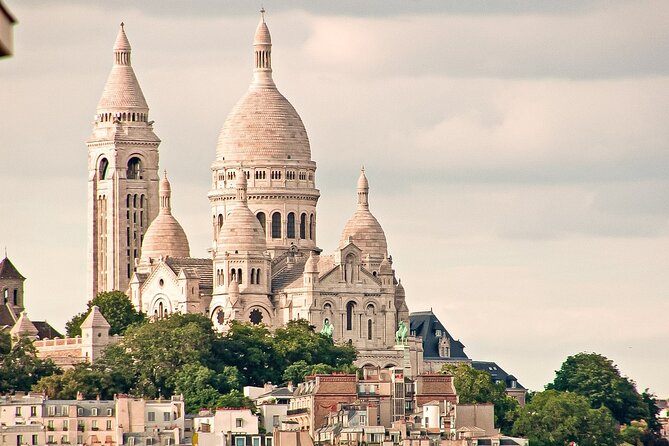
The route ends at the Basilique du Sacré-Cœur de Montmartre, the white basilica crowning the hill. This is the visual payoff of the walk.
You can take in the view from the steps, relax for a moment, or choose to explore the basilica’s interior. Admission to the tour’s stops is free, but the experience does not list a separate guided interior visit. The basilica is best treated as the final setting rather than a detailed church tour.
The climb is part of the experience, but it is also the main physical challenge. Montmartre’s slopes and stairs are manageable for most people, yet the walk is not a flat stroll. If you have mobility concerns, consider the hills, cobblestones, and time spent standing before booking. The tour notes that service animals are allowed and that most people can participate.
From the steps, Paris opens out below you. The panorama is especially satisfying after walking through the neighborhood rather than arriving by taxi and seeing the basilica in isolation. You have followed the hill upward, and the view gives you a clear sense of Montmartre’s position above the city.
What the two-hour timing really means
Ten stops in roughly two hours creates a brisk rhythm. Each place receives about ten minutes, with the remaining time used for walking and explanation. You will see a lot, but you will not have long at any one sight.
That format suits a first visit. You get a clear orientation, learn which streets interest you, and can return later to the places you want to explore more carefully. It is less suitable if you want extended photography, café time, church interiors, or a long discussion of individual artists.
The mobile ticket makes arrival simple, and confirmation is provided at booking. The meeting point is Cœur Sacré at 5 Rue Saint-Éleuthère. Since the details describe the route as ending at Sacré-Cœur but also say the activity ends back at the meeting point, ask the guide to confirm the final stopping place at the start.
The tour runs near public transportation, which is useful in a hilly neighborhood. Exact transit directions are not provided, so check your route before setting out and allow enough time to reach the meeting point.
Who should book this Montmartre tour?
I would choose this walk if you are visiting Montmartre for the first time and want a sensible introduction to its art, streets, and major sights. It is also a good match for film fans interested in Amélie, art lovers curious about Picasso and Van Gogh, and couples looking for a scenic Paris outing with cafés and a sunset-friendly viewpoint.
The walk may be less satisfying if you already know Montmartre well or want a specialized art lecture. The guide covers many places, so the storytelling has to remain broad. It also does not include food, drinks, attraction tickets, or tips.
The French comments supplied for the experience repeatedly praise the romantic setting, cobbled streets, small cafés, artistic mood, and view from Sacré-Cœur. Those are exactly the strongest reasons to book it. You get the pleasure of wandering, but with enough direction to avoid spending the whole visit guessing which streets matter.
Free cancellation is available if you cancel at least 24 hours before the start time. Cancellations made later are not refunded, and changes within that period are not accepted.
Should you book it?
Book this tour if you want a quick, guided introduction to Montmartre with a clear artistic thread and a strong final view. At $40.48, it offers fair value for two hours of local guidance, especially with a group capped at 20 people.
Skip it if you prefer to wander alone, spend long stretches in cafés, or explore the basilica and artists’ sites in depth. For most first-time visitors, though, this is a practical way to understand why Montmartre feels so different from the rest of Paris. Just bring good shoes, expect an uphill walk, and confirm where the group finishes.
FAQ
How long does the Montmartre Walking Tour last?
The tour lasts approximately two hours.
How much does the tour cost?
The listed price is $40.48 per person.
What sights are included?
The route includes the Moulin Rouge, Rue Lepic, Le Moulin de la Galette, Place des Abbesses, Le Mur des Je t’aime, Rue des Abbesses, Place Émile Goudeau, Église Saint-Pierre de Montmartre, Place du Tertre, and the Basilique du Sacré-Cœur de Montmartre.
Is admission included?
The tour includes a guided visit of Montmartre and a local professional guide. The listed stops have free admission. Food, drinks, and tips are not included.
Where does the tour begin?
The meeting point is Cœur Sacré, 5 Rue Saint-Éleuthère, 75018 Paris, France.
How large is the group?
The activity has a maximum of 20 travelers.
Can I cancel for a refund?
Yes. You can cancel for a full refund at least 24 hours before the experience start time. Cancellations or changes made less than 24 hours before the start time are not accepted for a refund.