REVIEW · PARIS
Latin Quarter Private Walking Tour
Book on Viator →Operated by My Paris Insider · Bookable on Viator
This is Paris, but at walking pace. You’ll trace the Latin Quarter from medieval studies to Roman walls, with a local guide keeping it lively and understandable.
Two things I like a lot: the private format (your group only, up to seven) and the mix of big landmarks with smaller stops you’d usually skip. Most site entries are free, so your money goes to the guide and the time—not just tickets.
One thing to consider: the pace is still a walking tour. You’ll want moderate fitness, and you should plan to move for the full 2 hours.
In This Review
- Key moments that make this tour worth your time
- Latin Quarter at human speed: what this private walk feels like
- Price and value: paying for a guide, not a ticket stamp
- Stop 1: Quartier Latin streets and how to read what you’re walking past
- Stop 2: Arènes de Lutèce, the Roman reminder you can’t ignore
- Stop 3: Collège des Bernardins and the medieval university vibe
- Stop 4: St-Étienne-du-Mont and the shrine inside
- Stop 5: Panthéon (ticket not included) and the difference between church and mausoleum
- Stop 6: Place de la Contrescarpe and the café-square break
- Stop 7: Fontaine Saint-Michel and the classic Paris meeting point
- Stop 8: Luxembourg Gardens, where the Latin Quarter relaxes
- Stop 9: 5th arrondissement and the neighborhood overview moment
- Stop 10: La fontaine Medicis, inspiration and style
- Stop 11: Montagne Sainte-Geneviève and the small hill that matters
- Stop 12: Place de la Sorbonne for the academic postcard look
- Stop 13: A second Quartier Latin loop to wrap the meaning
- What to wear, bring, and do after: practical tips that make it smoother
- Who this tour is best for
- Should you book this Latin Quarter private walk?
- FAQ
- How long is the Latin Quarter Private Walking Tour?
- Where does the tour start and where does it end?
- Is this tour private?
- How many people can be in the group?
- Is the tour offered in English?
- Are tickets included for the sights you visit?
- What kind of fitness level do I need?
- What is the cancellation policy?
- When will I receive confirmation?
Key moments that make this tour worth your time

- Private group up to seven means questions get answered in real time, not later in a group lecture
- Mostly free admissions help the value, with only one notable paid highlight at the Panthéon
- Latin Quarter focus for about 3 hours of total time on the subject, with breaks at key landmarks
- A Roman-era stop at the Arènes de Lutèce gives you a “wait, this is that old?” moment
- Classic Paris scenery at Luxembourg Gardens and the Fontaines areas keeps it photogenic without feeling theme-park-y
- Ends at Saint-Michel—easy to continue your evening on foot or by metro
Latin Quarter at human speed: what this private walk feels like

The Latin Quarter can overwhelm you fast. Streets twist, student life shows up everywhere, and the landmarks look like they’re stacked on top of older landmarks. This is the antidote: a structured walk that still feels flexible.
You’ll start at 7 Rue de Poissy (75005), then work your way through the historic core. The ending point is near the Saint-Michel metro (Fontaine Saint-Michel, Pl. Saint-Michel), so you finish right where lots of people want to go next.
You’re booking a private tour, which matters more here than in many other cities. In Paris, timing is everything—lines, street crossings, and even the angle of a view. With a small private group, you can slow down when something catches your eye, and speed up when you’re ready for the next stop.
Also: it’s English, and that’s a real advantage in this area. The Latin Quarter’s layers—Roman, medieval, revolutionary, modern—can get confusing fast without a guide translating what you’re seeing.
You can also read our reviews of more walking tours in Paris



Price and value: paying for a guide, not a ticket stamp

At $305.54 per person for a tour that’s about 2 hours, this isn’t a bargain-bin deal. But it’s priced like what it is: a private walking experience led by a local guide.
Here’s how the value holds up:
- You’re paying for interpretation. The Latin Quarter isn’t just pretty buildings. It’s an education in how Paris evolved. A guide makes that readable without you needing to study maps and plaques for hours.
- Most entrances are free. Stops like the Arènes de Lutèce, Collège des Bernardins, St-Étienne-du-Mont, and Luxembourg Gardens are listed with free admission time. That keeps your money focused on the tour itself.
- Only one major paid item appears on the path: the Panthéon has admission not included. So you can treat that as optional-on-the-day based on your interests.
If you’re traveling with a small group (or want a “no sharing” vibe), the pricing can feel fair. If you’re going solo and comparing to group tours, you may feel it more. But the private format is the whole point.
Stop 1: Quartier Latin streets and how to read what you’re walking past

The walk begins in the Quartier Latin, and you spend about 1 hour 30 minutes there in two larger stretches. That’s smart. This isn’t a quick drive-by of famous corners; it’s a guided walk through the neighborhood’s main story.
In practical terms, I love this kind of start because you get your bearings fast. Early on, you learn what kinds of buildings to look for—religious sites, academic spaces, public squares—and you start noticing how the area’s identity shows up in street layout.
What to expect: your guide points out key landmarks while also connecting them to the daily feel of the neighborhood. Even when you’re just standing at a corner, you’re learning why it matters.
A drawback: because this is a longer block of walking, you’ll want comfortable shoes. There’s no “sit down and just listen” mode for most of it.
Stop 2: Arènes de Lutèce, the Roman reminder you can’t ignore

Next up is the Arènes de Lutèce. It’s described as the oldest monument built in Paris that still partially exists, dating to the 1st century AD. This arena could seat about 17,000 people, and it served as both a theatre and an amphitheatre for gladiatorial fights.
Even if you only know Rome from a handful of famous names, this stop lands emotionally. It’s one of those moments where you look at the shape of the structure and think: how did this survive, and how did Paris grow around it?
Time on this stop is short—about 15 minutes—but it’s enough to see the scale and get the context. The big advantage is that the Roman layer is not just mentioned; it’s shown in front of you, right in the middle of modern streets.
Stop 3: Collège des Bernardins and the medieval university vibe

Then you’ll reach the Collège des Bernardins, a former Cistercian college connected to the University of Paris. It’s one of the largest and oldest medieval buildings in Paris, created in the 13th century.
The key idea here is function. This wasn’t a grand museum. It was built to welcome and train young monks. Over the 13th to 15th centuries, it trained thousands of monks across Europe.
This stop is only around 5 minutes, so you don’t come expecting an extended slow-tour of architecture. But the guide can still give you the “why it matters” context in a short amount of time. That’s one of the tour’s strengths: even micro-stops come with meaning.
A small consideration: because the time is brief, you’ll get the best experience if you’re ready to listen and move on quickly.
You can also read our reviews of more private tours in Paris
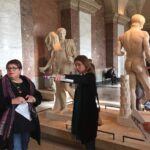





Stop 4: St-Étienne-du-Mont and the shrine inside

At St-Étienne-du-Mont, the tour shifts from institutions to faith and identity. The church sits on the Montagne Sainte-Geneviève, and the shrine of Geneviève, the patron saint of Paris, is inside.
It’s listed as about 10 minutes. In that window, you can usually see enough to appreciate the church’s place in the neighborhood. More importantly, you learn why this saint is tied to the idea of Paris itself—not just a local footnote.
This is the kind of stop that works well if you like atmosphere. Even if you’re not a church person, a good guide helps you understand what people were building and protecting.
Stop 5: Panthéon (ticket not included) and the difference between church and mausoleum

The Panthéon is a major landmark in the Latin Quarter area. It was built as a church and later converted into a mausoleum for the remains of distinguished French people.
You only spend about 5 minutes there, and admission is not included. That matters for your planning. If you want inside-time (views, tomb details, that whole experience), you’ll likely have to pay separately and potentially extend your day.
Still, the quick approach works. It gives you the “what am I looking at, and why did its role change?” context without forcing you to commit right on the spot.
My advice: if the Panthéon theme interests you—French political history, major figures, the transformation from worship to memory—plan to add time after the tour. If not, the exterior context is still worth it.
Stop 6: Place de la Contrescarpe and the café-square break

After the heavier history stops, you’ll hit Place de la Contrescarpe, a typical French square with cafés.
This is about 5 minutes—not a long break, but a breathing spot. I like these mini-squares on walking tours because they reset your eyes. You stop looking at stone and start noticing street life, pacing, and the small rhythms that make Paris feel like Paris.
If you’re sensitive to frequent stopping, you’ll still appreciate this one. It’s short and gives you that “okay, we’re in the neighborhood now” feeling.
Stop 7: Fontaine Saint-Michel and the classic Paris meeting point
Next is Fontaine Saint-Michel, a fountain built in 1860, and it’s roughly 5 minutes on the route.
This fountain is also a visual anchor for your day because the tour ends next to metro station Saint Michel. In other words, even if you don’t plan to linger, you’ll likely pass this area again as you continue exploring.
Practical tip: if you want a photo, aim for a moment when you aren’t fighting a crowd. The guide can help time the pause so you aren’t standing there for too long.
Stop 8: Luxembourg Gardens, where the Latin Quarter relaxes
Now comes one of the best parts: Luxembourg Gardens, listed for about 30 minutes. The Jardin du Luxembourg was created in 1612 by Marie de Medicis, the widow of King Henry IV. Today, it’s owned by the French Senate.
This stop is where the walk shifts from “history stops” to “slow Paris.” You’ll get time to actually look around: paths, open space, and that calm contrast to the surrounding city streets.
For me, the value is simple: the tour doesn’t drag you from one site to another without rest. You get a chunk of time where you can breathe, stroll a little, and take photos that don’t feel rushed.
Possible drawback: depending on the season, gardens can be busy. The guide can’t erase that, but having a plan helps you avoid wasting time circling.
Stop 9: 5th arrondissement and the neighborhood overview moment
There’s also a quick 5 minutes stop described as discovering main attractions of this old Paris neighborhood.
Think of this as a bridge. After the gardens, you’re re-centered in the broader area. It’s useful for tying everything together—what you saw earlier and what you’ll notice next as you walk.
Stop 10: La fontaine Medicis, inspiration and style
Inside the Luxembourg Gardens area, you’ll also reach La fontaine Medicis. It was built in 1630 by Marie de Medicis and later renovated and rebuilt in 1866. It’s described as one of the nicest fountains in Paris, and the tour notes that Victor Hugo was getting inspiration there.
Time here is about 5 minutes. That’s perfect for a fountain stop. You don’t need an hour to appreciate the structure and symbolism once you know the story behind it.
If you love French art and literature connections, this is the kind of fact that makes the site feel personal rather than generic.
Stop 11: Montagne Sainte-Geneviève and the small hill that matters
Next is Montagne Sainte-Geneviève, a small hill with several old Parisian monuments. It’s listed for about 15 minutes.
Even though it’s called a hill, what you’ll feel is perspective. You start to understand why this area became such a symbolic spot for faith and learning—because elevated ground and landmark density shaped the neighborhood’s identity.
This is also a good segment if you enjoy “walking and noticing.” You’ll likely look at buildings differently after a hill like this.
Stop 12: Place de la Sorbonne for the academic postcard look
You’ll stop at Place de la Sorbonne, a small square in front of the Sorbonne, for about 5 minutes.
This is a quick visual payoff. It helps you connect the academic theme in the neighborhood—monks, medieval colleges, the broader University of Paris story—to the modern street scene.
Because time is short, your best experience here comes from listening. The value is in what the guide links to the bigger story of the Latin Quarter.
Stop 13: A second Quartier Latin loop to wrap the meaning
The route brings you back into Quartier Latin again for about 1 hour 30 minutes to discover main landmarks of this historic neighborhood.
This repeat isn’t duplication for its own sake. It’s how you finish with clarity. After seeing Roman remnants, medieval buildings, religious sites, and gardens, the neighborhood stops feeling like random stops and starts feeling like a continuous narrative.
At the end, you land near Fontaine Saint-Michel, so you can continue easily—dinner, night stroll, or just more wandering with better context.
What to wear, bring, and do after: practical tips that make it smoother
This is a walking tour, and the duration is about 2 hours. You should plan on steady movement and occasional pauses for landmark viewing.
What helps:
- Comfortable shoes. You’ll thank yourself at the halfway mark, especially in the Latin Quarter streets.
- Light hydration. Snacks aren’t included, so bring something small if you get hungry.
- Keep your Panthéon decision flexible. Admission isn’t included, and the stop itself is short. Decide later if you want to go inside.
After the tour, you’re placed well. Ending near Saint-Michel means you’re back in a central zone with transit access.
Who this tour is best for
This private walking tour works especially well if:
- You want a guide-led explanation of what you’re seeing, not just photos
- You’re traveling with a group up to seven and want a shared pace
- You like classic Paris mix: Roman-era traces, medieval institutions, church history, and gardens
- You’d rather ask questions in real time than sit through a larger group format
It’s also a good fit for couples or small families who prefer structure. The tour notes moderate physical fitness, so plan for walking, not just standing.
Should you book this Latin Quarter private walk?
If you want an easy win in Paris planning, I’d say yes—especially if private time and guide clarity matter to you. The free admissions across many stops make it feel smarter than tours where you’re paying mostly to enter museums. The ending at Saint-Michel is also a real advantage for not losing time getting oriented afterward.
I’d think twice if you hate walking, or if you mostly want inside-views and long monument time. The Panthéon stop is quick, and admission isn’t included, so you might want to pair this with your own follow-up plan.
Bottom line: book it if you want your Latin Quarter to make sense fast, with a small-group guide doing the translation from stone and street layout into a story.
FAQ
How long is the Latin Quarter Private Walking Tour?
It’s listed as about 2 hours.
Where does the tour start and where does it end?
The tour starts at 7 Rue de Poissy, 75005 Paris and ends at Fontaine Saint-Michel, Pl. Saint-Michel, 75005 Paris, next to the metro station Saint Michel.
Is this tour private?
Yes. It’s a private tour/activity, and only your group participates.
How many people can be in the group?
The tour is described as ideal for groups of up to seven people.
Is the tour offered in English?
Yes, it’s offered in English.
Are tickets included for the sights you visit?
Most stops list free admission, but Panthéon admission is not included.
What kind of fitness level do I need?
You should have moderate physical fitness since it’s a walking tour.
What is the cancellation policy?
You can get a full refund if you cancel at least 24 hours in advance. If you cancel less than 24 hours before, the amount paid isn’t refunded.
When will I receive confirmation?
Confirmation is received at the time of booking.