REVIEW · PARIS
The Treasure of Saint-Louis : Île de la Cité & Saint-Louis
Book on GetYourGuide →Operated by Tous Azimut · Bookable on GetYourGuide
The fun here is not simply walking around central Paris. You are given a map and notebook, then asked to use your sense of direction, observation, and logic to follow a trail linked to Saint-Louis, the beloved medieval king. The route crosses both islands and brings Notre-Dame and lesser-known corners into one compact game.
I like the two-island design because you see a broader slice of Paris than on a single-site visit, and I like the way the guide keeps the group involved instead of delivering a long speech. The main thing to consider is the format: if you want detailed historical explanations at every stop, a traditional walking tour may suit you better.
In This Review
- Key points at a glance
- A treasure hunt in the middle of Paris
- Starting at Square Barye on Île Saint-Louis
- Crossing to Île de la Cité
- How the game changes the sightseeing
- What the guide adds to the 90 minutes
- Price and value at $35 per person
- Timing, meeting point, and practical details
- Who will enjoy this most
- Should you book The Treasure of Saint-Louis?
- FAQ
- How long does The Treasure of Saint-Louis last?
- Where does the activity begin?
- Where is Square Barye?
- Which places does the tour cover?
- Is Notre-Dame de Paris included?
- What is included in the price?
- Is transportation included?
- What languages are available?
- Is the activity suitable for children?
- Can I cancel for a refund?
Key points at a glance
- A two-island route: Spend about 45 minutes on Île Saint-Louis and 45 minutes on Île de la Cité.
- A map-and-notebook challenge: You solve clues and follow the trail rather than simply walking behind a guide.
- Family-friendly difficulty: The activity is rated 2 out of 5 and is designed for all ages.
- Notre-Dame is part of the route: You see the great cathedral along with more and less famous places.
- A personable guide matters: Max is named in one family’s account, and the guide is there to answer questions and add anecdotes.
- Good booking flexibility: The price is $35 per person, with free cancellation up to 24 hours before the start.
A treasure hunt in the middle of Paris
Central Paris can feel like a greatest-hits parade: Notre-Dame, the Seine, grand façades, and crowds moving in every direction. This experience changes the pace. Instead of treating the islands as a string of photo stops, it turns them into a puzzle.
You start with a guide, a map, and a notebook. The Saint-Louis theme gives the walk a story, while the clues give you a reason to pay attention to your surroundings. You may need to work out where you are, notice a detail, or connect one instruction to the next. The point is not speed. It is to make the city itself part of the game.
The activity is listed as difficulty 2 out of 5, so you should not expect an intense escape-room test. It is meant to work for families and mixed-age groups. Children can take part in the searching and solving, while adults get a guided look at two of Paris’s central islands.
The guide remains important. This is not a self-guided worksheet handed to you at the meeting point. The guide leads the route, explains the rules, responds to questions, and adds anecdotes along the way. One guide named in the available information is Max, who was praised for his friendly manner and his ability to make the family visit pleasant.
You can also read our reviews of more tours and experiences in Paris.



Starting at Square Barye on Île Saint-Louis
The meeting point is Square Barye, at the eastern end of Île Saint-Louis. You meet inside the square, in front of the statue. That detail matters because the island has several possible entrances and the square is not the kind of place you want to search for while the clock is ticking.
The opening 45 minutes take place on Île Saint-Louis. This island has a calmer, more residential feel than the busiest parts of central Paris, and it makes a sensible setting for the first part of a direction-based game. Your group begins by getting familiar with the map and the trail.
Expect to walk while solving tasks rather than stopping for a formal talk at every corner. The material describes the activity as a visit, guided tour, and walk, but the central feature is the interactive search. You may be asked to observe, orient yourself, and use clues in the notebook to decide where the route goes next.
This style works well if you enjoy having something to do with your hands and mind. A child who might lose interest during a standard lecture has a role to play. Adults who already know Paris may also find the format fresh, since the challenge encourages you to notice details you could otherwise pass without a second look.
The tradeoff is that the first island is not presented as a full historical course. The guide can answer questions and offer anecdotes, but the game sets the rhythm. If your priority is a detailed account of every building, church, and street, ask yourself if solving clues is more important to you than collecting facts.
Crossing to Île de la Cité
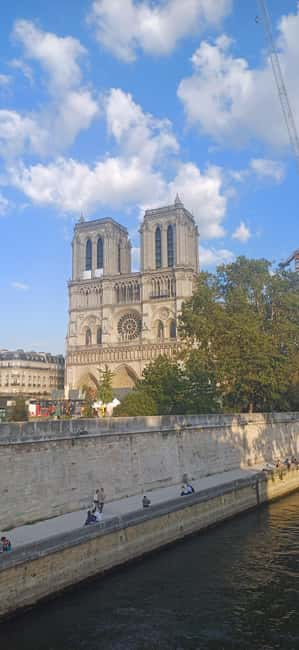
The second 45-minute section takes place on Île de la Cité, the larger and more famous of the two islands. This is where the route brings in Notre-Dame de Paris, one of the defining sights in the center of the city.
The value of including both islands is clear. You are not seeing Notre-Dame in isolation and then heading off. You get a compact comparison between two adjoining parts of Paris, with the activity linking them through one story and one set of clues.
The route also includes places that are more or less famous. That wording is useful because it signals a mix of major sights and smaller points of interest. You should expect the cathedral to be the headline stop, but not the only reason to join. The guide uses the walk to show you other places worth seeing, even if they are not on every first-time Paris itinerary.
The Notre-Dame portion should be understood as a sight on the walking route. The supplied details do not promise entry inside the cathedral, a reserved visit, or a cathedral-focused lecture. If you want an interior visit, check that separately rather than assuming it is part of this activity.
On Île de la Cité, the notebook and map continue to shape the experience. The second half is not simply a sightseeing add-on. You keep participating, looking for information, and working out the next step. That gives the walk a satisfying sense of progress, especially for families who like to reach a solution together.
How the game changes the sightseeing
A normal guided walk asks you to listen and look. This one asks you to listen, look, and respond. That extra task can make a short route feel more active.
The direction element is especially useful in Paris, where the river, bridges, narrow streets, and large landmarks can make orientation feel easy until you turn a corner. The activity tests that basic city skill in a gentle way. You are not being graded in a serious sense, but you are encouraged to make decisions rather than wait for the guide to point out everything.
Observation matters just as much. The supplied information does not list the exact puzzles, so you should not expect a fixed set of famous riddles or a particular final prize. What you can count on is a trail that uses the map, notebook, and features of the two islands.
Logic also enters the mix. The challenge is not described as physically demanding, and the low difficulty rating supports that. Its challenge comes from interpreting clues and cooperating with the group.
I would call this a strong choice for families with different interests. One person can enjoy the history, another can focus on the route, and children can help search and solve. The format is also suitable for people who want to see central Paris without committing to a much longer excursion.
What the guide adds to the 90 minutes
The guide is more than a route marker. French and English are available, and the guide explains the activity, keeps the trail moving, and answers questions. One account specifically highlights Max’s kindness, anecdotes, and willingness to respond to questions during a family visit.
That combination matters because a puzzle can become frustrating if the instructions are unclear or the group gets stuck. A live guide can adjust the pace and help the activity remain enjoyable. The experience is listed as adaptable to all ages, and a human guide is what makes that practical.
At the same time, you should set the right expectation. The strongest part of this format is participation, not a constant stream of historical commentary. One booking party enjoyed the interactive format but had expected more explanation. That is the clearest warning for anyone choosing between this and a conventional guided tour.
I would book it if you want stories and facts in small portions, mixed with a game. I would look elsewhere if your ideal Paris walk means standing at each monument while a guide gives a long historical account.





Price and value at $35 per person
At $35 per person, the price sits in a reasonable range for a 90-minute guided activity, especially since it includes both islands, a live guide, a map, and a notebook. You are paying for an organized experience, not just directions between landmarks.
The value improves if you are traveling with children or with people who need a reason to stay engaged. A short activity that holds everyone’s attention can be worth more than a longer walk that leaves part of the group trailing behind. The two-island route also gives you a useful introduction to a central Paris area in one booking.
The value is less certain if you mainly want a lecture. Since the game takes some of the available time, the guide cannot spend every minute on historical detail. You may learn plenty through the anecdotes and questions, but the experience is built around doing rather than listening.
The six available ratings are all five out of five, with especially strong praise for the originality, playful design, family suitability, and friendly guide. One French family described it as a surprising and engaging way to see Paris, while another called the treasure hunt suitable for all ages. Those strengths line up with what the activity promises: an active, social walk rather than a passive tour.
Timing, meeting point, and practical details
The experience lasts 90 minutes, divided into roughly 45 minutes on each island. That makes it easy to fit into a day of sightseeing, though you should allow extra time around it if you have a fixed reservation afterward.
You meet at Square Barye, inside the square and in front of the statue. The square is at the eastern end of Île Saint-Louis. Transportation is not included, so you need to arrange your own way to the starting point and return from wherever the route finishes.
The description says the activity begins at Square Barye and may finish wherever the trail leads. That makes the end point less predictable than the meeting point. It is a good idea not to schedule a tight appointment immediately after the walk.
French and English are offered. The activity is wheelchair accessible, which is important information for anyone planning a group with different mobility needs. Since the supplied details do not describe the exact street surfaces or route conditions, contact the provider if you need specific accessibility information beyond the stated access.
Booking is flexible. You can reserve now and pay later, and cancellation is free up to 24 hours before the start for a full refund. Starting times vary, so check availability for your chosen date.
Who will enjoy this most
I would recommend this activity to:
- Families looking for a shared challenge rather than a long talk.
- First-time Paris visitors who want Notre-Dame and both islands in one short outing.
- Repeat visitors who already know the major sights and want a different way to look at them.
- Couples or friends who enjoy maps, clues, and light problem-solving.
- Groups with French or English speakers, since both languages are available.
I would be more cautious if you dislike puzzles, prefer to walk at your own pace, or want a detailed academic history of Île de la Cité and Île Saint-Louis. The guide is there to explain and help, but the game remains the main event.
The difficulty rating of 2 out of 5 is reassuring for casual participants. You do not need to be a puzzle expert. Still, the activity may be more enjoyable when everyone takes part, since the pleasure comes from comparing observations and reaching the next answer together.
Should you book The Treasure of Saint-Louis?
Book it if you want a family-friendly Paris walk with a purpose. The route covers both islands, includes Notre-Dame, uses a map and notebook, and gives you a chance to solve clues with a live guide. At $35 per person, it offers a fair amount of structure and shared activity in 90 minutes.
Skip it in favor of a traditional walking tour if detailed explanations are your top priority. This is a playful introduction to the islands, with history and anecdotes woven into the search. For families and curious repeat visitors, that mix is the main reason to go.
FAQ
How long does The Treasure of Saint-Louis last?
The activity lasts 90 minutes.
Where does the activity begin?
It begins at Square Barye, inside the square and in front of the statue.
Where is Square Barye?
Square Barye is at the eastern end of Île Saint-Louis.
Which places does the tour cover?
The route covers Île Saint-Louis and Île de la Cité.
Is Notre-Dame de Paris included?
Notre-Dame de Paris is one of the places you will see during the route. Entry inside the cathedral is not specified.
What is included in the price?
The experience includes the tour of both islands, a live guide, a map, and a notebook.
Is transportation included?
No. Transportation is not included.
What languages are available?
The activity is offered in French and English.
Is the activity suitable for children?
Yes. It is described as family-friendly, adaptable to all ages, and rated difficulty 2 out of 5.
Can I cancel for a refund?
You can cancel up to 24 hours in advance for a full refund. You can also reserve now and pay later.