REVIEW · PARIS
Private Louvre Tour for Teenagers
Book on GetYourGuide →Operated by MEET THE LOCALS FOR FAMILIES · Bookable on GetYourGuide
The clever twist here is that the Louvre becomes a crime scene, and your teenagers become investigators. Instead of asking young visitors to admire one masterpiece after another, the guide gives them a mission: solve the 1911 theft of the Mona Lisa by working through eleven challenges and five suspects.
I like the private format, which keeps the pace suited to your family, and I like the way famous works become clues rather than isolated stops. The main drawback is the price: $784 for up to four people is a serious outlay, especially for a family of two or three.
In This Review
- Key points for families
- Why the Mona Lisa theft makes a strong Louvre game
- Meeting Louis XIV before the glass pyramid
- Inside the Louvre, the case begins
- Venus de Milo: a famous clue, not just a photo stop
- Winged Victory and the art of keeping teens moving
- Apollo Gallery and the final evidence
- What the private format really adds
- Is $784 good value?
- Who should book this Louvre experience?
- Booking details worth knowing
- Should you book Who Stole the Mona Lisa?
- FAQ
- How long does the Private Louvre Tour for Teenagers last?
- Where does the tour meet?
- Is the Louvre entrance ticket included?
- What language is the tour offered in?
- How many people can join the private tour?
- What should I bring to the Louvre?
Key points for families
- A true-crime puzzle inside the Louvre: Follow the case of the Mona Lisa theft from the empty frame discovered in 1911 to the final culprit.
- Eleven challenges for teenagers: Art facts, observation, listening, and deduction all play a part.
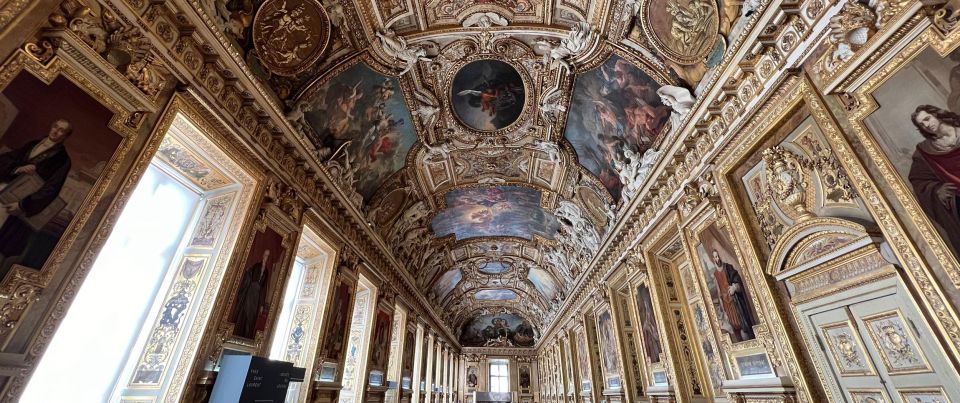
- Three major Louvre highlights: The route includes the Venus de Milo, Winged Victory of Samothrace, and Apollo Gallery.
- Private attention for one group: Your guide can adjust explanations and the pace to your family.
- Skip-the-line museum entry: You avoid buying separate Louvre admission tickets, though security and museum procedures still apply.
- A practical 150-minute visit: Long enough for a focused introduction to the museum without turning into an all-day art marathon.
Why the Mona Lisa theft makes a strong Louvre game
The central story is wonderfully simple. On Tuesday morning, August 22, 1911, the Mona Lisa was gone. In its place hung an empty frame. There were no clear clues, and the theft became a huge public sensation.
That setup gives your teens a reason to pay attention. They are not just hearing that Leonardo’s painting is important. They are trying to work out who took it, how the crime could have happened, and which details matter.
The guide acts as the Chief Investigating Officer. You receive a treasure hunt kit for each teenager, then work through eleven tasks connected to works in the museum. Five suspects enter the case, and each challenge helps narrow the possibilities.
I especially like this approach for families with children who would rather solve a puzzle than listen to a standard lecture. The format also gives quieter teens something specific to do. They can study an image, listen for a clue, or compare evidence instead of feeling put on the spot with a broad question such as what do you think of this painting.
There is still plenty of art learning here. The crime story is the framework, not the whole show. Your guide uses well-known masterpieces to explain symbols, details, artists, and the way the Louvre’s collections connect across time.
You can also read our reviews of more private tours in Paris



Meeting Louis XIV before the glass pyramid
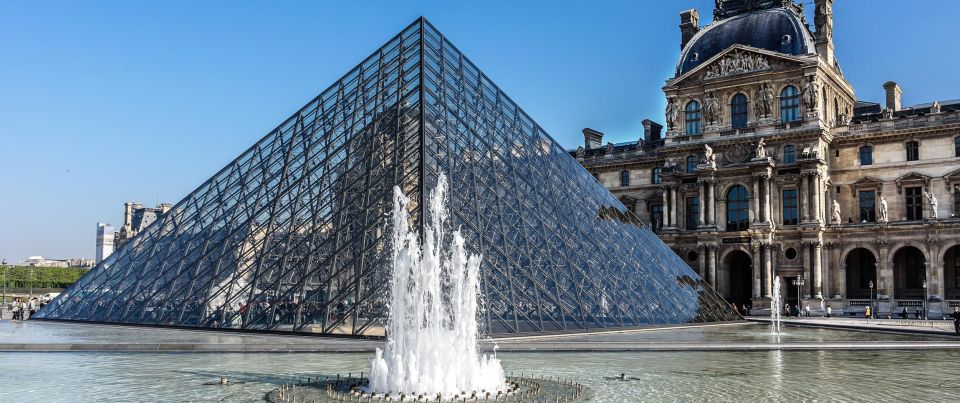
The meeting point is by the equestrian statue of Louis XIV near the Louvre glass pyramid, at 8 Place du Carrousel. This matters because the Louvre complex can feel confusing on a first visit, with broad courtyards, several entrances, and a constant stream of people.
Give yourself time to find the statue. You do not want to arrive at the last minute and begin the tour already flustered. The guide meets you there, confirms the group, and takes care of the museum entry.
The glass pyramid is an easy landmark, but the meeting point is not a hotel pickup. You must make your own way to the Louvre, and the tour returns to the same general location after the museum visit.
Wear comfortable shoes and clothes. Two and a half hours on museum floors is enough to make poor footwear memorable for all the wrong reasons. Large bags and luggage are not allowed, and items over 55 by 35 by 20 centimeters cannot enter the museum. Bring identification or a photocopy of it, as requested for the visit.
Inside the Louvre, the case begins
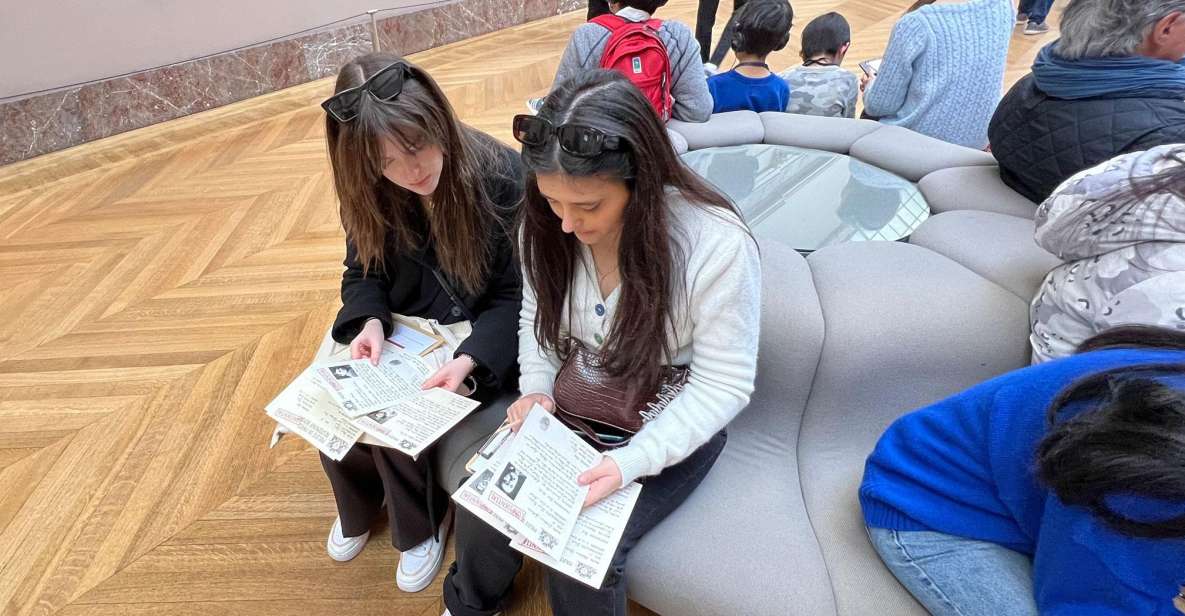
The tour lasts 150 minutes, or two and a half hours. That is a useful middle ground. You get a guided look at major works and a complete game, but you are not committing your family to an exhausting full-day museum stay.
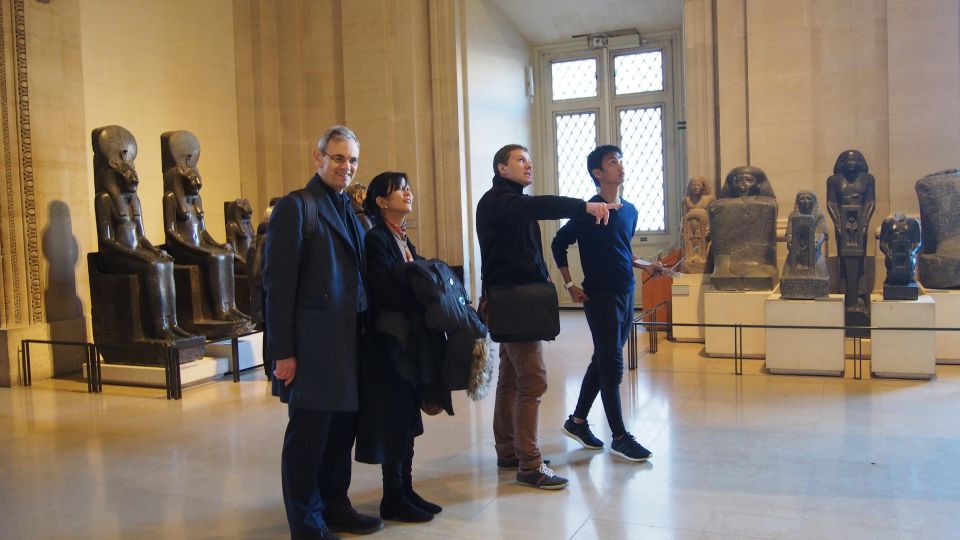
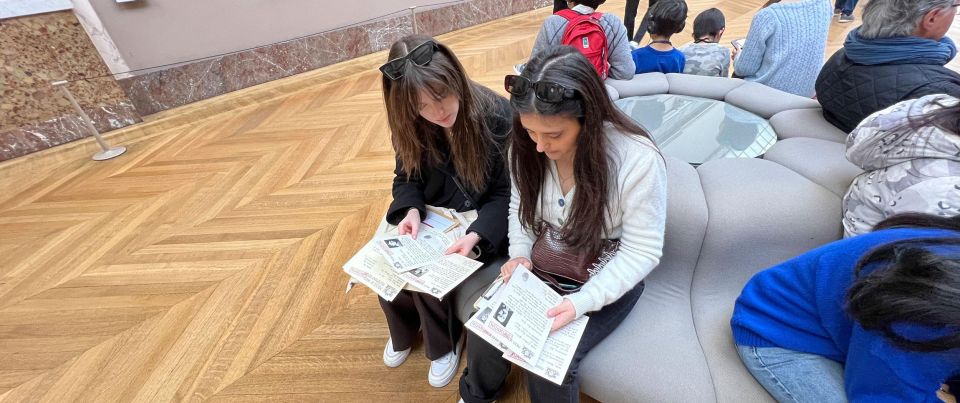
Your guide introduces the missing Mona Lisa case and explains how the challenges work. Each teen receives a treasure hunt kit. The tasks lead you through art and architecture while keeping the group focused on the next piece of evidence.
The private setting helps here. In a large public group, a guide has to aim every explanation at the average age and attention span. With a private family group of up to four, the guide can spend more time where your teens are engaged and move along when a display is not holding them.
The experience is offered in English. Guides Claudia and Sebastian have been associated with especially engaging family visits, while Claudia has also led tours with children aged 11 and 14. For your family, the exact guide assignment may vary, but the experience depends heavily on having someone who can explain art in a lively, clear way.
Venus de Milo: a famous clue, not just a photo stop
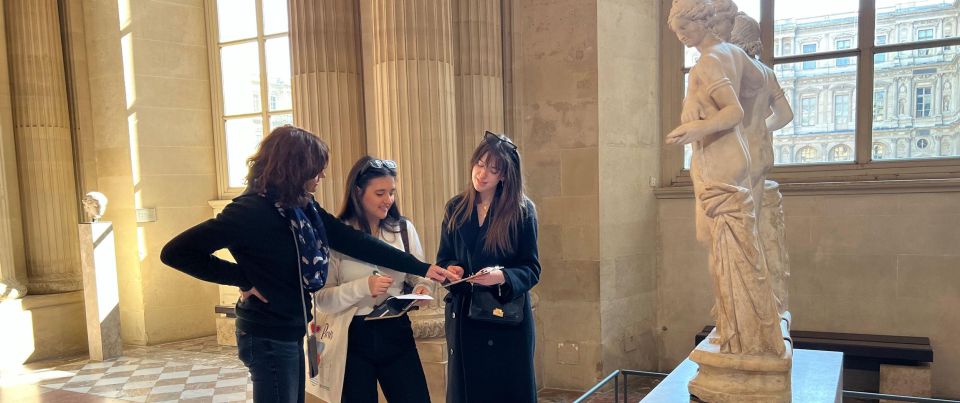
The Venus de Milo is one of the Louvre’s best-known sculptures, so many families would seek it out anyway. On this tour, it serves a more useful purpose. The work becomes part of the investigation, giving your teens a reason to examine it and listen closely.
That change in purpose is important. Famous works can blur together when young visitors are hurried from one room to another. A clue gives them a small target. They may need to notice a detail, remember information, or connect an explanation to one of the suspects.
You should not expect a long, academic lecture about every aspect of the sculpture. The tour has eleven challenges to complete, so the guide must keep the story moving. If you or your teens want extended time with one artwork, the game format may feel brisk.
For most families, that tradeoff is sensible. You are paying for a focused introduction to the Louvre, not a specialist course on ancient sculpture.
Winged Victory and the art of keeping teens moving
The Winged Victory of Samothrace is another major Louvre highlight included in the investigation. Its dramatic setting and instantly recognizable form give the group a strong visual pause during the case.
The route uses such works to break up the information. Your teens can look, answer, and move on, rather than sit through long blocks of explanation. The guide reveals secrets and clues as the group progresses, so each stop has a practical role in the story.
This is where the activity differs from a normal highlights tour. A typical Louvre visit often becomes a race toward the Mona Lisa, with a few famous sculptures along the way. Here, the Mona Lisa is the missing object at the center of a larger puzzle, while other masterpieces help you solve the crime.
The limitation is that the Louvre is enormous. A 150-minute visit cannot cover everything, and this route is not meant to. You will see selected highlights rather than gain a full map of the museum’s collections. Plan a separate visit if your family wants to explore additional rooms at length.






Apollo Gallery and the final evidence
The Apollo Gallery adds a different mood to the route. Its grand interior and royal associations help show that the Louvre is more than a container for famous paintings. The building itself is part of the story.
As the challenges continue, you study five high-profile suspects and gather enough information to identify the thief. The guide feeds you clues in stages, so the final answer depends on paying attention rather than simply waiting for the guide to reveal it.
This structure gives the visit a clear finish. You are not left wondering which room comes next or when the tour is over. There is a case to solve, evidence to collect, and a culprit to catch.
The experience may work best when adults resist solving everything for the teens. Let them listen, compare ideas, and make a few wrong guesses. The point is not only to reach the answer. It is to make the artworks useful to the story.
What the private format really adds
The group is private, with space for up to four people. That makes the tour a good match for one family or a small party of friends. You avoid being paired with strangers, and the guide can speak directly to your teenagers.
Private does not mean completely flexible in every way. The visit still follows the museum’s opening procedures, security rules, and the planned challenge route. But it does mean your guide can respond to the group in front of them.
That matters when ages differ. An 11-year-old may need simpler explanations, while a 14-year-old may want more detail. Teenagers who enjoy competition can take the lead on clues, while younger children can help inspect the visual details.
The supplied treasure hunt kit for each teen is another practical plus. It gives each child a role and reduces the chance that the activity becomes an adult-led discussion with young people trailing behind.
The tour is also wheelchair accessible. The information provided does not spell out every route detail or restroom arrangement, so contact the provider if your group needs specific access guidance.
Is $784 good value?
The listed cost is $784 per group of up to four. At the full group size, that works out to $196 per person. For two people, the effective cost is $392 each, so the value changes sharply with group size.
You are paying for private guiding, Louvre entrance tickets, and the treasure hunt kits. Skip-the-line access also saves you from arranging museum admission separately and can make a major difference when your time in Paris is limited.
I think the price is easier to justify for four people, particularly if your teenagers would otherwise resist a museum visit. A guide who keeps two 13-year-olds involved on a hot Paris day is doing more than pointing out paintings. The activity gives the family a shared goal and helps protect your limited sightseeing time.
The value is weaker if your group is only two adults who already know the Louvre well, or if your children are eager to wander independently. You may prefer ordinary admission and a self-guided visit in that case.
Tips are not included. Food and drinks are also not included, so plan those separately before or after the tour. Hotel pickup and drop-off are not part of the service.
Who should book this Louvre experience?
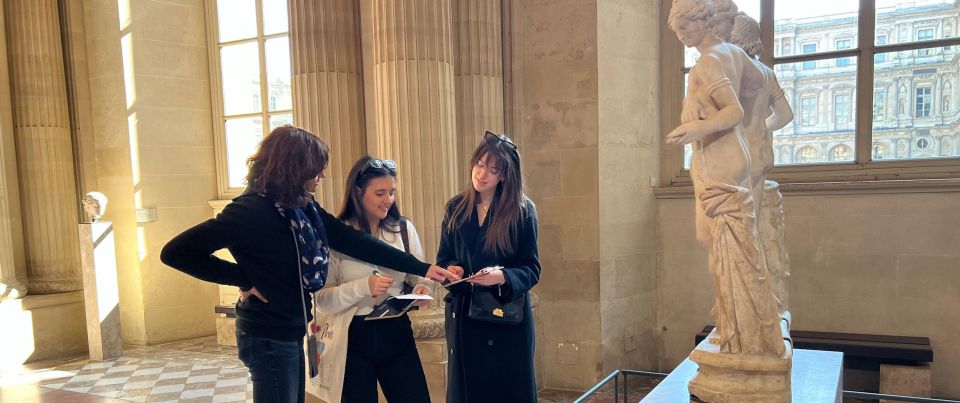
I would put this near the top of the list for families with children from roughly the early school years through the teenage years, based on the age range reflected in the tour’s family use. It is especially suited to teens who like puzzles, mysteries, competition, or stories with a clear goal.
It also makes sense for parents who want to see major Louvre works but do not feel confident explaining art themselves. Your guide supplies the structure and the context, while your family takes part in the investigation.
The tour may not suit a family looking for a quiet, slow art study. You will be asked to listen, respond, and keep moving through a selected route. It is active in attention, even if it is not physically strenuous.
Hot weather is worth considering. One family kept two 13-year-olds engaged despite a very hot day, but comfortable shoes, water before or after the visit, and realistic expectations about museum fatigue still help.
Booking details worth knowing
You can cancel up to 24 hours before the start time for a full refund, and you can reserve now while paying later. Check the available starting times because the duration is fixed at 150 minutes but the departure time can vary.
The tour starts and ends at the Louvre meeting area. There is no hotel transportation. Bring identification or a photocopy, avoid large bags, and do not arrive with luggage that exceeds the museum’s 55 by 35 by 20 centimeter limit.
Since this is a private group, book for the number of people who will actually attend. The maximum is four people per group, and the cost is not presented as a per-person rate.
Should you book Who Stole the Mona Lisa?
Book it if you want your teens to do more than look at famous art for a few minutes before asking when you can leave. The eleven challenges, five suspects, and true 1911 theft give the Louvre a clear purpose, while the Venus de Milo, Winged Victory, Apollo Gallery, and other major works provide the setting.
I would be more cautious if your party has fewer than four people and price matters, or if you want a broad, leisurely museum tour. For a family of four seeking a lively English-language visit with private attention and skip-the-line entry, this is a strong, focused choice. For a smaller group, compare the per-person cost carefully before booking.
FAQ
How long does the Private Louvre Tour for Teenagers last?
The tour lasts 150 minutes, or two and a half hours.
Where does the tour meet?
Meet by the equestrian statue of Louis XIV near the Louvre glass pyramid, at 8 Place du Carrousel.
Is the Louvre entrance ticket included?
Yes. Entrance tickets to the Louvre Museum are included.
What language is the tour offered in?
The live guided tour is offered in English.
How many people can join the private tour?
The price covers a private group of up to four people.
What should I bring to the Louvre?
Bring comfortable shoes, comfortable clothes, and an ID or photocopy of it. Large bags and luggage are not allowed, and items larger than 55 by 35 by 20 centimeters cannot enter the museum.