REVIEW · PARIS
Paris World Fairs Walking Tour Top Sights Along the Seine River
Book on Viator →Operated by Paris TRIP · Bookable on Viator
Paris’s World’s Fairs helped create the Paris you came to see. This two-hour walk follows that story from the Grand Palais to the Eiffel Tower, with ornate bridges, exhibition halls, old transport links, and river views along the way. It turns familiar sights into chapters of one big idea: Paris presenting modern life to the world.
I like the small group of 15 or fewer, which gives you a better chance to ask questions than on a large city walk. I also like the focus on details many visitors miss, such as the World’s Fair origins of the Bateaux Mouches and the Statue of Liberty flame near Pont de l’Alma.
The main consideration is pace. Nine named stops plus several river landmarks fit into about two hours, so this is a guided overview rather than a museum visit or a slow architectural study. You will also need to arrange your own transport to the starting point.
In This Review
- Key points to know before you book
- Why Paris’s World’s Fairs make a good walking theme
- Starting at Champs-Élysées and the 1900 metro entrance
- Grand Palais and Petit Palais: two very different fair buildings
- Pont Alexandre III and the Seine’s exhibition route
- Bateaux Mouches, Pont de l’Alma, and the Statue of Liberty flame
- Debilly Footbridge and the changing face of modern Paris
- Palais de Tokyo and Palais de Chaillot in the 1937 chapter
- Trocadéro, Pont d’Iéna, and the best Eiffel Tower view
- Eiffel Tower: from fair attraction to Paris icon
- What the $43.26 price really covers
- Guide style, walking effort, and timing
- Who should book this Seine walk?
- Should you book the Paris World Fairs Walking Tour?
- FAQ
- How long does the Paris World Fairs Walking Tour last?
- Where does the tour begin?
- Where does the tour end?
- What language is the tour offered in?
- How much does the tour cost?
- How large is the group?
- Are admission tickets included?
- Is food or drink included?
- Do I need to arrange my own transport?
- Can I cancel for a full refund?
Key points to know before you book
- A World’s Fair theme links the whole walk: The route explains how the fairs of 1855, 1867, 1878, 1889, 1900, and 1937 changed Paris.
- The walk covers major sights without entering them: You see the Grand Palais, Petit Palais, Palais de Chaillot, and Eiffel Tower from outside.
- Pont Alexandre III is a highlight: Gilded sculpture, Art Nouveau lamps, and Seine views make it one of the best photo stops.
- Guide Olivia receives especially warm praise: Her style is described as funny, clear, passionate, and full of useful anecdotes.
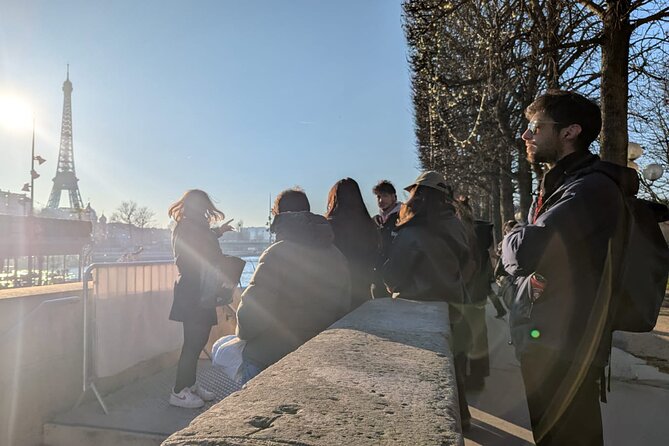
- The route ends at the Eiffel Tower: Start near Champs-Élysées and finish at one of Paris’s easiest landmarks for continuing your day.
- The $43.26 price buys context, not admission: The value comes from the guide, the theme, and the compact small-group format.
Why Paris’s World’s Fairs make a good walking theme
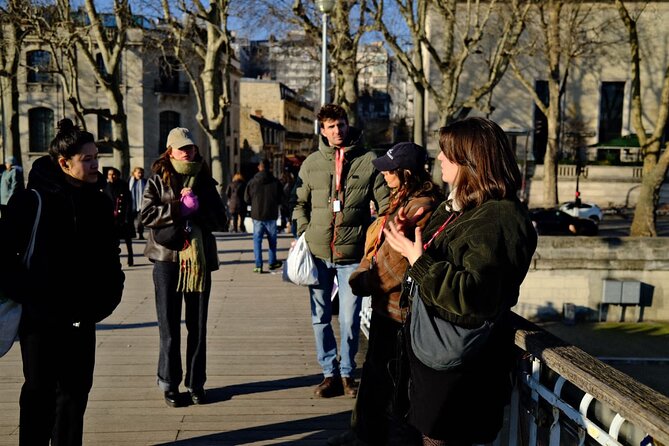
A standard Paris highlights walk can feel like a parade of monuments. This tour gives the monuments a reason to be there. The World’s Fairs were giant international showcases for engineering, art, politics, transport, and new technology. Paris used them to present itself as a modern capital.
That idea becomes clear along the Seine. The river was more than a pretty backdrop. It connected exhibition areas and gave visitors a natural route between grand buildings, bridges, fountains, and temporary displays. Several structures from those events remain part of everyday Paris.
I like this theme because it lets you see familiar places from a fresh angle. The Eiffel Tower is not only a symbol of Paris. It began as a bold engineering project for the 1889 Exposition Universelle. The Grand Palais is not simply a striking exhibition hall. It was built for the 1900 fair, when Paris wanted to show that industrial progress could share space with classical design.
This approach also suits repeat visitors. One comment comes from someone who had lived in Paris for years and still saw the neighborhood differently after the walk. That is the real strength of a thematic tour: you may know the buildings already, but not the connections between them.
You can also read our reviews of more walking tours in Paris
Starting at Champs-Élysées and the 1900 metro entrance
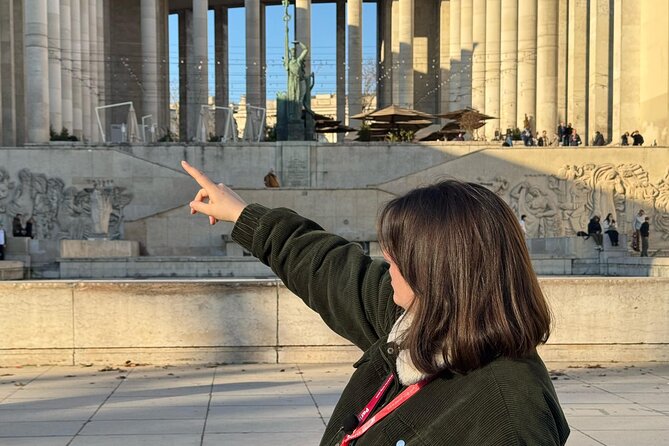
The meeting point is at the Statue du Général Charles de Gaulle, near Place Clemenceau in the eighth arrondissement. The nearest transport reference given for this area is Champs-Élysées, Clemenceau station on Line 1.
The station itself fits the theme. It opened for the 1900 Paris Exposition Universelle and was placed near the Grand Palais and Petit Palais. Your guide uses this detail to show that even Paris’s transport system was part of the fair’s modern message.
This is a smart opening because it begins with something easy to overlook. Most people hurry from the avenue toward the museums and river. Here, you start by considering how millions of fairgoers moved around the city.
The first stop is brief, listed at about five minutes. Do not expect a station tour or a long discussion of public transport. Instead, think of it as the first piece of evidence in the larger story.
Grand Palais and Petit Palais: two very different fair buildings
The Grand Palais and Petit Palais sit close together, but they offer a useful contrast.
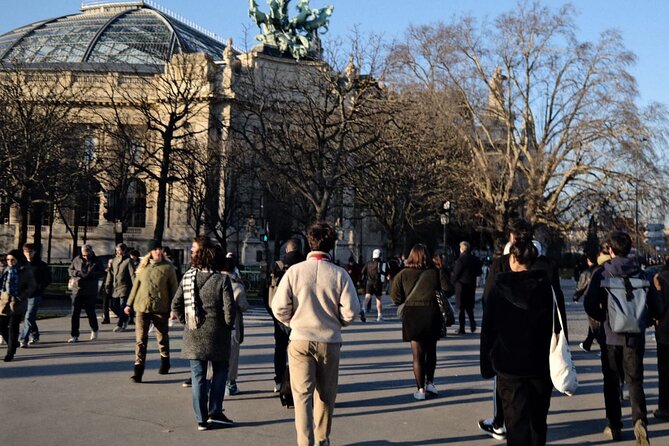
The Grand Palais is known for its huge glass-domed roof. Its design combines classical decoration with the metal and glass techniques associated with industrial progress. That mixture was exactly right for a World’s Fair, where Paris wanted to show both artistic tradition and modern construction.
The building still hosts major art exhibitions, fashion events, and cultural programs. On this walk, you view it from outside. The five-minute stop is enough to discuss its purpose and design, but not enough for a detailed inspection of the interior.
Across the road, the Petit Palais now houses the Musée des Beaux-Arts de la Ville de Paris. Its collection reaches from antiquity to the early twentieth century, and the building includes frescoes and a calm interior courtyard. Admission to the museum is free, though this tour does not include time for a visit.
That distinction matters. If you want to explore the Petit Palais’s art collection, plan a separate visit. The walk gives you the setting and historical context, then keeps moving.
I like having both palaces near the start because they show two sides of the 1900 fair. One suggests engineering and spectacle. The other points toward fine art, civic culture, and elegant public space.
Pont Alexandre III and the Seine’s exhibition route
Pont Alexandre III is one of the most decorative bridges in Paris. Its gilded statues, elaborate ironwork, and Art Nouveau lamps were created for the 1900 Exposition Universelle. The bridge also reflected the political relationship between France and Russia at the time.
This is one of the strongest stops for photographs. You get river views, ornate details, and a clear sense of how the fair connected grand avenues on both banks of the Seine.
The bridge is also a good place to understand the tour’s central argument. Paris did not treat the World’s Fairs as isolated events behind fences. They shaped public spaces people still use. A bridge built for an exhibition can become part of the city’s permanent identity.
The river section then links the buildings together. Your guide explains how the Seine carried visitors between displays and helped create a sense of one enormous exhibition district. Architectural experiments, inventions, and art were presented along its banks.
For me, this is where the walk becomes more than a list of dates. You begin to see Paris as a city that repeatedly rebuilt itself for international gatherings, then kept the best parts.
Bateaux Mouches, Pont de l’Alma, and the Statue of Liberty flame
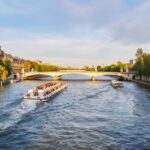
The Bateaux Mouches connection is a neat detail. These sightseeing boats began as visitor transport for the 1867 Exposition Universelle. They later became one of Paris’s best-known ways to see the city from the water.
That fact gives the boats a longer story than simple sightseeing. They are part of the same tradition of moving people through Paris’s major events. From the riverbank, you can understand why boat rides became such a lasting part of the city’s visitor culture.
At Pont de l’Alma, the tour touches another World’s Fair link. The bridge was built for the 1855 Exposition Universelle. Although the bridge was rebuilt, the Zouave statue remains. It once helped gauge the height of Seine floods.
Nearby is the Flamme de la Liberté, a full-size replica of the flame on the Statue of Liberty. Its story reaches back to the 1878 Exposition Universelle, when the Statue of Liberty was first shown in Paris before traveling to New York. The replica was donated by the International Herald Tribune in 1989.
Today, many people associate the flame with Princess Diana, and it has become an unofficial memorial. The tour adds another layer by connecting it to Franco-American friendship and the exchange of ideas between Paris and the United States.
This is a good example of the route’s method. You see a modern memorial, then learn that its visual symbol also points to a much older story of international cooperation.



Debilly Footbridge and the changing face of modern Paris
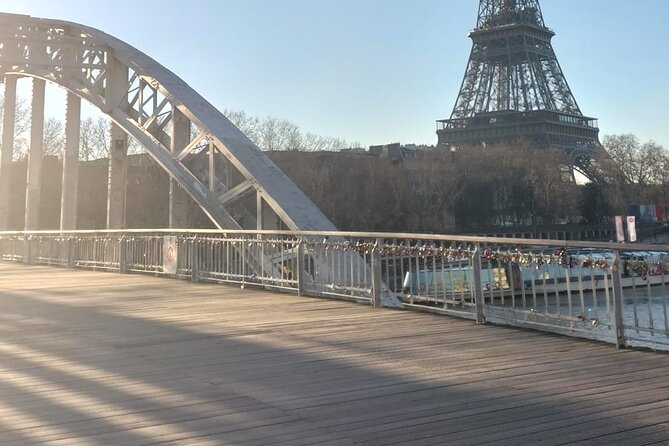
The Passerelle Debilly was built for the 1900 Exposition Universelle. It stretches 120 meters across the Seine, linking the Quai Branly with Avenue de New York.
Unlike Pont Alexandre III, the footbridge feels more direct and functional. It was built to help people move through the fair district, and it still serves as a crossing for pedestrians. The contrast between the two bridges makes the period’s mix of decoration and practical design easier to grasp.
This is also another pleasant place for river photographs. The tour is not built around staged photo sessions, but the route naturally includes several spots where you can frame the Seine, bridges, and major buildings.
Keep your phone or camera ready, but do not expect long stops at every location. The listed timing gives only a few minutes at most stops. The guide’s commentary is the main event, while the pictures are a useful bonus.
Palais de Tokyo and Palais de Chaillot in the 1937 chapter
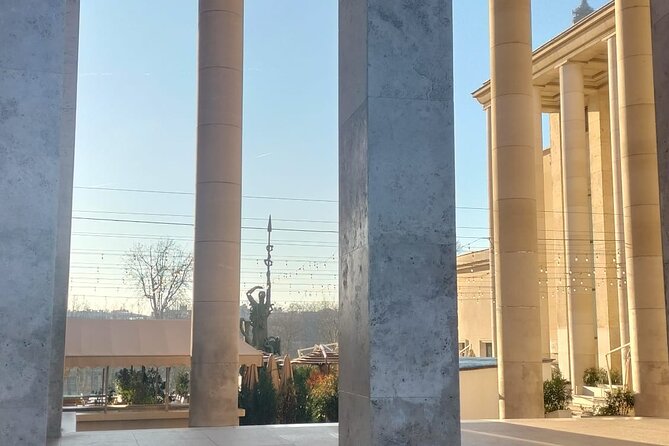
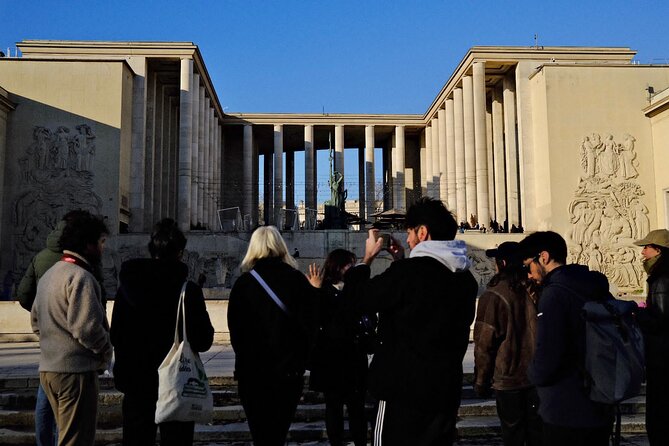
The tour then shifts from the 1900 fair to the 1937 Exposition Universelle. The former Palace of Modern Art Museums, now associated with the Palais de Tokyo, was inaugurated for that event. It has since become one of Europe’s largest centers for contemporary art.
That change in use is worth noting. A building created to present modern art in 1937 now supports contemporary art and temporary exhibitions. Paris keeps reusing its exhibition architecture instead of treating it as a closed historical display.
The Palais de Chaillot is another surviving structure from the 1937 fair. Architects Léon Azéma, Jacques Carlu, and Louis-Hippolyte Boileau designed it. Along with the Palais de Tokyo and Palais d’Iéna, it was intended to remain after the exhibition closed.
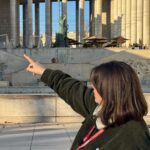
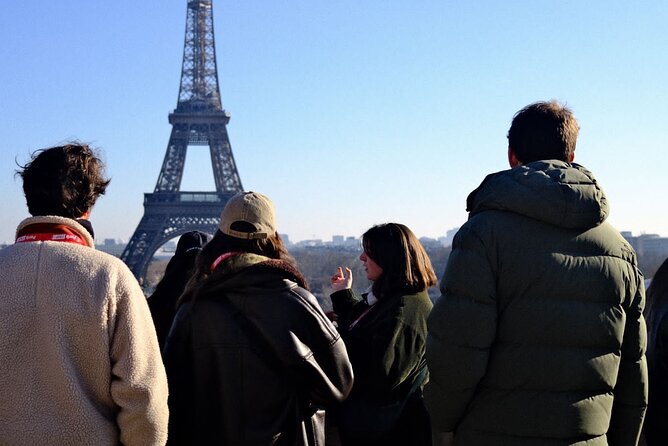
The longer stop here is about ten minutes, giving your guide more room to explain the building and its place in the fair. The Palais de Chaillot also puts you in one of the best viewing areas for the Eiffel Tower.
This part of the route may appeal most to architecture fans. The 1937 buildings feel more monumental and formal than the 1900 structures. They also show how Paris’s idea of modernity changed between the two events.
Trocadéro, Pont d’Iéna, and the best Eiffel Tower view
The Trocadéro Fountain was built in 1937 in the Trocadéro Gardens. It replaced an earlier fountain from the 1878 Exposition Universelle and uses jets, columns, and cannons to create a broad water display.
From the Trocadéro side, you get one of the classic open views toward the Eiffel Tower. The fountain and gardens create a strong foreground, making this one of the route’s most useful photo locations.
The Pont d’Iéna connects Trocadéro with the Eiffel Tower. Napoleon I originally commissioned the bridge, and it later became an entryway for visitors to the World’s Fairs of 1867, 1878, 1889, and 1900.
That repeated role gives the bridge unusual importance. It carried people toward the Eiffel Tower and the exhibition grounds during several major events, then continued as part of normal Paris life. Its use during the 2024 Olympics adds a modern chapter to the same pattern of international gatherings.
The tour ends at the Eiffel Tower, so the approach feels well planned. You finish where the World’s Fair story reaches its biggest symbol.
Eiffel Tower: from fair attraction to Paris icon
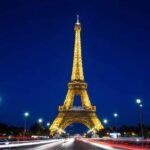
The Eiffel Tower was built for the 1889 Exposition Universelle, marking the centennial of the French Revolution. It was meant to show what modern engineering could do, and not everyone liked it at first.
The tower’s early criticism is an important part of its story. It was not born as an instantly beloved symbol. Its success came from its scale, its novelty, and the way it captured the public imagination.
The tour gives the tower about ten minutes. That is enough for a clear explanation and exterior views, but not for going up. No admission is included, and the walk does not promise entry to the tower.
I see the ending as a strength for first-time visitors. You finish at a landmark that is easy to recognize and easy to use as a base for the rest of your day. You can continue sightseeing from there, but any tower visit needs separate planning.
The Olympic connection also brings the story into the present. The same city that used the tower to display engineering progress in 1889 continued to use its major public spaces for international events more than a century later.
What the $43.26 price really covers
At $43.26 per person, this is not the cheapest way to see Paris’s monuments. You are paying for a guided walk, a specific historical theme, a small group, and the ability to ask questions.
There are no food or drinks, no transport to the meeting point, and no entry tickets. Since most stops are outside, the price makes the most sense if you want interpretation rather than admission.
I think the value is strongest for three types of people:
- You have already seen the basic sights and want a new way to connect them.
- You enjoy social and political history as much as architecture.
- You prefer a small guided group to wandering alone with a guidebook.
It is less useful if your main goal is to enter the Grand Palais, Petit Palais, Palais de Tokyo, Palais de Chaillot, or Eiffel Tower. You will see these places, but the tour does not provide interior access.
The experience is offered in English, includes a mobile ticket, and has a maximum of 15 people. Free cancellation is available up to 24 hours before the start time, which gives you some flexibility when arranging a Paris schedule.
Guide style, walking effort, and timing
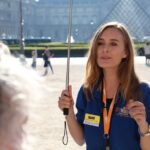
Olivia is the guide most often named in the feedback. Her strengths are clear explanations, humor, enthusiasm, and a talent for using small anecdotes to make the buildings easier to remember.
That style suits this route. The subject includes many dates and exhibitions, and a dry lecture could quickly become hard work. A guide who can keep the information moving without piling on too many facts makes a real difference.
The walk lasts about two hours and requires a moderate level of physical fitness. No exact distance is provided, but the route travels from Place Clemenceau to the Eiffel Tower along the Seine and includes several bridges, plazas, and outdoor stops.
Wear comfortable shoes. Also check the weather before you go. The experience is outdoors, and its appeal depends partly on enjoying the river, bridges, fountains, and open views.
The itinerary is tightly timed. If you like lingering at one building, taking many photos, or stopping for coffee, you may find the pace brisk. If you want an efficient introduction that leaves the rest of your day open, the schedule works well.
Who should book this Seine walk?
I would recommend it to first-time visitors who want a guided route through several major sights without spending the whole day in a museum. It gives you orientation, useful context, and a logical finish at the Eiffel Tower.
It also works well for repeat visitors. The theme reaches beyond standard tourist facts and includes forgotten buildings, fair transport, political links, and changes in Parisian public space. Even someone familiar with the monuments can come away with a different view of the neighborhood.
History and architecture fans will get the most from it. Photographers should also like the sequence of bridges and river viewpoints, especially Pont Alexandre III, Trocadéro, and the Eiffel Tower approach.
Families and casual sightseers may enjoy it if they are comfortable walking for two hours and listening outdoors. The tour is not designed as a children’s activity, and the amount of historical detail may suit older children better than very young ones.
Should you book the Paris World Fairs Walking Tour?
Book it if you want Paris’s famous sights to make more sense. The World’s Fair theme ties together the Grand Palais, ornate bridges, river transport, the Statue of Liberty flame, Trocadéro, and the Eiffel Tower in a way a basic highlights walk often cannot.
I especially like the route for repeat visitors and curious first-timers who want facts beyond the usual postcard script. Olivia’s clear, lively style is an added reason to consider it, though guide assignments can vary.
Skip it if you want interior visits, lots of free time, or a slow photo walk. At $43.26, the value depends on caring about the stories behind the buildings. If you do, this compact Seine route offers a smart and distinctive way to get oriented.
FAQ
How long does the Paris World Fairs Walking Tour last?
The tour lasts approximately two hours.
Where does the tour begin?
It begins at the Statue du Général Charles de Gaulle at Place Clemenceau, 75008 Paris, France.
Where does the tour end?
The walk ends at the Eiffel Tower, Tour Eiffel, 5 Avenue Anatole France, 75007 Paris, France.
What language is the tour offered in?
The tour is offered in English.
How much does the tour cost?
The listed price is $43.26 per person.
How large is the group?
The maximum group size is 15 people.
Are admission tickets included?
No admission tickets are included. The listed stops are outdoor viewing stops, and entry to museums or the Eiffel Tower is not part of the experience.
Is food or drink included?
No. Food and drinks are not included.
Do I need to arrange my own transport?
Yes. Transport to and from the meeting point is not included. The route begins near public transportation.
Can I cancel for a full refund?
Yes. You can cancel at least 24 hours before the experience start time for a full refund. Cancellations or changes made less than 24 hours before the start time are not accepted for a refund.