REVIEW · PARIS
Paris: Private guided tour in Rickshaw bike – Gustave Eiffel
Book on GetYourGuide →Operated by GoTurtle · Bookable on GetYourGuide
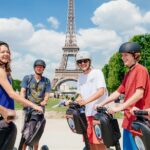
A pedicab makes the Eiffel Tower feel close. This private ride is built for big views and quick landmark spotting along cycle-friendly routes, with photo breaks that keep things fun instead of rushed. What I like most is the comfortable seat with an extra-wide 180° view, plus the chance to see the Eiffel area and major sights from angles you normally miss. One thing to consider: it’s a short format (30 minutes to 1 hour), so you’ll be sightseeing by viewpoints, not doing long stops.
You start near the Flame of Liberty and roll through the Eiffel Tower neighborhood, the Seine corridor, and key Paris photo points like Trocadéro. The driver’s job is to get you great angles and keep the tour moving, and the overall vibe stays easy—you just sit back and steer your camera. My only caution is simple: if you want a deep, slow museum-style day, this ride won’t replace that. It’s a “see a lot, see it well” experience.
In This Review
- Key highlights you’ll actually feel
- Why a pedicab around the Eiffel Tower works so well
- Starting at the Flame of Liberty: your easy meeting point and first viewpoint
- The short 30-minute Mini Gustave Eiffel route: see the essentials fast
- The full 1-hour Gustave Eiffel route: more Paris in one loop
- Stop-by-stop: what each landmark adds (and how to use your camera time)
- Photo stop (early in the loop)
- Musée du quai Branly (photo stop)
- Eiffel Tower viewpoint (photo stop)
- Parc du Champs de Mars (photo stop)
- Pont de Bir-Hakeim (photo stop)
- Seine River (photo stop)
- Place du Trocadéro (photo stop)
- Arc de Triomphe (photo stop)
- Champs-Élysées (photo stop)
- Back to Flame of Liberty (finish)
- Weather, comfort, and photo breaks you can actually use
- Price and value: what $23 gets you (and what it doesn’t)
- Who this tour fits best (and who might want a different plan)
- Book it or pass: my practical recommendation
- FAQ
- How long is the tour?
- Is this tour private?
- Where do we meet?
- What languages are available for the guide and audio?
- Do you get photo stops during the ride?
- Does the tour run in bad weather?
Key highlights you’ll actually feel

- 180° views from a comfy seat: the layout is made for wide, postcard-style sightlines.
- 20+ landmarks in the 1-hour route: you cover a serious loop without feeling stuck in traffic.
- Photo breaks built into the plan: you’re not sprinting between stops.
- Live guide + optional audio: English, French, Spanish live guidance, with additional audio languages available.
- Weather protection for rain or shine: you’re still able to run the tour year-round.
- Private pedicab for up to 2 people: more control, less waiting around.
Why a pedicab around the Eiffel Tower works so well

Paris can be intense. Even when the monuments are amazing, getting from one view to the next can turn into a time tax—waiting, walking extra blocks, and trying to line up angles while crowds swell.
A private pedicab flips that. You get a moving viewing platform, and you ride along cycle lanes where the experience is designed to keep you flowing. The payoff is that you see the Eiffel Tower area as a neighborhood of viewpoints, not just one famous photo spot.
On top of that, the tour is built around photo breaks. That sounds basic, but it changes everything. Instead of doing the “we’ll stop later” routine, you’re given moments to actually frame shots—especially around the Seine and Trocadéro, where timing and angles matter.
You can also read our reviews of more cycling tours in Paris
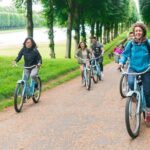
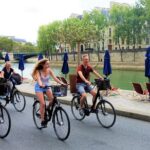
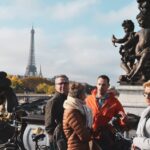
Starting at the Flame of Liberty: your easy meeting point and first viewpoint

You meet at the Flame of Liberty, in front of the Golden Flame. This is a helpful start because it’s one clear location—no complicated “find a side street behind the café” hunt.
The Flame of Liberty stop also makes sense for the theme. It’s tied to the Eiffel Tower area and the wider postcard corridor around the Eiffel neighborhood. You begin with the kind of view that sets expectations: wide angles, city lines, and the feeling that you’re about to loop through the best panorama spots.
From a practical angle, being near the action reduces your pre-tour walking. You get the ride sooner, and you can spend your energy on enjoying the route rather than assembling logistics.
The short 30-minute Mini Gustave Eiffel route: see the essentials fast

If you pick the 30-minute Visit Mini Gustave Eiffel, the tour is designed to give you a focused Eiffel Tower circuit. The idea is simple: you go from near the base area up through iconic viewpoint points toward Trocadéro, keeping the route tight and efficient.
In this mini version, you’ll also pass by landmarks like Tokyo Palace and the Flame of Liberty. The route is made for quick “wow” moments, with photo stops along the way.
When this option shines:
- You’re only in the area for part of a day.
- You want the famous Eiffel views without committing to a full hour.
- You’d rather spend the rest of your time walking through cafés, markets, or interiors.
What to watch:
- You’ll see fewer of the wider Paris sights compared with the full route.
- If you’re hoping to make a long, slow day out of this, a 30-minute loop won’t scratch that itch.
The full 1-hour Gustave Eiffel route: more Paris in one loop

For the 1-hour Visit Gustave Eiffel, the route expands beyond the Eiffel Tower itself. You still get multiple Eiffel Tower viewpoints, but you also move through a broader Paris checklist of sights.
Along the way, you ride near a French Statue of Liberty, then you go along the Seine to Place du Trocadéro. After that, the tour pushes into major “big name” zones: Arc de Triomphe, Champs-Élysées, and finishing back at the Flame of Liberty.
This longer loop matters because it changes the feeling of the ride. The Eiffel Tower becomes the center of a bigger story—Paris moving outward, with the river and grand avenues acting like visual bridges.
What you gain with the full route:
- More landmark variety in a compact time window.
- Better odds of getting the view angles you want, since you’re visiting multiple stops.
- A smoother way to experience the city’s geography: tower → river → Trocadéro → grand monuments → avenue.
One consideration:
- It’s still a short-format tour, so expect viewpoint watching over lingering.
Stop-by-stop: what each landmark adds (and how to use your camera time)
Here’s how the route works as a “sequence of viewpoints,” with photo stops where the scenery is most useful.
You can also read our reviews of more guided tours in Paris
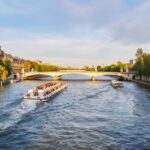
Photo stop (early in the loop)
You’ll have a photo stop right away. This isn’t filler—it helps you start the tour with a “proof of Paris” moment while you’re fresh and the pedicab view is set.
Practical tip: take one wide shot first, then take one tighter shot immediately after. Eiffel views can look similar from a distance, but your angle changes dramatically once you move even a few meters.
Musée du quai Branly (photo stop)
At Musée du quai Branly, you get a river-adjacent city view that frames Paris in a different way than the Eiffel Tower alone. The value here is perspective. You see that this area isn’t just about one monument; it’s also about the riverfront layout and how buildings line up.
Photo-wise, think about reflections and lines—this is where the Seine corridor makes the city feel “connected.”
Eiffel Tower viewpoint (photo stop)
Then comes the Eiffel Tower itself, with a photo stop that’s the main event. In a short ride like this, the best move is to be ready: sit comfortably, relax your shoulders, and don’t waste the stop fiddling with your camera settings.
If you want variety, take:
- one shot with the tower as the dominant subject,
- and one shot that includes nearby streets or river context.
That combination gives you both the famous image and the “where in Paris is this?” context.
Parc du Champs de Mars (photo stop)
Parc du Champs de Mars adds more breathing room to the route. It’s where the Eiffel Tower starts to feel like part of a wider green-and-stone zone rather than a single icon against the skyline.
It’s also a nice moment to reset—literally and mentally—before the ride continues toward bridges and the river.
Pont de Bir-Hakeim (photo stop)
The route continues through Pont de Bir-Hakeim, which is a practical storytelling stop. Bridges are where you get motion and geometry. Even if you’re not doing a long walk, a bridge view helps you “read” how the city is arranged around the river.
For photos, this is usually a strong spot for framing the tower area from a different direction.
Seine River (photo stop)
The Seine River photo stop is one of the best uses of a short pedicab tour. The river gives you that classic Paris feel—long lines, light reflecting on water, and a sense of scale you can’t fully get from a single street corner.
If the weather is dramatic, the river also tends to look great. That’s one reason this tour’s weather-ready plan matters.
Place du Trocadéro (photo stop)
This is where you get one of the Eiffel-area’s signature angles. Place du Trocadéro is a key viewpoint, and the tour’s route treats it like a centerpiece moment.
Spend your photo time wisely here. In a short tour, Trocadéro is the spot where most people want the “classic” shot—so take a few frames, check your angle, then move on.
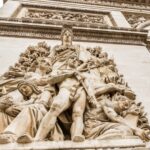
Arc de Triomphe (photo stop)
For the full 1-hour route, the Arc de Triomphe stop adds a grand monument reset. It’s not just a famous building—it gives you a sense of Paris scale and the “avenue city” mindset.
If you’re a person who likes symmetry and big urban lines, you’ll appreciate this stop.
Champs-Élysées (photo stop)
The tour’s move onto Champs-Élysées is the classic Paris finale energy. You get the feel of a major boulevard without needing to plan multiple walks or coordinate metro timing.
This stop also works as a transition: you’re already in the heart of the city’s big sights, so it sets you up for whatever you do after the tour.
Back to Flame of Liberty (finish)
You end at Flame of Liberty, the same place you started. That simple loop is convenient because it reduces the mental overhead of “how do I get back from here?” After a short sightseeing ride, that matters more than you’d think.
Weather, comfort, and photo breaks you can actually use

The tour is scheduled to run rain or shine, with weather protections built for year-round conditions. That’s not just marketing. For Paris, it’s the difference between enjoying the ride and rushing through it in bad weather.
Comfort is also clearly part of the design:
- a comfortable seat
- and an extraordinary 180° view
That 180° piece is more important than it sounds. It means you’re not constantly twisting your body to catch a decent angle. You can keep the camera aimed, and you can relax enough to notice details—the Seine curve, the skyline lines, and the rhythm of the monuments.
Photo breaks are a real selling point here. In a city like Paris, stopping matters. The ride gives you the movement; the stops give you the photos.
Also included: WiFi on board. During a short tour, that can help you quickly confirm your camera settings, share one quick preview, or look up which viewpoint you’re currently shooting.
Price and value: what $23 gets you (and what it doesn’t)
At about $23 per person for 30 minutes to 1 hour, the value is mostly about time and convenience.
Here’s where the money goes:
- Private pedicab transport with an experienced driver
- A route that covers 20+ landmarks on the longer option
- Photo stops built into the flow
- Live guide help in English, French, and Spanish, plus optional audio in multiple languages
- On-board WiFi
- Weather-ready operation
What it doesn’t claim to be:
- A full day of slow sightseeing
- A walking-heavy itinerary
- A deep, multi-hour museum experience
So the question becomes: do you want a fast, high-impact landmark tour? If yes, this is strong value. If your goal is hours of strolling, galleries, and long interior visits, you’ll likely pair this with something else.
Who this tour fits best (and who might want a different plan)

This tour suits you if:
- You want Eiffel Tower views with minimal hassle
- You like private, personalized pacing (and up to 2 people means it stays intimate)
- You want photo breaks rather than nonstop moving
- You’re traveling with someone who appreciates sitting and viewing, not walking for long stretches
It may not be ideal if:
- You need long stops at museums or interiors (this is viewpoint touring)
- You’re determined to do a lot of walking on purpose
- You prefer a very slow, neighborhood-by-neighborhood exploration
One small note for planning: alcohol and drugs are not allowed. Keep it simple and focus on the views.
Book it or pass: my practical recommendation

I’d book this when you want a high-yield Eiffel-area experience that feels smooth and photo-friendly. The strongest selling points are the service-first tone around the ride, the guide and driver effort to make you happy, and the way the stops support great photos. That’s exactly what you want when you only have 30–60 minutes.
If you’re on the fence, choose the version based on your day:
- Pick the 30-minute Mini if you’re prioritizing the Eiffel Tower views and a quick hit.
- Pick the 1-hour Gustave Eiffel if you want Trocadéro plus the wider monument corridor, including Arc de Triomphe and Champs-Élysées.
If your schedule is tight or the weather is unpredictable, the rain-or-shine structure is also a real advantage.
FAQ
How long is the tour?
The tour lasts 30 minutes to 1 hour, depending on which option you choose.
Is this tour private?
Yes. It’s a private group with transport up to 2 people.
Where do we meet?
You meet at the Flame of Liberty, in front of the Golden Flame.
What languages are available for the guide and audio?
The live tour guide is available in English, French, and Spanish. Audio guidance is offered in multiple languages, including English, French, German, Japanese, Spanish, and it’s listed as available in Italian as well.
Do you get photo stops during the ride?
Yes. The tour includes photo breaks during the route.
Does the tour run in bad weather?
It runs rain or shine, with weather protections designed for year-round conditions.