REVIEW · PARIS
Paris Louvre Guided Tour To Mona Lisa
Book on Viator →Operated by Adventour · Bookable on Viator
The Louvre, minus the guesswork. This small-group English tour (max 25) steers you to the Mona Lisa and other crowd magnets like Venus de Milo, with a guided path that runs from ancient Egypt to the French monarchy.
Watch the tradeoff: the visit is short, and explanation depth and headset/audio support can depend on your group size and the day’s setup. If you want deep art lessons, you’ll do best if you come with a few questions ready to ask.
In This Review
- Key things to know before you go
- Louvre in 1 to 2 hours: what this tour actually covers
- Price and value: is $95 a good deal for the Louvre?
- Meeting at Arc de Triomphe du Carrousel: where to start and how not to lose time
- Your guided Louvre path: what makes each stop worth your attention
- Mona Lisa (La Joconde): the part everyone thinks they know
- Venus de Milo: beauty, minus the arms
- Winged Victory of Samothrace (Nike of Samothrace): movement in stone
- Napoleon’s Coronation (Le Sacre de Napoléon): propaganda-scale painting
- Liberty Leading the People (La Liberté guidant le peuple): revolution on canvas
- The Raft of the Medusa (Le Radeau de la Méduse): aftermath you can’t ignore
- Large Sphinx of Tanis: a fast hit of Egypt
- How the tour feels: group size, guide style, and sound levels
- Timing, entrances, and lines: what you should plan for
- Who this tour is best for (and who should choose something else)
- Quick booking guidance (so you don’t get surprised)
- Should you book this Louvre Guided Tour to see the Mona Lisa?
- FAQ
- FAQ
- How long is the Paris Louvre Guided Tour To Mona Lisa?
- Is the tour offered in English?
- Where does the tour start?
- Does the price include Louvre admission?
- How many people are in the group?
- What major artworks are included in the route?
- Do children or young European residents get free admission?
- Can I cancel for a refund?
Key things to know before you go

- A tight highlights loop that targets the Louvre’s biggest names in about 1 to 2 hours
- Headline masterpieces included, from La Joconde to Liberty Leading the People
- Small-group pace (up to 25) that’s easier than DIY in the busiest galleries
- Audio gear isn’t guaranteed for every group size, so hearing your guide matters
- Entrance/logistics can shift on busy days, which can affect how long each stop feels
Louvre in 1 to 2 hours: what this tour actually covers

This isn’t a whole-museum day. It’s a focused tour designed to get you to the works most people came for—then move you on before the crowds swallow your time.
Inside the Louvre, your guided route centers on a mix of painting, sculpture, and world-famous “office hours” museum icons. You’ll be looking at Leonardo da Vinci’s Mona Lisa (La Joconde), the ancient Greek Venus de Milo, and the Hellenistic Winged Victory of Samothrace (Nike of Samothrace). You’ll also see major French masterpieces like Napoleon’s Coronation (Le Sacre de Napoléon) by Jacques-Louis David and Liberty Leading the People (La Liberté guidant le peuple) by Eugène Delacroix.
Then the tour widens the lens with dramatic scenes and ancient artifacts: The Raft of the Medusa (Le Radeau de la Méduse) by Théodore Géricault and The Large Sphinx of Tanis, an Egyptian sculpture that showcases the Louvre’s depth beyond French art. If you’ve only got a slice of time in Paris, this kind of “greatest hits” route can be smart.
You can also read our reviews of more guided tours in Paris



Price and value: is $95 a good deal for the Louvre?
At $95.03 per person, you’re paying for three things at once: a guided visit, a Louvre admission ticket, and a curated route. The tour notes that the included entrance ticket is €22 for adults, which helps you feel less like you’re paying only for narration.
Here’s how I’d judge the value. If you’re going solo, the Louvre can be a maze—especially when you’re trying to find one or two specific icons before your energy runs out. A guide can cut through that confusion fast and keep you pointed at the most worthwhile stops in the time you have.
The part to be honest about: a short tour can only fit so much detail. If your top goal is spending a long time absorbing one painting, this may feel like a quick stop rather than a full lesson. If your goal is to hit the classics efficiently and then roam afterward at your own pace, the price starts to make more sense.
Meeting at Arc de Triomphe du Carrousel: where to start and how not to lose time

Your meeting point is Arc de Triomphe du Carrousel, Pl. du Carrousel, 75001 Paris. That area is easy to connect to by public transit, and it’s one of the nicer spots to orient yourself because you’re near the museum complex before you dive into indoor lines and gallery crowds.
Plan to arrive a bit early. With any timed museum tour, the first minutes matter. The Louvre is huge, and once you’re separated by entrances or security flow, it’s hard to “catch up” without spending extra time.
The tour also ends back at the meeting point. For me, that’s a good sign if you don’t want the stress of navigating back out after the museum.
Your guided Louvre path: what makes each stop worth your attention

This tour builds a route that moves between centuries and styles, so you’re not just looking at one art era over and over.
Mona Lisa (La Joconde): the part everyone thinks they know
The star is the Mona Lisa, Leonardo da Vinci’s portrait famous for its enigmatic smile. Even if you’ve seen reproductions a hundred times, the real painting has a different presence in person. What a guide can help with here is timing and focus—getting you to the right spot quickly and helping you understand what you’re looking at beyond the surface fame.
A practical tip: don’t plan to stand there for long speeches to yourself. Plan for a quick look, a good angle, and then move on while the tour keeps momentum.






Venus de Milo: beauty, minus the arms
Next is Venus de Milo, the ancient Greek statue associated with Aphrodite. The key visual detail is obvious once you’re there: the arms are missing, but the pose and form still carry power. Having this in the same outing as the Mona Lisa can be surprisingly effective because it forces your brain to switch from Renaissance painting to ancient sculpture.
Winged Victory of Samothrace (Nike of Samothrace): movement in stone
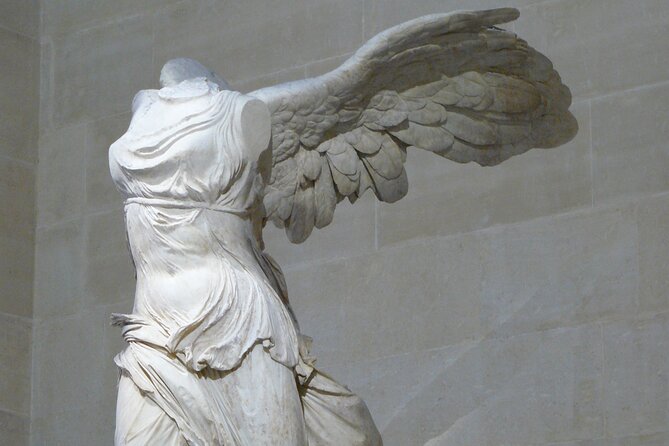
Then comes the Winged Victory of Samothrace, a Hellenistic sculpture of Nike standing on the prow of a ship. This is one of those works where the “action” feels captured in stillness—draped stone that reads like it’s mid-flight.
If you like drama in art, this stop tends to satisfy fast.
Napoleon’s Coronation (Le Sacre de Napoléon): propaganda-scale painting
You’ll see Le Sacre de Napoléon by Jacques-Louis David: Napoleon’s coronation rendered as a grand, staged moment. It’s more than history; it’s about how power wanted to be remembered. In a short tour, this kind of landmark painting gives you context for France’s shift from monarchy and upheaval into imperial self-image.
Liberty Leading the People (La Liberté guidant le peuple): revolution on canvas
Eugène Delacroix’s Liberty Leading the People is next on the big list. This painting is tied to the July Revolution of 1830, and it’s famous for mixing political symbolism with human urgency. Seeing it in person helps because you can read the scene like a snapshot of public emotion, not just a textbook reference.
The Raft of the Medusa (Le Radeau de la Méduse): aftermath you can’t ignore
Then you get the heavy drama of The Raft of the Medusa by Théodore Géricault. It depicts the aftermath of a shipwreck, and it’s the kind of work that makes you pause. If you’ve got a museum attention span of 20 minutes, this stop can either steal your focus or make the tour feel too rushed—so it helps to know you’re stepping into a serious mood.
Large Sphinx of Tanis: a fast hit of Egypt
The final highlighted stop is the Large Sphinx of Tanis, an ancient Egyptian sculpture tied to the Louvre’s extensive Egypt collection. If you came for the Mona Lisa but want one non-French, non-Renaissance anchor to balance your visit, this is a nice payoff.
How the tour feels: group size, guide style, and sound levels

This is where you should set your expectations. The tour is designed for small groups (up to 25), which generally makes it easier for a guide to direct you and answer questions. But in real museum conditions, details can still change day to day.
One issue that came up is audio. For some groups, the guide did not use headsets, and the group size mattered. The tour information says audio devices are used for larger groups, and in at least one case with four people, headsets weren’t provided—so hearing clearly became a problem when the guide moved between points or when the room noise rose.
Guide style also varies. One guide named Violet received very strong praise for being amazing and making the museum feel easier to understand. Another experience flagged that the guide’s information felt minimal, with less explanation than expected, even though the main stops were delivered.
Then there are rare hiccups. One report described a guide being escorted out shortly after entry due to a forgotten license, and that person said they received a full refund. I can’t predict how your day will go, but it’s worth knowing that even famous museum operations can have unexpected disruptions.
My practical advice: if you care about depth, don’t wait for the guide to guess your needs. Ask short questions as you walk—things like what to notice first, or why the Louvre displays that piece where it does.
Timing, entrances, and lines: what you should plan for

The tour includes museum admission and is scheduled for about 1 hour on the listed program time, though it can run up to 2 hours depending on pacing and day conditions.
On busy days, the biggest risk to your experience is not finding the art—it’s the time you spend moving through entrances and security flow. Even with guided help, you can’t control crowd density. If you’re the kind of person who gets annoyed by “waiting a bit,” bring a calm plan for flexibility.
If you have a later reservation in the area, schedule a buffer. The tour ends back near where it starts, but the timing can be affected by how the museum handles entry that day.
Who this tour is best for (and who should choose something else)

You’ll probably like this tour if:
- you’re visiting the Louvre for the first time and want a fast hit of the Mona Lisa plus several other headline works
- you prefer guidance over self-navigation in a huge museum
- you want a short outing you can build on later with your own wandering
You might want to skip it (or pair it with extra time) if:
- you want deep analysis at each stop and don’t like a quick pace
- you’re very sensitive to audio and hate when headsets aren’t available
- you’re expecting a long, lecture-style experience inside the galleries
For families, the route can work because it’s structured and fast. For serious art fans, I’d treat it as a warm-up: see the classics with a guide, then come back later with more time for the parts that really hook you.
Quick booking guidance (so you don’t get surprised)

This tour is in English, and the group limit is 25 travelers. Confirmation is received at booking time, and free admission can apply to visitors under 18 and EEA residents under 26 with valid ID and proof of residency.
The tour also states that it’s tied to good weather, and if it’s canceled due to poor weather you’ll get an alternate date or a full refund. That’s more relevant to the general tour operation than the museum itself, but it’s still something to keep in mind when your trip is tight.
Should you book this Louvre Guided Tour to see the Mona Lisa?
I’d book it if your goal is simple and time-based: see the Mona Lisa plus several of the Louvre’s best-known works without spending hours figuring out where to go. The included museum ticket and the small-group format make it a practical value when your schedule is tight.
I would think twice if you’re coming for heavy, detailed commentary. The tour is short, and there are signs that audio support and explanation depth can vary. If you choose it anyway, go in with a smarter expectation: treat the guide as your shortcut to the main sights, then do your own deeper reading after you’ve found what you actually love.
FAQ
FAQ
How long is the Paris Louvre Guided Tour To Mona Lisa?
The tour lasts about 1 to 2 hours.
Is the tour offered in English?
Yes, the tour is offered in English.
Where does the tour start?
The meeting point is Arc de Triomphe du Carrousel, Pl. du Carrousel, 75001 Paris, France.
Does the price include Louvre admission?
Yes. The tour includes a ticket to the Louvre, and it lists the adult entrance ticket as €22.
How many people are in the group?
The tour has a maximum of 25 travelers.
What major artworks are included in the route?
The tour highlights include the Mona Lisa, Venus de Milo, Winged Victory of Samothrace, the Coronation of Napoleon, Liberty Leading the People, The Raft of the Medusa, and the Large Sphinx of Tanis.
Do children or young European residents get free admission?
Free admission applies to visitors under 18 and EEA residents under 26, with valid ID and proof of residency.
Can I cancel for a refund?
Yes, free cancellation is available up to 24 hours in advance for a full refund.