REVIEW · PARIS
Paris Guided City Sightseeing Tour by Bike or E-Bike
Book on Viator →Operated by Orange Fox · Bookable on Viator
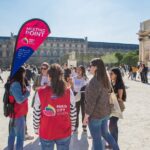
Paris reveals itself quickly from a bicycle. In about two and a half hours, you can pedal from the Palais-Royal and Louvre to Notre-Dame, the Eiffel Tower, Invalides, and the Champs-Élysées without spending your day underground or stuck in a taxi. This is a big-picture introduction to Paris, not a museum tour.
I like two things here: the route covers an impressive stretch of central Paris, and the guide adds the political stories, local customs, and historical links that turn famous buildings into a connected city. I also like the choice of a standard bike or e-bike, since the electric option makes the long route easier.
The main caution is pacing. You will stop often, but usually for only about five minutes, and the tour is built for seeing many sights from outside rather than entering them. The advertised maximum is nine people, yet some outings have reportedly been much larger, which can make city riding and hearing the guide harder.
In This Review
- Key points to know before you book
- Why a bicycle works so well for this Paris route
- From Palais-Royal to the Louvre: a strong start in the historic center
- Medieval Paris around Saint-Jacques and the Hôtel de Ville
- Île de la Cité, Sainte-Chapelle, and Notre-Dame
- The Musée d’Orsay, Pont Alexandre III, and Invalides
- The Eiffel Tower and Trocadéro photo stop
- The Right Bank finale: the Flame, Grand Palais, and Champs-Élysées
- The guides can make or break the ride
- What is included, and what you still need to plan
- Who should book this Paris bike tour?
- Should you book it?
- FAQ
- How long does the Paris bike tour last?
- How far does the tour travel?
- Where does the tour begin?
- Where does the tour finish?
- Is a bicycle included?
- Is bottled water included?
- Are attraction admission tickets included?
- Can children join the tour?
- What is the maximum group size?
- What is the cancellation policy?
Key points to know before you book
- More than six miles in 2.5 hours: This is one of the quickest ways to get an overview of central Paris.
- A photo-stop tour, not an admission tour: The Louvre, Sainte-Chapelle, Musée d’Orsay, and other interiors are not included.
- Choose an e-bike for an easier ride: The electric option can help if you want to cover the full route without treating the outing as a workout.
- Guides shape the experience: Stan, Slava, Alexey, and Alexi have received particularly warm praise for clear explanations, humor, safety, and practical advice.
- Group size deserves a check: The stated limit is nine, but some outings have had around 15 or 16 people.
- Useful for a first day in Paris: You return to the starting point with a better sense of where major sights fit together.
Why a bicycle works so well for this Paris route
At $54, this tour is priced less like a simple bike rental and more like a moving orientation lesson. You get the bicycle, helmet, phone holder, luggage storage, bottled water, and a guide who handles the route. If you tried to connect all these sights on foot, you would spend much of your day walking between them.
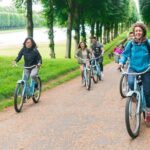
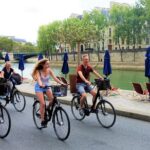
A bicycle also gives you a better feel for Paris than a coach. You pass through streets, cross bridges, and move between neighborhoods at street level. You can pause near a monument, hear a short explanation, and then continue before the next stop.
The standard city bike suits confident riders who enjoy light exercise. The e-bike is the practical pick if you are less comfortable with a long ride, traveling with mixed fitness levels, or simply want to save energy for museums and dinner. The route is long enough that the electric assistance is more than a novelty.
You should still be comfortable riding in an urban setting. Paris has bike paths in many places, and guides are expected to manage the group and safety, but this is not a park ride. One guide received specific praise for helping a rider regain confidence after a fall, while another was credited with keeping a mixed-age group together in the rain. Those details suggest that guide care matters a great deal here.
You can also read our reviews of more cycling tours in Paris
From Palais-Royal to the Louvre: a strong start in the historic center
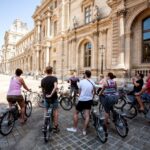
The ride begins at 32 Rue Feydeau in the 2nd arrondissement and heads toward the Palais-Royal. Once linked to royal power, the complex now pairs elegant architecture with a calm garden and surrounding galleries. It is a useful opening because it introduces the contrast that defines Paris: grand political spaces beside ordinary city streets.
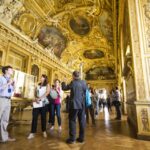
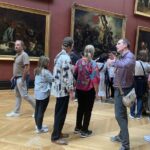
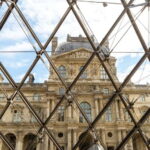
The Louvre comes next. You will see the enormous palace complex and its famous glass pyramid, but you will not enter the museum. Five minutes is enough for an explanation and a photograph, not enough for a serious look at the art collection. If the Louvre is a priority, plan a separate visit and book that admission independently.
The route then moves through the Tuileries Garden, the formal park stretching between the Louvre and Place de la Concorde. The garden provides a welcome change from traffic and stone. The nearby Arc de Triomphe du Carrousel adds a Napoleonic note, with its military symbolism and position between the palace and garden.
Rue de Rivoli gives you a look at working Paris rather than only royal Paris. The long street is lined with shops and boutiques, and cycling here helps you understand how the monumental center connects to everyday commerce.
At Saint-Germain-l’Auxerrois, the guide can explain the church’s former role as a royal chapel and its close ties to the Louvre. The stop is brief, so think of it as a visual introduction to the building and its place in the city, not a full church visit.
Medieval Paris around Saint-Jacques and the Hôtel de Ville
The solitary Saint-Jacques Tower is a striking remnant of a 16th-century church. Its presence hints at the older city that survives among wide avenues and later monuments. The stop is especially useful if you want a glimpse of medieval Paris without committing to a long walking tour.
Next comes the Hôtel de Ville, Paris’s grand town hall. Its ornate exterior gives the guide another opening to discuss how municipal power shaped the capital. Since both the tower and town hall are outside stops, you get context and photographs rather than interior access.
This part of the route can feel rushed if the group takes time to reassemble. One person described missing explanations because the guide began speaking before everyone had arrived. Stay close to the guide and move promptly at each stop. That simple habit can make a real difference.
Île de la Cité, Sainte-Chapelle, and Notre-Dame
The ride reaches Île de la Cité, the island at the heart of Paris. Here, the city’s story becomes easier to picture: the Seine surrounds a compact center filled with churches, government buildings, bridges, and former royal sites.
Sainte-Chapelle is included as an outside stop. Its Gothic design and famous stained glass deserve far more than five minutes, but the quick visit helps you decide if you want to return for an indoor look. Admission is not part of the tour.
Notre-Dame receives about ten minutes, making it one of the longer stops. The cathedral remains under restoration, so the experience is mainly about viewing its exterior and understanding its place in Paris. You will not receive a cathedral admission with this tour.
Pont Neuf follows. Despite its name, it is the oldest standing bridge across the Seine in Paris. From here, you can appreciate how bridges organize the city, linking the islands to the larger streets on both banks.
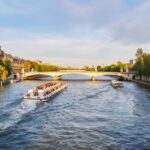
The route also includes time along the Seine itself. This is less a formal stop than a chance to ride beside the river and take in the historic buildings from a moving viewpoint. It is one of the most pleasant parts of the outing, though a large group may have trouble staying together near crossings and busy roads.
The Musée d’Orsay, Pont Alexandre III, and Invalides
The Musée d’Orsay is seen from outside, in its former railway-station setting. Its clock and Beaux-Arts facade make it easy to recognize, even if you know little about the art inside. The museum admission is not included, so save it for another part of your Paris schedule.
Pont Alexandre III is one of the route’s best photo locations. Its elaborate decorations and broad views toward the Seine and major monuments make the five-minute pause worthwhile. The guide can also explain its connection to Franco-Russian friendship.
Les Invalides shifts the focus to France’s military past. The complex houses a military museum and Napoleon’s tomb, but this tour does not include entry. You will see the exterior and hear the basic story, which is enough to place the golden-domed building on your mental map before a later visit.
I like this middle section because it connects art, diplomacy, and military power in a short distance. The weakness is the same as before: if you want to study any one site, the schedule gives you a reason to return, not the time to do that work on the spot.
You can also read our reviews of more guided tours in Paris


The Eiffel Tower and Trocadéro photo stop
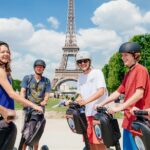
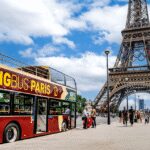
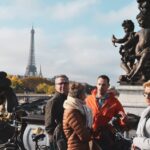
The Eiffel Tower is given about ten minutes. That may sound short, but a guided bike tour cannot replace a dedicated tower visit. The value here is orientation: you arrive from a different part of Paris, see how the tower relates to the Seine, and learn where to return for your own longer visit.
The ride continues to Place du Trocadéro et du 11 Novembre, one of the city’s best viewpoints for tower photographs. The gardens, fountains, and open sightline make this a natural place to pause. If your phone is mounted on the handlebars, the included phone holder may be handy for navigation and quick photos, though you should follow the guide’s instructions while riding.
This is also where the e-bike can feel worthwhile. By this stage, you have crossed much of the city. Electric assistance lets you enjoy the view instead of worrying about the remaining distance.
The Right Bank finale: the Flame, Grand Palais, and Champs-Élysées
The Flamme de la Liberté is a smaller but memorable stop. It is a full-size replica of the Statue of Liberty’s flame, linked to Franco-American friendship and the memorial to Princess Diana. It gives the guide a chance to discuss a modern Paris landmark that many people pass without understanding.
The Grand Palais and Petit Palais bring you back to Paris’s exhibition and fine-arts world. Their Belle Époque architecture is worth seeing from the outside, especially the Grand Palais’s large glass roof. Admission to either museum is not included.
The route then takes you along the Champs-Élysées toward the Arc de Triomphe. Cycling this famous avenue gives you a sense of its scale and ceremony, although traffic and group spacing may affect how relaxed the ride feels. You will not have time to visit the Arc de Triomphe interior on this outing.
Place de la Concorde follows, with its Luxor Obelisk and long record of political upheaval. It is a fitting stop after the Champs-Élysées because you can see how Paris’s grand avenues meet one of its largest public squares.
The final sight is the Palais Garnier, the ornate Paris Opera House. Again, this is an exterior visit. If you want to see the lavish interior, schedule it separately and do not expect the bike tour to cover admission.
The activity ends back at the starting point. That makes it easier to continue with lunch or another central Paris plan, but allow a little flexibility since group riding and city traffic can affect the exact timing.
The guides can make or break the ride
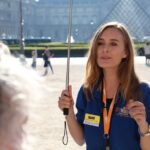
The strongest part of this experience is the guide. Stan has been praised for humor, clear context, local bike etiquette, and useful Paris tips. Slava earned credit for supporting riders of different ages and abilities, keeping the group together, and offering recommendations along the way.
Alexey and Alexi have also been singled out for clear English, good humor, safety awareness, and explanations at each stop. One guide received praise for detailed cultural background and fluent communication, while another person found a guide’s accent occasionally difficult to follow but said clarification was easy.
The feedback is not uniform. One outing was described as poorly explained, with a guide who seemed negative about the sights. Another person felt the guide spoke before the entire group had gathered. These are not minor points on a bike tour. If you miss a talk while crossing a street or catching up, you lose part of what you paid for.
The advertised maximum is nine people, which would be a comfortable size for city riding. Yet some outings have reportedly included about 15 or 16 riders. A larger group can mean more waiting, harder hearing, and less freedom at traffic lights. Confirm the expected group size close to your date if that matters to you.
What is included, and what you still need to plan
The $54 price includes:
- A city bike with a basket or an e-bike
- Helmet
- Phone holder
- Luggage storage
- Bottled water
- A guide
The information also specifically describes a basket, but one outing reported that bikes did not have them. If you plan to carry a purse, camera, or small day bag, ask about current bike equipment before departure rather than relying on the listed feature.
You should plan separate time and money for the Louvre, Sainte-Chapelle, Notre-Dame access when available, Musée d’Orsay, Invalides, Eiffel Tower, Grand Palais, Petit Palais, Arc de Triomphe, and Palais Garnier. The tour lets you see many of these places, but entrance tickets are not included.
Children under six can ride free on a parent’s bike when they weigh up to 20 kilograms and measure up to 140 centimeters, using the child seat. Children under 12 must be with an adult. Most people can participate, and service animals are allowed.
The tour has a mobile ticket and starts near public transportation. Free cancellation is available if you cancel at least 24 hours before the local start time. Cancellations or changes within 24 hours are not refunded.
Who should book this Paris bike tour?
I would choose it for a first visit, a short stay, or the first full day of a longer trip. It helps you place the major sights before you return to the ones you want to explore properly. It is also a smart fit for couples, families with capable young riders, and people who want exercise mixed with sightseeing.
The e-bike is the better choice for anyone unsure about the six-mile distance. Families should remember that children under 12 need an adult beside them, and novice riders should be comfortable following a group through city streets.
I would not choose this as your main Louvre, Notre-Dame, Eiffel Tower, or Musée d’Orsay experience. The stops are too short, and several sites are only viewed from outside. I would also think twice if you dislike group activities or need a guaranteed small group.
Should you book it?
Book this tour if your goal is to cover a lot of Paris quickly, hear useful stories, and learn how the central sights connect. At $54, the combination of bike, equipment, guide, and city coverage is fair value, especially with the e-bike option.
Before paying, confirm the meeting details, expected group size, bike type, and basket availability. If the group is near the advertised limit and your guide is as clear and attentive as Stan, Slava, Alexey, or Alexi, this can be a fun and efficient introduction to Paris. If your priority is quiet sightseeing or detailed time inside monuments, use it only as an orientation and save the real visits for later.
FAQ
How long does the Paris bike tour last?
The tour lasts approximately 2 hours and 30 minutes.
How far does the tour travel?
The route covers more than six miles through central Paris.
Where does the tour begin?
The meeting point is 32 Rue Feydeau, 75002 Paris, France.
Where does the tour finish?
The activity ends back at the meeting point.
Is a bicycle included?
Yes. You receive use of a city bike with a basket or an e-bike, along with a helmet, phone holder, and luggage storage.
Is bottled water included?
Yes, bottled water is included.
Are attraction admission tickets included?
No. Admission is not included for places such as the Louvre, Sainte-Chapelle, Notre-Dame, Musée d’Orsay, Eiffel Tower, Grand Palais, Petit Palais, and Palais Garnier.
Can children join the tour?
Children under six can ride free on a parent’s bike if they weigh up to 20 kilograms and measure up to 140 centimeters, using the child seat. Children under 12 must be accompanied by an adult.
What is the maximum group size?
The stated maximum is nine people. Some outings have had larger groups, so confirm the expected group size before booking if this is important to you.
What is the cancellation policy?
You can cancel for a full refund at least 24 hours before the experience starts. Cancellations or changes made less than 24 hours before the start time are not refunded.