REVIEW · PARIS
Napoleon’s Paris: A Self-Guided Audio Tour
Book on Viator →Operated by VoiceMap Audio Tours · Bookable on Viator
Napoleon’s Paris is best understood on foot, one grand boulevard and imperial monument at a time. This self-guided audio walk links the Arc de Triomphe du Carrousel with Napoleon’s tomb, showing how military ambition, royal ceremony, revolution, and modern Paris meet along the route.
I like the freedom to start when you please and the pause-and-resume format, which lets you stop for water, a snack, or a restroom without losing your place. I also like the low $11.99 price and lifetime access. The main catch is the walking distance and exposure to the weather, so a very hot day could make this less pleasant.
In This Review
- Key points to know before you go
- Napoleon’s Paris from the Carrousel Arch
- The Tuileries Garden and the making of a public Paris
- Rue de Rivoli and the long imperial viewpoint
- Rue Saint-Honoré and Saint-Roch’s troubled facade
- Rue de Castiglione and the Place Vendôme column
- Place de la Concorde and the view across Paris
- The National Assembly and the military road to Les Invalides
- Napoleon’s tomb beneath the golden dome
- How the app changes the experience
- Is $11.99 good value?
- Who should book this audio walk?
- Should you book Napoleon’s Paris?
- FAQ
- How long does Napoleon’s Paris take?
- What language is the tour offered in?
- Where does the tour start?
- Where does the tour end?
- Do I need internet access during the tour?
- What does the $11.99 price include?
Key points to know before you go
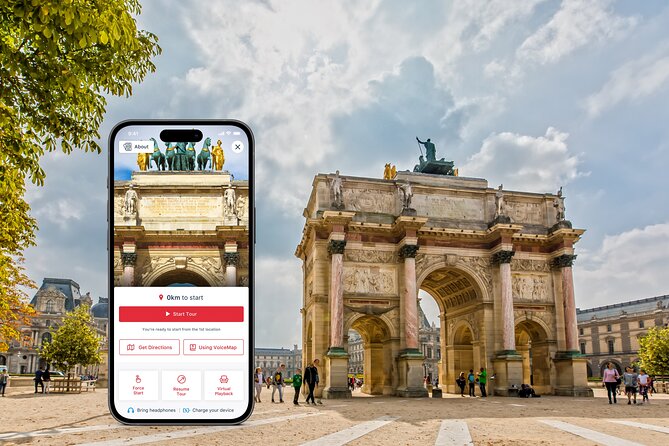
- The route runs from the Carrousel Arch to Napoleon’s tomb, crossing central Paris from the Louvre area to Les Invalides.
- GPS guidance and offline maps help you follow the route without needing mobile data at every turn.
- The audio lasts about 90 minutes to two hours, but you control the pace and can pause as often as needed.
- The tour is in English only, with no live guide or fixed departure time.
- The $11.99 fee buys lifetime access, which makes it useful for a relaxed first walk or a later return to places you passed quickly.
- The route ends at Napoleon’s tomb, but admission costs for attractions and personal expenses are not included.
Napoleon’s Paris from the Carrousel Arch
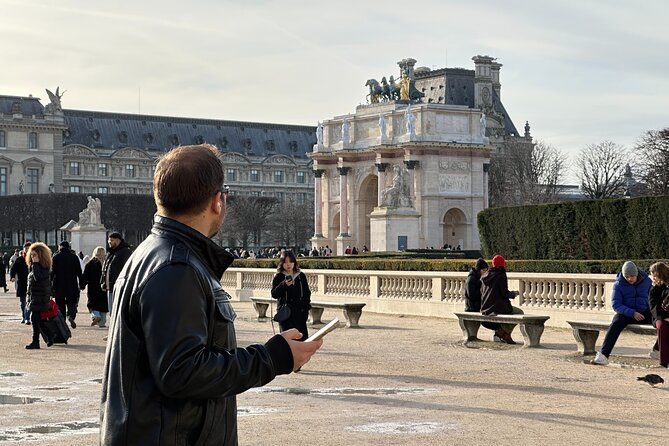
Your starting point is the Arc de Triomphe du Carrousel, at Place du Carrousel beside the Louvre. This is not the Arc de Triomphe at the top of the Champs-Élysées. It is the smaller, ornate arch built to celebrate Napoleon’s military victories.
Look up at the bronze quadriga, the chariot drawn by horses, and study the carved scenes of conquest. The arch also frames the entrance to the Tuileries Garden, giving you an immediate sense of how Napoleon used architecture and open space to project power.
I like this start because it gives the tour a clear visual theme from the first minute. You are not beginning on an anonymous street. You are standing in a ceremonial gateway, with the Louvre behind you and the gardens ahead.
Use the directions to reach the correct arch before pressing on. The app is designed to begin when you arrive at the starting point, so it helps to have the app installed and your phone ready before you reach Place du Carrousel.
You can also read our reviews of more guided tours in Paris


The Tuileries Garden and the making of a public Paris
The Tuileries Garden offers a calmer stretch after the formal stonework of the arch. Its straight paths, clipped trees, statues, and fountains reflect the ordered style favored by French royal planners and later used by Napoleon’s government.
This is a good place to slow down. The walk is not only about monuments. It also shows how Parisians use historic spaces today. You can follow the main route while watching people sit by the fountains, cross the tree-lined paths, and move between the Louvre and Place de la Concorde.
The audio gives this garden a political setting. It connects the royal past with the years when Paris became a stage for revolution, empire, and public ceremony. You get more from the stop if you look around while listening instead of treating it as background scenery.
The route remains outdoors for much of this section. Bring water, especially in warm weather. A previous participant liked being able to stop for a drink, snack, or restroom break, and that is one of the real advantages of an audio tour over a fixed group walk.
Rue de Rivoli and the long imperial viewpoint
From the garden, the walk reaches Rue de Rivoli, one of the city’s most recognizable planned streets. Its arcaded buildings, orderly facades, shops, and long lines give you a strong example of Napoleonic-era urban design.
The street is more than a place to pass through. Its symmetry and scale show how government planners wanted Paris to look and function. As you walk beneath or near the arcades, the audio helps explain why this part of the city feels so deliberate compared with older Paris streets.
This section can feel busy because Rue de Rivoli is a major central thoroughfare. You need to pay attention to crossings, other pedestrians, and traffic. The GPS directions are useful here, since a grand street can still leave you unsure about the next turn.
The route includes a pâtisserie stop connected with golden, buttery madeleines. That small food break adds a welcome local touch to a tour focused on military power and political upheaval. Food is not included, so you pay for anything you choose to buy, but the pause can break up the walking nicely.
Rue Saint-Honoré and Saint-Roch’s troubled facade
The route continues toward Rue Saint-Honoré, a famous street where luxury shops and old landmarks share the same stretch of Paris. The setting shifts from formal garden and government planning to commerce, fashion, and daily city life.
I like this change of mood. Napoleon’s Paris was not only about columns and battle victories. It was also about controlling and reshaping a capital where people worked, shopped, worshipped, and gathered.
You then pass a baroque-style church whose facade still carries bullet holes linked with the French Revolution. The contrast is striking: a place designed for quiet worship, marked by a period of violence and political change.
The audio is especially useful at a stop like this. Bullet holes can look like minor surface damage unless you know why they matter. The story gives the building a human scale and reminds you that the grand streets around you were once scenes of conflict.
Do not expect every stop to function like a full museum visit. This is an outdoor audio route, and the emphasis is on setting, context, and Napoleon’s connection to the city. If you want to go inside a church or another attraction, check its own opening arrangements and budget for any admission that applies.
Rue de Castiglione and the Place Vendôme column
Rue de Castiglione brings you into one of the most polished pieces of central Paris. Its Neoclassical arcades create a composed, almost theatrical street view. The route uses this setting to tell stories of political intrigue and assassination plots tied to Napoleon’s era.
This is where looking up matters. The repeated arches, balconies, and aligned facades are part of the experience. The audio can tell you what happened, but you should also pause to notice how the street itself was designed to guide your eye.
Place Vendôme is the next major landmark. At its center rises the bronze Vendôme Column, decorated with a spiral relief of Napoleon’s military victories. The metal was made from melted enemy cannons, giving the column a blunt political message: conquest turned into public art.
The column’s symbolism is not simple. It celebrates Napoleon’s victories, but its later history also reflects the arguments that followed his rule. Even without a long stop, the column gives you a useful reminder that public monuments can honor power while also provoking debate.
Place Vendôme is a good point to pause the app. The square rewards a slow look, and the tour’s lifetime access means you do not need to hurry through it to protect a limited audio window.
A few more Paris tours and experiences worth a look




Place de la Concorde and the view across Paris
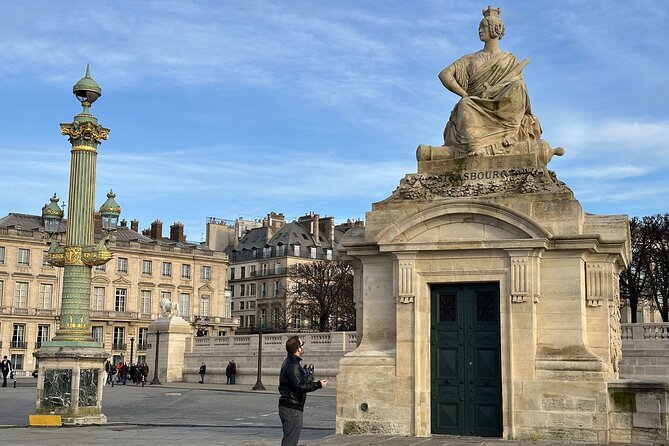
The walk reaches Place de la Concorde, one of Paris’s largest squares. The Luxor Obelisk is its most recognizable marker, but the full setting matters just as much. From here, you can connect the Tuileries, the broad avenues, the river area, and the direction of Les Invalides.
The square carries several layers of French history. It began with royal grandeur, became tied to the violence of the Revolution, and later formed part of the ceremonial city Napoleon helped shape.
This stop works best when you take in the scale. Place de la Concorde can feel too large to read at first, but the audio gives you a reason to connect its open space with public power, executions, celebration, and national identity.
Crossing or approaching the square requires care. It is a major city junction, not a quiet plaza. Keep your phone use brief while moving, and stop somewhere safe when you need to check the map.
The National Assembly and the military road to Les Invalides
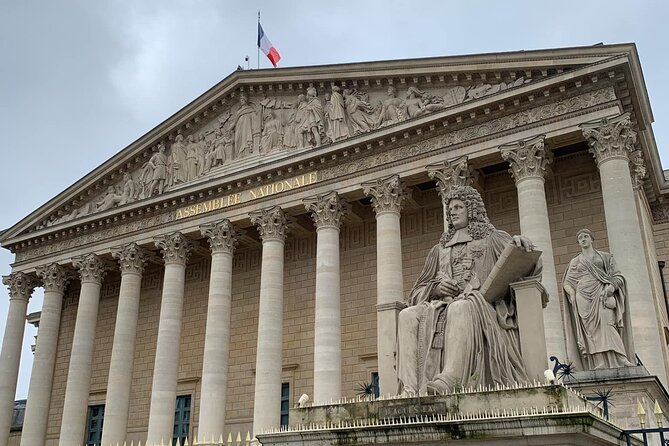
The route continues past the French National Assembly, housed in a grand Neoclassical building. Its columns and formal facade fit the visual language of post-Revolutionary Paris, when new political institutions sought authority through architecture.
This is a useful counterpoint to the military monuments. Napoleon’s legacy is often reduced to battles, but the route also shows the political setting in which modern France took shape. You see the connection between government, ceremony, and the design of the capital.
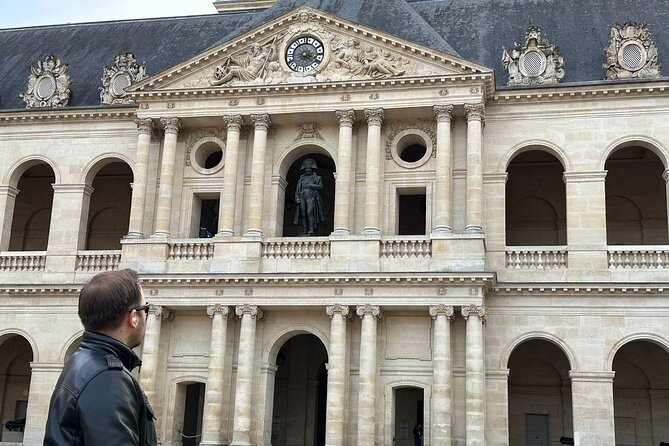
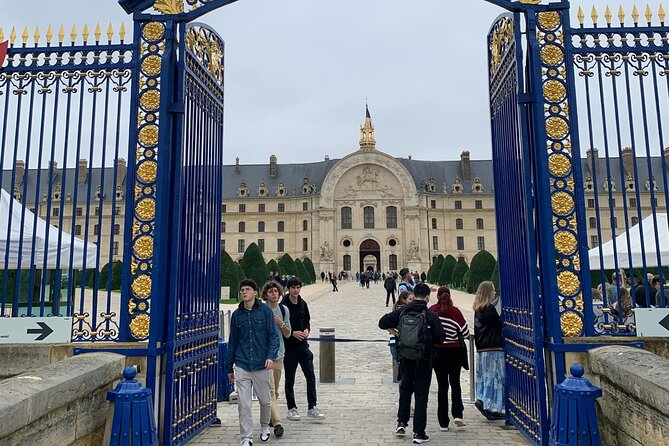
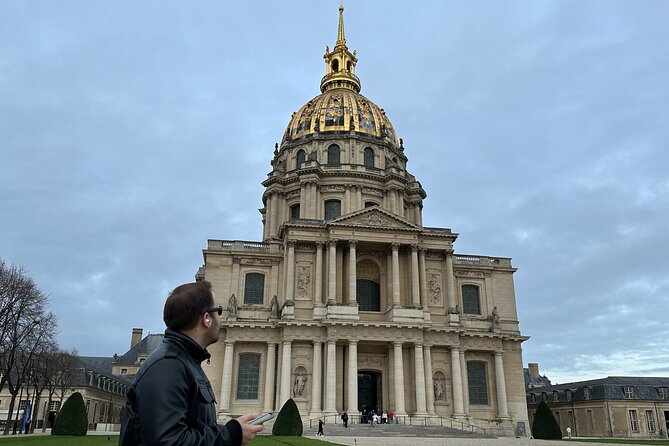
The final section leads toward Les Invalides. The complex was first built as a hospital for wounded soldiers, and its courtyards and gilded dome still make its original purpose clear. At the same time, the site became one of France’s great military and cultural monuments.
You should expect the route to take roughly 90 minutes to two hours, depending on how often you stop. The stated duration does not include long visits inside attractions, extended food breaks, or time spent studying each square. If you walk slowly, as one participant did, allow yourself the longer end of the estimate.
Napoleon’s tomb beneath the golden dome
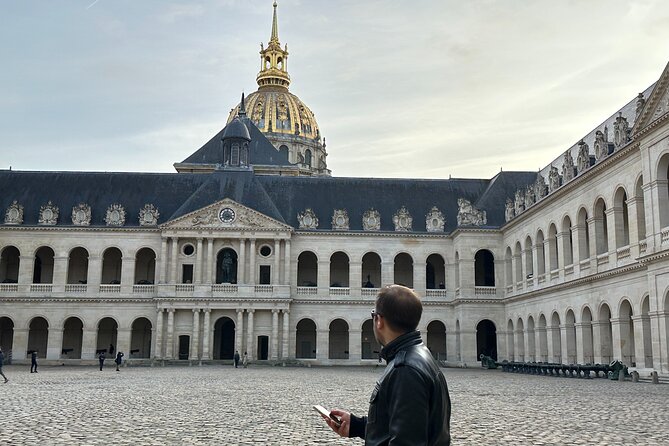
The tour ends at Napoleon’s tomb beneath the dome of Hôtel des Invalides. His marble sarcophagus sits within an elaborate setting of sculptures and military symbolism.
This is the emotional finish of the route. You have followed Napoleon’s image through arches, gardens, streets, squares, and government buildings. Here, the focus narrows to the man himself and the effort made to preserve his memory.
The tomb is grand by design. It asks you to consider both Napoleon’s extraordinary reach and the way later generations chose to present him. The audio helps connect the final monument with the public image built along the entire walk.
Your tour ends at 129 Rue de Grenelle, at Napoleon’s tomb. The route itself does not include personal expenses, food, transportation, or attraction admission. If you want to enter paid sites along the way, those costs are separate.
How the app changes the experience
A self-guided tour suits Paris well because the city rewards pauses. You can stop to take a photograph, sit in a garden, buy a madeleine, or find a restroom without asking a guide to wait for the group.
The app includes GPS guidance, directions to the start, offline audio, offline maps, and offline geographic data. That matters in a crowded city where your phone signal may not be steady or where you do not want to spend the walk staring at a map.
You need to supply your own smartphone and headphones. Download or prepare the app before setting out, and make sure your phone has enough battery for a long outdoor walk.
There is no live guide named for this experience. A separate service note refers to Victor as kind, helpful, and punctual, including help with a property problem and an airport ride, but that does not describe the audio walk itself. Book this as an independent app-based tour, not as a private outing with Victor.
Is $11.99 good value?
At $11.99 per person, the tour is inexpensive for a route linking this many major places. You get lifetime access in English, so the price is not tied to one narrow time slot. You could use it on a first visit, pause halfway, and return later.
The value is strongest if you enjoy setting your own pace and want an organized route without paying for a live private guide. You also avoid the pressure of keeping up with a group.
The value is weaker if you want deep access to interiors, personal conversation, or someone who can answer questions on the spot. Admission fees, food, drinks, transportation, a phone, and headphones are all extra.
Free cancellation is available if you cancel at least 24 hours before the experience start time. Inside that window, the payment is not refunded, and changes are not accepted. The local Paris time controls the cut-off.
Who should book this audio walk?
I would choose this for independent visitors who like architecture, military history, political stories, and central Paris streets. It also suits anyone who walks more slowly and wants full control over breaks.
Families and mixed-age groups may appreciate the pause function, though each person needs a way to hear the audio. Couples can use it as a flexible city walk rather than a fixed appointment.
I would think twice if you dislike walking in open weather or need a guide beside you. The route is outdoors, and the only language offered is English. On a very hot day, plan generous breaks or choose a cooler time.
Should you book Napoleon’s Paris?
Book it if you want a low-cost, flexible route that connects Napoleon’s monuments with the streets and institutions around them. The best features are practical ones: lifetime access, GPS guidance, offline content, and the ability to pause whenever you need.
Skip it if your main goal is a museum visit, a live conversation, or a short walk with little exposure to sun and city traffic. For everyone else, this is a useful way to give central Paris a clear story, from the Carrousel Arch to the marble tomb beneath Les Invalides.
FAQ
How long does Napoleon’s Paris take?
The tour takes approximately one hour and 30 minutes to two hours. Your actual time may be longer if you pause for food, photos, restrooms, or extra sightseeing.
What language is the tour offered in?
The audio tour is offered in English.
Where does the tour start?
It starts at the Arc de Triomphe du Carrousel in Place du Carrousel, 75001 Paris, France.
Where does the tour end?
It ends at Napoleon’s tomb at 129 Rue de Grenelle, 75007 Paris, France.
Do I need internet access during the tour?
The app provides offline access to the audio, maps, and geographic data. You still need your own smartphone and headphones.
What does the $11.99 price include?
The price includes lifetime access to the English tour, GPS guidance, directions to the starting point, and the Android or iOS app. Food, drinks, transportation, personal expenses, admission to attractions, a smartphone, and headphones are not included.