Lyon’s best introduction is a walk that links its grand squares, old passageways, cathedral, and hilltop basilica. This private tour takes you from Place des Terreaux through Vieux Lyon and finishes at Notre-Dame de Fourvière, giving you a clear sense of how the city fits together.
I like the private format, which lets you ask questions without holding back a large group. I also like the chance to adjust the route with your guide, especially if you want more architecture, local history, or practical advice for exploring on your own.
The main drawback is pace. Two solid hours on foot, with much of the time spent listening outdoors, may feel long without a short sitting or coffee break. English ability may also vary by guide, so clear communication is worth confirming before you book.
In This Review
- Key points to know before booking
- Starting among Lyon’s grand facades at Place des Terreaux
- Following Rue de la République into modern Lyon
- Meeting Lyon’s cathedral at Saint-Jean
- Finding the traboules of Vieux Lyon
- Climbing toward Fourvière and the basilica
- What the private guide adds to the experience
- Is $402.01 a fair price for up to 15 people?
- Who will enjoy this Lyon walk most?
- Practical details that affect your day
- Should you book this private Lyon tour?
- FAQ
- How long does the Lyon private walking tour last?
- Where does the tour begin?
- Where does the tour end?
- What sights are included on the route?
- Is this a private tour?
- Is the tour offered in English?
- Are entrance fees included?
- Can the tour be changed to suit my interests?
Key points to know before booking
- A true small-group experience: Your guide works only with your party, with space for up to 15 people.
- A strong city-to-hill route: The walk begins at Place des Terreaux and ends at the Basilica of Notre-Dame de Fourvière.
- Traboules are a highlight: You’ll explore Lyon’s old covered passageways in Vieux Lyon.
- Good for history lovers: The tour includes stories linked to the French Revolution and the St. Bartholomew’s Day Massacre.
- Guides can adjust the focus: You can ask for more attention to the places and subjects that interest you.
- Bring practical expectations: Entrance fees are not included, and the two-hour walk has no guaranteed rest stop.
Starting among Lyon’s grand facades at Place des Terreaux
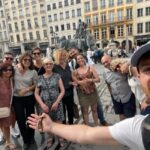
Your walk begins at Place des Terreaux, one of Lyon’s most impressive urban spaces. The square gives your guide plenty to work with right away: architecture, public art, civic power, and the city’s changing identity.
The Bartholdi Fountain is the obvious visual marker. Its horses and dramatic movement make it an easy meeting-place landmark, but the square is more than a photo stop. This is a useful point for understanding Lyon as a major French city with a strong sense of place, not simply a base for visiting other parts of the country.
A private guide is especially helpful here because you can pause over details that might otherwise pass unnoticed. If you care about architecture, ask your guide to explain the buildings around the square. If you prefer social and political history, ask how Lyon’s public spaces changed during periods of unrest.
The private setup also helps at the start of the tour. You do not need to wait for a large group to gather or listen to questions that have nothing to do with your interests. With up to 15 people allowed, the experience can still work for an extended family or a group of friends, but a party of 12 to 15 will naturally feel less personal than a party of four.
You can also read our reviews of more walking tours in Lyon
Following Rue de la République into modern Lyon
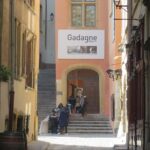
From Place des Terreaux, the route continues along Rue de la République. This is one of the city’s key commercial streets and provides a useful contrast with the older quarters later in the walk.
I like this kind of transition in a city tour. You are not being shown isolated monuments one after another. Instead, you move from a grand civic square into a busy urban corridor, then toward the older districts beside the Saône. The changes in street design and building style help you read Lyon as a living city.
Your guide can also make this section practical. Ask where the central shopping areas are, which streets are worth walking again, and how the different parts of Lyon connect. Since the tour ends at Fourvière rather than returning to the starting point, this is a good time to ask for advice about what to do next.
The route is flexible, but only within the limits of a two-hour walk. You should not expect a full survey of every major district. The value is in getting a well-shaped first look, then using your guide’s suggestions to continue independently.
Meeting Lyon’s cathedral at Saint-Jean
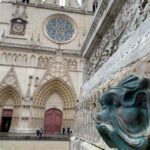
Cathedral Saint Jean Baptiste brings you into the historic heart of Lyon. Its setting in Vieux Lyon makes it an important stop both for religious history and for the city’s older street pattern.
A guide can help you look past the basic exterior view. You might discuss the cathedral’s role in Lyon, the surrounding district, and the way religious buildings shaped daily life in the old city. The tour also includes stories connected with the French Revolution and the St. Bartholomew’s Day Massacre, so this is a good point to ask how national events affected Lyon specifically.
Because the tour is private, you can decide how much time you want to spend on these darker chapters. Some people want dates, causes, and political context. Others prefer to keep moving and focus on the building and neighborhood. Your guide can respond to that preference more easily than a guide leading 30 or 40 people.
The cathedral stop is also a natural reminder that this is a walking tour, not a museum visit. Entrance fees are not included, and the advertised experience is built around seeing the city from its streets. If you want time inside paid attractions, ask your guide what can realistically fit before the walk begins.
Finding the traboules of Vieux Lyon
The traboules are likely to be the most distinctive part of the route. These passageways connect streets and courtyards through Lyon’s old buildings. They are easy to miss if you walk alone, and some entrances are not obvious to first-time visitors.
You will explore Traboules du Vieux Lyon as part of the walk through Vieux Lyon. This is where a local guide adds real value. Rather than simply pointing out an attractive lane, your guide can explain how the passageways fit into the structure of the neighborhood and why they matter to Lyon’s identity.
The traboules are not a grand monument in the usual sense. Their appeal comes from moving through spaces that feel tucked into the fabric of the old quarter. You may pass from a street into a quieter interior court, then emerge somewhere else. That change in mood is one of the best reasons to choose a walking tour instead of a bus-based city overview.
Conditions can vary, and the passageways are part of an active neighborhood rather than a theatrical attraction. Keep your group together and follow your guide’s lead. The private format is useful here because you can ask about what you are seeing without disrupting a large procession.
Vieux Lyon itself deserves attention beyond the traboules. Give yourself a chance to notice the buildings, lanes, and relationship between the old quarter and the hill above it. If the group is especially interested in architecture or local stories, ask for more time in this area, though that may mean moving faster elsewhere.
Climbing toward Fourvière and the basilica
The route finishes on Fourvière Hill at the Basilica of Notre-Dame de Fourvière. This gives the tour a strong ending, but it also shapes the physical demands of the walk.
You are going from the lower city to a hilltop destination, so comfortable shoes are sensible. The route may feel easy at first, then more demanding as you approach Fourvière. A two-hour walk with continuous standing and listening can be tiring, particularly for anyone who prefers frequent pauses.
The reward is the change in viewpoint. From Fourvière, you can look back across Lyon and understand the city’s rivers, old quarters, and newer districts as one connected place. The basilica gives the tour a memorable final landmark rather than ending on an ordinary street.
One practical detail deserves attention. The funicular system serving Fourvière has more than one line, and taking the wrong one can send you to the wrong destination. If your guide walks you toward the funicular at the end, ask specifically which line goes to Fourvière and which stop you need. Pierre was praised for giving useful direction for further exploring, and this kind of practical help is exactly what you should request before saying goodbye.
The basilica is the endpoint, not a promise of an included interior visit. Entrance fees are not part of the tour price. If you want to spend more time at the basilica after the guided walk, plan that as your own follow-up.
You can also read our reviews of more guided tours in Lyon




What the private guide adds to the experience
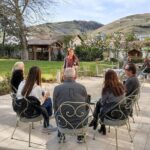
The best reason to book this tour is the ability to shape the conversation. You can ask about French history, Lyon’s architecture, food, neighborhoods, or directions for the rest of your stay. The guide is with your group only, so questions do not need to be saved for a formal pause.
The guides named in the available feedback include Pierre and Margaux, also written as Margeau in one comment. Pierre was praised for using the time well and pointing out useful places for later exploration. Margaux was described as personable and strong at combining historical, cultural, and architectural information.
That balance matters. A guide who gives only dates can make a beautiful city feel like a classroom. A guide who gives only personal anecdotes may leave you without a clear understanding of what you are seeing. The most useful approach combines both, and this tour appears designed for that mix.
Still, you should keep your expectations realistic about English. One party found its guide pleasant and well-informed but felt that her English was not always easy to understand. That is a fair concern for a history-heavy walk. If exact explanations matter to you, contact the provider before booking and ask about the English ability of the guide assigned to your date.
A private tour also gives you a better chance to fix small problems as they arise. You can ask a guide to repeat a point, slow down, change the subject, or spend less time at a stop that does not interest you. That flexibility is more useful than a rigid promise to see every listed sight.
Is $402.01 a fair price for up to 15 people?
The listed price is $402.01 for the group, not per person. For two people, that is a costly introduction to Lyon. For four adults, it comes to about $100.50 each. For a larger family or friend group, the per-person cost drops sharply, which makes the private format easier to justify.
You are paying for a local guide who stays with your party, a private route, and the chance to adjust the focus on the spot. You are not paying for entrance fees, food, drinks, or a full-day service. The tour lasts about two hours, so the value depends heavily on your group size and how much you care about personal attention.
I would find the price easiest to justify for a group of four to 10 people who want a focused first walk through Lyon. It is also useful for families or friends who do not want to be folded into a large tour. Solo visitors or couples may prefer a less expensive group experience unless privacy and flexibility are their top priorities.
Before booking, ask your group what you actually want from the walk. If everyone enjoys history and conversation, the private guide can be a good use of money. If you mainly want quick photo stops and basic directions, two hours at this price may feel excessive.
Who will enjoy this Lyon walk most?
This tour suits first-time visitors who want the city explained in a logical sequence. The route links Place des Terreaux, Rue de la République, Saint-Jean, Vieux Lyon, Fourvière Hill, and the basilica, so you finish with a useful mental map.
It is also a good match for groups with mixed interests. One person can ask about architecture, another about the Revolution, and someone else can ask where to continue walking afterward. A guide can adjust the conversation without turning the tour into a debate over what the whole group wants to hear.
Families and close friends may appreciate the privacy. You can ask basic questions, stop briefly when needed, and avoid the pressure of speaking in front of strangers. Service animals are allowed, and the activity is near public transportation. Most people can participate, but the walking time and hilltop finish still make comfortable footwear important.
I would be more cautious if you need frequent seated breaks, have difficulty with uphill walking, or want a tour conducted in clearly bilingual English and French. One useful improvement would be a short coffee or sitting stop, but that is not included as a fixed part of the experience. Ask about the pace and break options before you commit.
Practical details that affect your day
The meeting point is Place des Terreaux, Pl. des Terreaux, 69001 Lyon. The tour ends at 8 Pl. de Fourvière, 69005 Lyon, at the Basilica of Notre-Dame de Fourvière. This one-way design is convenient if you want to continue at Fourvière, but it is less useful if you need to return immediately to the starting area.
Confirmation is provided at booking. The tour is offered in English and uses a mobile ticket. Public transportation is nearby, which helps with reaching the start and leaving the hilltop finish.
You can cancel for a full refund if you do so at least 24 hours before the local start time. Cancellations or changes made inside that window are not accepted for a refund. Keep that deadline in mind if your Lyon plans depend on weather or a changing rail schedule.
Should you book this private Lyon tour?
Book it if you are a group of at least four, want a personal introduction to Lyon, and value conversation more than a checklist of sights. The route has a satisfying shape, the traboules add a distinctive local element, and the finish at Fourvière gives you both a major landmark and a broad city view.
I would book with two requests in mind: confirm the guide’s English clarity and ask whether a brief sitting pause can be worked into the two-hour route. Also ask for precise funicular instructions if you plan to use public transportation after the tour.
Skip it if you want a slow café-based outing, included admissions, or a route with little walking. For the right group, though, this is a useful way to get oriented quickly and then explore Lyon with better questions and better direction.
FAQ
How long does the Lyon private walking tour last?
The tour lasts approximately two hours.
Where does the tour begin?
It begins at Place des Terreaux, Pl. des Terreaux, 69001 Lyon, France.
Where does the tour end?
The tour ends at the Basilica of Notre-Dame de Fourvière, 8 Pl. de Fourvière, 69005 Lyon, France.
What sights are included on the route?
The route includes Place des Terreaux, the Bartholdi Fountain, Rue de la République, Cathedral Saint Jean Baptiste, the traboules of Vieux Lyon, Vieux Lyon, Fourvière Hill, and the Basilica of Notre-Dame de Fourvière.
Is this a private tour?
Yes. Only your group participates, and the private group can include up to 15 people.
Is the tour offered in English?
Yes. English is the listed language for the experience.
Are entrance fees included?
No. Entrance fees are not included in the tour price.
Can the tour be changed to suit my interests?
The itinerary may be customized with your local guide on the spot, so you can discuss your interests and request adjustments during the tour.