REVIEW · PARIS
Louvre Guided Tour with Mona Lisa & Masterpieces
Book on GetYourGuide →Operated by City Wonders Ltd. · Bookable on GetYourGuide
The Mona Lisa may draw the biggest crowd, but this three-hour Louvre tour gives you much more than a quick look at Leonardo’s famous smile. You’ll also see Michelangelo, Caravaggio, Raphael, the Venus de Milo, Winged Victory of Samothrace, and grand rooms from the Louvre’s royal past.
I like the reserved afternoon access, which helps you spend less time waiting and more time with the art. I also like the headset system and expert English-speaking guide, especially in galleries where a crowd can swallow a quiet explanation. The main drawback is the pace: three hours is useful for an overview, but it cannot cover a museum this large in full.
- A carefully chosen route: See major Greek, Roman, and Renaissance works without trying to conquer the entire Louvre.
- Afternoon entry: The tour is scheduled for a later visit, when the museum may feel less pressured than at peak morning times.
- Florence is a praised guide: A recent booking singled out Florence for her enthusiasm and command of the subject.
- Royal rooms included: The Apollo Gallery and Napoleon Apartments add palace drama to the art collection.
- Simple central meeting point: Meet beside the Arc de Triomphe du Carrousel, not at the Louvre Pyramid entrance.
- Bring light luggage: Strollers and large bags are not allowed, and anything over 55 by 35 by 20 centimeters cannot enter.
In This Review
- Three Hours Inside the Louvre, Without Losing Your Way
- Finding the Arc de Triomphe du Carrousel
- Reserved Entry and the First Security Check
- The Mona Lisa, Famous for Good Reason
- Renaissance Art Beyond Leonardo
- Greek and Roman Works With a Wider Story
- Canova, Apollo, and the Louvre as a Palace
- What the Afternoon Schedule Really Means
- Group Size, Accessibility, and Practical Limits
- Who Gets the Most From This Louvre Tour
- Should You Book It?
- FAQ
- How long does the Louvre guided tour last?
- Where does the tour begin?
- Where does the tour finish?
- Is the Louvre ticket included?
- Is the tour conducted in English?
- Can I bring luggage or a baby stroller?
- Can wheelchair users join this tour?
Three Hours Inside the Louvre, Without Losing Your Way
The Louvre is not a museum you casually wander through in three hours. It is a former royal palace with vast collections spread through several wings and floors. Without a plan, you can spend half your visit finding the next staircase.
This tour solves that problem with a fixed route and a live guide. You will not see every gallery, but you will reach a strong selection of famous works and hear why they matter. That is the right approach for a first visit, especially if you want context instead of a checklist of names.
The advertised price is $80 per person. That includes the Louvre entrance ticket, the reservation fee, reserved access, the guide, and a headset. The museum ticket is listed as 22 euros, and a 70 euro reservation fee applies per group, so the tour price is paying for more than admission alone. Its value depends on how much you want explanation and structure.
If you already know the Louvre well and prefer to set your own route, the added cost may not appeal to you. If this is your first visit, the guide can make three hours count.
Finding the Arc de Triomphe du Carrousel
Your meeting point is beside the Arc de Triomphe du Carrousel, not at the Louvre entrance. This detail matters. Many people instinctively walk toward the glass Pyramid, then discover they need to turn around and cross back toward the arch.
Stand with your back to the Louvre Pyramid and look across the road toward the entrance to the Tuileries Garden. The arch has a horse-drawn chariot on top, making it easier to identify. The tour coordinators wait to the left of the arch, along the wall railing, dressed in blue.
Give yourself time to locate this spot. The Louvre area is busy, and the meeting point is close to the museum without being at its front door. Arriving early also gives you time to find your guide before the group moves toward security.
There is no hotel pickup or drop-off. You make your own way to the Arc de Triomphe du Carrousel and leave from the Louvre Pyramid at the end.
You can also read our reviews of more guided tours in Paris



Reserved Entry and the First Security Check
Reserved access helps reduce the ticket-line problem, but it does not mean you walk straight into the galleries. Everyone must pass through museum security, and that can still take time.
Keep your belongings small. Baby strollers and luggage or large bags are not allowed. Items larger than 55 by 35 by 20 centimeters cannot enter the museum. This is not the place to arrive with a full suitcase after checking out of your hotel.
The tour includes a headset, a practical touch that is easy to underestimate. Louvre rooms can be noisy, and guides often need to speak over a steady wash of conversation. With the headset, you can stay near the group and still hear the explanation.
Parties of seven or more may be split into different groups on the day. If you are traveling with a large family or group of friends, be prepared for that possibility.
The Mona Lisa, Famous for Good Reason
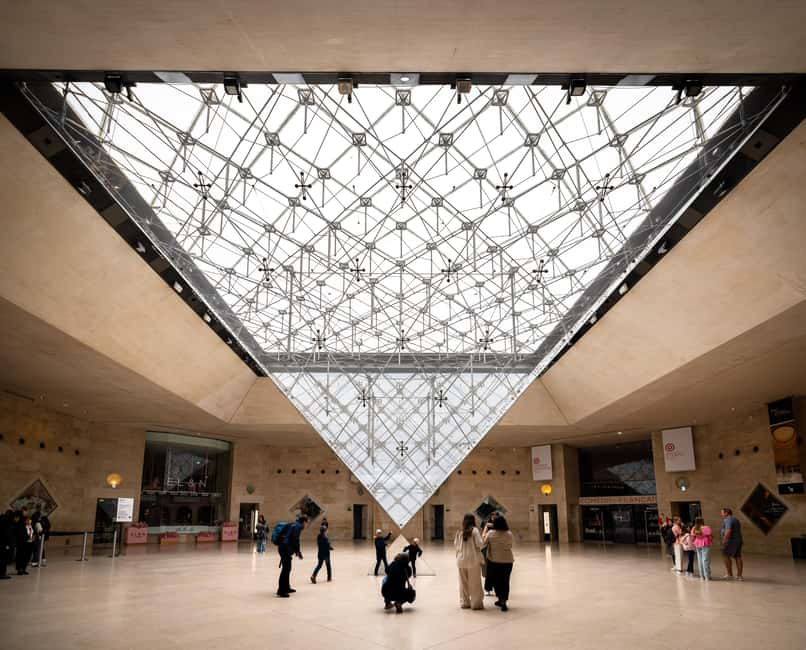
Leonardo da Vinci’s Mona Lisa is the headline stop. You will see the painting in person, but do not expect a quiet, private encounter. It is one of the Louvre’s most visited works, and the room can be crowded.
A guide adds value here by helping you look beyond the familiar image. The painting’s small scale, guarded presentation, and immense fame are all part of the experience. You can consider the expression, the pose, and the landscape behind the figure, rather than simply taking a photograph and moving on.
The visit is not designed around an unlimited amount of time in front of the painting. The group needs to keep moving, and the museum has many other works to cover. If the Mona Lisa is your only goal, a guided three-hour tour may give you more surrounding material than you need. For most first-time visitors, that wider view is a benefit.
The afternoon timing is another advantage. It does not promise an empty gallery, but it offers a chance to avoid the heaviest early rush. The exact feel depends on the day and museum conditions.
Renaissance Art Beyond Leonardo
The Renaissance section broadens the visit beyond one celebrated painting. You will see works associated with Leonardo and Raphael, along with Michelangelo’s Dying Slave.
Michelangelo’s sculpture is especially useful for understanding how Renaissance artists treated the human body. The figure is not simply a decorative statue. It carries tension, weight, and an unfinished quality that gives the work emotional force.
You will also encounter paintings by Caravaggio. His strong contrasts of light and dark and his direct treatment of human figures make his work easy to recognize, even if you are new to art history. A guide can point out how these choices differ from the balance and ideal beauty often linked with earlier Renaissance painting.
This is where the tour format earns its fee. You receive a thread connecting the works, rather than stopping at random objects because they look familiar. The guide can also explain lesser-known details that are easy to miss when you are moving through the galleries alone.
Florence is one named guide for this experience. A recent verified booking praised her knowledge and enthusiasm, qualities that matter in a museum where a flat lecture can make even great art feel distant. Guide quality always affects a walking tour, but her strong reputation is a useful reason to feel confident about the human side of this visit.
Greek and Roman Works With a Wider Story
The classical collection includes two of the Louvre’s best-known sculptures: the Venus de Milo and the Winged Victory of Samothrace.
The Venus de Milo is famous for its missing arms, but the sculpture deserves more than a quick photograph. Its pose, proportions, and surface give you a chance to think about how ancient Greek sculpture shaped later European art. The guide can also place it within the wider Greek and Roman collection, where lesser-known pieces may reveal more about daily life, religion, and public ideals than the famous objects alone.
Winged Victory makes a powerful impression because of its setting and form. The sculpture appears to move forward, with fabric clinging to the body as if caught by wind. Even without knowing its full background, you can see why it has become one of the Louvre’s essential stops.
The route also includes Greek and Roman antiquities that do not have the same fame. Pay attention here. These quieter objects often make the collection feel less like a parade of famous names and more like a record of changing cultures.
You should expect plenty of walking and standing. The Louvre’s floors are large, and the route moves between major sections. Wear comfortable shoes and avoid planning another demanding walking activity immediately afterward.





Canova, Apollo, and the Louvre as a Palace
Antonio Canova’s Psyche Revived adds a different mood to the sculpture route. Where Michelangelo’s Dying Slave suggests struggle and constraint, Canova’s work is polished, graceful, and carefully balanced. Seeing both helps you compare two very different ideas of the ideal body and emotional expression.
The Apollo Gallery shifts the tone again. It is a regal interior rather than a simple display room, and its decoration reflects the Louvre’s connection to monarchy and ceremony. You are not only looking at individual works; you are also seeing the building as a palace built to impress.
The Napoleon Apartments continue that royal theme with opulent interiors. They show how power was presented through furniture, decoration, scale, and controlled movement through rooms. For many people, these spaces provide a welcome change from painting galleries.
I like this part of the route because it explains the Louvre as a place with two identities. It is one of the world’s great museums, but it began as a royal residence and political symbol. The rooms help you understand why the building can feel almost as important as the objects inside it.
What the Afternoon Schedule Really Means
The tour lasts three hours and takes place in the afternoon. That schedule suits you if you want to spend the morning elsewhere, perhaps walking through the Tuileries Garden or visiting another Paris sight before heading to the museum.
The later time may also help with crowd levels. It does not remove lines at security or guarantee open space around the Mona Lisa. Still, reserved entry and a planned afternoon visit can make the day less dependent on luck.
Three hours is long enough to see the headline works and several important rooms. It is not long enough for a slow study of each gallery. The guide must keep the group moving, and you should accept that some rooms will receive only a short explanation.
That tradeoff is sensible for a first visit. You gain orientation and a reliable selection of masterpieces. You lose the freedom to linger wherever your eye catches something unexpected.
Group Size, Accessibility, and Practical Limits
The tour is conducted in English. A headset keeps the guide audible as the group moves through the museum, which is useful in crowded rooms.
Large parties may be divided if there are seven or more people. This could be inconvenient if your group wants to remain together, though splitting can also make movement easier inside tight galleries.
The experience is not suitable for wheelchair users. It also involves a fair amount of walking, so anyone with limited stamina should take that seriously. The supplied information does not promise a reduced walking route or special accessibility arrangements.
Free cancellation is available up to 24 hours before the tour for a full refund. You can also reserve now and pay later, which gives you some flexibility when building a Paris schedule.
Who Gets the Most From This Louvre Tour
I would choose this tour for a first-time Louvre visitor who wants the major works explained by a guide. It is also a good fit if you have only one afternoon in the museum and do not want to spend valuable time deciding which wing to visit next.
Art lovers who already have a personal list of lesser-known paintings may prefer a self-guided visit. The fixed route means you cannot shape the experience around your own research.
Families with young children should consider the walking time and the ban on strollers. Teenagers and older children may appreciate the famous sculptures and the palace rooms, but three hours inside a large museum can still be tiring.
The tour also suits anyone who likes art history in plain language. You can ask questions, compare styles, and connect the objects to the building around you. The experience is not just a trip to the Mona Lisa, but it does give that painting the attention its fame requires.
Should You Book It?
Book this tour if you want a well-planned first look at the Louvre, value an English-speaking guide, and prefer reserved entry to managing the museum alone. The combination of Mona Lisa, Renaissance works, classical sculpture, Apollo Gallery, and Napoleon Apartments gives you a strong range in three hours.
Think twice if you need wheelchair access, want to carry luggage, or prefer to spend long periods with one artist or collection. The $80 price is reasonable when you value the guide, headset, reservation, and time saved, but less attractive if you only want admission.
If Florence leads your group, her praised enthusiasm is another encouraging detail. Overall, this is a practical choice for seeing the Louvre’s essential sights without treating the museum like a race.
FAQ
How long does the Louvre guided tour last?
The guided tour lasts three hours.
Where does the tour begin?
It begins beside the Arc de Triomphe du Carrousel, near the entrance to the Tuileries Garden. The meeting point is not at the Louvre Pyramid entrance.
Where does the tour finish?
The tour finishes at the Louvre Pyramid.
Is the Louvre ticket included?
Yes. The entrance ticket and reservation fee are included in the tour price.
Is the tour conducted in English?
Yes. The tour has a live English-speaking guide.
Can I bring luggage or a baby stroller?
No. Baby strollers and luggage or large bags are not allowed. Items exceeding 55 by 35 by 20 centimeters are also not permitted.
Can wheelchair users join this tour?
No. This experience is not suitable for wheelchair users.