REVIEW · PARIS
Kickstart Paris Private Tour. City Highlights for Newcomers
Book on Viator →Operated by Local CoolTour · Bookable on Viator
Paris feels big on day one. This private Kickstart Paris tour helps you get your bearings fast, linking landmark after landmark with clear local context. You’ll cover the A-list sights, but the real win is how the guide turns them into a first-visit plan—what to linger at later, what to skip, and how to move around without getting frazzled.
I especially like the newcomer-friendly flow: parks, churches, classic neighborhoods, major squares, and river views, all stitched into one sensible route. I also like that you’re not stuck with a rigid script; this is private, so your guide can adjust the pace for your group and keep the experience comfortable. The one thing to consider is that some big-name stops (like the Louvre and the Eiffel Tower) aren’t included, so you’ll likely want to plan tickets or timing for those separately.
In This Review
- Key Points You’ll Care About
- Kickstart Paris: A First-Visit Plan You Can Actually Use
- What You’re Really Paying For (Private Time + Smart Direction)
- How the Route Works: Walking + One Metro Hop That Saves Energy
- Stop-by-Stop: The Highlights That Set Up Your Next Days
- Luxembourg Gardens: The Paris “Wait, This Is Beautiful” Moment
- Église Saint-Sulpice: A Church With Big-Story Energy
- Saint-Germain-des-Prés: Intellectual Paris, Cafe-Style
- Pont des Arts: A Romance Bridge With Real Walking-Bridge Charm
- Louvre Museum: See the Big Name, Plan the Big Visit
- Jardin des Tuileries: A Classic Walk Between Two Anchors
- Place de la Concorde: History in a Square That Still Feels Giant
- Invalides: War History and a Place People Remember
- Wall of Peace: A Quiet Modern Counterpoint
- Eiffel Tower: Finish at the Icon, Then Decide What’s Next
- The Guide Factor: Tips That Don’t Feel Like a Sales Pitch
- Price and Value: When This Private Tour Makes Sense
- Who This Tour Fits Best
- Quick Tips Before You Go
- Should You Book This Kickstart Paris Private Tour?
- FAQ
- How long is the Kickstart Paris Private Tour?
- How much does the tour cost?
- Is the tour private or shared with other travelers?
- What language is the tour offered in?
- What are the main sights included on the route?
- Are tickets included for the Louvre Museum and Eiffel Tower?
- What stops have free admission?
- Is there any public transportation included?
- Where does the tour start and end?
- Can I cancel for a refund?
Key Points You’ll Care About

- A first-day lineup of A-list sights, explained in plain English so Paris makes sense fast.
- Free entry for most stops, including Luxembourg Gardens and major landmarks along the way.
- One practical Metro ride built in (Place de la Concorde to Invalides), which is gold if you don’t speak French.
- Private pacing for your group, so you can slow down, ask questions, and stay comfortable.
- Guides who are ready for real first-night stress, with multiple English-speaking guides praised for being kind, patient, and helpful (names like Matthias, Pamela, Susan, Achraf, Carmen, and Marine show up in standout experiences).
Kickstart Paris: A First-Visit Plan You Can Actually Use

If Paris is your first big European city trip, day one can feel like drinking from a firehose. This tour is designed for that moment. In about 2 hours 30 minutes, you get the shape of the city: where the important areas are, how they connect, and what to treat as a quick “got it” versus a “I need to come back” stop.
Think of it like getting a map that you can walk through. The guide doesn’t just point at monuments; they explain what you’re seeing and—just as importantly—what you can do next. That matters because Paris isn’t one big sightseeing theme park. It’s neighborhoods, streets, and daily life layered on top of centuries of history. This tour gives you a starter kit so you can keep choosing well after you walk away.
You can also read our reviews of more city tours in Paris



What You’re Really Paying For (Private Time + Smart Direction)

At $104.53 per person for a 2.5-hour private walking tour, the value isn’t in “checking off” spots. It’s in the human guidance: someone local, working with your group in English, who helps you decide how to spend your limited vacation time.
Most of the stops here have free admission, which is a big part of why this works for newcomers. You’re not paying to enter ten places in a short window. Instead, you’re seeing the landmarks from the outside, learning why they matter, and getting cues for what you might want to revisit in depth later.
Also, the end of the tour at the Eiffel Tower is a payoff. You finish at one of the most recognizable icons on earth, but you do it after learning the “why” behind the route. That turns the Eiffel Tower from a postcard into a piece of your own day.
How the Route Works: Walking + One Metro Hop That Saves Energy

This is primarily a walking tour, with a Metro ride included. The included ride runs from Place de la Concorde to Invalides. That’s a smart compromise: you still get the feel of Paris on foot, but you don’t burn your legs on a section where getting between major points is easier by rail.
If you’re arriving in Paris with jet lag or you don’t speak French yet, this is one of the most useful parts of the experience. You’re not thrown into the deep end alone. You get a guided walkthrough of how transit fits into your sightseeing day, and you come away with a little confidence for the rest of your trip.
This also helps with logistics. The tour starts near public transportation, and you end near a major transit hub at the Eiffel Tower area. You’re not stuck far from where you want to go next.
Stop-by-Stop: The Highlights That Set Up Your Next Days

Luxembourg Gardens: The Paris “Wait, This Is Beautiful” Moment
You start at Luxembourg Gardens, a classic Paris park with major historical roots. Designed in 1612 by Marie de’ Medici, it’s known for being central and popular, which means you’ll likely see the park at its best: people strolling, benches in use, and a sense of everyday Paris life.
As a first stop, it’s a smart choice. You’re not rushing straight into museum mode. You ease in with a place that feels like the city’s living room, and the guide can set the tone: how Paris uses green spaces, and how people actually hang out here.
Possible drawback: it can be crowded at peak times, so you may feel a bit of foot-traffic around you. The guide can help you steer through it efficiently.
You can also read our reviews of more private tours in Paris





Église Saint-Sulpice: A Church With Big-Story Energy
Next is Église Saint-Sulpice, built in the 17th century on earlier foundations. It’s one of the larger churches in Paris, and it has a reputation in pop culture linked to Dan Brown’s Da Vinci Code.
This stop is about more than architecture. It’s a chance to train your “Paris eye”—looking at how religious buildings sit in the city, and how Paris layers eras on top of each other. Even if you’re not an art-history fan, you’ll leave with an understanding of why this church is worth spotting.
Saint-Germain-des-Prés: Intellectual Paris, Cafe-Style
Then you head to Saint-Germain-des-Prés, famous for being a center of French intellectual life, especially in the 1960s. The guide points you toward the cafe culture that attracted major figures like Jean-Paul Sartre and Simone de Beauvoir.
This is where the tour starts to feel less like landmarks and more like a story. You get a sense of the neighborhood as a place that shaped ideas—not just a backdrop for tourists.
If you want to later plan a dinner or a casual drink in the area, this stop gives you a mental shortcut: you’ll know where that “scene” is.
Pont des Arts: A Romance Bridge With Real Walking-Bridge Charm
You cross (or stop near) Pont des Arts, the pedestrian bridge over the Seine. It’s known internationally as a romance symbol, and it was the first metal bridge built in Paris.
This is a great pause point. River views can reset your brain. You’ll see why the Seine is the spine of so many Paris stories. And you get photos that don’t just feel like “I was there.” They feel like “this is what Paris looks like.”
Louvre Museum: See the Big Name, Plan the Big Visit
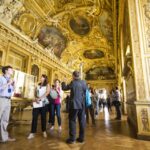
You’ll arrive at the Louvre Museum, the French national museum, housed in the former royal palace. It covers fine arts, archaeology, and decorative arts—one of the world’s most important museum sites.
But here’s the key: Louvre admission isn’t included, so you’re not going into the galleries on this tour. Instead, you get the essential orientation outside—enough to make future planning easier. If you decide you want a Louvre day, you’ll know what area you’re aiming for and you’ll be better prepared for crowds and time needs.
If you already know you want a long Louvre visit, consider doing this tour early in your trip, so you can decide exactly which wing or highlights to target afterward.
Possible drawback: if you’re hoping to walk inside as part of the 2.5 hours, you’ll need to set expectations. This stop is a “setup,” not a ticketed museum tour.
Jardin des Tuileries: A Classic Walk Between Two Anchors
Between the Louvre and Place de la Concorde is Jardin des Tuileries. This public garden in the 1st arrondissement gives you a smooth, elegant transition from one major sight to another.
Walking here helps break up the day. It’s easier to absorb the city when you’re not constantly stopping and starting. Plus, it’s a pleasant “in-between” space—one that feels designed for strolling rather than sprinting.
Place de la Concorde: History in a Square That Still Feels Giant
Then comes Place de la Concorde, one of Paris’s most important squares. It connects directly to major French Revolution history, including execution by guillotine involving Louis XVI and also Queen Marie-Antoinette.
This stop works because it’s both architectural and emotional. You’ll understand why this square is treated like a centerpiece, not just a traffic circle. The guide can point out how squares in Paris function as gathering points and historical stages.
Invalides: War History and a Place People Remember
Invalides is next, and it’s tied to the will of King Louis XIV, who ordered its construction in 1670 to shelter disabled war veterans.
This is another “orientation with meaning” stop. You get the sense of why Paris keeps certain buildings monumental. Invalides isn’t random sightseeing. It’s part of how the city honors history, and it’s also a strong landmark for the next move: the included Metro hop.
Wall of Peace: A Quiet Modern Counterpoint
A stop at the Wall of Peace (part of the 2000 celebrations) adds a modern touch to the day. It was inspired by the Wailing Wall in Jerusalem.
This moment is brief, but it’s the kind of stop newcomers often miss if they only chase the oldest famous things. It shows Paris as a city that keeps layering new meanings on top of old streets.
Eiffel Tower: Finish at the Icon, Then Decide What’s Next
The tour ends at the Eiffel Tower in the 75007 area. It’s about 300 meters high and was built for the 1889 Universal Exhibition by Alexandre Gustave Eiffel and collaborators.
Admission isn’t included here either. But finishing at the tower at the right point in your trip is useful: you’re not staring up at it all day without context. You end with a clear sense of what it represents and how it fits into the broader Paris story.
If you want to go up later, you’ll know it’s waiting for you—plus you’ll have a calmer plan for timing.
The Guide Factor: Tips That Don’t Feel Like a Sales Pitch

The strongest part of this experience is the guide’s role in making Paris usable. You’ll get an overview of top sights and suggestions for what to see in more depth later. On top of that, guides share practical tips for sightseeing, dining, and shopping.
From the guide style praised on past tours, the pattern is clear: the best guides are patient and adaptable. Some standout experiences mention guides who were courteous and extremely well educated, and others highlight help navigating practical needs like finding bathrooms and working around tired first-day energy.
And yes, language matters. This tour is offered in English, and some guides have been praised for being friendly to travelers who don’t speak much French, including support around the Paris transportation system. If you’re on your first full day in Paris and you’d rather not guess your way through the Metro like it’s a puzzle, this is the kind of help that makes the city feel less intimidating.
Price and Value: When This Private Tour Makes Sense

Let’s talk value without sugarcoating it. You’re paying for a private guide plus structured time around major sights. At $104.53 per person, it can be a smart move when:
- You’re short on time and want a high-quality first orientation.
- You’re traveling with family members who need a manageable pace.
- You’re not confident with transit yet and want help for the route.
- You’d rather spend money on guidance than on multiple museum tickets immediately.
If you already know Paris well and you’re comfortable navigating the city alone, you could skip this type of tour. But for newcomers, the “start here” benefit is real: you leave with a clearer plan for the rest of your trip.
Also, because most stops are free, you’re not paying entrance fees on top of the tour price for most of the day. The biggest non-included icons are the Louvre and Eiffel Tower, so your budgeting is easier: you can decide later how deep you want to go.
Who This Tour Fits Best

This is built for newcomers and for people who want a first-day backbone.
It’s a good match if:
- You want a guided introduction without a strict, museum-heavy schedule.
- You like the idea of walking through neighborhoods, squares, and parks.
- You want a private experience where the guide can tailor pacing.
It may be less ideal if:
- You want a full museum visit to the Louvre within 2.5 hours.
- You want guaranteed Eiffel Tower access during the tour time.
Quick Tips Before You Go

- Wear shoes that handle cobblestone and lots of walking.
- Bring a light layer; parks and river areas can feel cooler.
- Think about the Louvre and Eiffel Tower as future visits you’ll plan after orientation, not as included stops.
- If you’re traveling with kids or anyone who gets tired easily, this private format is a real advantage.
Should You Book This Kickstart Paris Private Tour?
Yes, if you’re arriving in Paris and want a structured, newcomer-friendly day that teaches you how the city connects. The biggest reason to book is that you’re not just viewing landmarks—you’re getting a guide-led sense of what to do next, plus practical transit help with a Metro ride included.
If you’re the type who already has a tight plan for the Louvre and Eiffel Tower and you don’t need orientation, then you might skip. But if you want your first day to feel calmer and clearer, this is a strong way to start.
FAQ
How long is the Kickstart Paris Private Tour?
The tour is about 2 hours 30 minutes.
How much does the tour cost?
The price is $104.53 per person.
Is the tour private or shared with other travelers?
It’s a private tour/activity, so only your group participates.
What language is the tour offered in?
It’s offered in English.
What are the main sights included on the route?
You’ll see Luxembourg Gardens, Église Saint-Sulpice, Saint-Germain-des-Prés, Pont des Arts, the Louvre Museum area, Jardin des Tuileries, Place de la Concorde, Invalides, the Wall of Peace, and you end at the Eiffel Tower.
Are tickets included for the Louvre Museum and Eiffel Tower?
No. Admission for the Louvre Museum and the Eiffel Tower is not included.
What stops have free admission?
Admission is listed as free for Luxembourg Gardens, Église Saint-Sulpice, Pont des Arts, Jardin des Tuileries, Place de la Concorde, Invalides, and the Wall of Peace.
Is there any public transportation included?
Yes. A Metro ride from Place de la Concorde to Invalides is included.
Where does the tour start and end?
It starts at 65 Bd Saint-Michel, 75005 Paris, and ends at the Eiffel Tower, Av. Gustave Eiffel, 75007 Paris.
Can I cancel for a refund?
Yes. Free cancellation is available if you cancel up to 24 hours in advance for a full refund.