REVIEW · LYON
Guided tour of the Basilica of Fourvière and Gallo-Roman site of Lyon
Book on Viator →Operated by Aimer Savoir T&E · Bookable on Viator
Lyon’s Fourvière Hill gives you an unusually compact lesson in the city’s past. In about two and a half hours, you move from a Roman theater nearly 2,000 years old to a grand 19th-century basilica, then down toward Old Lyon. It is a smart way to connect the city’s ancient, religious, and everyday sides.
I like the private format and the included entrance fees. Your group can focus on its own questions, and the guide can set the pace instead of herding you through a large crowd. I also like the finish at Place Saint-Jean, since you end in the historic center rather than back on the hill.
The main caution is reliability. One recorded booking problem involved a guide who did not arrive, with the supplied phone number failing to connect and customer service proving hard to find. That is a serious concern, so save every confirmation detail and check the meeting arrangements before the day.
In This Review
- Key points to know before booking
- Why Fourvière Hill is the right place to begin
- Inside the Basilica of Notre-Dame de Fourvière
- The Roman theaters and the story of Lugdunum
- The viewpoint and the walk toward Old Lyon
- What the private format means for your group
- Timing, meeting point, and practical planning
- Who will get the most from this Lyon tour
- Is the $289.65 group price worth it?
- Should you book the Fourvière tour?
- FAQ
- How long does the guided tour last?
- Where does the tour begin?
- Where does the tour end?
- Which sites are included?
- Are entrance fees included?
- How many people can join the private tour?
- Can I cancel for a full refund?
Key points to know before booking
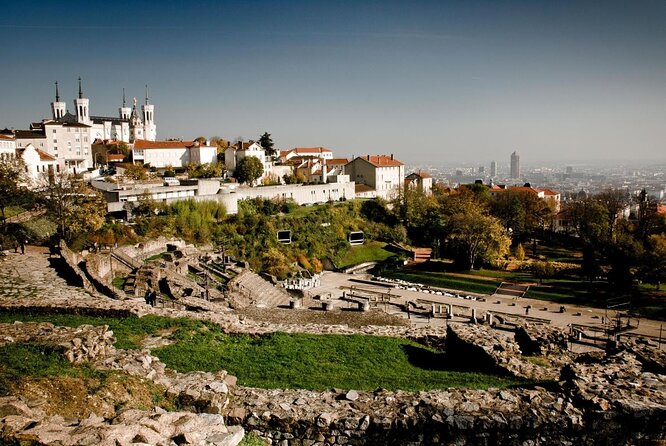
- Three layers of Lyon in one outing: Roman performance spaces, the Fourvière Basilica, and a panoramic view over the city.
- A small private group: The price is listed as $289.65 for up to 10 people, while the tour details also mention a maximum of 15, so confirm the exact group limit when booking.
- A useful downhill finish: You begin at Place de Fourvière and finish at Place Saint-Jean in Old Lyon.
- About 30 minutes at each main site: The remaining time covers walking, explanations, and the route between the hilltop and the old center.
- Good but not effortless walking: A moderate fitness level is advised, and Fourvière’s slopes make sensible shoes a good idea.
- Weather and minimum numbers matter: Poor weather or too few bookings can lead to a new date, another activity, or a full refund.
Why Fourvière Hill is the right place to begin
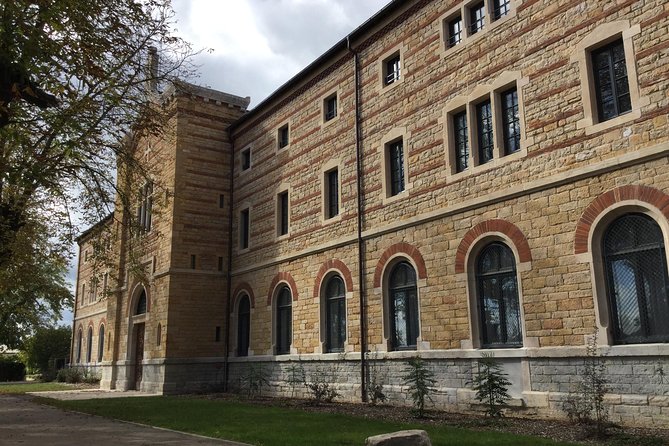
Fourvière is not just a viewpoint with a church on top. It is the high point from which Lyon’s story spreads outward. The hill overlooks the meeting area of the Rhône and Saône, the two rivers that helped shape the city’s trade, politics, and growth.
You start at Place de Fourvière, directly beside the Basilica of Notre-Dame de Fourvière. That opening location saves time. You do not spend the first part of the tour finding the monument or climbing toward it, although getting up to Fourvière before the meeting time still requires planning.
The route then links three very different sights. The Roman theater explains Lyon as Lugdunum, a major Roman center. The basilica shows the city’s later Catholic identity and its devotion to the Virgin Mary. The viewpoint ties both periods to the modern city below.
I like this structure because each stop answers a different question. Why was Lyon important in antiquity? Why is this hill so meaningful to local people? How did the city develop around its rivers and old quarters? A good guide can make those links clear without turning the outing into a string of disconnected facts.
You can also read our reviews of more guided tours in Lyon


Inside the Basilica of Notre-Dame de Fourvière
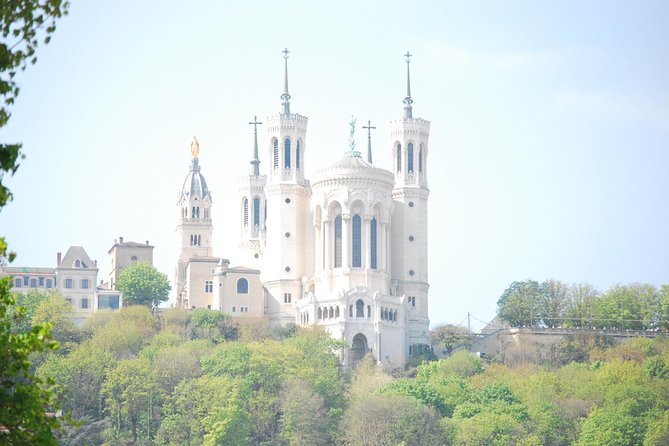
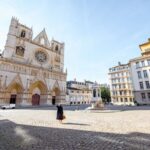
The basilica receives about 30 minutes, which is enough for an introduction but not a long architectural study. You can expect the guide to explain why this is Lyon’s best-known monument and why the Virgin Mary holds such an important place in the city’s religious life.
Fourvière’s basilica is associated with a special devotion to Mary, described here as the city’s protector and a figure who has appeared repeatedly in Lyon’s history. That gives the building more meaning than its dramatic exterior alone. The visit is about local belief and civic identity as much as decoration.
The basilica dates from the end of the 19th century, placing it many centuries after the Roman theaters below. That contrast is one of the tour’s strengths. You are not looking at a single period preserved in isolation. You are seeing how Lyon kept adding new meanings to the same hill.
Thirty minutes can feel short if you want to study every detail. The time works best if you treat the stop as a guided orientation rather than a full museum visit. Listen for the local stories and the reasons the basilica matters to Lyonnais people, then return on your own later if you want a slower look.
The supplied information does not name the guide, so you cannot choose a particular historian or local specialist in advance. The tour does promise a passionate local guide, but the actual quality will depend heavily on the person assigned. That makes the communication issue noted above worth taking seriously.
The Roman theaters and the story of Lugdunum
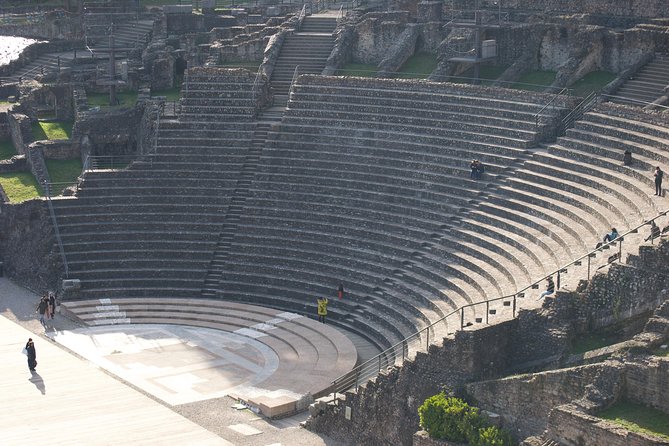
The Roman theaters are the historical centerpiece for many people. These performance spaces were built roughly 2,000 years ago, and their survival gives you a direct sense of Lyon’s place in the Roman world.
The site is described as remarkably intact. That does not mean every original feature survives, but enough remains to show the scale and purpose of the venues. You can picture performances taking place here long before Lyon became the city you see today.
The theaters were rediscovered in the 20th century, and that discovery helped restore their original purpose as public performance spaces. The site is still used for events, which adds a useful connection between ancient entertainment and modern cultural life.
Your guide is expected to use the theaters as a way to explain Fourvière and Lugdunum more broadly. This is where the tour should move beyond stones and measurements. Lyon was an important Roman center at the meeting point of the Rhône and Saône, and the hill was part of that larger urban setting.
The listed stop lasts about 30 minutes. That is enough to walk through the main area and get the basic story, but it will not cover every detail of Roman planning, construction, or archaeology. If Roman history is your main reason for booking, you may want to reserve extra time after the guided portion to look around at your own pace.
I especially like the sequence here. Seeing the basilica first makes the Roman remains feel even older, while arriving at the theaters first would give the religious monument a sharper contrast. Either way, the two sites explain why Fourvière is more than a scenic hill.
The viewpoint and the walk toward Old Lyon
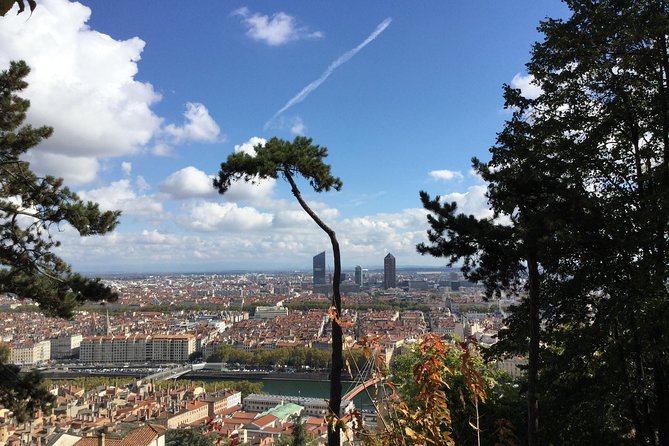
The tour also includes a lookout point below the basilica, where you can see across Lyon. The exact viewing platform is not named, so you should not expect a detailed promise about a particular angle or landmark. Still, the location provides the visual payoff that helps organize everything the guide has explained.
From above, the city’s position at the confluence of the Rhône and Saône becomes easier to understand. The view also gives you a practical sense of direction before you head into Old Lyon. You are not just hearing about the city’s layout; you are looking down at it.
The route ends at Place Saint-Jean, in the historic heart of Old Lyon. That is a useful finish for a day of sightseeing. You can continue exploring from there, stop for food, or simply use the square as a new reference point for getting around.
The downhill direction is convenient, but do not confuse downhill with effortless. The tour advises a moderate level of fitness, and Fourvière’s route can involve slopes and uneven surfaces. Wear shoes that are comfortable for walking and avoid planning a tight appointment immediately after the tour.
Because the advertised duration is approximately two hours and 30 minutes, allow a little flexibility around the finish. The two main stops account for about an hour altogether. The rest includes the viewpoint, transitions, guide commentary, and the walk from the hill to Saint-Jean.
What the private format means for your group
This is described as a private activity, meaning only your group participates. That is valuable if you want to ask questions or keep the walk focused on a particular interest, such as Roman Lyon, religious architecture, or city history.
The pricing is listed at $289.65 per group of up to 10 people. For a full group, that works out to about $29 per person. For two people, the same total is roughly $145 per person, so the value changes sharply with group size.
Entrance fees are included, which makes the total easier to judge. You are not paying the guide fee and then adding admission at each main stop. The private arrangement can also make sense for a family or group of friends that would otherwise book several separate tickets or accept a larger public group.
There is one detail to clarify before paying. The tour summary says the booking covers up to 10 people, while the highlights mention groups of no more than 15. Those figures do not match. Ask the provider to confirm the exact limit for your booking, especially if your party has more than 10 people.
The tour is booked an average of 25 days ahead, which suggests that planning early is sensible. That does not guarantee every date sells out, but it does tell you this is not always a last-minute activity. A mobile ticket is provided, making it easy to keep the confirmation on your phone.



Timing, meeting point, and practical planning
The meeting point is Place de Fourvière, 69005 Lyon. The end point is Place Saint-Jean, 69005 Lyon. Since the tour does not return you to its starting point, plan your next stop from Old Lyon rather than from Fourvière.
The area is near public transportation, but the supplied details do not specify which service or the best route from your accommodation. Check your route before setting out. The key point is to arrive at Place de Fourvière, not merely somewhere in the Fourvière district.
The mobile ticket is convenient, but it does not replace the need to save the provider’s contact information. One serious service failure was recorded: the guide did not arrive, the listed phone number would not connect, and a customer service number was difficult to locate. I would screenshot the confirmation, meeting point, start time, and emergency contact before leaving your hotel.
The experience requires good weather. If rain or other poor conditions cause cancellation, you are offered another date or a full refund. It also requires a minimum number of participants, and if that minimum is not met, you are offered a different date or experience, or a full refund.
Normal cancellation is free up to 24 hours before the start time. Changes or cancellations made inside that window are not accepted for a refund. The cut-off follows Lyon’s local time, so check the clock carefully if you are booking from abroad.
Who will get the most from this Lyon tour
I would recommend this outing to a first-time visitor who wants a clear introduction to Lyon without spending half a day inside one museum. The route connects major sights and ends in a part of town where you can continue on foot.
It also suits families and small groups that value a private guide. The format lets you ask for simpler explanations, more Roman detail, or a faster pace. The moderate fitness requirement makes it a poor fit for anyone who has trouble with slopes or extended walking.
History fans will appreciate the Roman theaters, but you should book with realistic expectations. The guided stop is about 30 minutes, not an all-day archaeological study. People mainly interested in religious art may also find the basilica visit brief.
This is less suitable if you want a completely flexible morning. The meeting time, route, and finish are set, and the walk between sites is part of the design. It is also not the best choice if you need a guaranteed named guide, since no guide name is provided.
Is the $289.65 group price worth it?
The price is easiest to justify when you have several people sharing it. Ten people would bring the cost to about $29 each, before considering the value of the guide and included admissions. A couple pays much more per person, so two people should compare this with a standard group tour or self-guided visit.
The private setting is the main reason to pay more. You get one guide focused on your party, a planned route through three important sites, and a finish in Old Lyon. If you want help understanding how Roman Lugdunum, the basilica, and modern Lyon fit together, that structure has real value.
The cost is harder to defend if you mainly want to see the basilica and take a few photos from the hill. Both the basilica and Roman theaters can be appreciated without spending $289.65 on a private booking, although you would lose the connected explanation and organized route.
The included fees remove one common surprise, but the group-size mismatch should be settled first. Ask exactly how many people the quoted price covers and what happens if your party is larger than 10.
Should you book the Fourvière tour?
Book it if you want a compact, guided introduction to Lyon’s oldest hill, prefer a private group, and plan to continue exploring Old Lyon afterward. The combination of a Roman theater, a landmark basilica, and a city view gives the tour a strong sense of place.
I would be more cautious if your schedule is tight, your group is very small, or you need dependable phone support on the day. The reported no-show and failed contact number are not minor concerns. Confirm the appointment well ahead of time, keep the free-cancellation deadline in mind, and save all contact details.
For a full group, the price can be fair. For two people, book only if the private guide and connected historical story matter more to you than keeping costs low. The tour offers a useful route and strong sights, but its value depends on group size and reliable coordination.
FAQ
How long does the guided tour last?
The tour lasts approximately 2 hours and 30 minutes.
Where does the tour begin?
It begins at Place de Fourvière, Pl. de Fourvière, 69005 Lyon, France.
Where does the tour end?
It ends at Place Saint-Jean, Pl. Saint-Jean, 69005 Lyon, France, in the historic heart of Old Lyon.
Which sites are included?
The tour includes the Basilica of Notre-Dame de Fourvière, the Roman theaters of Fourvière, and a lookout point with panoramic views over Lyon.
Are entrance fees included?
Yes. Admission fees for the included sites are covered in the tour price.
How many people can join the private tour?
The price is listed for a group of up to 10 people. The tour details also mention groups of no more than 15, so confirm the exact limit with Aimer Savoir T&E before booking.
Can I cancel for a full refund?
Yes. You can cancel at least 24 hours before the local start time for a full refund. Cancellations or changes made less than 24 hours before the start time are not refunded or accepted.