REVIEW · PARIS
Guided tour of Montmartre in songs with a professional
Book on Viator →Operated by Montmartre en chansons · Bookable on Viator
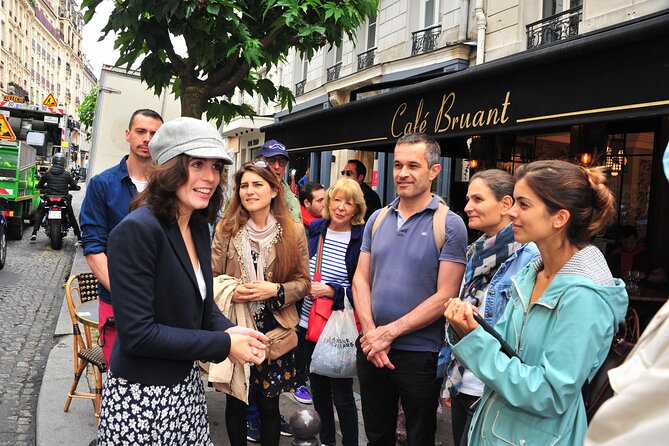
Montmartre sings its way up the hill. This tour turns the neighborhood into a living playlist, with a professional guide leading short stops tied to songs and specific landmarks, from Place des Abbesses to Sacré-Cœur. I love how the singing gives you a simple story thread as you hop from one famous spot to the next.
What I really liked is the way famous names are woven into the walk without feeling like a lecture. You hit the Wall of I Love You, stroll lively streets, and then you’re in the Dalida and cabaret orbit, with moments where you’re encouraged to join in.
One consideration: you should plan for walking on hills and getting around on foot. The tour says moderate physical fitness is best and it’s not recommended for serious mobility problems.
In This Review
- Key highlights you’ll feel on the streets
- Montmartre in songs: why this tour feels different
- Price and timing: a $33.79 taste of Montmartre artistry
- From Place des Abbesses to Sacré-Cœur: how the route plays out
- Place des Abbesses: starting at the lively heart
- The Wall of I Love You: sing-along romance in many languages
- Rue des Abbesses and Rue Lepic: lively streets and the Renoir link
- Dalida stops: a pop-culture track through Montmartre
- Theatre Lepic and Claude Lelouch’s Montmartre tie-in
- La Petite Maison Rose and Place du Tertre: the photo stops you’ll care about
- Vigne du Clos Montmartre: vineyards on a city hill
- Au Lapin Agile and Rue Norvins: cabaret culture in walking-distance form
- Saint-Pierre de Montmartre and the route’s church rhythm
- Rue de Mont Cenis: the Patachou cabaret connection
- Parvis du Sacré-Cœur: the payoff view
- The guide factor: sing-alongs done by a pro
- Tips to get the most from this 2-hour song walk
- Who should book this Montmartre en chansons tour
- Should you book it or skip it?
- FAQ
- How long is the Montmartre in songs guided tour?
- Where does the tour start and end?
- What time does the tour begin?
- Is the tour offered in English?
- How much does it cost?
- Do I need admission tickets for the stops?
- What is the maximum group size?
- Is it suitable for people with mobility issues?
- Are service animals allowed?
- What happens if the weather is bad?
Key highlights you’ll feel on the streets

- Songs as your guide: every stop is tied to a tune, so you keep moving with purpose
- Big icons, short stops: Wall of I Love You, Dalida sites, Au Lapin Agile, Sacré-Cœur
- English support through translation: French song content with an English pamphlet translation
- Photo-friendly Montmartre corners: including the pink house and the Place du Tertre area
- Small group size: up to 28 people, which helps the guide keep the flow moving
Montmartre in songs: why this tour feels different
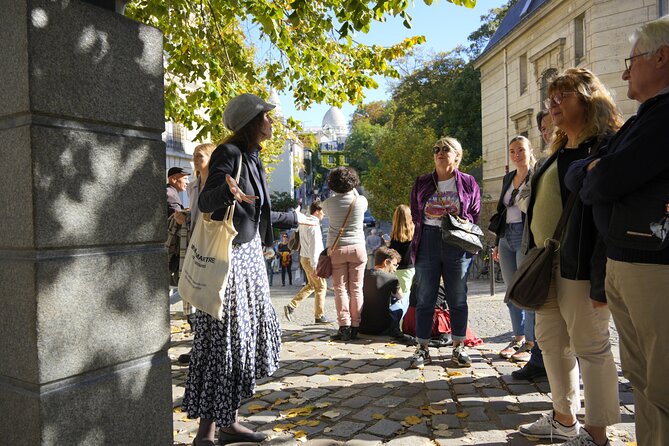
Most Montmartre tours give you facts and free time. This one uses something more playful: music. Instead of memorizing dates, you’re picking up the neighborhood by sound. The guide sets the mood, points out what to notice, and then adds a song moment that ties the place to the bigger Montmartre myth.
That’s the main value for you: it’s not just a checklist. It’s a guided experience that helps you connect the places. You leave with a stronger sense of what Montmartre is actually about—artists, romance, performance, and the slightly theatrical side of Paris.
You can also read our reviews of more guided tours in Paris



Price and timing: a $33.79 taste of Montmartre artistry
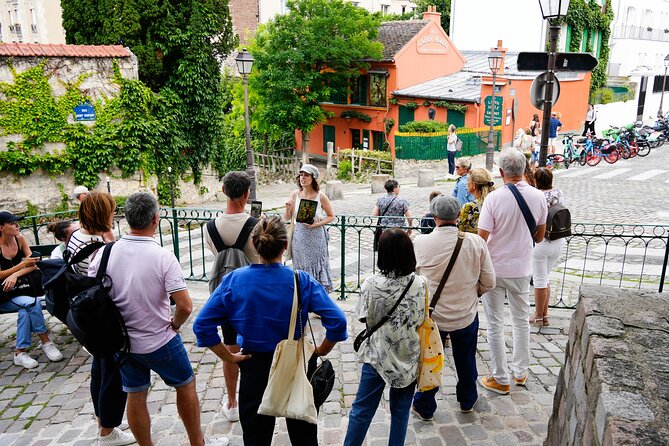
At about $33.79 per person for roughly two hours, this is priced like an activity, not like an all-day pass. The “feel” of the value comes from how much you pack into the time: key landmarks, multiple song stops, and a finish at one of the most famous viewpoints in Paris.
You’ll also want to know it’s timed for the afternoon (start time listed as 2:15 pm). That works well because you can climb with daylight and still end at Sacré-Cœur without rushing into late-night chaos. The tour also requires good weather, so keep an eye on conditions; if the organizer cancels for poor weather, they’ll offer a different date or a refund.
From Place des Abbesses to Sacré-Cœur: how the route plays out
The walk starts at Place des Abbesses (75018) and ends at Parvis du Sacré-Cœur (near the Place du Tertre souvenir area). This matters because Montmartre is all about slopes. You’ll be moving through neighborhoods that change character block to block—square to street to lookout to church.
A two-hour format is the sweet spot for first-time visitors. You get enough structure to feel oriented, but you still have room to wander a bit afterward. Since the group cap is 28, you’re not stuck behind a giant crowd, which helps for seeing façades and getting quick photos.
Place des Abbesses: starting at the lively heart
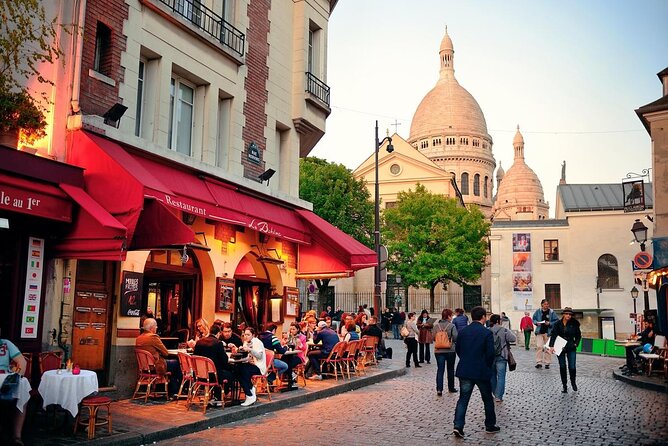
Your first stop is Place des Abbesses, a square where musicians show up and the vibe is instantly Montmartre. This is where the guide helps you orient fast. You get a feel for the neighborhood texture—street life, little corners, and the sense that art lives right on the sidewalk.
You’ll also have time to admire Saint Jean de Montmartre church from the Place des Abbesses area and then visit it before the route begins. The practical win here is that you start with something solid and local before you chase more tourist-famous sites. If you’ve never been to Montmartre before, that early church stop gives you a calmer moment before the singing and photo points ramp up.
The Wall of I Love You: sing-along romance in many languages
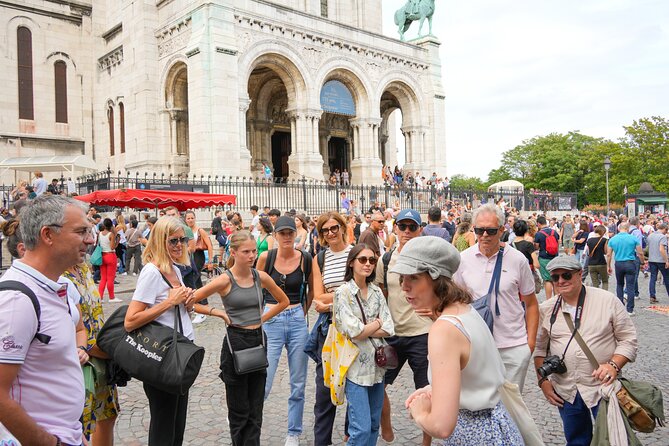
Next comes the Le Mur des Je t’aime stop. It’s short, but that’s the point: you’re meant to glance, recognize what you can, and then sing along with your guide. The tour leans into the idea of language as part of the romantic mythology of Montmartre, and it works because it’s interactive without turning into a long production.
If you’re traveling as a couple or with friends, this is one of those moments you’ll remember because everyone ends up doing the same simple action at the same place. Even if you don’t consider yourself a singer, you can still join in at the comfortable level the guide sets.






Rue des Abbesses and Rue Lepic: lively streets and the Renoir link
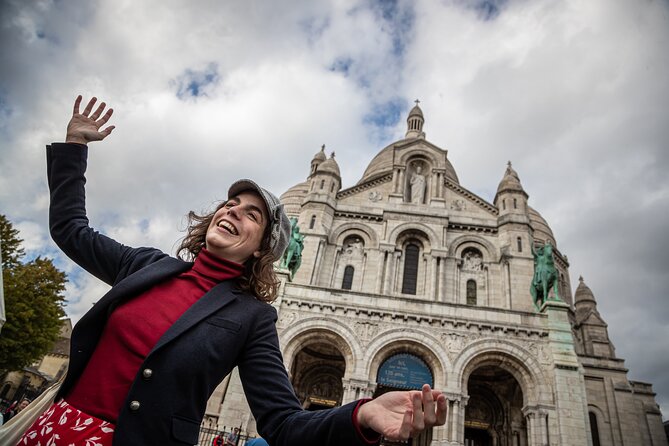
From there you move through Rue des Abbesses, described in the tour style as a Montmartre cousin of the Champs-Élysées. Think shopping street energy—cafés, small stores, and people pausing just long enough to take in views.
A bit later, you head along Rue Lepic, stopping in its upper portion. This is where you can look toward the famous Le Moulin de la Galette, linked to Renoir’s painting of the former open-air ballroom. Here’s what you’ll want to do: don’t just look at the building. Watch the street line and the angle. Montmartre is a neighborhood of slopes and sight lines, and these stops are chosen so you understand why artists liked painting here in the first place.
The stop is brief, but it’s a good example of what this tour does well: it points you toward the right angle for photos and then keeps moving before you get stuck.
Dalida stops: a pop-culture track through Montmartre
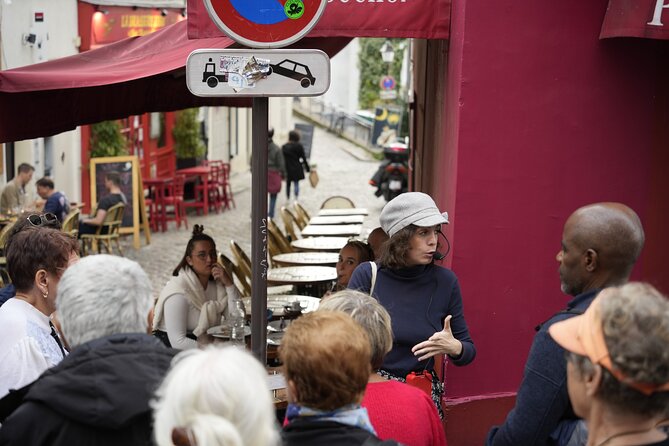
If you like music icons, you’ll probably enjoy the Dalida sequence. You’ll stop at La Maison de Dalida, with a song moment tied to the singer. Then you’ll see the Dalida statue bust and sing again with your guide.
What makes this valuable is that it shifts Montmartre from “only artists and painters” into “also pop culture and performance.” It gives you another way to understand the neighborhood’s identity. Instead of treating Montmartre as a museum, the tour frames it like a stage where different eras left their marks.
Theatre Lepic and Claude Lelouch’s Montmartre tie-in
One of the most movie-fan stops is Theatre Lepic. You’ll look at the facade of Claude Lelouch’s former cinema. Then the guide links the moment to the film Édith and Marcel, including a note that one of the scenes was filmed inside.
Even if you haven’t seen the film, this works as a “spot the story” stop. Facades matter in Montmartre, and the guide is effectively teaching you how to read the neighborhood through what went on behind the doors.
La Petite Maison Rose and Place du Tertre: the photo stops you’ll care about
Then you hit La Petite Maison Rose de Montmartre, noted as being there since 1920. It’s a quick stop, but it’s one of the easiest places to capture that classic Montmartre look. You’ll also get a song that evokes it, which helps the photo feel less random and more connected.
After that, the tour passes by Place du Tertre—the artists’ square—and you return there later after the visit for a portrait opportunity. This isn’t just a random detour. It’s a neat way to end with something playful that fits Montmartre’s street-art tradition.
Vigne du Clos Montmartre: vineyards on a city hill
Next you’ll learn about Vigne du Clos Montmartre, the vineyard area of the neighborhood. You don’t get a long lesson here, but you do get context on why vineyards belong in Montmartre’s story at all.
This stop is a nice break from the constant street and façade viewing. It also gives you a different kind of Montmartre image: not only cabarets and romance, but land and tradition.
Au Lapin Agile and Rue Norvins: cabaret culture in walking-distance form
The tour includes Au Lapin Agile, described as the oldest cabaret in Montmartre. You’ll sing about Montmartre and the famous rue Saint Vincent with your guide. Cabarets are a core part of how Montmartre earned its reputation, so this is one of the stops that helps you understand why the neighborhood feels so theatrical.
After that, you pass through Rue Norvins, where you’ll see the classic tourist street elements—musicians, souvenir shops, cafés—and learn about older cabarets that sat there. If you want the “what happened here before” version of Montmartre, this is where the tour adds meaning without slowing you down.
Saint-Pierre de Montmartre and the route’s church rhythm
On the way, you’ll pass by Saint-Pierre de Montmartre and visit it near the end of the tour. It’s a good pacing move. After the cabaret energy, you get a more reflective setting before finishing at the big view point.
Church visits in Montmartre tend to be quick, so don’t expect a long museum-style interior time. Instead, focus on the feeling of the space and what it adds to the route’s mood.
Rue de Mont Cenis: the Patachou cabaret connection
Another key street stop is Rue de Mont Cenis. You’ll walk through the tourist-friendly strip and hear about old cabarets that were located there, including the famous Patachou cabaret.
Again, the timing is short. The value is in the guide’s ability to connect what you see now—shops and street performers—to the Montmartre reputation that built over time.
Parvis du Sacré-Cœur: the payoff view
Finally, you arrive at Parvis du Sacré-Cœur. You’ll admire the Sacré-Cœur basilica from the square and get the view over Paris. Then you’ll visit the basilica at the end of the tour.
This is where the whole route makes sense. You started at a lively square, walked streets tied to art and music, and then closed with one of the city’s most recognizable silhouettes. Even if you’ve seen photos of Sacré-Cœur, standing there after a walking route feels different. You understand why people want to paint this view.
The guide factor: sing-alongs done by a pro
One reason this tour earns top scores is the guide’s performance. A name that comes up is Ann-Sophie, described as charming and a wonderful singer. That matters because the singing moments aren’t random. The guide’s voice and tone help the tour feel light, not forced.
Expect French song content even when the experience is offered with English support. One review note points out that it’s French with an English translation provided via a pamphlet. So you can follow along even if you’re not fluent, but you should still be ready to listen to the songs in French.
Tips to get the most from this 2-hour song walk
Here’s how to make it easy on yourself:
- Wear shoes with grip. Montmartre streets can be uneven, and you’ll move between multiple levels.
- Arrive a few minutes early at Place des Abbesses. It’s the start point, and it helps you avoid rushing.
- Use the English pamphlet if provided. It’s your bridge for understanding the lyrics and prompts.
- Don’t overpack your photo mission. The guide keeps stops short; if you try to do everything at once, you’ll lose the singing moments.
- Plan for weather. The tour requires good conditions, and you’ll appreciate that early confirmation.
If you’re someone who gets annoyed by “standing around,” this tour usually works because it keeps turning brief stops into a rhythm: look, listen, sing, move on.
Who should book this Montmartre en chansons tour
This tour is a great fit if you want:
- a fun first visit to Montmartre without needing to study before you go
- music-themed storytelling that connects Dalida, cabarets, and street landmarks
- a structured walk that still ends with freedom near Place du Tertre and Sacré-Cœur
It’s probably not the best fit if:
- you have serious mobility limitations (the tour is marked as not recommended in that case)
- you want long, quiet time in museums or churches
- you hate the idea of joining in, even lightly, with songs
Should you book it or skip it?
Book it if you want a Montmartre intro that feels like a show but moves like a normal walking tour. The combination of recognizable stops, short meaningful moments, and a guide who actually sings makes the experience more memorable than a standard sightseeing loop.
Skip it if you’re looking for deep architectural detail or a slow, long-form exploration. This is designed to cover ground and keep energy up, not to sit and read every plaque.
If you’re deciding based on value, the math is simple: $33.79 for about two hours, with multiple landmark stops marked as admission free, plus a professional singing guide and English translation support. That’s a solid way to spend an afternoon in Paris’s most theatrical neighborhood.
FAQ
How long is the Montmartre in songs guided tour?
The tour lasts about 2 hours (approx.).
Where does the tour start and end?
It starts at Place des Abbesses, 75018 Paris and ends at Parvis du Sacré-Cœur, 75018 Paris near the Place du Tertre souvenir area.
What time does the tour begin?
The listed start time is 2:15 pm.
Is the tour offered in English?
Yes, it is offered in English. One note indicates you may hear French with an English translation on a pamphlet.
How much does it cost?
The price is $33.79 per person.
Do I need admission tickets for the stops?
The listed stops show admission ticket free.
What is the maximum group size?
The tour has a maximum of 28 travelers.
Is it suitable for people with mobility issues?
It’s intended for travelers with moderate physical fitness. It’s not recommended for people with serious mobility problems.
Are service animals allowed?
Yes, service animals are allowed.
What happens if the weather is bad?
The tour requires good weather. If canceled due to poor weather, you’ll be offered a different date or a full refund.