REVIEW · CAEN
D-Day Omaha Beach sector – Small group from Caen aboard a Van
Book on Viator →Operated by ADRIAN ROADS · Bookable on Viator
Pointe du Hoc gives you the clearest physical sense of the D-Day battle. You walk across bomb craters and past damaged German bunkers on cliffs high above the English Channel, then follow the story to Omaha Beach and the American Cemetery. Guide Régis brings the sites together with stories on the road, not just dates and military terms.
I like the small group of four to eight people, which keeps the van personal and makes it easier to ask questions. I also like the included visit to the Overlord Museum, where vehicles, weapons, and personal objects help explain what happened beyond the shoreline.
The main drawback is the tight half-day schedule. You see the essential Omaha sector, but you do not have the time of a full-day tour. There is also no hotel pickup or lunch, and you must meet at the Caen Memorial at noon.
In This Review
- Key points to know before booking
- Why this Omaha Beach tour works well in six to seven hours
- Pointe du Hoc and the cliffs climbed by American Rangers
- The National Guard Monument and a smaller battlefield stop
- Omaha Beach at Easy Green
- Overlord Museum: vehicles and personal objects
- Colleville American Cemetery deserves the final hour
- Régis and the value of a small van
- Is $238.28 a fair price?
- Practical details before you reserve
- Who should book this Omaha Beach experience?
- Should you book it?
- FAQ
- Where does the tour begin?
- Where does the tour end?
- What time does the tour start?
- How long does the experience last?
- How many people can join the tour?
- Is transportation included?
- Is the Overlord Museum admission included?
- Can I cancel for a full refund?
Key points to know before booking
- Pointe du Hoc feels like a battlefield, not just a viewpoint: Bomb craters, concrete bunkers, and steep cliffs make the assault easier to picture.
- Régis is the named driver-guide: His passion for the subject is a major part of the experience, especially during the road time between stops.
- The group is capped at eight people: You travel in an air-conditioned minivan rather than a large coach.
- The American Cemetery is given a full hour: That allows time for the rows of white crosses, the chapel, and the view toward Omaha Beach.
- The Overlord Museum admission is included: Its collection covers the landing through the liberation of Paris, with more than 35 vehicles, tanks, and guns.
- The tour returns to Caen: You meet and finish at the Mémorial de Caen, with no hotel transfer included.
Why this Omaha Beach tour works well in six to seven hours
This is a focused tour of the American sector of Normandy. From Caen, you spend the afternoon at five important places, with the driving time used for explanation and context.
That format matters. The D-Day sites are spread across the coast, and a first visit can become a blur of place names. A guide helps you understand how Pointe du Hoc, Omaha Beach, the National Guard Monument, the museum, and the cemetery fit into one story.
You meet at the Mémorial de Caen at 12:00 pm. The tour then heads west in an air-conditioned minivan. With a maximum of eight people, you avoid the scale and fixed rhythm of a large coach group.
I would treat this as a strong introduction rather than a complete study of Normandy. You get the major American sites around Omaha Beach, but the schedule does not include Utah Beach, Sainte-Mère-Église, the British and Canadian sectors, or a longer visit to the Caen Memorial itself.
The length is useful if your time in Normandy is limited. It also works well if you want to pair the tour with another morning activity in Caen. Still, the final return time can vary because the experience lasts roughly six to seven hours, so plan your evening with some flexibility.
You can also read our reviews of more tours and experiences in Caen.



Pointe du Hoc and the cliffs climbed by American Rangers
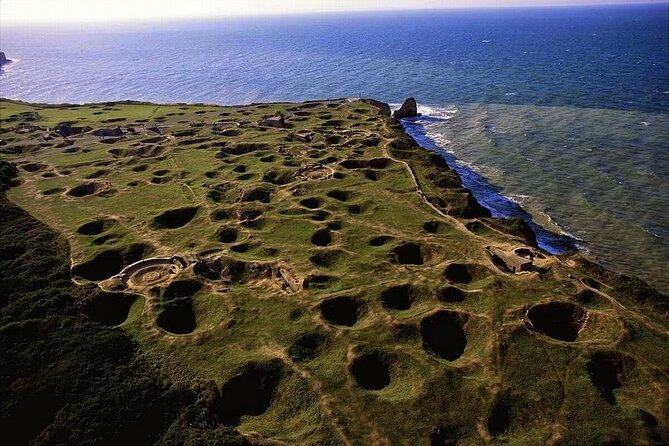
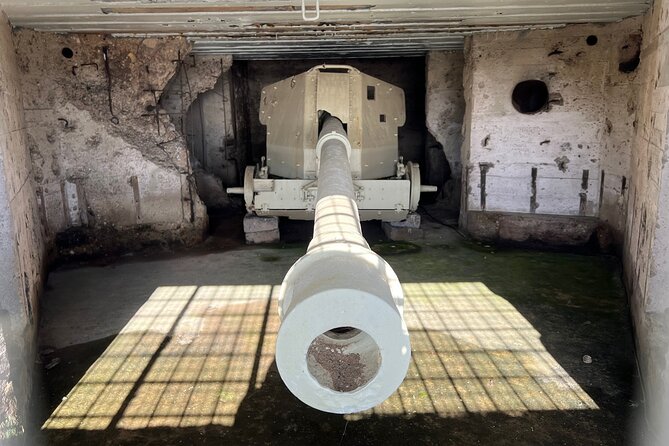
Pointe du Hoc is the most dramatic first stop. The site sits on cliffs about 100 feet high between Omaha and Utah beaches, looking out over the English Channel.
In 1943, the German organization Todt placed six long-range 155mm guns here in concrete positions. The battery formed part of the Atlantic Wall, Hitler’s coastal defense system of bunkers, artillery, and beach obstacles.
The German guns could threaten the landing beaches, which made Pointe du Hoc a key target. On June 6, 1944, 225 American Rangers landed below the cliffs at about 7:10 am. They used ropes to climb the face of the cliffs and attack the gun positions.
You can still see the physical marks of that fight. Bomb craters and shattered concrete bunkers remain across the ground. These are not polished museum displays. You are walking through a damaged military position where the shape of the battle is still visible.
Allow about an hour here. Wear shoes suited to uneven ground, since the significance of the site is tied to walking around it rather than simply looking from one platform. The information supplied for the tour does not promise a private lecture or special access, so the value comes from Régis explaining what you are seeing and placing it in the wider battle.
Pointe du Hoc is also the stop most likely to affect you physically and emotionally. The height of the cliffs makes the Rangers’ climb easier to imagine, while the open view shows why the position mattered.
The National Guard Monument and a smaller battlefield stop
The National Guard Monument is a shorter visit, about 20 minutes. It marks WN72, the position where the 29th National Guard Division broke through German defenses on D-Day.
The monument sits over an original bunker. It is maintained to honor National Guard members who fought in the European theater. This is a more compact and specific stop than Pointe du Hoc, but it adds an important layer to the day.
The D-Day story is often told through famous units and commanders. At WN72, you get a reminder that the operation depended on many formations pushing through fortified positions. The original bunker gives the monument a direct link to the fighting.
Because the stop is brief, you should expect a focused explanation and time to look around rather than a long walk. That is appropriate for this itinerary. The tour gives you a little military detail here, then moves on to the broader human meaning of Omaha Beach and the cemetery.
Omaha Beach at Easy Green
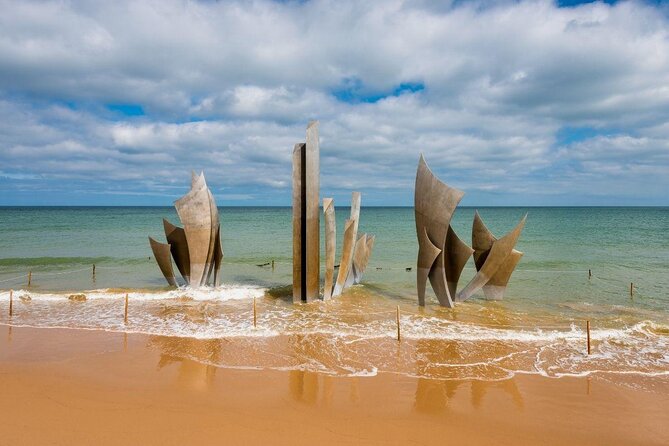
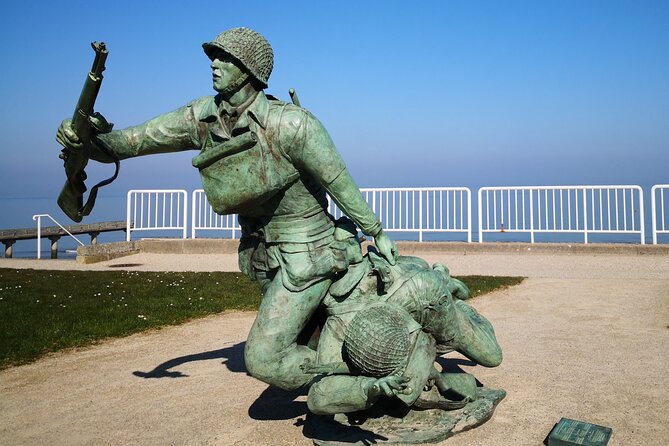
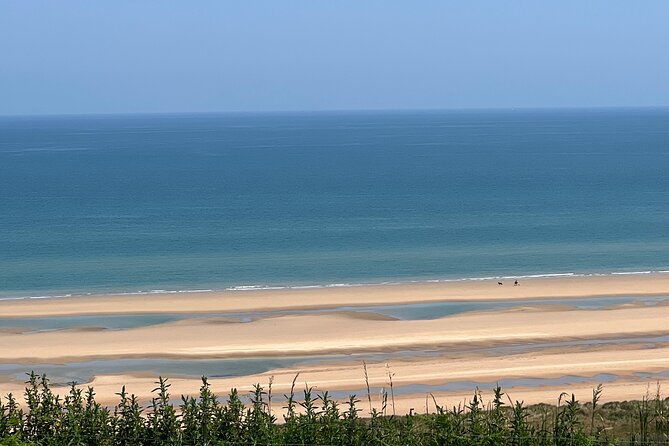
At Omaha Beach, the van stops in the Easy Green sector for about 30 minutes. Two monuments provide the main focus.
The Signal of the Liberation monument honors the Allied landing on June 6, 1944, and the liberation of Europe. Its two frescoes refer to the 1st US Infantry Division and the 116th Regimental Combat Team of the 29th US Infantry Division.
You also see The Braves, a large work by sculptor Anilore Banon dedicated to the courage of the Allied soldiers. The sculpture gives the shoreline a modern memorial, while the beach itself remains wide and open.
You have time to walk along the sand. The tour also suggests bringing home a small amount of sand in a tiny glass container, a simple keepsake that connects the quiet beach of today with the violence of 1944. Follow local rules and keep the amount genuinely small.
Half an hour is enough for the monuments, photographs, and a short walk, but not for a long beach stroll. If you want to sit quietly by the water or explore at a slow pace, this schedule may feel rushed.
That is the tradeoff throughout this tour. You cover several important places in one afternoon, but each visit has a clear limit. For a first look at Omaha Beach, I think the balance is sensible. For a slower, more reflective visit, choose a full-day option.
Overlord Museum: vehicles and personal objects
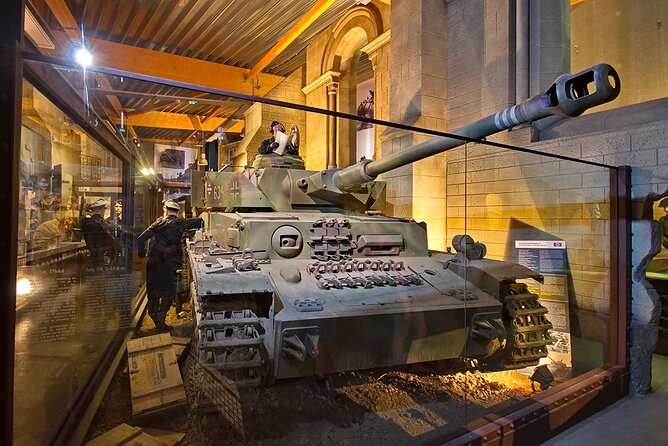
The Overlord Museum adds the equipment and personal detail that a beach visit cannot provide. Admission is included, and you spend about an hour inside.
The museum covers the period from the Allied landing through the liberation of Paris. Its collection came from someone who witnessed the conflict and later took part in the reconstruction of Normandy.
More than 35 vehicles, tanks, and guns from the six armies involved in Normandy appear in reconstructed scenes. Personal items belonging to individual soldiers add a human scale to the machines.
This stop is especially useful if military hardware means little to you. A tank or artillery piece can look anonymous until it is placed in a scene with uniforms, equipment, and a clear explanation of its role. The museum helps connect the beach assault to the larger campaign.
One hour gives you a worthwhile visit, but not necessarily time for every display. If you are passionate about military museums, you may want to return independently for a longer look. For this tour, the museum is a well-chosen middle stop between the battlefield sites and the cemetery.
The included ticket also improves the value of the price. You do not need to arrange a separate admission, and the museum gives the tour a change of pace after several outdoor locations.


Colleville American Cemetery deserves the final hour
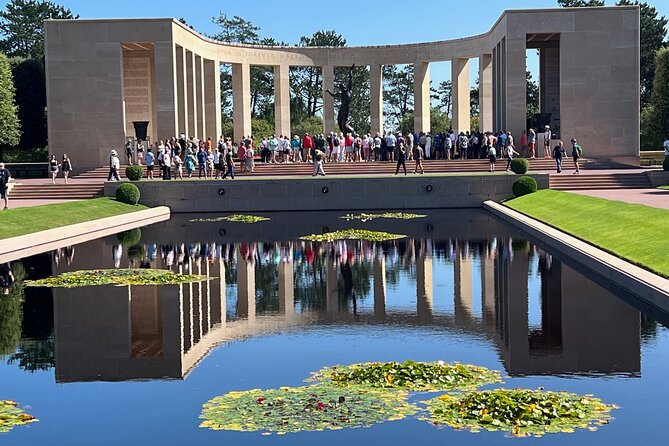
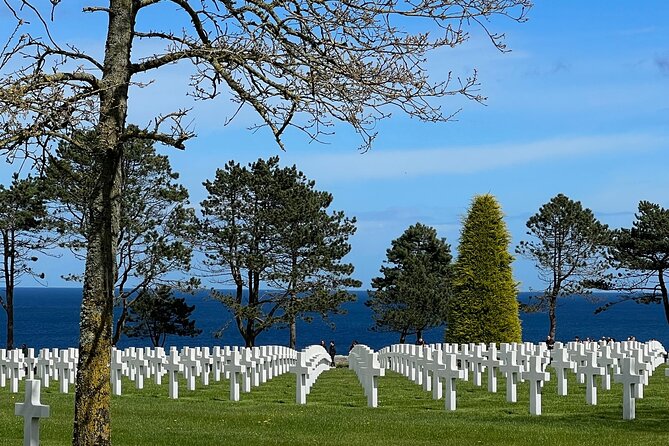
The American Cemetery at Colleville-sur-Mer is the most solemn stop of the afternoon. It occupies 180 acres above Omaha Beach and contains 9,387 white crosses arranged in precise rows, along with a memorial chapel.
Give this visit its full weight. The setting is carefully maintained, but it is not merely beautiful. The orderly rows show the scale of the cost in a way that individual monuments cannot.
Régis shares stories of soldiers who fought nearby and received the highest military decorations for gallantry. Those accounts can help you look beyond the numbers and think about the people represented by the headstones.
You have about an hour here. That should allow time to walk among the graves, visit the chapel, and pause to look toward Omaha Beach. The cemetery overlooks the coast, linking the resting place directly to the operation that brought these soldiers to Normandy.
This is a place where a guide’s tone matters. The best approach is not a flood of facts, but enough personal detail to help you reflect. The experience’s strongest praise centers on the guide’s passion and the way the day becomes deeply moving. That is most likely to matter here.
If you prefer to explore cemeteries entirely alone, a guided visit may feel less private. On the other hand, the stories can give structure to an emotional place that might otherwise feel difficult to understand.
Régis and the value of a small van
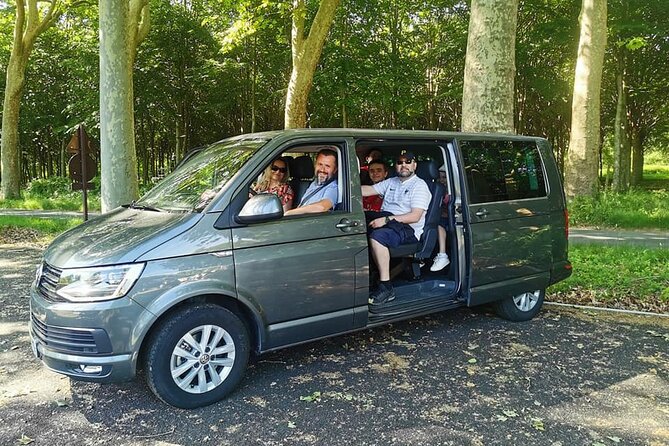
The vehicle is an air-conditioned minivan, and the group size is limited to four to eight people. That is a meaningful difference from a large bus tour.
A small group usually makes road time more useful. You can ask about a bunker, a regiment, or a detail you noticed at the previous stop. The driver-guide can also speak to the group without a microphone or a formal lecture setup.
Régis is the named guide for this experience. The available information describes him as personable, passionate about the history, and willing to cover more than originally planned when time allowed. Those qualities matter because much of the tour’s teaching happens between stops.
The minivan also makes a half-day route practical. You are not spending the afternoon finding parking, reading road signs, or trying to work out how far one site is from another.
Still, this is not a private tour for one couple or family. Other people may join, up to the eight-person limit. If your booking is smaller, the exact group size is not specified in advance.
Is $238.28 a fair price?
At $238.28 per person, this is not a budget outing. You are paying for a half-day vehicle, a driver-guide, transport from Caen to the Omaha sector and back, a small group, and admission to the Overlord Museum.
The price makes the most sense if you value convenience and interpretation. Renting a car can appear cheaper, but then you must drive, navigate, manage parking, and build a route that connects these sites efficiently. You also lose the road commentary and the chance to ask Régis questions.
The included museum ticket helps, but the bigger value is the guide. Pointe du Hoc and the cemetery can be visited independently, yet the meaning of the bunkers, monuments, and graves is much clearer when someone explains the connections.
The price is harder to justify if you already have a car, know the D-Day sites well, or want a full day across several sectors. It is also less attractive if you plan to spend only a few minutes at each place and would rather move at your own pace.
For someone staying in Caen without a car, the small-group format makes the cost more understandable. For a family, calculate the total carefully, since the per-person price adds up quickly.
Practical details before you reserve
The tour starts and ends at the Mémorial de Caen, Esplanade Général Eisenhower, 14050 Caen. There is no hotel pickup or drop-off, so you need to reach the meeting point yourself.
The activity is offered in English. Confirmation is provided when you book, and most people can participate. The meeting point is near public transportation, which helps if you are staying elsewhere in Caen.
Lunch is not included. Since the tour begins at noon and lasts six to seven hours, eat beforehand or plan for the fact that the schedule does not include a meal stop.
Wear comfortable shoes for Pointe du Hoc and bring clothing suited to changing weather. The tour requires good weather. If poor weather forces cancellation, you can choose another date or receive a full refund.
Free cancellation is available up to 24 hours before the start time. Cancellations or changes made less than 24 hours ahead are not accepted for a refund. The tour also requires a minimum number of people, so a cancellation caused by low demand brings the choice of another date or experience, or a full refund.
Who should book this Omaha Beach experience?
I would choose this tour if you have one afternoon, are based in Caen, and want the main American D-Day sites without driving. It suits first-time visitors who want history explained in plain language and a small group rather than a coach.
It is also a good fit for families or pairs who appreciate a guide with a personal approach. The named guide, Régis, appears to be one of the experience’s main strengths, particularly for people who want stories rather than a string of dates.
I would look elsewhere if you want every Normandy sector, a long beach walk, or hours inside the museum. A full-day experience would give you more room. You should also skip this option if you need hotel transportation or a supplied lunch.
Should you book it?
Book it if you want an efficient and emotionally serious introduction to Omaha Beach. Pointe du Hoc and the American Cemetery provide the strongest moments, while the Overlord Museum fills in the military detail.
The half-day length keeps the plan manageable, but it also means you must accept short stops. At this price, the tour is best for you if the guide’s explanations and the ease of small-group transport are worth more than independent flexibility.
For a focused visit from Caen, I would consider it a strong choice. Just arrive fed, wear sensible shoes, and leave your evening open until the van returns.
FAQ
Where does the tour begin?
It begins at the Mémorial de Caen, Esplanade Général Eisenhower, 14050 Caen, France.
Where does the tour end?
The activity ends back at the Mémorial de Caen meeting point.
What time does the tour start?
The start time is 12:00 pm.
How long does the experience last?
It lasts approximately six to seven hours.
How many people can join the tour?
The group is limited to a maximum of eight people, with travel in a small group of four to eight people.
Is transportation included?
Yes. You travel in a comfortable, air-conditioned minivan with a driver-guide. Hotel pickup and drop-off are not included.
Is the Overlord Museum admission included?
Yes. The admission ticket to the Overlord Museum in Colleville-sur-Mer is included.
Can I cancel for a full refund?
Yes, if you cancel at least 24 hours before the experience start time. Cancellations made less than 24 hours ahead are not refunded.