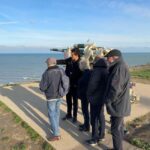
The most worthwhile part of this experience is the Caen Memorial Museum, where World War II is presented as a story of occupied France, the Vichy regime, genocide, the Holocaust, and the uneasy peace that followed. You also get access to a self-guided route covering 21 D-Day sites, including Omaha Beach and Arromanches.
I like the mix of a serious museum visit and independent sightseeing. I also like the freedom to use the digital map at your own pace, without being tied to a guide or group schedule. The main drawback is the audio setup: you must download it yourself, bring your own phone and headphones, and a failed app connection could spoil the outdoor portion.
In This Review
- Key points at a glance
- Start at the Caen Memorial Museum
- See the German general’s underground bunker
- Move from the museum to the D-Day route
- Omaha Beach brings the story outdoors
- Arromanches adds the engineering story
- The Dieppe raid gives you a wider timeline
- The audio guide is the key practical risk
- What the $31.36 price really buys you
- Timing your visit at Caen
- Who should choose this experience
- Booking advice and final verdict
- FAQ
- How long does the experience take?
- Where do I begin?
- What D-Day sites are included?
- Is transportation included?
- Are headphones or a phone provided?
- What languages are available?
Key points at a glance
- Caen Memorial Museum: See exhibits on occupied France, Vichy, the Holocaust, the Cold War, and the fragility of peace.
- German command bunker: Visit the underground bunker used by a German general during the D-Day defense.
- 21 D-Day locations: Use the digital map and audio commentary to explore places such as Omaha Beach and Arromanches.
- Self-guided pace: There is no live guide or included transportation, so you control the route and timing.
- English and French audio: Commentary is available in both languages, but you need your own mobile device and headset.
- Four-hour estimate: This is a useful half-day plan, though the exact outdoor time depends on how many sites you visit.
Start at the Caen Memorial Museum
Begin at the Mémorial de Caen, located at Esplanade Général Eisenhower. Your mobile e-ticket gets you inside. Show it on your phone to the museum staff, and remember that last admission is one hour before closing.
The museum is not simply a display of tanks, uniforms, and battlefield photographs. Its purpose is broader. You move through the political and human causes of the Second World War, life in occupied France, the Vichy government, the warning signs of genocide, and the Holocaust.
That wider frame matters. The D-Day beaches are powerful places, but it is easy to treat them as isolated military stops. The museum gives you the background needed to understand why the invasion happened, what Allied forces were trying to achieve, and how ordinary people lived under occupation.
The exhibits use real-life stories to keep the subject personal. That approach can be especially helpful if you are visiting with teenagers or with someone who knows the military outline but wants a clearer sense of daily life and moral choices during the war.
The museum also carries the story beyond 1945. Its sections on Berlin and the Cold War show how quickly wartime alliance gave way to suspicion and division. The message is not limited to one battle or one country. It asks you to consider how peace can remain fragile even after a major conflict ends.
A few more Caen tours and experiences worth a look


See the German general’s underground bunker
One of the museum’s most distinctive features is an underground bunker used by a German general directing the defense against the Allied landings. This is a useful counterpoint to the outdoor beaches, where the visitor naturally sees the invasion from the Allied side.
A bunker makes military command feel less abstract. You can think about how decisions were made underground while troops fought along the coast. The setting also helps explain why D-Day was not just a single morning of landings, but part of a wider German defensive effort.
This stop will appeal to anyone interested in military planning, but it also supports the museum’s larger theme. History is not only about famous commanders. It is also about systems, orders, fear, confusion, and the people affected by decisions made far from the front line.
Move from the museum to the D-Day route
The second part of the experience uses a digital map and audio guide for 21 points of interest. This is not a coach excursion. Transportation is not included, and there is no live guide leading you from beach to beach.
That arrangement gives you flexibility, but it also puts more responsibility on you. You need to decide how to move between locations and how many stops fit your schedule. The listed duration is about four hours, so treat it as a compact introduction rather than a full tour of every D-Day site in Normandy.
The route includes the Dieppe raid, Omaha Beach, and Arromanches. Those names cover different chapters of the war, so the audio commentary can help connect them rather than leaving you with a string of disconnected viewpoints.
A self-guided route works best if you prefer quiet time at important places. You can pause the commentary, look around, and continue when you are ready. You are not waiting for a group to take photographs or rushing to keep up with a guide.
The tradeoff is simple: you do not get a person answering questions or adjusting the route for you. If you want detailed interpretation on the spot, a live guided tour may suit you better.
Omaha Beach brings the story outdoors
Omaha Beach is one of the best-known D-Day locations included in the digital route. Its fame can make it difficult to picture the confusion and danger of the landings. Audio commentary can help supply the sequence of events and direct your attention to why the site mattered.
The value of an audio guide here is not just convenience. A quiet beach can look deceptively ordinary, especially on a calm day. The spoken explanation helps you connect the physical setting with the military problem faced by the Allied forces.
You should allow yourself time to stop and listen rather than treating Omaha as a quick photo break. The route is self-guided, so you can set the pace. If the app works properly, that freedom is one of the strongest reasons to choose this format.
Arromanches adds the engineering story
Arromanches provides another angle on the invasion. The site is associated with the artificial harbor used to bring supplies ashore after the landings. The audio route includes it among the 21 points of interest, allowing you to add the logistics of the campaign to the better-known combat story.
That is an important part of understanding D-Day. Soldiers could not hold territory without food, fuel, vehicles, weapons, and medical supplies. A stop at Arromanches helps broaden your view from the first assault to the difficult work of sustaining an army in France.
The digital guide is useful here because you can listen while examining the setting. It may also help you decide how long to remain at the site, particularly if you are working within the four-hour estimate.
You can also read our reviews of more museum experiences in Caen


The Dieppe raid gives you a wider timeline
The route also covers the Dieppe raid, which took place before the Normandy landings. Including it gives the experience a useful chronological reach. You are not looking only at the successful invasion. You are also considering an earlier operation and the lessons it offered.
This is one reason the outdoor guide can add value to the museum ticket. The museum provides the broad political and human setting, while the route links specific places to the course of the war.
Do not expect every stop to receive the same amount of attention. You control the order and timing, and the experience does not include transportation. The best approach is to treat the map as a framework and choose the places that matter most to you.
The audio guide is the key practical risk
The outdoor section depends heavily on your phone. The digital audio guide is sent through WhatsApp within 24 hours of your travel date, and you are instructed to scan a QR code to download it before arrival.
You should set it up well before reaching the first D-Day site. Check that the correct application is installed, confirm that the audio route appears, and make sure your phone has enough battery. Bring your own headset, since neither a headset nor a mobile device is supplied.
There has been a serious reported setup problem involving a long download, a separate app, and an incorrect route appearing after installation. The result was a lost day of sightseeing. That is not a minor nuisance when the outdoor audio is central to the experience.
I would not treat the digital delivery as automatic. Download the guide before leaving for the beaches, keep the WhatsApp message available, and do not wait until you are standing at the first stop. If the tour fails to connect, contact the supplier promptly, but keep in mind that support may not solve the problem once your sightseeing time has passed.
The museum itself is the stronger part of the package because its entry does not depend on the outdoor app. If the audio fails, you can still visit the museum, but you may lose much of the added value promised by the D-Day route.
What the $31.36 price really buys you
At $31.36 per person, the price covers museum admission, the digital D-Day map, and audio commentary in English or French. It does not include transportation, a live guide, a headset, a phone, or the museum’s separate audio guide.
That makes the value depend on how you plan your day. If you already have transportation and want the museum plus a flexible introduction to major D-Day sites, the package can be a practical way to combine both. You pay for access and interpretation, then handle the movement between places yourself.
If you need a vehicle, driver, or guided beach tour, the listed price does not cover the main extra cost. You will need to arrange transport separately. The package is therefore better suited to an independent itinerary than to someone looking for a fully organized excursion.
The museum admission alone gives the experience a solid base. The outdoor route adds breadth, with 21 locations rather than one beach. But the audio technology must work for that extra value to appear. I would book it only after making a clear plan for transportation and phone setup.
Timing your visit at Caen
The museum is open daily from 9:30 a.m. to 6 p.m. during the stated operating period, from March 25, 2025, through June 18, 2026. Last entry is one hour before closing.
A four-hour estimate is reasonable for a focused visit, but it is not a strict timetable. The museum covers a lot of ground, and the D-Day sites are spread across the region. You may need to choose between spending longer inside the museum and visiting more outdoor points.
For a calmer experience, arrive early enough to enter without pressure. You can then complete the museum portion before using the map for selected D-Day locations. Since there is no included transportation, leave room for the time needed to get between sites.
The experience is not described as a group tour, and no group size is given. You should expect to make your own decisions about pace, route, and stops.
Who should choose this experience
I would recommend this package to an independent history-minded visitor who wants a museum first and a flexible D-Day route afterward. It is also a good fit if you prefer audio commentary in English or French and do not want to follow a live guide.
Families may appreciate the ability to pause and move at their own speed. The subject is serious, though, especially in the sections on genocide and the Holocaust. Younger children may need help with the material, and the museum is likely to suit older children and teenagers better.
This is less suitable if you want door-to-door transport, a dedicated historian, or a carefully managed beach itinerary. It is also a poor choice for anyone who dislikes app downloads or has unreliable mobile access.
Service animals are allowed, the museum is near public transportation, and most people can participate. Those facts make access relatively straightforward, but they do not remove the need to plan your transport between the outdoor sites.
Booking advice and final verdict
Free cancellation is available if you cancel at least 24 hours before the local start time. Changes or cancellations inside that window are not accepted for a refund.
I would book this experience for the museum and its broad historical scope, then regard the digital D-Day route as a useful bonus that requires preparation. Download the audio before the day begins, check that it contains the correct tour, bring your own headset, and plan your transport in advance.
Choose it if you value independence and want to connect the Caen museum with Omaha Beach, Arromanches, Dieppe, and other points. Skip it if you need a live guide or want every logistical detail handled for you. At $31.36, it offers fair value when the technology works and your transportation plans are already in place. The museum is the dependable reason to go. The audio guide is the part you must manage carefully.
FAQ
How long does the experience take?
The estimated duration is about four hours. Your exact timing can vary because the D-Day route is self-guided and does not include transportation.
Where do I begin?
You begin at the Mémorial de Caen, Esplanade Général Eisenhower, 14050 Caen, France. You can go directly to the museum and show your mobile e-ticket to staff.
What D-Day sites are included?
The digital route includes 21 points of interest, including the Dieppe raid, Omaha Beach, and Arromanches.
Is transportation included?
No. Transportation is not included, so you must arrange your own way between the museum and the outdoor D-Day sites.
Are headphones or a phone provided?
No. You need to bring your own mobile device and headset. The audio guide is digital and should be downloaded before arrival.
What languages are available?
The audio commentary is available in English and French. The experience includes the museum entry ticket, but the museum’s separate audio guide is not included.