REVIEW · TOULOUSE
Toulouse: Guided Tour of the Historic Center
Book on GetYourGuide →Operated by AGIT Association des Guides Interprètes du Tarn · Bookable on GetYourGuide
Toulouse reveals itself best on foot, and this private two-hour tour links the city’s grandest sights in one compact route. You move from the Capitole and its broad square to Saint-Sernin, the Jacobins, the Garonne River, and Hôtel d’Assézat, with a guide filling in the stories between the stones.
I like the small-group format, which gives your party room to ask questions and lets the guide adjust the pace. I also like the range of subjects: pilgrimage, Romanesque and Gothic art, river life, civic power, and the pastel trade all appear in one walk. The main consideration is time. Two hours is enough for a strong introduction, but not enough for a slow, detailed look at every interior.
- The Capitole starts the walk with Toulouse’s grand civic heart and famous square.
- Saint-Sernin connects the city to the Way of Saint James pilgrimage route.
- The Jacobins convent features a remarkable Gothic palm-tree column.
- Hôtel d’Assézat shows how pastel wealth shaped Toulouse’s architecture.
- The private group can include up to 10 people, with guides in five languages.
- The Jacobins cloister is optional and costs €5 per person.
In This Review
- A compact route through Toulouse’s old center
- The Capitole and Toulouse’s main square
- Saint-Sernin and the Way of Saint James
- The Jacobins convent and its Gothic palm tree
- Along the Garonne River
- Hôtel d’Assézat and the pastel trade
- What the two-hour pace feels like
- Is $306 good value for your group?
- Who will get the most from this walk?
- Booking flexibility and practical details
- Should you book this Toulouse walking tour?
- FAQ
- How long is the Toulouse historic center tour?
- Is this a private tour?
- What sights are included on the route?
- Is entry to the monuments included?
- Which languages are available?
- Is the tour wheelchair accessible?
- Can I cancel or pay later?
A compact route through Toulouse’s old center

This is not a general city bus tour with a quick photo stop at each monument. It is a walking route through the historic core, built around a handful of places that explain why Toulouse looks and feels the way it does.
The city is often called the Pink City because of the warm color of its brick buildings. That nickname is easy to understand as you walk through the center, but the tour also shows that Toulouse is more than attractive façades. Its identity comes from several forces: the medieval church, the Way of Saint James, powerful local government, trade along the Garonne, and the wealth created by pastel.
You receive a private guide for your own group, with a maximum of 10 people. That matters here. In a large group, it can be hard to hear explanations in a busy square or to ask about a detail that catches your eye. With family or friends, you can keep the focus on your interests, and the guide can adapt the pace.
The guides named in the feedback include Murielle, Clément, and Angeline. Murielle is especially suited to groups that prefer a measured pace. She guided a family group that included older relatives and adjusted the walk to suit them. Clément has an art history background and can handle detailed questions about architecture. Angeline is described as making the tour informative and entertaining.
Those details suggest a useful strength: the experience is not tied to one rigid presentation. You can expect a live guide in French, English, Italian, Spanish, or German, then use the walk to ask about the parts of Toulouse that interest you most.
The Capitole and Toulouse’s main square

The tour begins at the Capitole, the city’s best-known civic building and the natural place to start learning how Toulouse presents itself.
The building gives the opening section a sense of scale. Its grand design and connection to the famous square introduce the city’s political and cultural life, while the open space outside gives you a chance to get your bearings. This is an active city center, so the square helps you understand Toulouse as a living place rather than a collection of preserved monuments.
Your guide explains the importance of the Capitole and the role it has played in local life. The value of this stop is not just the façade. It gives context for the city’s public identity before the route shifts toward religious architecture.
Allow yourself a few minutes to look around rather than treating the Capitole as a quick starting marker. If your group enjoys architecture, ask the guide to point out details that are easy to miss from a distance. The tour description promises an explanation of the building’s historical and cultural importance, but the exact time spent here will depend on your guide and the pace of your group.
You can also read our reviews of more guided tours in Toulouse



Saint-Sernin and the Way of Saint James

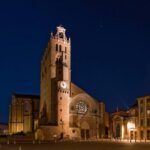
From the civic world of the Capitole, the route turns to the Basilica of Saint-Sernin. This is one of the most important stops on the walk, especially if you want to understand Toulouse’s place in medieval Europe.
Saint-Sernin is a major stop on the Way of Saint James pilgrimage route. That connection gives the basilica a wider meaning. Pilgrims did not see it simply as a beautiful church. It formed part of a long religious journey, and its position in Toulouse helped make the city an important stop for people moving toward Santiago de Compostela.
The building is also a major example of Romanesque art. Your guide explains the story behind its construction and draws attention to the interior details. This is where a guide earns the tour fee. Without context, Romanesque architecture can look like a series of arches, columns, and carved surfaces. With an explanation, you can start to see how the structure, decoration, and pilgrimage role fit together.
I would pay close attention here if you have an interest in medieval art or religious history. The basilica offers more than a quick photograph, though two hours for the entire route means you should not expect a long, quiet study of every chapel or carving.
Entry to the mentioned monuments is included at no extra charge, with one exception: the cloister at the Jacobins costs €5 per person. The information provided does not promise a separate paid visit inside Saint-Sernin, so ask your guide how the stop will be handled on your date.
The Jacobins convent and its Gothic palm tree

The Convent of the Jacobins supplies the tour’s most memorable architectural surprise. It is a Gothic complex, but its famous interior feature is what gives the stop its nickname: a column that spreads overhead like a palm tree.
This design is worth seeing with a guide because the effect can be hard to understand from a photograph. The column rises and branches into the vault, creating a shape that feels both structural and theatrical. Your guide explains the history of the religious site and points out the features that make it different from the Romanesque basilica visited earlier.
The contrast between Saint-Sernin and the Jacobins improves both stops. Saint-Sernin gives you the solid, weighty character associated with Romanesque construction. The Jacobins brings a lighter, more upward-reaching Gothic style. In a short walk, you see two important stages of medieval church architecture without needing a separate architecture lecture.
There is one clear extra cost here. Access to the cloister is not included and costs €5 per person. That fee is modest, but it changes the value calculation for a group of 10, where the optional admission could add €50. If you care about the full convent experience, budget for it before booking. If your priority is the guided explanation and the main architectural highlights, you may decide the two-hour route is enough without adding the cloister.
The tour is listed as wheelchair accessible. Still, because the route includes historic religious buildings and a walking itinerary, it is sensible to confirm the exact access arrangements for the cloister if anyone in your party needs step-free entry.
Along the Garonne River
The river section changes the mood. After civic buildings and churches, you reach the banks of the Garonne for open views and a quieter pause.
The Garonne has played an important part in Toulouse’s development, and the guide connects the river to the city’s past. You also get a break from close streets and enclosed interiors. The riverbank gives your group space to look out, take photographs, and absorb the setting without racing from one building to the next.
This stop is less about a single monument and more about how Toulouse fits together. The city’s churches, commerce, and public life developed alongside the water. The river remains a place where people gather, so you can see how an old feature of the city still belongs to everyday life.
Do not expect a long riverside walk. The overall tour lasts two hours and includes five major points, so this is likely a scenic and interpretive section rather than a full exploration of the riverfront. That is useful if you want variety, but less suitable if your main aim is an extended walk beside the water.
Hôtel d’Assézat and the pastel trade
The final major stop is Hôtel d’Assézat, a mansion linked to Toulouse’s pastel culture. It gives the tour a chance to move beyond religion and government and into commerce.
Pastel was a valuable crop used to create blue dye, and its trade helped create wealth in the region. Hôtel d’Assézat reflects that prosperous period through its grand architecture. The building is presented as one of the finest examples of Toulouse’s golden age of pastel culture, so the guide connects what you see to the economic forces that shaped the city.
This is a particularly useful stop if you want to understand why Toulouse contains such impressive private buildings. Monumental architecture is often the result of money, and here the source of that money has a clear local connection. The mansion lets you see how business success could become stone, ornament, and social status.
The route’s mix works well: the Capitole represents public authority, Saint-Sernin represents pilgrimage, the Jacobins represents religious art, the Garonne represents the city’s setting and daily life, and Hôtel d’Assézat represents trade. You finish with a broader picture of Toulouse rather than five unrelated sightseeing stops.
You can also read our reviews of more historical tours in Toulouse

What the two-hour pace feels like
Two hours is a practical length for a first look at the center. It is long enough to cover the major sights without turning into a half-day commitment, and short enough to fit around lunch, a museum visit, or an afternoon train.
The tradeoff is pace. You will be walking between stops, listening to explanations, and making decisions about how much time to spend inside each monument. If your family includes older people, children, or anyone who needs frequent pauses, tell the guide at the start. Murielle’s ability to adapt to an older family group suggests that pace can be discussed rather than treated as fixed.
Wear comfortable shoes and keep the schedule simple around the tour. This is a walking experience through the historic center, not a vehicle-based sightseeing outing. The description does not provide an exact distance or meeting point, so check the start time and location when booking.
The guide languages are French, English, Italian, Spanish, and German. That broad choice is helpful for mixed-language groups, though you should select your preferred language when reserving.
Is $306 good value for your group?
The price is $306 for a private group of up to 10 people. That works out to $30.60 per person if you fill all 10 places, but the calculation changes for smaller parties. A couple pays the full group price, so this is not the best-value option if you are traveling alone or with one companion.
For a family or group of friends, the price can make sense. You receive a private guide, a tailored pace, and the chance to ask questions without competing with strangers. A group of six, for example, pays about $51 per person before any optional cloister admission. That is more than a standard group walk, but the privacy and flexibility are part of what you are buying.
The free monument entry also helps. The only stated extra admission is the €5-per-person fee for the Jacobins cloister. If your group of 10 chooses to enter, add €50 to the overall cost. The tour itself still covers the main route and explanations, so the cloister is an optional enhancement rather than a surprise compulsory charge.
I would choose this tour for a group that values interpretation and convenience over the lowest possible price. If you are counting every euro, a public walking tour may suit you better. If you are marking a family gathering, traveling with older relatives, or want the guide to respond to your questions, the private format offers a stronger case.
Who will get the most from this walk?

This experience suits first-time visitors who want a clear introduction to Toulouse. You see the principal historic sights, learn how they connect, and finish with enough orientation to plan your own return visits.
It also works well for families and friends. The private setup means you do not have to worry about holding up an unfamiliar group or losing the guide in a busy square. You can ask for simpler explanations, more art history, or a slower rhythm.
Art and architecture enthusiasts will find the route especially useful. Saint-Sernin and the Jacobins offer a clear comparison between Romanesque and Gothic design, while Hôtel d’Assézat adds secular architecture shaped by trade. Clément’s art history training suggests that a detailed question about form or construction will not be out of place.
This may be less suitable if you want extensive free time at each monument, a food-focused tour, or a visit built around museums. The route has a defined set of historic highlights, and the two-hour limit keeps it moving.
Booking flexibility and practical details
You can cancel up to 24 hours in advance for a full refund, which gives you some protection if your Toulouse plans change. You can also reserve now and pay later, so the booking does not require payment at the time of reservation.
The tour is private and wheelchair accessible. It runs for two hours, with starting times subject to availability. Since the exact meeting point and start times are not provided here, check those details before you finalize your day.
The overall rating is 4.9 from nine ratings, with especially strong praise for the guides’ ability to explain clearly, answer questions, and adjust to the group. The most consistent strength is the human side of the walk. Murielle is noted for balancing expertise with simple language, Clément for answering questions precisely, and Angeline for making the history engaging.
That is important in Toulouse, where a short distance can take you from civic architecture to a medieval basilica, a Gothic convent, a riverbank, and a merchant’s mansion. The monuments are worth seeing on their own, but the connections between them are what make the route useful.
Should you book this Toulouse walking tour?
Book it if you are traveling with family or friends and want a private introduction to Toulouse’s historic center. The route covers the Capitole, Saint-Sernin, the Jacobins, the Garonne, and Hôtel d’Assézat, while the guides can work in five languages and adjust the pace to suit the group.
Think twice if you are a solo visitor, a couple on a tight budget, or someone who prefers to spend an hour inside one monument. The $306 group price is easiest to justify with several people, and the two-hour schedule favors breadth over slow inspection.
For a first afternoon in the Pink City, though, it is a well-shaped choice. You get the city’s major architectural themes, a useful explanation of its pilgrimage and pastel connections, and a private guide who can turn a short walk into a solid foundation for the rest of your stay.
FAQ
How long is the Toulouse historic center tour?
The walking tour lasts two hours.
Is this a private tour?
Yes. The experience is for a private group of up to 10 people.
What sights are included on the route?
The route includes the Capitole and its square, the Basilica of Saint-Sernin, the Convent of the Jacobins, the banks of the Garonne River, and Hôtel d’Assézat.
Is entry to the monuments included?
Entry to the mentioned monuments is free, except for access to the Jacobins cloister. The cloister costs €5 per person.
Which languages are available?
The live guide can conduct the tour in French, English, Italian, Spanish, or German.
Is the tour wheelchair accessible?
Yes, the activity is listed as wheelchair accessible.
Can I cancel or pay later?
You can cancel up to 24 hours before the tour for a full refund. You can also reserve now and pay later.