REVIEW · PARIS
Skip-the-line Les Invalides Army Museum Paris Private Tour
Book on GetYourGuide →Operated by Rosotravel · Bookable on GetYourGuide
Napoleon’s enormous tomb is only the most famous stop inside Les Invalides. The real reward is seeing how French military power changed over centuries, from armor and royal armies to the Napoleonic Wars, the world wars, and modern conflicts. A private guide turns a huge museum into a readable story, rather than a long march past cases of uniforms and weapons.
I like the timed museum entry, which saves you from buying a ticket at the ticket office, and I like the private format, since your guide can focus on Napoleon, royal France, World War II, or another period that catches your interest. The main point to consider is that skip-the-line access does not remove entrance or security checks, and the museum is large enough that two hours requires a focused visit.
In This Review
- Key points to know before booking
- Why Les Invalides deserves a place in your Paris plans
- Entering the Army Museum with a timed ticket
- Armor, weapons, and the long story of French warfare
- Napoleon Bonaparte beneath the golden dome
- From the Napoleonic Wars to World War II
- What the two-hour private visit feels like
- When the 3.5-hour option is worth the extra time
- Is $269 per person fair value?
- Language, access, and planning details
- Who will enjoy this tour most?
- Should you book the Les Invalides private tour?
- FAQ
- Where does the tour take place?
- How long does the tour last?
- Are skip-the-line tickets included?
- Does skip-the-line access include security?
- Is transportation included?
- Can I meet the guide at Les Invalides?
- Which languages are available?
- Is the tour private?
- What can I see inside the museum?
- Can I see Napoleon’s tomb?
Key points to know before booking
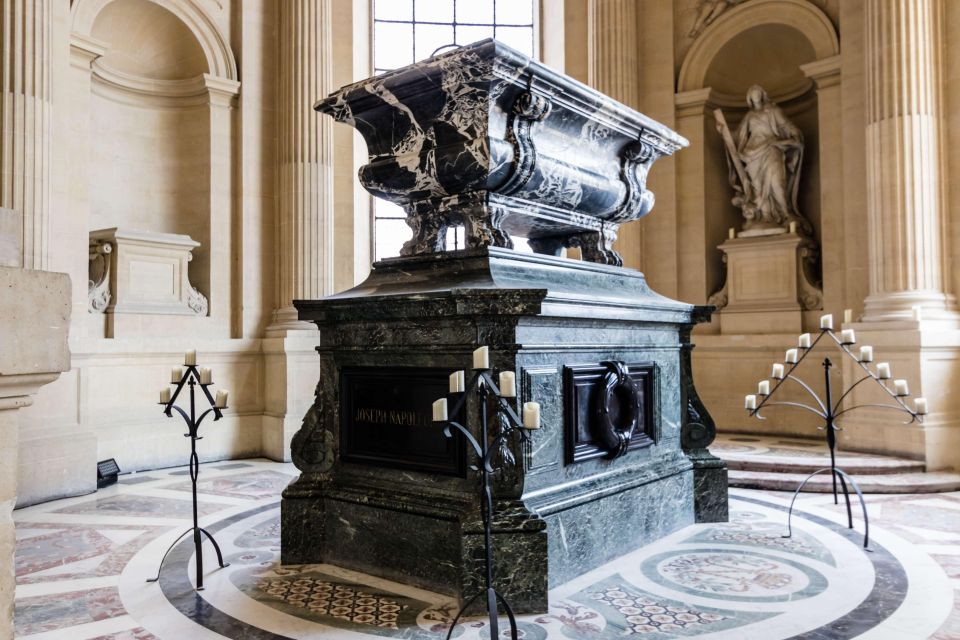
- Napoleon’s tomb is the headline stop: See the grand tomb of Napoleon Bonaparte beneath the Dôme Church.
- The collection spans centuries: Expect armor, weapons, uniforms, art, and objects from the Gauls to modern France.
- Your guide can shape the visit: Private touring makes it easier to focus on the Napoleonic Wars, the world wars, or French military leaders.
- Two tour lengths are available: The standard visit lasts two hours, while the 3.5-hour option adds round-trip private transport.
- Skip the ticket office line, not every line: Timed tickets help, but security and museum entrance procedures still apply.
- The language choice is broad: Guides are available in English, French, German, Italian, Spanish, Russian, and Polish.
Why Les Invalides deserves a place in your Paris plans
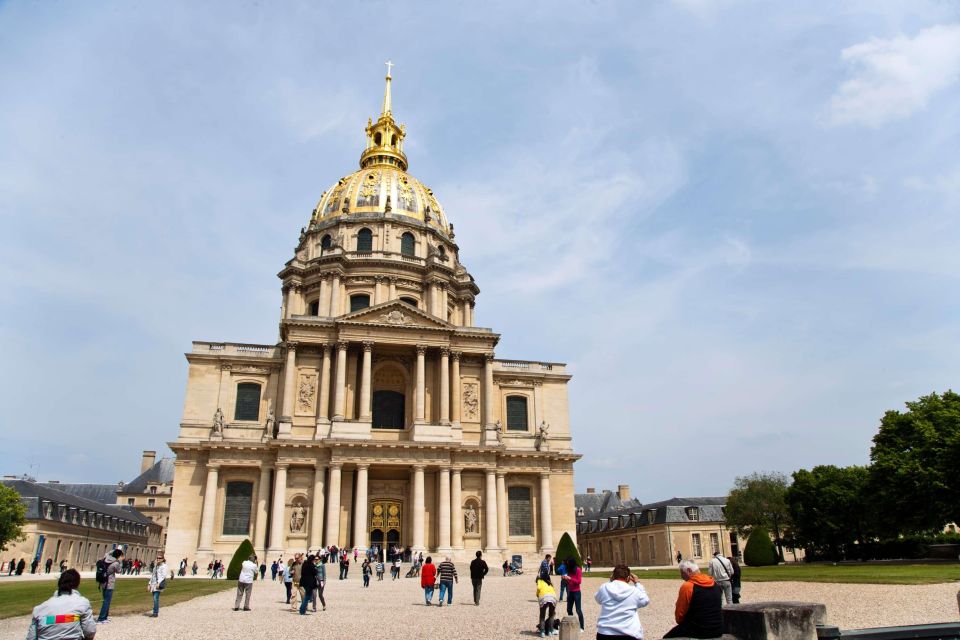
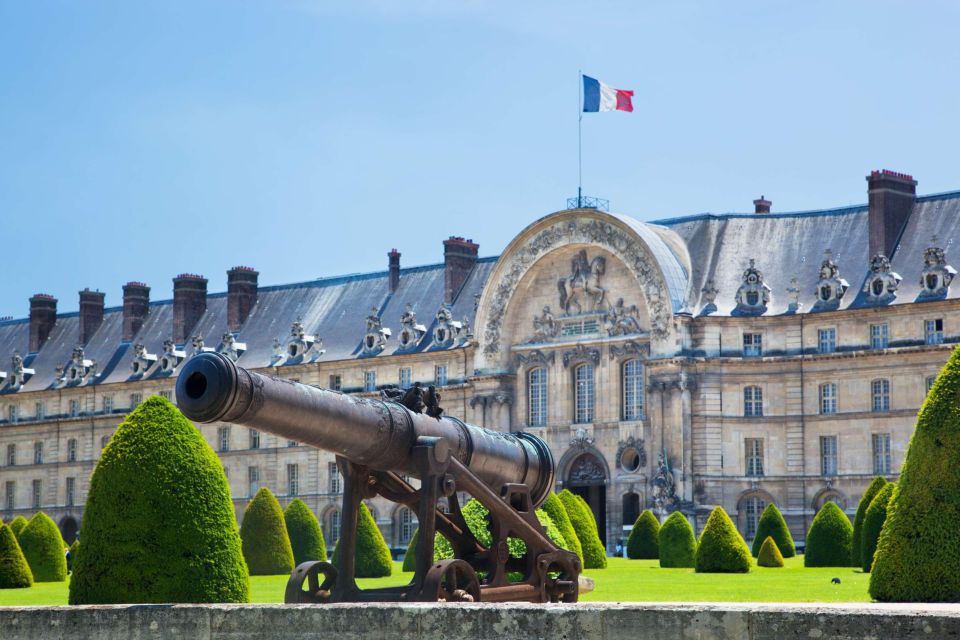
Les Invalides is one of Paris’s most striking historic complexes. Its golden dome is easy to spot, but the Army Museum inside gives the building a purpose beyond grand architecture. Here, France tells its military story through objects you can actually see: armor, swords, firearms, uniforms, standards, and personal items connected with war.
I find this more useful than a simple monument visit because the museum gives context to names you have probably heard before. Napoleon appears as part of a longer line of French commanders and political rulers, not as an isolated hero. You also get a clearer sense of how warfare changed, from hand-to-hand combat and royal armies to industrial warfare in the 20th century.
The museum covers several periods, so your guide matters. Without direction, you could spend too much time admiring individual objects and lose the wider story. A private guide can point out the pieces that best explain a period, then connect them to French politics, society, and national identity.
You can also read our reviews of more private tours in Paris


Entering the Army Museum with a timed ticket
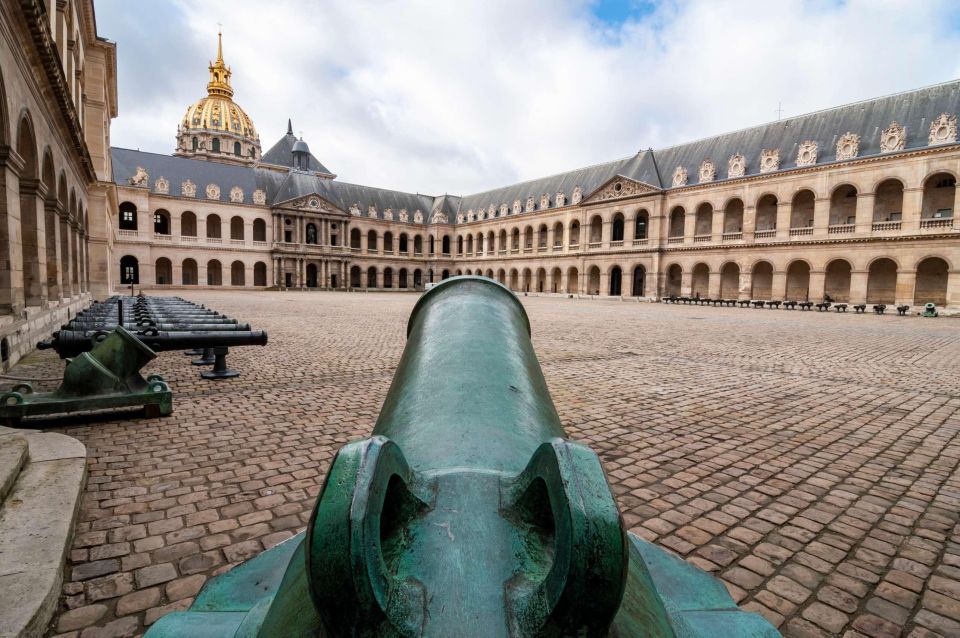
The two-hour option begins at Les Invalides in Paris, unless you choose the longer package with pickup. Your timed ticket lets you bypass the ticket office queue. That is useful at a major Paris museum, especially when you have a tightly planned day.
Be clear about what skip-the-line means here. You still pass through the museum entrance and security checks, and those steps can take time. I would arrive with enough margin rather than treating the timed entry as permission to arrive at the last second.
The admission covers the permanent collection. Some areas may be closed during renovation, so the exact route can change. That is normal in a museum of this scale, but it is worth keeping in mind if one particular room is the main reason you are booking.
Once inside, your guide can give you a useful framework before you start looking closely. That first explanation matters. The collection is not designed like a single narrow exhibition, and the number of objects can feel overwhelming if you do not know what to look for.
Armor, weapons, and the long story of French warfare

One of the strongest parts of the visit is the chance to see military objects from different eras in one place. Armor and weapons are not just decorative pieces. They show how armies fought, how technology changed, and how rulers displayed power.
Your guide can explain the difference between ceremonial objects and equipment made for actual combat. That distinction helps you read the displays with more care. A richly decorated weapon may say as much about status and royal image as it does about the battlefield.
The museum also lets you follow the development of the French army across a long span of time. The story includes early French forces, royal armies, the Revolutionary period, Napoleon’s campaigns, the First World War, the Second World War, and later conflicts.
I would not expect to absorb every era equally in two hours. That is one of the tradeoffs of the short format. You will get the best value by telling your guide what interests you before the visit begins. If Napoleon is your priority, say so. If you want the world wars or the experience of ordinary soldiers, ask for that focus.
Napoleon Bonaparte beneath the golden dome
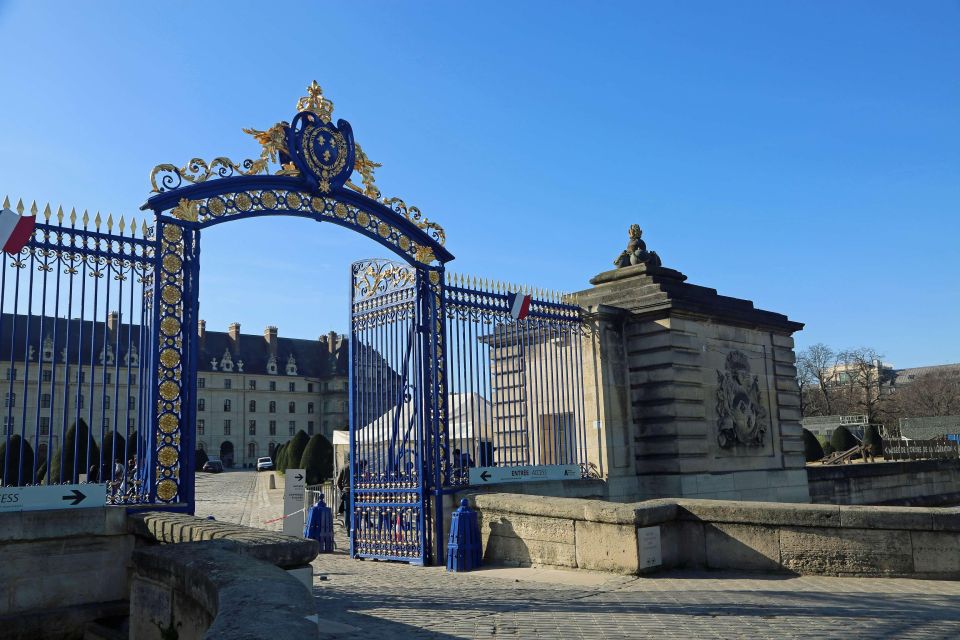
The Dôme Church is the emotional center of the visit. Its Baroque design is grand, formal, and built to impress. Beneath the dome is the tomb of Napoleon Bonaparte, one of the most recognizable memorials in Paris.
The tomb is not a quiet side display. Its size and placement make a clear statement about Napoleon’s importance in French memory. Your guide can help you consider the gap between the image of Napoleon as a national hero and the immense human cost of his wars.
That balance is important. The tour presents Napoleon’s military legacy, but you should not expect a simple celebration. The Napoleonic Wars reshaped Europe and made Napoleon one of France’s most famous leaders, yet they also caused enormous loss. A good private visit gives you room to ask about both achievement and consequence.
The Dôme Church also contains the final resting places of French monarchs, including Louis XIV and Louis XVIII, according to the tour information. This adds a royal and political layer to the building. You are not looking at a military memorial alone. You are also entering a place tied to France’s monarchy, empire, and national memory.
From the Napoleonic Wars to World War II

The tour is especially useful if you want to connect military events with French history. The Napoleonic period is often the main draw, but the museum continues through the First World War, the Second World War, and modern conflicts.
That wider coverage helps prevent a common Paris mistake: treating French history as a series of famous names without seeing how one period led to another. The guide can explain the army’s changing role and introduce military figures beyond Napoleon.
The world war sections offer a different mood from the polished armor and royal objects. Uniforms, weapons, and military equipment from more recent conflicts feel closer to the modern world. They can also raise harder questions about mechanized war, occupation, resistance, and national identity.
The supplied details do not promise a fixed list of objects or a set route for every guide. Museum rooms may change, and some exhibits can close for renovation. Think of this as a guided way through the permanent collection, not a guarantee of one exact sequence.
You can also read our reviews of more museum experiences in Paris





What the two-hour private visit feels like

The standard tour lasts two hours. That is a sensible length for a first visit if you want a clear introduction rather than a full museum study day.
I would expect the guide to lead you through the main sections, explain key military periods, stop at important objects, and finish around the Dôme Church and Napoleon’s tomb. The exact balance depends on your interests and the guide’s approach.
Two hours is long enough to learn a lot, but short enough to fit beside other Paris plans. It works well before or after nearby sightseeing, provided you allow time for entry, security, and the walk to your next stop.
The limitation is simple: Les Invalides contains more material than any short tour can cover. If you love military history, you may want to return and explore on your own. If you are traveling with children or with someone who tires quickly in museums, the guide’s ability to keep the visit focused is a real advantage.
The private format also gives you more control than a large group tour. You can ask questions, slow down at a display, or move on from a period that does not interest you. Group size is limited to 1 to 19 people per guide, with more guides arranged for larger parties, so this is private rather than a public walk-in group.
When the 3.5-hour option is worth the extra time
The longer package combines the two-hour guided museum visit with an estimated 1.5-hour round-trip transfer. Pickup and drop-off are available at your accommodation, making this the more convenient choice if you are staying far from Les Invalides or do not want to manage Paris transport before a timed entry.
The transfer is by standard car for one to four people. Groups of five or more are placed in a larger van, and you can book a five-person tour to secure a larger vehicle.
Do not read the 1.5-hour transfer estimate as fixed driving time. Traffic and the distance from your accommodation can change the journey. Paris traffic can be slow, so the transfer is mainly about convenience and scheduling, not speed.
I would choose the 3.5-hour option for families, first-time visitors who are uneasy about finding the meeting point, or anyone staying outside central Paris. It also makes sense if you value door-to-door service enough to pay for it.
If you are already near Les Invalides, the two-hour option is likely the better value. You can reach the meeting point yourself and spend your money on the private guide and museum entry rather than a transfer you may not need.
Is $269 per person fair value?

At $269 per person, this is not a budget museum visit. You are paying for more than admission. The price includes a private licensed guide, skip-the-line ticket handling, commentary in your chosen language, and, with the longer option, round-trip private transport.
The value depends mainly on your group size and your interest in the subject. A solo visitor or couple will pay more per person for a private experience than they would for a standard museum ticket. In return, you get personal attention and the chance to shape the visit around your questions.
For a family or small group, the price can feel more reasonable because the guide serves your party rather than selling a separate seat to each person in a large public tour. The 3.5-hour package costs more in practical terms because of the transport, but it may save you the hassle of coordinating a timed arrival.
I would not book this tour simply to enter the building. The museum can be visited in other ways. I would book it if you want the collection explained, if Napoleon and French military history are central to your Paris plans, or if private transport solves a real problem.
The experience is also a stronger choice for visitors who want to ask questions. A guide can adjust the level of detail, clarify French names and dates, and explain why an object matters instead of leaving you to guess.
Language, access, and planning details

Live guiding is available in English, French, German, Italian, Spanish, Russian, and Polish. Select your preferred language when booking, then check the email sent the day before for final information.
The activity is wheelchair accessible. That is useful to know in advance, though museum routes and temporary closures can still affect exactly which areas you see.
Pickup is optional. In the two-hour option, you meet at a specific point in Paris and arrange your own way there. The 3.5-hour option includes pickup and drop-off at the accommodation address supplied during booking.
Free cancellation is available up to 24 hours before the tour for a full refund. You can also reserve now and pay later, which helps if your Paris schedule is still shifting.
Who will enjoy this tour most?
I would recommend it most strongly to:
- First-time visitors who want a clear introduction to French military history.
- Napoleon enthusiasts who want more than a quick look at the tomb.
- Families who need a guide to keep a large museum focused.
- Small private groups who prefer conversation over a fixed public route.
- Visitors staying farther from central Paris who value included transport.
- Anyone who wants to tour in a language other than English or French.
It may be less suitable if you only have time for a quick photograph of the dome, dislike military subjects, or want to spend many hours studying the collection independently. The private guide adds value when you want explanation and context. It adds less if you prefer to read every label at your own pace.
Should you book the Les Invalides private tour?
Book it if you want the Army Museum to make sense, not just to see a famous tomb. The combination of a private guide, timed museum entry, and a route that connects royal France, Napoleon, the world wars, and modern conflicts gives you a useful introduction in two hours.
Choose the 3.5-hour option when pickup and drop-off will make your day easier. Choose the two-hour visit if you are already near Les Invalides and want the better-value version.
The chief caution is simple: skip-the-line does not mean skipping security, and two hours cannot cover every room in detail. Set your priorities before arriving, ask your guide to tailor the visit, and you will get a focused look at one of Paris’s most important museums.
FAQ
Where does the tour take place?
The tour takes place at the Army Museum in the Les Invalides complex in Paris, in the Île-de-France region.
How long does the tour last?
You can choose a two-hour guided museum visit or a 3.5-hour option that includes the museum tour and an estimated 1.5-hour round-trip transfer.
Are skip-the-line tickets included?
Yes. Skip-the-line tickets to the Army Museum are included in every option.
Does skip-the-line access include security?
No. The timed ticket lets you skip the ticket office line, but you still need to pass through the museum entrance and security checks.
Is transportation included?
Round-trip pickup and drop-off at your accommodation are included only with the 3.5-hour option. Transportation is not included with the two-hour option.
Can I meet the guide at Les Invalides?
Yes. Pickup is optional, so you can meet at a specific point in Paris when booking the two-hour option.
Which languages are available?
Guides are available in English, French, German, Italian, Spanish, Russian, and Polish.
Is the tour private?
Yes. The activity is arranged as a private group tour. Groups are limited to 1 to 19 people per guide, with additional guides arranged for larger parties.
What can I see inside the museum?
The permanent collection includes artifacts, weapons, armor, uniforms, and other objects from different periods of French military history, including the Napoleonic Wars, World War I, World War II, and modern conflicts.
Can I see Napoleon’s tomb?
Yes. The tour includes the Dôme Church, where you can see the tomb of Napoleon Bonaparte. The church also contains the final resting places of French monarchs, including Louis XIV and Louis XVIII.