REVIEW · PARIS
Private tour of the battlefields of Verdun from Paris in Van (2/7 travelers)
Book on Viator →Operated by ADRIAN ROADS · Bookable on Viator
Verdun is not a tidy museum visit. It is a broad stretch of wooded hills, ruined villages, trenches, forts, cemeteries, and shell craters where the First World War still feels close to the surface. This private day trip lets you see the key sites with Régis, a French guide praised for bringing the battles to life with energy and detailed explanations.
I like the small-group format, which keeps the day personal and makes a long drive from Paris more comfortable. I also like that the tour combines major memorials with harder-to-find reminders of the fighting, including the Bayonet Trench and Fleury-devant-Douaumont. The main drawback is the length: 13 to 14 hours is a demanding day, and the $465.43 price per person is high unless you have a strong interest in military history.
In This Review
- Key points to know before booking
- Why Verdun works best as a full-day trip from Paris
- The Sacred Way and the road that kept Verdun alive
- Douaumont Ossuary and the cemetery of the unidentified dead
- Fort Douaumont, the battle’s concrete stronghold
- Fleury-devant-Douaumont, a village that disappeared
- Verdun Cathedral and the old town
- Victory Monument and Porte Chaussée
- The Bayonet Trench and the memory of soldiers underground
- The Verdun Memorial Museum puts the pieces together
- Guide, language, and the small-group experience
- Price, food, and practical value
- Who should book this Verdun tour?
- Should you book it?
- FAQ
- Where does the tour begin?
- What time does pickup begin?
- How long does the tour last?
- Is the tour private?
- How many people can join?
- Is transportation included?
- Is a guide included?
- Are Fort Douaumont tickets included?
- Is admission to the Verdun Memorial Museum included?
- Is lunch included?
- What is the cancellation policy?
Key points to know before booking
- Régis leads the day: He is described as an entertaining and enthusiastic guide with a strong command of First World War and Second World War history.
- Hotel pickup is included: You are collected from your residence or hotel in Paris and the Paris region at about 6:00 a.m.
- The key entrance fees are covered: Admission to Fort Douaumont and the Verdun Memorial Museum is included.
- You see both memorials and battlefield remains: The route includes the ossuary, national cemetery, ruined Fleury village, trenches, forts, and Verdun’s old center.
- Lunch is not included: Plan to buy or bring food during the day.
- Check the group limit carefully: The tour description refers to a maximum of seven participants in one place and six travelers in another, so confirm the exact vehicle capacity when booking.
Why Verdun works best as a full-day trip from Paris
The distance is the first thing to understand. Verdun is far enough from Paris that the round trip takes much of the day, but the long journey gives you time to reach a major First World War site without changing hotels.
A 6:00 a.m. pickup is early, yet it is necessary if you want a useful visit rather than a rushed look at one fort. Once you arrive, the route moves through the town of Verdun and then into the former battle zone around Douaumont and Fleury-devant-Douaumont.
I would choose this format over trying to piece together trains, taxis, and local transport. The battlefields are spread out, and several important sites are not close to the town center. Having one vehicle also means you are not spending your limited time waiting for connections.
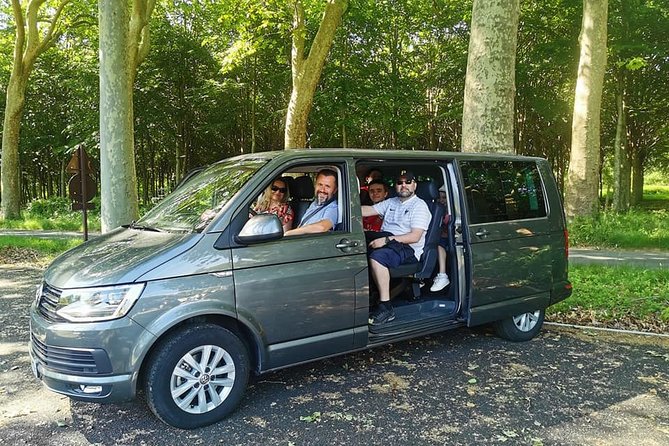
The minivan is air-conditioned and reserved for your group. That matters on a day with a lot of driving and walking. The tour is private, so you can ask Régis to explain a point again or adjust the pace within the limits of the schedule.
The tour is advertised for two to seven participants, while the included details specify a maximum of six travelers. That mismatch deserves a quick message to the operator before paying. The minimum is two participants, and a booking for only one person may be canceled rather than operated at the same price.
You can also read our reviews of more private tours in Paris


The Sacred Way and the road that kept Verdun alive
The first stop is the Memorial de la Voie Sacrée, about 15 minutes. It honors the road between Bar-le-Duc and Verdun, the crucial supply route used to carry food and ammunition to the front and remove wounded soldiers.
The memorial’s curved wall carries a relief showing soldiers, road transport, and rail transport. Its meaning is practical rather than decorative: Verdun could not have continued without a steady flow of men and supplies.
Helmeted markers once marked each kilometer along the Sacred Way. The road became a symbol of endurance during the battle, and this opening stop gives you a useful frame for the rest of the day. You begin by thinking about logistics, not just charges across open ground.
The stop is brief and admission is free. Do not expect a large museum here. Its value comes from Régis explaining why this road mattered before you reach the forts and cemeteries.
Douaumont Ossuary and the cemetery of the unidentified dead
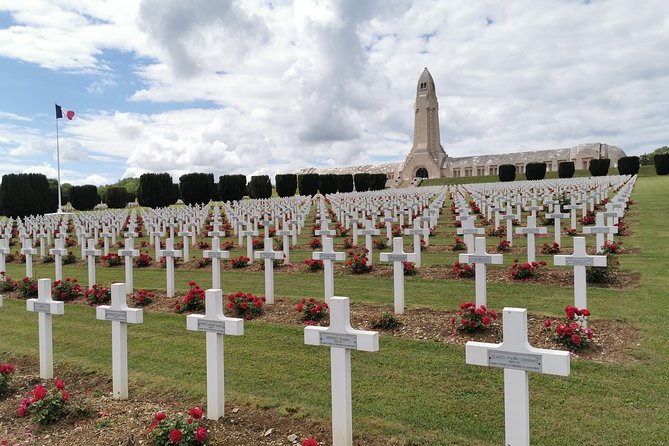
The Douaumont Ossuary is one of the most solemn places on the route. Allow about an hour to see the building and the National Military Necropolis in front of it.
The ossuary holds the remains of French and German soldiers whose identities were never established. Through small windows near the base, you can see bones stored in the lower alcoves. The sight is stark, and it gives a physical sense of the enormous human cost of the battle.
Inside, plaques carry the names of French soldiers who died at Verdun. Outside, rows of graves in the national cemetery bring the scale of the loss into view. The commonly cited figure connected with the ossuary is at least 130,000 unidentified fighters from both nations, while the wider Verdun battlefield claimed about 140,000 French soldiers.
This is not a quick photo stop. You should allow yourself time to be quiet. The visit is emotionally heavy, and the direct presentation of human remains may not suit every child or visitor.
The ossuary is also a useful counterpoint to the military sites. Forts and guns can make war seem like engineering. Here, the result is impossible to separate from the people who died.
Fort Douaumont, the battle’s concrete stronghold
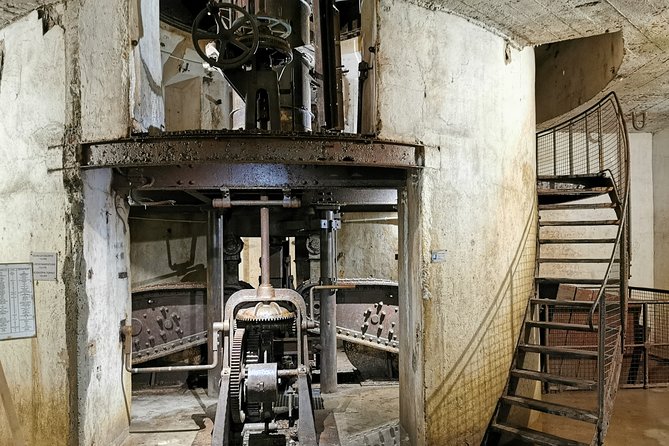
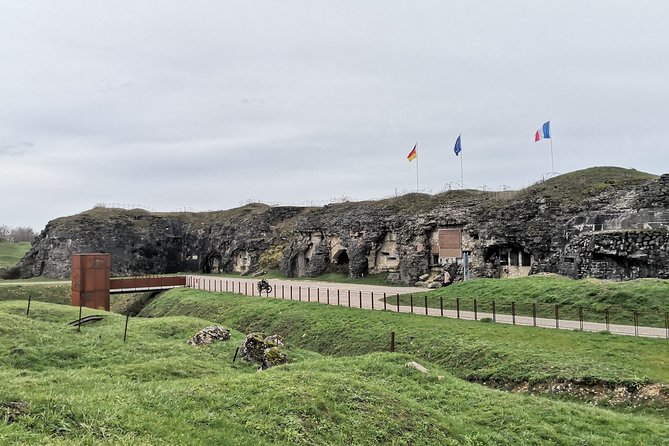
Fort Douaumont receives about an hour and includes admission. It was the largest and highest of the major forts built to protect Verdun from the 1890s onward.
The fort changed hands in a remarkable early moment of the 1916 battle. In February 1916, a small French garrison occupied the fort when German forces took it without a fight. German troops then used it for eight months as a shelter and a base on the right bank of the Meuse.
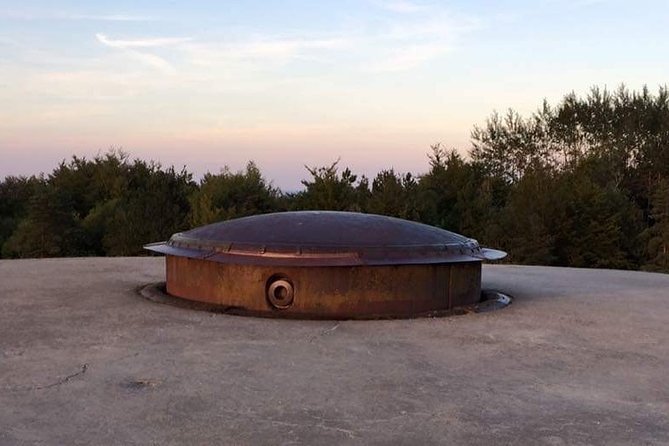
Inside, you walk through underground galleries and see the 155mm retractable cannon beneath its armored dome. The fort is valuable because it turns abstract battle maps into a real place. You can see how thick walls, narrow passages, defensive positions, and underground rooms shaped daily life for soldiers.
Do not expect a polished modern attraction. Fort Douaumont is a military structure, and the underground sections may feel dark and austere. That is part of the point. The site gives you a strong sense of the cramped conditions and the strategic value of a fort that both armies wanted.
Régis is especially useful here. A fort can otherwise become a series of concrete rooms. His explanation connects the building to the opening days of the battle and to the wider German offensive.
Fleury-devant-Douaumont, a village that disappeared
Fleury-devant-Douaumont takes only about 15 minutes, but it is one of the most powerful stops. The village was destroyed during the 1916 battle and never rebuilt.
Today it is an uninhabited place of remembrance. Small markers identify the former village streets and buildings, yet there is no functioning town to welcome you. The absence is the story.
Between June and August 1916, French and German forces fought repeatedly for this ground. The village changed hands 16 times in two months. By the end, bombardment had erased the settlement.
This stop works best if you resist the urge to rush. Look at the ground and the markers. The site shows that the battle did not simply damage a village. It removed the village from everyday life.
The short time allowed here is a limitation. You will not spend long walking through the former community, so listen closely to the explanation and use the visit as a quiet pause between the larger museum sites.





Verdun Cathedral and the old town
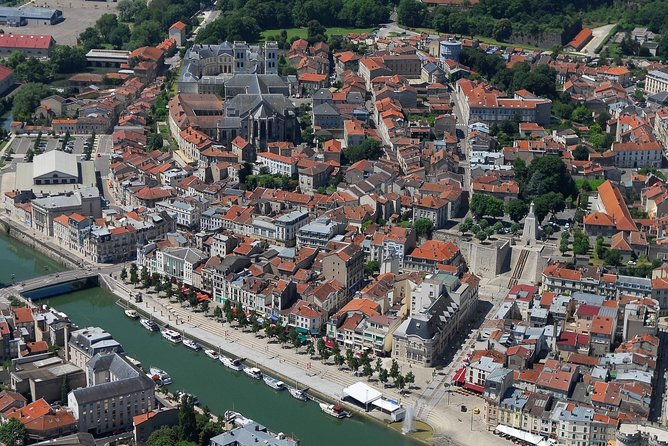
The tour returns to Verdun for the cathedral, with about 30 minutes at the foot of the building. Dedicated to the Virgin Mary, the cathedral was begun around 990 and is among the oldest in Europe.
Its appearance reflects many centuries of change. The original Romanesque-Rhenish plan was altered with Gothic work between the 14th and 16th centuries. A fire in 1755 led to further redesign in Baroque and Rococo styles, and wartime bombing caused additional damage before another restoration.
This stop broadens the day beyond the battlefield. Verdun was not created by the First World War, and the cathedral reminds you that the city has a much longer story.
Thirty minutes is enough for an exterior look and a short visit if the building is open, but not enough for a careful architectural study. The guide’s drop-off at the cathedral also gives you a brief change of scene after the cemetery and fort.
Victory Monument and Porte Chaussée
The Monument de la Victoire takes about 20 minutes. Built in central Verdun and opened in 1929, its 73 steps lead toward a crypt containing name registers for soldiers who received the Verdun medal.
At the top of the 30-meter tower, a warrior leans on his sword and looks east. The monument remains part of the city’s public memory, and a ceremony is held each November 1 when the Sacred Flame from the Arc de Triomphe reaches Verdun.
The nearby Porte Chaussée receives about 10 minutes. Built in 1380 along the Meuse, it was one of three major gates in the city walls. It was redesigned in 1690 and later served as a military prison before becoming city property.
These two brief stops are worthwhile if you want to understand Verdun as a living city rather than only a battlefield. They are not the main reason to book the tour, but they add older layers to the day.
The Bayonet Trench and the memory of soldiers underground
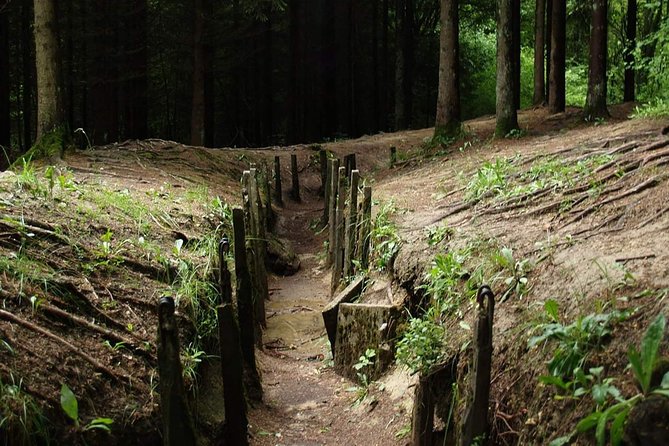
The Bayonet Trench is another short stop, around 15 minutes. It commemorates soldiers who were believed to have been buried by earth thrown up by shell impacts, with their bayonets left visible above the ground.
The story has been debated over time, but the memorial remains an important part of Verdun’s memory. The site was designated a historic monument in 1922 and later recognized as a national memory center.
You should approach this place with some caution. The popular story is powerful, but the memorial reflects the way wartime events were remembered and presented after 1918. Its importance is not limited to proving every detail of the account. It shows how the dead were honored and how stories of sacrifice took shape.
The stop is free and short. It works well as a link between the physical remains of the battlefield and the museum’s broader presentation of the war.
The Verdun Memorial Museum puts the pieces together
The final major stop is the Verdun Memorial Museum at Fleury-devant-Douaumont, with about an hour and admission included.
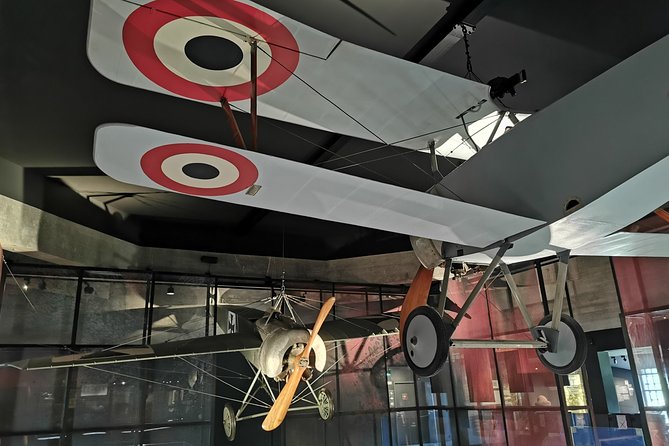
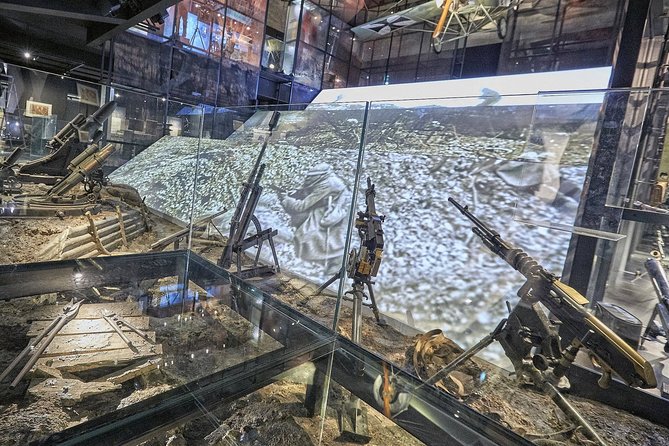
The museum places combat at the center of the visit. The ground floor focuses on the front-line experience, while the upper level explains the wider setting and the countries at war. The building was renewed in 2016, with an added upper floor, interactive material, and temporary exhibition space.
This is where the day’s separate impressions begin to connect. The Sacred Way explains supply. The fort shows defense. Fleury shows destruction. The ossuary shows the human cost. The museum brings those threads into one account.
A terrace opens toward the former battlefield and memorial area. That view is useful because it gives you a sense of how the sites relate to one another. You are not just looking at displays in a closed room. You can connect the museum’s maps and objects with the ground outside.
An hour is enough for a purposeful visit, but not for every display in detail. If military history is your main reason for booking, you may wish the schedule allowed longer inside. Still, the museum is an important finish, and the included ticket improves the value of the tour.
Guide, language, and the small-group experience
Régis is the central human part of this tour. He drives and guides, and the strongest praise focuses on his enthusiasm, humor, and ability to explain both world wars.
The tour is conducted in French. That is a major consideration. You should be comfortable following detailed historical explanations in French, especially because much of the tour’s value comes from the guide’s commentary during the drive and between stops.
The private setup is particularly useful for a subject like Verdun. You can ask about the timeline, the military decisions, or the meaning of a memorial without waiting for a large group to catch up. The small minivan also reduces the strain of a long day on the road.
Do not book this simply as a scenic outing. The battlefields are moving, but the experience depends on your interest in military history and your willingness to spend many hours with the subject.
Price, food, and practical value
At $465.43 per person, this is an expensive day trip. The price includes private transportation, pickup and return service in Paris and the Paris region, a driver-guide, and admission to Fort Douaumont and the Verdun Memorial Museum.
The value improves if you are traveling with several people and can share the private vehicle. It also makes more sense if you would otherwise need to organize separate transport between Verdun, the forts, the memorials, and the museum.
Lunch is not included. Since the start is early and the schedule is full, make a plan before departure. The supplied details do not specify a restaurant or a fixed lunch break, so ask Régis or the operator how food fits into your particular day.
Free cancellation is available up to 24 hours before the 6:00 a.m. start. Poor weather can also lead to a new date or a full refund, and the tour may be canceled if the minimum number of participants is not met.
Who should book this Verdun tour?
I would recommend it to someone staying in Paris who has a serious interest in the First World War and wants to see the main Verdun sites in one long day. It also suits a private group that values hotel pickup, a dedicated guide, and a comfortable vehicle more than the lowest possible price.
It is less suitable if you want a relaxed sightseeing day, dislike early starts, or prefer to spend hours at a single museum. The French-language format also matters, since you will get far more from the day if you can follow Régis’s explanations.
Should you book it?
Book this tour if Fort Douaumont, the ossuary, ruined villages, and battlefield memorials are high on your list and you want Régis to connect them into one story. The combination of private transport and included admissions makes the long journey from Paris practical.
Skip it if the price feels too high for one day or if you want a lighter outing. Before confirming, verify the exact group limit, confirm that French is comfortable for everyone in your party, and ask how lunch is handled. For the right history-minded visitor, this is a powerful and efficient way to reach Verdun from Paris.
FAQ
Where does the tour begin?
Pickup is offered from your residence or hotel in Paris and the Paris region.
What time does pickup begin?
The stated start time is 6:00 a.m.
How long does the tour last?
The experience lasts approximately 13 to 14 hours.
Is the tour private?
Yes. Only your group participates in the private activity.
How many people can join?
The tour summary says a maximum of seven participants, while the included details say a maximum of six travelers. Confirm the exact capacity with the operator before booking.
Is transportation included?
Yes. Private transportation in a comfortable, air-conditioned minivan is included.
Is a guide included?
Yes. Régis is the driver and guide, and the tour is conducted in French.
Are Fort Douaumont tickets included?
Yes. Admission to Fort Douaumont is included.
Is admission to the Verdun Memorial Museum included?
Yes. Admission to the Verdun Memorial Museum is included.
Is lunch included?
No. Lunch is not included in the tour price.
What is the cancellation policy?
You can cancel at least 24 hours before the start time for a full refund. Changes or cancellations made less than 24 hours before departure are not accepted for a refund.