REVIEW · PARIS
Pointe du Hoc,Omaha Beach, American Cemetery – Day trip from Paris to Normandy
Book on Viator →Operated by ADRIAN ROADS · Bookable on Viator
Cliffs, crosses, and D-Day facts in one day. I love the small-group feel (max 7 travelers) and the fact that Overlord Museum admission is built in, so your day isn’t just driving between sites. The only real downside is the sheer length of the day: you start early and you’ll be on the road for most of it.
This is a full-day Normandy loop with a private, climate-controlled vehicle and an English-speaking driver-guide. You meet at Théâtre du Lido in Paris at 6:30am, grab a mobile ticket, and then roll west with a plan that keeps photo stops and walk time realistic.
You’ll hit the big emotional moments in the right order: Pointe du Hoc’s cliffside fighting, Omaha Beach’s sector-specific landmarks, and the American Cemetery overlooking the water. Along the way, you get short stretches of free time to look, breathe, and take it in—plus a museum stop when you want a bit of shelter.
In This Review
- Key points before you go
- From Paris to Normandy: the long ride that sets the tone
- Pointe du Hoc: 155mm guns, concrete bunkers, and a cliff you can’t forget
- National Guard Monument at WN72: small stop, big meaning
- Omaha Beach in Easy Green: monuments, sectors, and why the guide’s map matters
- Wiederstandsnest 62 and the 1st US Infantry Division obelisk
- Overlord Museum: the timeline you wish you had before the last stop
- American Cemetery at Colleville-sur-Mer: 9,387 crosses and 1,557 names
- Arromanches Mulberry Port remains: the logistics side of D-Day
- Who this day trip is best for
- Should you book this Paris to Normandy D-Day day trip?
- FAQ
- What’s the duration of the Paris to Normandy day trip?
- What’s included in the ticket price?
- Do I need to arrange lunch?
- How big is the group?
- What time does the tour start, and where do we meet?
- Is the tour offered in English, and how do I receive tickets?
Key points before you go
- Small group of up to 7 people means quicker questions and a less chaotic feel at stops
- Pointe du Hoc’s Atlantic Wall guns are still written into the landscape with craters and wrecked concrete
- Omaha Beach is explained by sectors so monuments make sense instead of feeling random
- Overlord Museum included gives you the timeline from the landing to the liberation of Paris
- American Cemetery details matter: 9,387 crosses, 1,557 names on the Walls of the Missing
- Arromanches Mulberry harbour remains show how the Allies kept unloading supplies after D-Day
From Paris to Normandy: the long ride that sets the tone
This is one of those day trips that sounds simple, but it’s really a full commitment. You leave Paris at 6:30am and spend about 13 to 14 hours total, ending back at the same meeting point. The good news: the early start usually means you get to Normandy before crowds fully settle in at the most popular spots.
The vehicle is air-conditioned and the driving is direct. That matters because the day is a lot more doable when you’re not bouncing around in a hot van or waiting on schedules. You’ll also get guided context on the road, which helps you understand what you’re seeing once you step out.
One practical note: bring layers. Even in decent weather, coastal Normandy can feel colder than Paris, and you may be standing around more than you think.
A few more Paris tours and experiences worth a look



Pointe du Hoc: 155mm guns, concrete bunkers, and a cliff you can’t forget
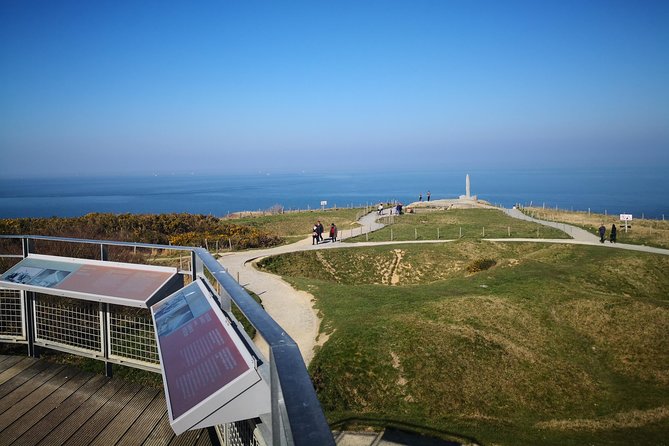
Pointe du Hoc is the first stop, and it’s a heavy one. These are about 100-foot cliffs between Omaha and Utah, part of the German Atlantic Wall defensive system. Here, German Todt organization installed six long-range artillery guns (155mm) in concrete bunkers facing the English Channel.
The point of visiting is not just the view. It’s what the view represents. On June 6, 1944, US Rangers landed below the cliffs and scaled them using ropes to attack and destroy the gun emplacement. The landscape still shows traces: blown concrete bunkers, bomb craters, and damage patterns that make the battle feel physical instead of abstract.
You’ll have about 40 minutes here, with admission included as free to enter. That time is enough to look at the cliffline, walk the accessible viewpoints, and absorb your guide’s explanation of how this position fit into the larger coastal defense plan.
Tip for this stop: keep your footing in mind. You’re on a cliff area with uneven ground, so if it’s wet, go slower than you would on a museum floor.
National Guard Monument at WN72: small stop, big meaning
Right after the cliffs, you shift to a quieter but important location: the National Guard Monument at WN72. This is the spot where the 29th National Guard Division broke through German defenses on D-Day, June 6, 1944.
What I like about this stop is how it widens the lens. The day trip could easily turn into an Omaha-only story, but WN72 reminds you the invasion wasn’t one single moment—it was a chain of breakthroughs and pressure points. The monument sits atop an original bunker and is maintained by NGEF to preserve the legacy.
You’ll have around 20 minutes here. It’s a photo-and-reflection stop more than a walk-all-day stop, but it’s worth the time because it adds another layer to your understanding of the battle map.
Omaha Beach in Easy Green: monuments, sectors, and why the guide’s map matters
Omaha Beach is where many people expect a flat, dramatic shoreline. What you get instead is a place of structure—sectors, defenses, and memorials placed so you can trace the action.
Your visit happens in the Easy Green sector. Two monuments are your photo stops:
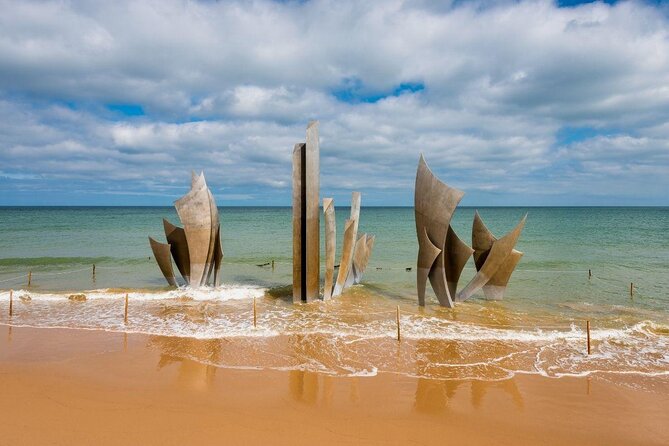
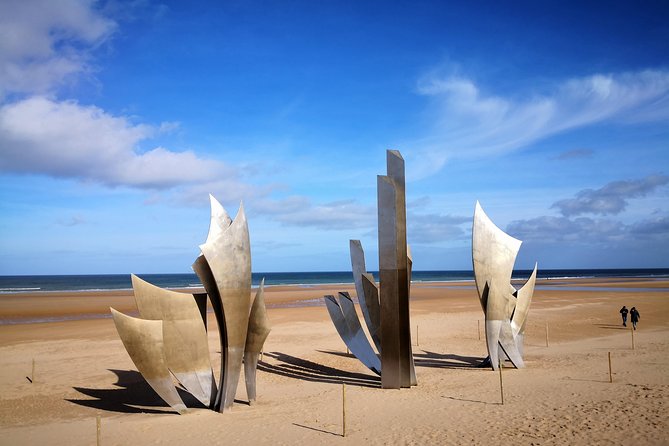
- Signal of the Liberation: commemorates the Allied landing on June 6, 1944 and the liberation of Europe, with frescoes on either side. One fresco is dedicated to the 1st US Infantry Division, and the other to the 116th Regimental Combat Team of the 29th US Infantry Division.
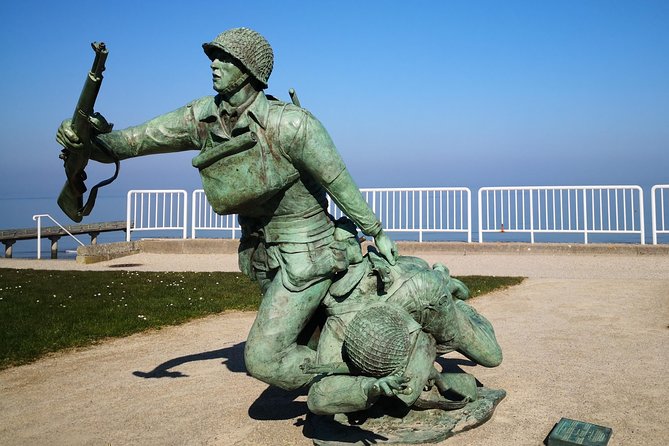
- The Braves: a monumental work by sculptor Anilore Banon honoring the courage of Allied soldiers.
After the photos, you get time to walk along the beach for about 20 minutes. There’s even the simple souvenir idea of filling a tiny container with sand.
Here’s the practical value: Omaha becomes far more meaningful when someone explains what sector you’re standing in. Your guide can point you toward the logic of the defenses and the landing zones, so the beach stops feel like coordinates in a story instead of random stones.
Wiederstandsnest 62 and the 1st US Infantry Division obelisk
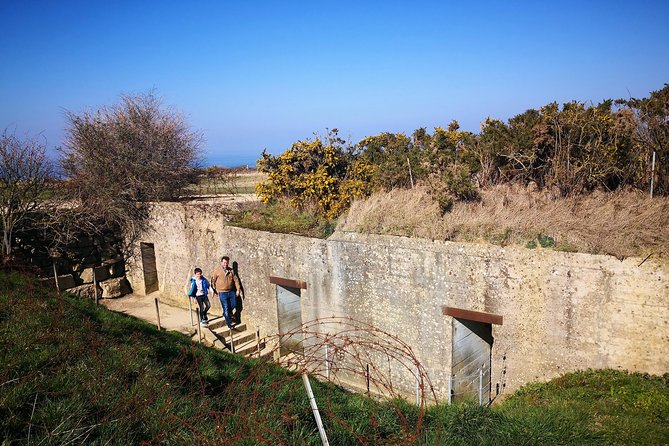
Next up is a monument tied directly to the defensive network along the Omaha coastline: the Memorial of the 1st US Infantry Division. It’s an obelisk located in the heart of an area called Wiederstandsnest (WN62), which was one of the strongest defending positions.
WN62 overlooks Easy Red and Fox Green sectors of Omaha Beach at Colleville-sur-Mer. In other words, this isn’t just a marker in a field. From here, you can connect the memorial’s placement to the terrain and the sectors your guide is describing.
You’ll have about 30 minutes for this stop, and it’s a good buffer before the museum. If the beach itself is moving but a bit overwhelming, this is where the day starts to feel organized: you see how the defense system was arranged, and you can picture why certain actions were so hard.






Overlord Museum: the timeline you wish you had before the last stop
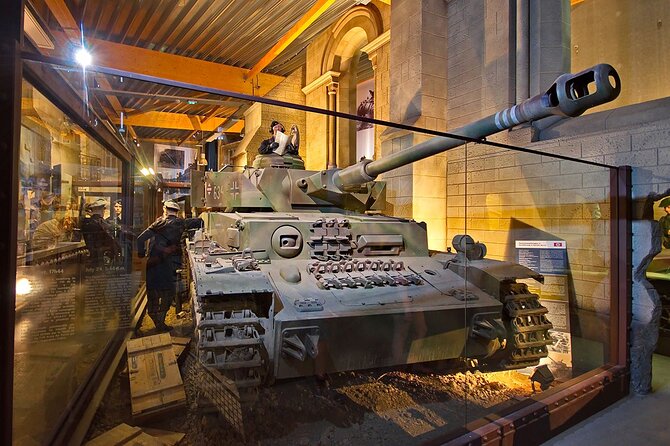
After the outdoors stops, you move to a calmer, indoor reset: Overlord Museum. This is included in the tour, with about an hour set aside for it.
The museum chronicles the period from the Allied landing to the liberation of Paris. One detail I like is that the collection was gathered by a person who was both a witness to the conflict and involved in the reconstruction of Normandy. That gives the museum a grounded feel, not just a display case feel.
What you’ll actually see matters here:
- Personal items from individual soldiers
- Armored fighting vehicles from six armies in Normandy
- A set of reconstructions showing more than 35 vehicles, tanks, and guns
If you’re trying to understand how the battle moved from landing chaos into a working campaign, this museum helps connect the dots. It also gives you a break from wind and cold, which can be a big deal on a long day.
American Cemetery at Colleville-sur-Mer: 9,387 crosses and 1,557 names
Then comes the stop that many people remember most clearly—not because it’s dramatic, but because it’s precise and quiet.
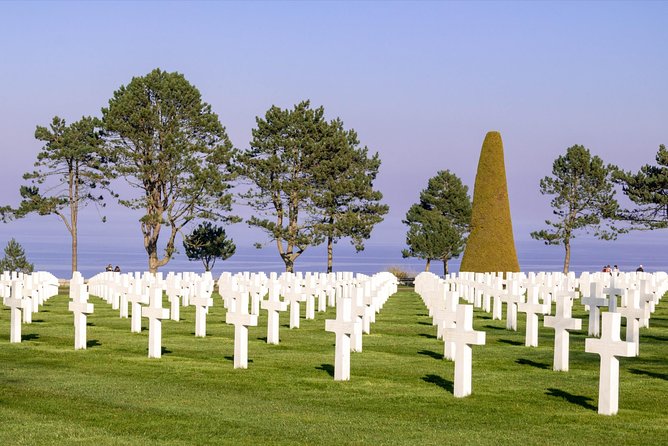
The American Cemetery in Colleville-sur-Mer covers about 180 acres and overlooks Omaha Beach nearby. The memorial contains 9,387 perfectly aligned white crosses and a memorial chapel. It’s maintained to a standard that makes the place feel cared for, not forgotten.
Your guide walks you through what you’re looking at and shares stories connected to soldiers who fought in the area. The cemetery also marks gallantry and honors, so the meaning doesn’t stay generic.
One of the most important features is the Walls of the Missing: a semicircular garden on the east side of the memorial with 1,557 names. Rosettes mark the names of those recovered and identified. Even if you’re not a museum person, this section hits because it shows how uncertainty was part of the war, not just the fighting.
The memorial layout is also built to guide your sense of direction:
- A semicircular colonnade with maps and narratives
- The bronze statue Spirit of American Youth Rising from the Waves
- An orientation table overlooking the beach landings
- A reflecting pool and the burial area with a circular chapel
- Granite statues representing the United States and France facing the direction you approach
You’ll have about an hour here, and it’s the right amount for a slow walk. If you want photos, do them gently and quickly; save your energy for the moments that make you stop moving.
Arromanches Mulberry Port remains: the logistics side of D-Day
After all that emotion, you shift to something very practical: supplies.
Your last major stop is at the Vestiges du Port de Mulberry in Arromanches. This is where the Allies installed an artificial Mulberry harbour port. The key idea is simple: the Allies needed a way to unload heavy equipment and supplies quickly without waiting for captured deep-water ports like Le Havre or Cherbourg.
The artificial harbour made it possible to disembark about 9,000 tons of material per day. The port was commissioned on June 14, 1944, and it was one of two chosen sites. One was at Arromanches, and the other was built further west at Omaha.
The British built huge floating concrete caissons, towed from England and assembled into walls and piers forming the Mulberry harbour. These were made of pontoons linked to land by floating roadways.
What’s left today is what makes the story feel real. You can still see sections of the Mulberry harbour: huge concrete blocks sitting on the sand, plus other remnants visible further out at sea.
You’ll have about 20 minutes, and it’s a good closing note because it shows the war wasn’t just landing and fighting—it was also engineering, repair, and constant supply.
Who this day trip is best for
This tour fits best if you want a single, guided hit list of the most important D-Day sites from Paris without juggling buses and tickets. The small-group size helps if you like asking questions and getting direct answers, not listening to explanations from the next seat.
It’s also a good option if you care about context. Pointe du Hoc and Omaha Beach aren’t just pretty viewpoints here. They’re tied to specific elements of the defense system—like gun placements and named defensive nests—so you leave with a clearer mental map.
The big tradeoff is stamina. It’s a long day, and you’ll likely spend much of it in transit. If you’re traveling with someone who tires easily or can’t handle early mornings, you might want a multi-day plan instead.
Should you book this Paris to Normandy D-Day day trip?
I’d book it if:
- You want a guided small-group day that hits Pointe du Hoc, Omaha Beach, and the American Cemetery in one run
- You value having someone connect each stop to the bigger D-Day picture
- You like the combo of outdoor sites plus an indoor anchor like Overlord Museum
I’d think twice if:
- You’re looking for a slow, flexible day with minimal driving
- You hate early starts and long transit days
- You plan to do lots of independent exploring beyond what fits in set time windows
One smart move before booking: pack for weather changes (even if forecasts look friendly) and plan for lunch since it’s not included. If you do that, you’ll get a day that feels both organized and emotionally honest, with plenty of time to stand where history actually happened.
FAQ
What’s the duration of the Paris to Normandy day trip?
It runs about 13 to 14 hours, starting at 6:30am and ending back at the meeting point.
What’s included in the ticket price?
The tour includes an air-conditioned vehicle, a driver-guide, and admission tickets to Overlord Museum. Many of the other key memorials and monuments you stop at have admission listed as free.
Do I need to arrange lunch?
Lunch food and drinks are not included. Plan for lunch on your own during the day.
How big is the group?
The tour is set up for a maximum of 7 travelers.
What time does the tour start, and where do we meet?
You meet at Théâtre du Lido, 116 bis Av. des Champs-Élysées, 75008 Paris, France. Start time is 6:30am.
Is the tour offered in English, and how do I receive tickets?
The tour is offered in English, and it uses a mobile ticket.