REVIEW · PARIS
Paris Tootbus Discovery by Day and by Night Routes
Book on Viator →Operated by Tootbus · Bookable on Viator
Paris at night feels like a movie scene.
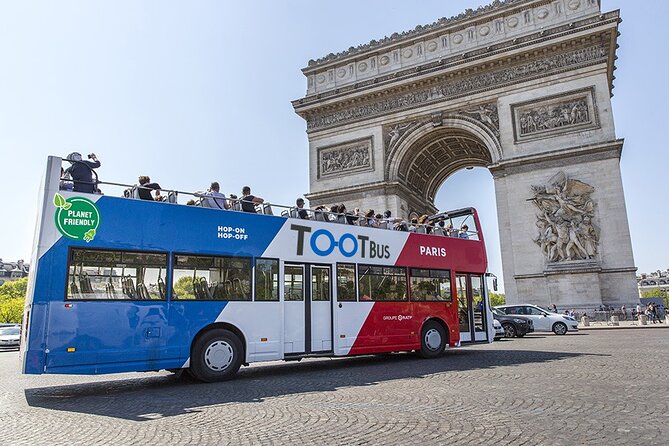
This Tootbus experience gives you a practical way to see major landmarks with an open-top deck and audio commentary in English for adults and kids. I like that you can pick from different pass options to match your days in town, and I also like that the day-and-night combo helps you get the big photo moments without crisscrossing the city on foot. One real drawback: the start point and stop signage can be confusing if it’s your first time in Paris, so you’ll want extra time and a charged phone.
What makes this tour especially useful is the mix of flexibility and structure. During the day, you can ride and explore at your own pace in the open air, then you shift into a 2-hour evening tour designed for those classic night views. Add the free Tootbus app with live bus tracking, audio guides, and self-guided walking tours, and you have a simple system to plan your sightings between stops.
Just remember it’s an open-air format. If you hit cold or rainy weather, the comfort level drops fast, especially on the upper deck. Also, there’s no restroom on board, so plan bathroom breaks before you settle in.
In This Review
- Key highlights that actually matter
- Paris landmarks, strung along a smart “first-time” route
- Daytime open-top riding: the best way to “see” Paris without over-walking
- The evening tour: night views with a simple, built-in plan
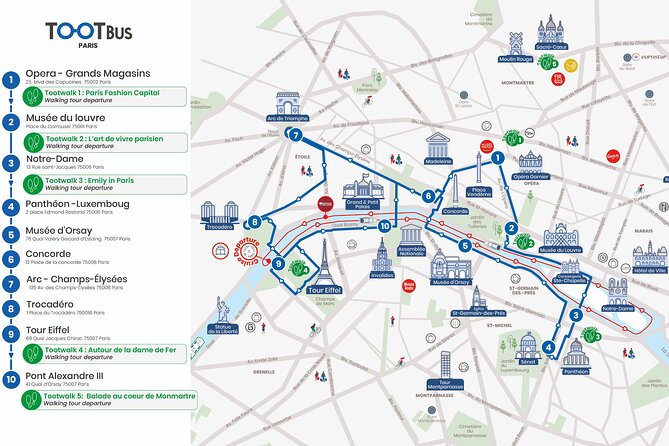
- Stop-by-stop guide: what to look for at each major pull-off
- Opera / Grands Magasins (Bd des Capucines)
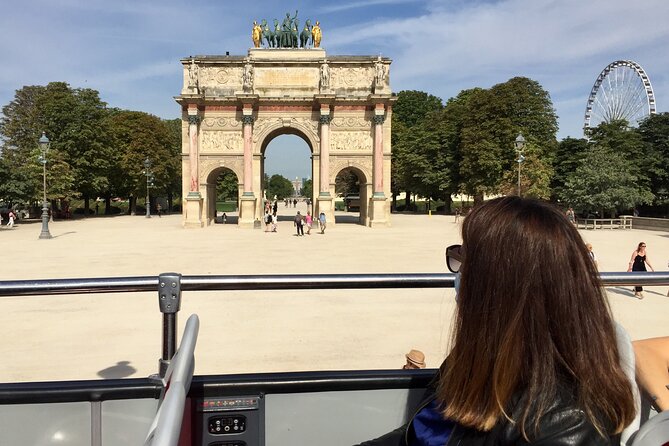
- Louvre area (Place du Carrousel, plus a Comédie-Française relocation)
- Notre-Dame area (from 10 Nov 2025)
- Panthéon–Luxembourg zone (from 10 Nov 2025)
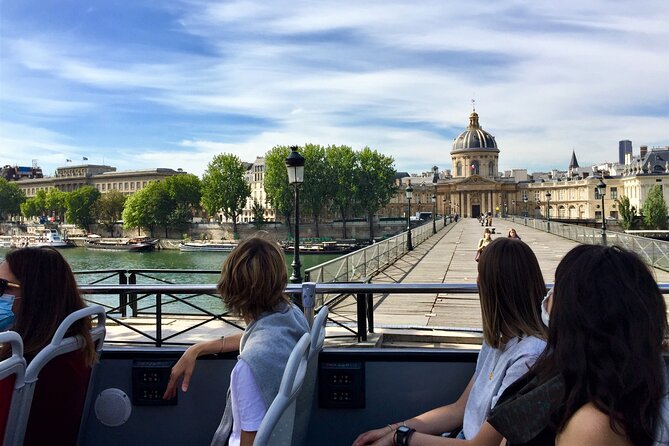
- Musée d’Orsay
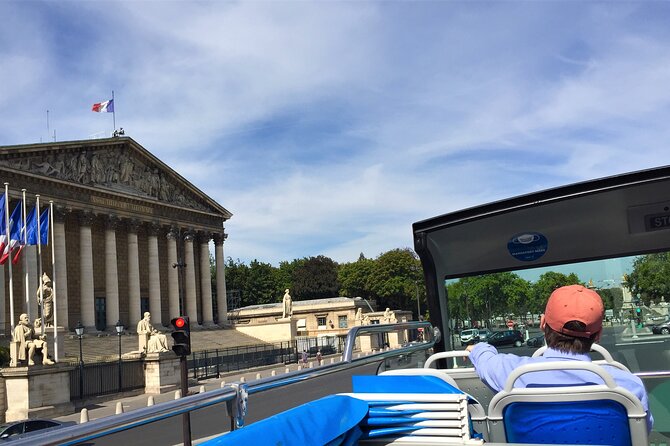
- Concorde
- Arc / Champs-Élysées area
- Trocadéro
- Tour Eiffel area (Quai Jacques Chirac)
- Pont Alexandre III
- Audio in English for adults and children: turn rides into learning time
- App with live bus tracking: the difference between stress and smooth
- Price and value: where $67.19 makes sense
- Logistics that can make or break your day: stops, signage, and timing
- Who this bus tour is best for (and who might want a different plan)
- Should you book Tootbus Paris Discovery by Day and by Night?
- FAQ
- How long is the Paris Tootbus Discovery experience?
- What language is the tour offered in?
- Is this tour open-air?
- Where does the tour start?
- Does the tour include audio guides?
- Are food and drinks included?
- Is there a restroom on board?
- What is the cancellation window?
Key highlights that actually matter
- Day + night coverage: open-air sightseeing plus a dedicated evening loop (about 2 hours)
- Live-tracking app: see where the bus is in real time and use audio and walking tours
- Audio for adults and children: built-in key facts in English so families aren’t left out
- Multiple pass choices: pick the option that fits how many days you really have
- Major landmark stops in one run: Opera, Louvre area, Notre-Dame area, Panthéon, Orsay, Concorde, Arc area, Trocadéro, Eiffel area, Pont Alexandre III
- Meeting at Bd des Capucines: one central starting point near the Opera district
Paris landmarks, strung along a smart “first-time” route
This is built for getting your bearings fast. The tour starts at 23 Bd des Capucines (near the Opera area) and then works through the central highlights that most first-timers want in one shot. You’ll move from the shopping-and-theatre zone toward the Seine, then toward the grand squares and monuments—ending up around the Eiffel and bridge views.
A useful heads-up: some stops are marked as starting 10 Nov 2025, including the Opera/Grands Magasins stop, the Notre-Dame stop, and the Panthéon–Luxembourg stop. If you’re traveling near that date, it’s smart to double-check what the stop list looks like in the app the day you ride, since schedules and landmark access can shift.
Also note the Louvre area is currently affected. Instead of the usual Louvre-area pull-off, the Louvre stop is noted as relocated to Comédie-Française at 3 Avenue de l’Opera, 75001 Paris until further notice. The plan also references a stop in the Louvre courtyard opposite the glass pyramid, so your best bet is to follow what you see in the app on the day.
You can also read our reviews of more evening experiences in Paris



Daytime open-top riding: the best way to “see” Paris without over-walking
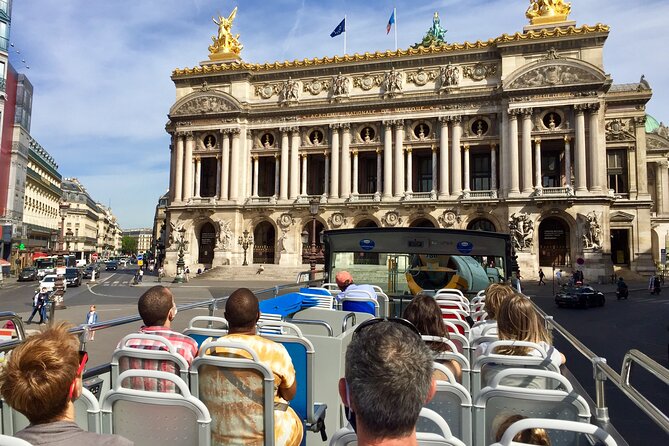
If you only have limited time, a bus loop is a cheat code. The open-top deck matters because Paris landmarks aren’t just about reading plaques—you want wide views, skyline angles, and the feeling of moving through the city.
During the day, you’ll get the kind of sightlines that are tough to recreate later in photos:
- Opera area looks especially striking in daylight, because the building massing and street energy are clear.
- The route also hits the big classic landmarks you’d otherwise spend hours walking between—like the Louvre area, the Notre-Dame area, and the Panthéon–Luxembourg zone.
Practical note: because it’s open air, you’ll do best with a light layer you can take on and off. Bring sunglasses if you’re sensitive to glare, and try to sit in a spot where you can see straight ahead and not only at angles (that sounds obvious, but it’s the difference between “cool” photos and “why is this blurry” photos).
The evening tour: night views with a simple, built-in plan
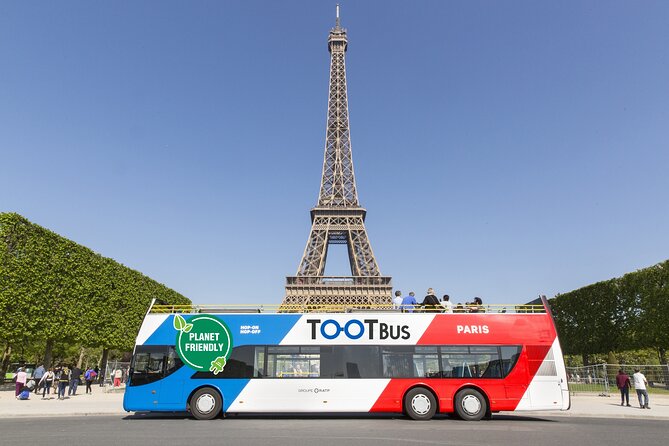
The “daytime sightseeing” part is convenient, but the 2-hour night tour is where you get the payoff. Paris after dark has that soft glow effect on stone façades and bridges, and this format helps you hit the big illuminated moments without the hard part: deciding where to go next and how to get there.
On this route, night has strong anchor points:
- Trocadéro (you’ll be positioned for the iconic Eiffel viewpoint)
- Tour Eiffel area itself
- Pont Alexandre III, which is one of those bridges that looks like it was made for night photos
Even if you’re not obsessed with photography, the night loop gives you a clear storyline. You’re not guessing. You’re moving from monument to monument on a schedule, using the audio to understand what you’re looking at while the city does the light show.
One caution from real-world experience: when weather turns—rain, wind, or cold—upper-deck comfort can disappear quickly. If you’re flexible, plan the night ride when the forecast is most favorable, and consider bringing a packable layer even in mild seasons.
Stop-by-stop guide: what to look for at each major pull-off
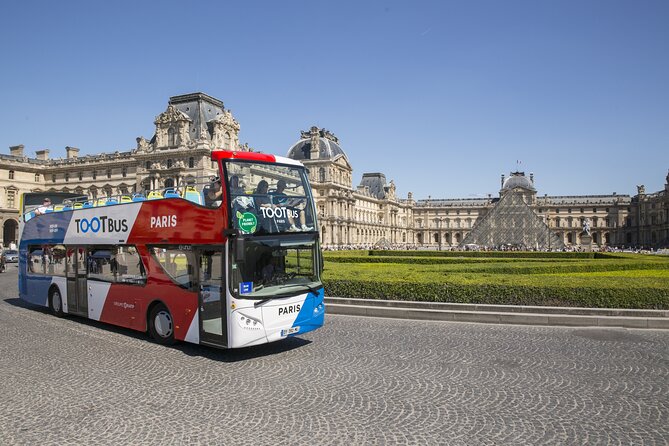
Here’s how I’d think about the stops, and what they’re good for once you’re actually at the curb.
Opera / Grands Magasins (Bd des Capucines)
This is a solid starting point because it’s in the heart of the central city. Opera-area streets give you energy immediately—use it to get oriented before you start hopping off later. If you’re arriving early, this is a good place to “read” the street layout in your mind.




Louvre area (Place du Carrousel, plus a Comédie-Française relocation)
The tour references the Louvre courtyard opposite the glass pyramid, but also notes the Louvre stop has been relocated to Comédie-Française (3 Avenue de l’Opera, 75001 Paris) until further notice. That means the bus can still serve the general Louvre area theme, but the exact curb where you hop may differ.
What to do with it: if you want a quick Louvre hit, use this as your orientation moment. If you want museum time, you’ll still need a separate plan—this isn’t positioned as a museum ticket.
Notre-Dame area (from 10 Nov 2025)
Notre-Dame is on the route with a stop specifically marked to start 10 Nov 2025. Even if you don’t spend time right there, you’ll get the visual context—how the cathedral area sits within the river and surrounding streets.
Practical tip: treat this as a “see it from the right angle” stop. If you want a full visit, you’ll need extra time on your own.
Panthéon–Luxembourg zone (from 10 Nov 2025)
This is another landmark-dense area. The value here is that you can connect the dots between major city points without a long walk. If you’re using the app’s walking tours, this sort of stop works well for turning bus views into a short, satisfying stroll.
Musée d’Orsay
This stop is positioned for the Orsay area, which is one of the best parts of the Seine corridor for classic views. Even a brief look from the street or riverfront gives you that sense of Paris lining up in layers—buildings, water, and bridges.
Concorde
Concorde is a key “big square” stop—perfect if you like grand urban geometry. It’s also a good place to time your photos because the light can change quickly through the day. If you’re hopping on and off, this is a practical pause point before you head toward the Champs-Élysées and Arc direction.
Arc / Champs-Élysées area
This is where the route becomes very “Paris postcard.” You’ll see the big straight boulevard energy and the monument end-point you probably already recognize. From a bus, it’s easier to keep your orientation than if you’re trying to navigate the area on foot while traffic and crowds fight you.
Trocadéro
Trocadéro is one of the best-value stops on any Paris sightseeing loop because it directly supports the iconic Eiffel view. If the goal is photos and awe, this is one of your best opportunities on the whole route.
Tour Eiffel area (Quai Jacques Chirac)
This stop is the practical “Eiffel time.” You may not get hours here, but you can still do the important part: stand where the view works and soak in the monument in person.
If you’re sensitive to crowds, try to pick a realistic window. Night is often easier to manage than midday for some visitors, but weather can change that.
Pont Alexandre III
This bridge is a standout because it’s decorative and photogenic in daylight and night lighting. If you’re doing the evening tour, this is a great closer-feeling stop—like the city finally hands you a finished frame.
Audio in English for adults and children: turn rides into learning time
The tour includes audio guides for adults and children, and the app provides audio commentary plus self-guided walking tours. For you, that means less staring at buildings like you’re on a quiz show, and more understanding what you’re seeing while you ride.
Two practical tips to make the audio actually work for you:
- Download and test the app before you go to the curb. If your phone battery dips in transit, you’ll feel it.
- Bring earbuds. Open-top wind and engine noise can make speaker audio tough, and earbuds keep the narration clear.
Also, I’d treat audio as a guide, not a substitute for time on the ground. Some stops are more “look and move on” than “full explanation.” If you want deep detail on one monument, plan one targeted walk from that stop and let the bus do the rest.
App with live bus tracking: the difference between stress and smooth
This is one of the best features for real-life sightseeing. The Tootbus app includes live bus tracking, audio commentary, and walking tours. When you can see the bus approaching, your decisions get easier: you don’t need to guess, and you don’t have to hover at the curb forever.
For first-timers, this matters because the route is dense. Paris stops aren’t always obvious, and if you don’t know the neighborhood, your brain does the extra work. Live tracking takes away that anxiety and replaces it with something you can control.
Price and value: where $67.19 makes sense
The price shown is $67.19 per person, with a tour duration of about 2 hours. On paper, that can feel like a “tour bus tax.” In practice, it’s often good value if you use it as an orientation tool.
Here’s the value logic:
- You’re getting open-air landmark coverage plus a 2-hour night tour option within the experience design.
- You also get the app with live tracking and audio (which helps you spend time seeing, not figuring).
- It’s eco-friendly and designed for comfort and safety.
What you should factor in:
- Food and drinks aren’t included.
- There’s no restroom on board.
- Weather can reduce enjoyment since it’s open-air.
So the smart way to judge value is this: if your alternative is long walks across central Paris, constant metro confusion, and searching for the next sight, the bus can be worth it fast—especially if you’re traveling with kids or you’re on a tight schedule.
Logistics that can make or break your day: stops, signage, and timing
The tour starts at 23 Bd des Capucines, and it’s near public transportation. That’s good news. The tricky part is finding the exact start/stop area without local street knowledge.
Here’s how you protect yourself:
- Arrive early enough to locate the stop without rushing.
- Use the app’s live tracking so you’re not stranded by uncertain timing.
- Keep your phone charged, and keep your mobile ticket ready.
Also, consider that open-air deck time means you’ll feel weather more than you would on a fully enclosed ride. Pack for cold or wet conditions even if the forecast looks mild—your experience quality depends on comfort as much as on sightseeing.
Who this bus tour is best for (and who might want a different plan)
This tour fits best when you want:
- A quick way to see major landmarks in central Paris
- A low-effort method to connect neighborhoods visually
- Family-friendly audio for adults and children
- Night views that don’t require planning a separate itinerary from scratch
I’d be a little cautious if you want:
- A deep, stop-by-stop guided explanation at each monument
- A long museum-style experience at the Louvre or Notre-Dame sites
- A fully comfortable ride in strong rain and cold, since it’s open air
Should you book Tootbus Paris Discovery by Day and by Night?
If you’re short on time and want the “greatest hits” of Paris in a way that’s easy to manage, I think this is a strong booking choice. The combination of open-top viewing, audio in English for adults and kids, and the app with live bus tracking is exactly what you need for first-time comfort.
Book it when you can plan around weather, arrive early to find your stop confidently, and treat the ride as your framework. If you do that, you’ll leave with clear photos, better orientation, and less wasted time wandering the wrong streets.
FAQ
How long is the Paris Tootbus Discovery experience?
It’s about 2 hours.
What language is the tour offered in?
The experience is offered in English.
Is this tour open-air?
Yes. The sightseeing is described as open air, with views from the open-top deck.
Where does the tour start?
The first stop is at 23 Bd des Capucines.
Does the tour include audio guides?
Yes. You get an audio guide with key facts about Paris for both adults and children, and you can access audio through the Tootbus app.
Are food and drinks included?
No. Food and drinks are not included unless specified.
Is there a restroom on board?
No restroom on board is listed as an included detail (so you should plan for bathroom breaks before you ride).
What is the cancellation window?
Free cancellation is available if you cancel at least 24 hours before the start time for a full refund.