REVIEW · PARIS
Paris: Ticket Entrance to Science Experiences Museum
Book on GetYourGuide →Operated by Science Expériences · Bookable on GetYourGuide
Science Experiences turns a museum visit into a fast trip from the edge of the universe to the bottom of the sea, then on to the center of Earth and the strange rules of quantum physics. I like the wide range of subjects and the use of video mapping, virtual reality, and multisensory rooms to make science easier to grasp. I also like that the course is designed for both children and adults, rather than treating science as a wall of dry text.
The main caution is that this is more of a guided, room-to-room presentation than a traditional hands-on science center. Some displays may not work, and the flow between groups can become messy. At the listed price of $1,178 per person for 90 minutes, you should confirm the current rate before booking, since that is an unusually steep charge for a short museum visit.
In This Review
- Key Points
- Science Experiences at Bercy Village
- From the Edge of the Universe to Earth’s Center
- Quantum Physics with Lasers and Levitation
- How Much Do You Actually Do?
- A Good Choice for Children Ages 6 and 11?
- Reading Panels, Hearing Audio, Following the Instructor
- The 90-Minute Timing
- What Is Included and What Costs Extra?
- How the 3.3 Rating Fits the Experience
- Who Should Book Science Experiences?
- My Booking Verdict
- FAQ
- Where is Science Experiences located?
- How long does the visit last?
- What subjects does the course cover?
- Is an instructor included?
- Are virtual reality simulators included?
- Is the audio guide included?
- Is the museum wheelchair accessible?
- Can I cancel the booking?
Key Points
- 850 square meters at Bercy Village: The compact museum fits a full science-themed route into a central Paris setting.
- Four big science zones: The course moves from outer space to the abyss, Earth’s interior, and quantum physics.
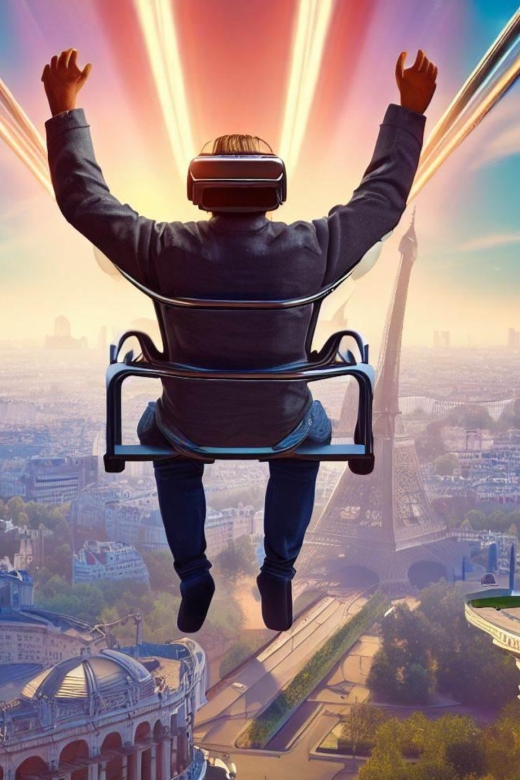
- Technology drives the visit: Video mapping, virtual reality, laser effects, teleportation themes, and levitation create the main attractions.
- A 90-minute timed experience: The visit is short enough for a busy Paris day, but the pace may feel quick when several groups share the same route.
- Extra charges may apply: Virtual reality simulators and the audio guide are not included.
- Best for curious families: Children ages 6 and 11 both enjoyed the visit, but adults should set realistic expectations about how much visitors actually handle.
Science Experiences at Bercy Village
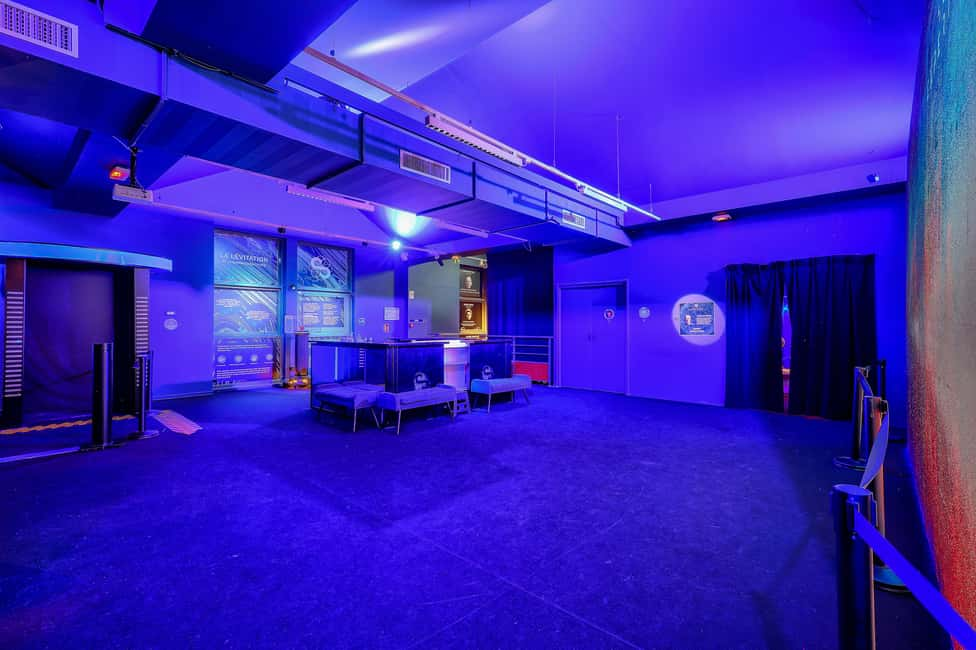
Science Experiences is an indoor museum in Bercy Village, in the Île-de-France region. Its 850-square-meter space is arranged as a sequence of themed rooms rather than a collection of standard galleries.
That layout matters. You do not simply walk past cases and read labels. You follow a route built around movement, screens, projection, sound, and short explanations. An instructor is included, and the attraction is presented as an educational course with entertainment at its center.
I like this approach for a first introduction to science. You can move from the largest possible subject, the universe, to the smallest and strangest, quantum physics. The route gives you a sense of scale. It also keeps the visit lively for children who might lose patience in a conventional museum.
Still, you should not expect a full science lesson on every topic. The course is built to spark interest, not to provide detailed study. The short format means each theme receives a quick treatment, with the technology doing much of the work.
A few more Paris tours and experiences worth a look



From the Edge of the Universe to Earth’s Center

The route begins with the borders of the universe. The supplied description does not give the names of individual rooms or the exact order of every activity, so you should think of this as a broad journey rather than a fixed scientific lecture.
The space section is likely to be the most immediately appealing part for many families. Large-scale subjects work well with projection and sound because they can make a small room feel much bigger. You may find yourself moving through visual presentations that explain distance, scale, and the larger workings of the cosmos.
From there, the route turns toward the depths of the abyss. This change of setting gives the experience a useful rhythm. Space and the deep sea are both hard for us to picture in ordinary life, so visual effects can help turn abstract ideas into something you can see.
Next comes the center of Earth. Here again, the attraction uses the idea of travel to explain a place no ordinary visitor could reach. You are not taking a literal trip underground, of course. The value is in showing the layers and forces beneath the surface through images and sensory presentation.
These sections are likely to work best when you let the instructor guide your attention. One French parent found it hard to read the panels, listen to the audio guide, and follow the instructor at the same time. That is useful advice: do not try to consume every channel at once. If an audio guide is available as an extra, decide in advance whether you want it, rather than adding another voice to an already busy presentation.
Quantum Physics with Lasers and Levitation

The final part of the route focuses on quantum physics, with themes including lasers, teleportation, and levitation. This is the point where the museum shifts from huge natural spaces to ideas that can seem impossible.
Quantum physics is not an easy subject to explain in a short museum visit. The attraction’s answer is to use familiar science-fiction ideas as entry points. Teleportation and levitation catch your attention first, then the presentation can connect those ideas to real scientific questions.
I appreciate that the route does not stop with outer space and dinosaurs of the imagination. It attempts to introduce a topic that many adults find difficult. The result may be more memorable than a technical explanation, especially for younger children.
The drawback is that spectacle can sometimes replace participation. One visitor described the experience as having too few things to try, with much of the visit spent listening rather than testing. That is the key distinction between this museum and a hands-on science center. You may see and hear plenty, but you should not assume every room offers an experiment you control yourself.
How Much Do You Actually Do?
The answer depends on what you count as participation. The course uses virtual reality, video mapping, and multisensory presentations. Some parts are designed for your senses and attention rather than for building, pressing, mixing, or measuring.
Virtual reality simulators are listed as optional extras, not part of the basic admission. If trying VR is important to you, budget for that separately and ask about availability when you arrive. The same applies to the audio guide.
The included instructor can help give the route structure. An instructor is especially useful for children, since the science themes move quickly and the displays may not explain every idea in depth. However, no instructor name is provided, and the language information is not clearly stated in the supplied details. If you need a particular language, confirm it before paying.
The technology also needs to be working properly for the visit to feel worthwhile. Several screens and attractions were reported as nonfunctional during one visit. That can leave you waiting for a feature that forms an important part of the room’s presentation.
Group management is another practical concern. The route is shared among different groups, and poor spacing can cause groups to cross and mix. When that happens, you may not know which activity to follow or when to move on. This is not a problem with the scientific ideas, but it can affect the basic enjoyment of the visit.
A Good Choice for Children Ages 6 and 11?
The clearest positive signal is that children aged 6 and 11 both enjoyed the experience. That makes sense. The format offers visual effects, large subjects, and playful scientific ideas without requiring a long attention span in one room.
For a six-year-old, the appeal will probably come from the movement between rooms, the visual effects, and themes such as lasers and levitation. The child may not remember the explanation of quantum physics, but the visit can still plant a useful question.
An 11-year-old may get more from the explanations and the connection between the demonstrations and real science. You can help by asking simple questions as you go: What makes this look like teleportation? How is a laser different from ordinary light? What would it mean to travel to Earth’s center?
I would be more cautious about booking this for a teenager or adult who wants serious, detailed science content. The course is educational, but entertainment is part of its core design. The 90-minute duration also limits how much detail each subject can receive.
Families should also prepare for a slightly uneven experience. Some attractions may not be working, and some parts may be more about watching than doing. That does not make the visit worthless, but it means the children should not be promised a full afternoon of experiments.
You can also read our reviews of more museum experiences in Paris





Reading Panels, Hearing Audio, Following the Instructor
The museum appears to use several information channels at once: written panels, audio, visual effects, and spoken instruction. Each method can help, but all four together may create confusion.
You can make the visit easier by choosing your main source of information. If the instructor is explaining a room, listen first and read later if there is time. If you prefer to move at your own pace, the audio guide may help, but remember that it costs extra and may compete with the live explanation.
The written signs may also be difficult to read while the presentation is running. This is especially important for visitors who need time to translate or who have hearing or vision concerns. Since the supplied information does not identify the available languages, confirm language support before booking.
The course is wheelchair accessible, which is an important advantage. The details do not specify the design of every individual room or attraction, so you should still ask the provider about access to any optional simulator you want to use.
The 90-Minute Timing
Ninety minutes is a sensible length for a technology-based museum course. It can fit before lunch, after another Bercy Village activity, or into a day when you want one indoor stop without giving up half your schedule.
The short duration also shapes your expectations. You are getting a compact sequence of experiences, not a museum where you can return to a favorite gallery for hours. If the group flow is smooth, the pace should keep the visit lively. If groups mix or an attraction is out of service, the same short schedule can feel less satisfying.
Check the available starting times before booking. The activity is timed, and the exact schedule is not supplied here. Arrive ready to follow the planned sequence rather than expecting an open-ended visit.
Because the course is only 90 minutes, the stated price deserves close attention. At $1,178 per person, the value is poor unless that figure is a listing error, a package price, or a special fare with other inclusions not described here. For a family of four, that rate would become especially expensive very quickly. Confirm the currency, date, and final total before you commit.
What Is Included and What Costs Extra?

The basic admission includes the Science Experiences course itself. That means the themed route through the museum, the instructor, and the scheduled presentations and activities described as part of the course.
The following are not included:
- Virtual reality simulators
- Audio guide
- Any options paid for on site
This distinction matters because the museum’s main appeal comes from its technology. If you see VR listed in promotional material, do not assume it is part of your ticket. Ask about the extra cost and whether the simulator is operating on your date.
I would also ask whether the instructor leads the full route or only certain sections. The information confirms that an instructor is included, but it does not name the person or spell out the exact format. That small clarification can help you decide if you need the audio guide too.
How the 3.3 Rating Fits the Experience
The overall rating is 3.3 out of 5 from six ratings, which suggests a mixed visit rather than a clear success or failure. The strongest positive is the variety and playful design. The most enthusiastic family response came from a visit with children aged 6 and 11, who both enjoyed trying the material in different ways.
The main complaints are practical. Some people found too little to test directly. Others dealt with broken screens or attractions, groups that crossed into one another, and difficulty handling the panels, audio guide, and instructor at the same time.
That pattern tells you how to book wisely. Choose Science Experiences for its themes, visuals, and family format. Do not book it expecting every station to be interactive or every explanation to be calm and orderly.
The staff effort also appears uneven. The scientific organizers are described as highly involved, but the operation may not always have enough resources to keep every technical feature and group transition running smoothly. If something is not working, report it promptly on site rather than waiting until the end.
Who Should Book Science Experiences?
I would recommend it most strongly to families with children, particularly children in the broad 6 to 11 age range. The route offers enough variety to hold attention and enough science vocabulary to start conversations after the visit.
It may also suit adults who enjoy visual presentations and want a short, unusual museum stop at Bercy Village. You will probably get more from it if you enjoy seeing an idea presented through sound and projection, rather than needing to manipulate an experiment at every stage.
I would hesitate if your priority is a traditional museum with detailed labels, quiet galleries, or a large number of working hands-on stations. I would also hesitate at the listed price unless the provider confirms that the amount is correct and explains what it covers.
The experience is wheelchair accessible, and free cancellation is available up to 24 hours before the activity for a full refund. You can also reserve now and pay later, which helps keep plans flexible, but neither policy fixes a poor value calculation. Check the final price first.
My Booking Verdict
Book Science Experiences if you want a short, family-friendly science show built around space, the deep sea, Earth’s interior, and quantum physics. Its best qualities are variety, playful presentation, and a format that can make difficult subjects approachable for children.
Skip it if you want guaranteed hands-on experiments, a quiet learning environment, or a long museum visit. Also, do not pay the listed $1,178 per person without first checking the price and inclusions. At a normal museum admission rate, this could be a fun addition to a Paris family day. At the stated rate, it is not a sensible buy.
FAQ
Where is Science Experiences located?
Science Experiences is located at Bercy Village in the Île-de-France region of France.
How long does the visit last?
The activity lasts 90 minutes.
What subjects does the course cover?
The route covers the borders of the universe, the depths of the abyss, the center of Earth, and quantum physics themes such as lasers, teleportation, and levitation.
Is an instructor included?
Yes. An instructor is included as part of the activity, though the supplied information does not provide the instructor’s name.
Are virtual reality simulators included?
No. Virtual reality simulators are listed as options that require payment on site.
Is the audio guide included?
No. The audio guide is not included in the basic admission and may require an additional payment.
Is the museum wheelchair accessible?
Yes. The activity is listed as wheelchair accessible.
Can I cancel the booking?
Yes. You can cancel up to 24 hours in advance for a full refund. The activity also offers a reserve now and pay later option.