REVIEW · PARIS
Paris: Montmartre Must-See Walking Tour with a Local Guide
Book on GetYourGuide →Operated by French Tales · Bookable on GetYourGuide
Montmartre rewards slow steps and sharp stories. This 150-minute walk from the Carrousel de Saint-Pierre turns famous sights like Sacré-Cœur into a trail of art, people, and odd Paris details you would miss on your own. You’ll follow an English-speaking guide (often Jean-Baptiste, aka JB), with a route built for photos and real street-level context.
I like two things most: the mix of big-name landmarks and quiet, specific spots (Louise Michel Gardens, Square Nadar, Bateau-Lavoir), and the way the guide keeps energy up while watching the group’s pace and comfort. You get practical tips for where to stand for views and how to keep your bearings in tight streets.
One consideration: this is a hill walk. Expect uphill paths, cobblestones, and some stairs near viewpoints, so it’s not a fit if you have mobility issues or want minimal walking effort.
In This Review
- Key highlights that make this walk worth your time
- Why Montmartre works best with a guide (not just a map)
- Start at Place Saint-Pierre, then let the hill do the rest
- Square Louise Michel Gardens: the view before the views
- Sacré-Cœur: the parvis, the mosaics, and the skyline payoff
- Square Nadar and Place du Tertre: the camera history of Montmartre
- Le Poulbot and Maison Rose: street kids to pastel icons
- Dali Museum and Cabaret Au Lapin Agile: surreal art and stage legends
- Dalida’s places: a pop icon route you’ll actually enjoy walking
- Square Suzanne Buisson: the quieter kind of monument
- Moulin de la Galette and Bateau-Lavoir: windmill to workshop
- Vignes du Clos Montmartre: Paris winemaking in a place you don’t expect
- Wall of Love: finish at Place des Abbesses with romance and color
- Price and value: what $29 buys you in real-life terms
- Weather, pace, and comfort: how to plan your body for Montmartre
- Food stops and local recommendations: what to do with the guide’s suggestions
- Should you book this Montmartre walking tour?
- FAQ
- How long is the Montmartre walking tour?
- What is the tour price?
- Where does the tour start and where does it end?
- What’s included in the tour?
- Is the tour in English?
- Does the tour run in bad weather?
- Is transportation included?
- Is this tour wheelchair accessible?
- What should I bring?
- Can I cancel for a refund?
Key highlights that make this walk worth your time
- Sacré-Cœur from parvis to mosaics, plus high-point views over Paris
- Place du Tertre and its working art scene, including painters and caricaturists
- Vignes du Clos Montmartre, a real working vineyard history lesson in the city
- Bateau-Lavoir, the famed artists’ workshop linked with Picasso and Modigliani
- Wall of Love (Le Mur des Je T’aime), ending with I love you in 250+ languages
Why Montmartre works best with a guide (not just a map)
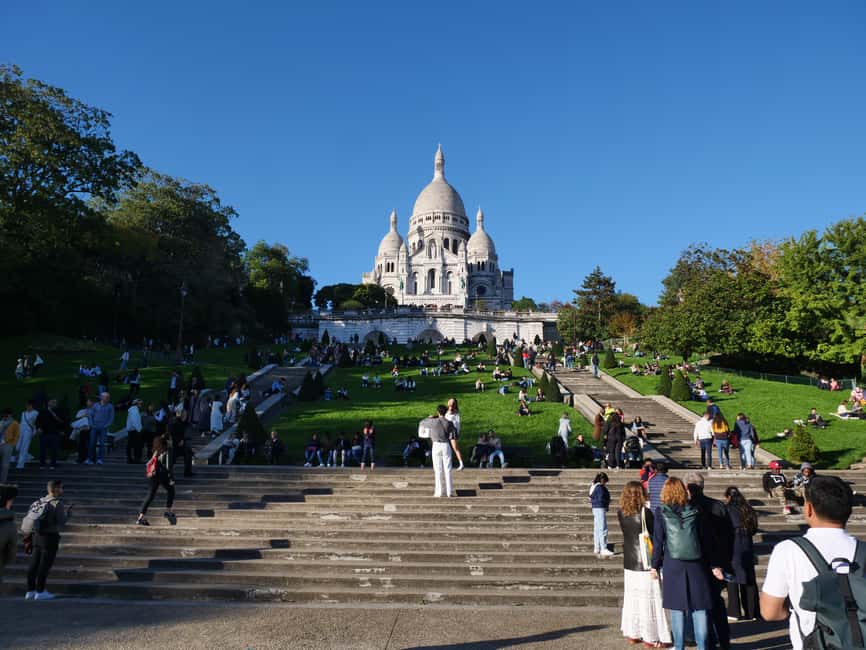
Montmartre can feel like a postcard that repeats itself—until someone points out why it looks the way it does. This tour is built around that shift: you’re not only seeing famous addresses. You’re learning how artists, musicians, and dreamers shaped the neighborhood, street by street.
I also like the pacing model here. The route uses a string of “stop-and-look” moments that give you time to absorb views and reset your legs. That matters because Montmartre is not a flat museum stroll.
The guide’s role is the real value. A person like JB doesn’t just point. He explains, adds humor, and helps you get photos at the spots that actually work from the sidewalk.
You can also read our reviews of more walking tours in Paris



Start at Place Saint-Pierre, then let the hill do the rest
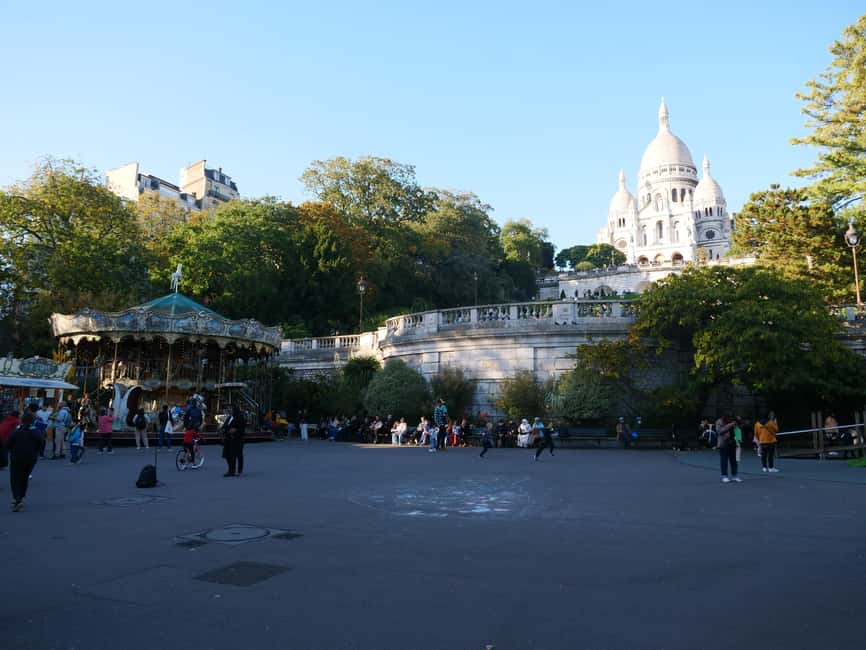
Your meeting point is Place Saint-Pierre (bottom of Square Louise Michel) near Café Le Ronsard, the one with the red storefront. The meeting setup is simple: arrive 15 minutes early, look for the guide holding a French Tales sign, and head straight toward the carousel area.
Why this start makes sense: it places you at the foot of Montmartre, right where the neighborhood begins to “thicken” with character. You start walking while the area still feels like a normal Paris street, not a viewing platform.
If you’re using the metro, the tour is easy to reach from Line 2 at Anvers (about a 5-minute walk) or Line 12 at Abbesses (about a 7–10 minute walk). One practical note: don’t take the stairs from Abbesses—elevators are available, and you’ll thank yourself later when the route gets steep.
Square Louise Michel Gardens: the view before the views
The first meaningful stop is Square Louise Michel Gardens. This is one of those places that feels like a breather right at the base of the hill, and it sets up what you’ll see later: Paris spreads out, and Montmartre’s slope starts to make sense.
Expect a photo-friendly lookout and a sense of orientation. You’ll also get story context early, which helps the later landmarks land harder, because you’re not meeting them cold.
If you’re the type who likes to understand a neighborhood’s “logic” (why streets bend where they do), this start fits you.
Sacré-Cœur: the parvis, the mosaics, and the skyline payoff
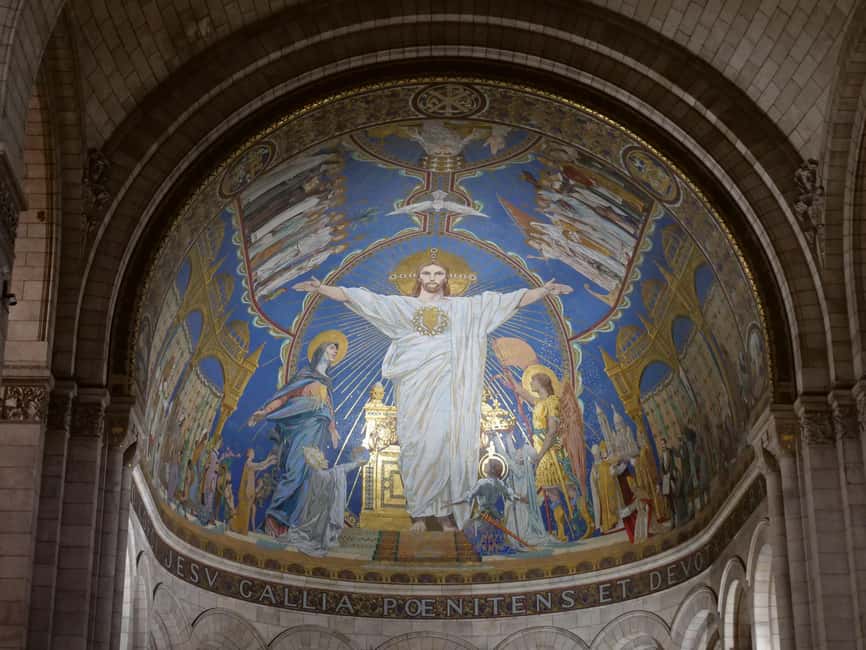
Next comes Sacré-Cœur Basilica, with time outside on the parvis and time inside. If you’ve only seen Sacré-Cœur from the outside, you’ll feel the difference once you’re standing at the mosaics and taking in the atmosphere.
What you should plan for: a climb and some time spent in a crowded area. The guide helps you choose where to stand for good sightlines and keeps the group moving so you’re not stuck in the worst spots.
This is also where the tour’s “storytelling” matters. It’s not only about the landmark. It’s about why Montmartre became a magnet for artists and pilgrims, and how Sacré-Cœur fits into that timeline.
Square Nadar and Place du Tertre: the camera history of Montmartre
From the quiet side, you’ll head to Square Nadar, a calm spot dedicated to the famous photographer associated with Montmartre. It’s a small moment, but it’s a clever one: it reminds you that Montmartre’s creative identity wasn’t only painting and music. Photography helped shape how the area was seen.
Then you’ll step into Place du Tertre, the well-known artist square. This is where you’ll see painters and caricaturists at work, plus the cafes that line the square. The guide’s job here is to keep it from turning into pure tourist theatre. You’ll learn what the square represents and how it connects to the neighborhood’s artistic reputation.
You’ll also get photo opportunities. Aim for simple compositions: street-level angles that include steps, awnings, and the flow of people. The guide will help you find the angles that don’t just look good, but also feel Montmartre.
You can also read our reviews of more guided tours in Paris






Le Poulbot and Maison Rose: street kids to pastel icons
Two stops that tend to click with people fast are Le Poulbot and La Maison Rose.
Le Poulbot is named for the illustrator connected to Montmartre’s street children. Even if you’re not a comic-figure fan, the story gives the neighborhood a human backbone. It explains why certain images, names, and legends keep resurfacing in Montmartre.
Then you’ll get La Maison Rose, the pastel-pink building that’s become a symbol of Montmartre’s charm. This is one of those “yes, that’s the photo spot” stops. The value is learning how it ties to the broader neighborhood identity rather than treating it like a single snapshot.
Dali Museum and Cabaret Au Lapin Agile: surreal art and stage legends

Montmartre’s artistic reach stretches far beyond one era. The tour includes a pause for the Dali Museum, an homage to Salvador Dalí. Even if surrealism isn’t your main interest, it helps you see Montmartre as a place that kept reinventing itself.
After that, you’ll hear stories at Cabaret Au Lapin Agile, a legendary cabaret that hosted major artists and writers of the 20th century. This stop is partly about the building, but mostly about the idea: Montmartre as a stage for ideas, not just entertainment.
The guide’s style matters here. A fun, energetic guide (many groups get JB) tends to make these stops feel like scenes, not facts on a plaque. That’s what keeps the tour from becoming a checklist.
Dalida’s places: a pop icon route you’ll actually enjoy walking
You’ll also visit Place Dalida and Dalida’s House. It’s not always what people plan first when they think of Montmartre, but it adds a different layer to the neighborhood.
This section works especially well if you like celebrity history that’s grounded in real streets. Instead of only museum-style history, you’re walking the streets tied to a familiar voice and image.
Square Suzanne Buisson: the quieter kind of monument
Not every stop is loud or photogenic at first glance. Square Suzanne Buisson offers a calmer break, dedicated to a local heroine. It’s a reminder that Montmartre isn’t only famous for art brands and big names. It also has civic memory.
Take a moment here. Sit for a minute if your legs are getting heavy. You’ll likely be grateful right before the route hits the next set of higher-energy landmarks.
Moulin de la Galette and Bateau-Lavoir: windmill to workshop
Then you’ll reach Moulin de la Galette, the historic windmill with a role in Montmartre’s artistic and social life. This stop often feels like a turning point: the walk shifts from “looking at history” to “feeling the environment that made history happen.”
Finally, one of the most memorable stops is Bateau-Lavoir, the famous workshop area associated with artists including Picasso and Modigliani. This is where the neighborhood turns from atmosphere into creative engine.
If you like art history, this is a strong stop. If you don’t, it still works because the guide connects the workshop concept to why people gathered here. You end up understanding the neighborhood’s creative gravity, not just learning names.
Vignes du Clos Montmartre: Paris winemaking in a place you don’t expect
You’ll also visit Vignes du Clos Montmartre, a vineyard area that’s a rare survival of Paris winemaking history. This is the kind of stop that makes Montmartre feel less like a theme park and more like a living city.
Expect a short photo stop and story context, not a formal tasting. The value is the contrast: you’re in a dense urban neighborhood, and yet you’re standing in something that echoes how Paris used to produce wine locally.
Wall of Love: finish at Place des Abbesses with romance and color
The tour ends at Place des Abbesses, with a final stop at Wall of Love (Le Mur des Je T’aime). This wall features I love you in more than 250 languages, which makes it both sweet and unexpectedly fun.
It’s a good finish point because it gives you a strong visual payoff after hours of walking. It also works as a natural transition: you’ve got an easy endpoint near a lively area, so you can keep exploring on your own without feeling “cut off” from the city.
Price and value: what $29 buys you in real-life terms
At $29 per person for about 150 minutes, this tour is priced like a “serious walk,” not a quick pass-by. You’re paying for more than access to landmarks. You’re paying for a guide who connects the dots—stories, names, and details that help you remember what you saw.
You also get practical add-ons: English live guide plus an English audio guide. That’s useful if you want to review while you wander, or if you’re trying to catch everything while the group is moving through busy streets.
The reviews for guides like JB often highlight the same payoff: humor, attention to comfort, and photo help. That turns a standard sightseeing walk into something you can actually feel good about at the end of the day.
Weather, pace, and comfort: how to plan your body for Montmartre
This tour runs rain or shine, so plan for wet pavement and changing conditions. If you pack like a sensible adult (comfortable shoes, a layer you can adjust, and ideally water), you’ll have a much easier time on the cobblestones.
The route is not wheelchair accessible, and it isn’t designed for mobility limitations or seniors over 95. That’s not a judgment—just terrain reality. Uneven surfaces and stairs are part of the route, especially around viewpoints.
If you’re traveling with teenagers or you want a first-morning plan that keeps people interested, this tour tends to work well because the guide uses stories and interaction. Even if you start skeptical, the energy usually helps you stay engaged.
Food stops and local recommendations: what to do with the guide’s suggestions
Food and drinks aren’t included, but the guide will point you toward local cafés and attractions. In practice, you’ll likely follow those suggestions later, because Montmartre has a lot of tourist traps and a few places that still feel genuinely local.
One example that comes up often with JB is Le Poulbot for classic comfort food, including duck confit. Another example mentioned in guide recommendations includes a dessert stop known for madeleines. You don’t have to plan around these. But if you do, it’s a good way to turn the tour into a day with momentum.
If you’d rather keep it low-key, just use the tour’s tips to choose where to sit after you’re done walking.
Should you book this Montmartre walking tour?
Book it if you want Montmartre to make sense. This is a strong choice for first-timers who want Sacré-Cœur plus the quieter art-world threads—Square Nadar, Bateau-Lavoir, the vineyard, and the Wall of Love—without spending hours figuring out your own route.
Skip it if you need minimal walking, can’t handle uphill cobblestones, or prefer a fully accessible route. Also skip if you want a silent, self-guided museum vibe. This walk is story-led and designed to move.
If you do book, bring comfortable shoes, give yourself an extra minute or two at the start, and let the guide steer you to the photo angles. You’ll walk away with more than postcards—you’ll have a working mental map of how Montmartre became Montmartre.
FAQ
How long is the Montmartre walking tour?
It lasts about 150 minutes.
What is the tour price?
The price is listed as $29 per person.
Where does the tour start and where does it end?
It starts at Place Saint-Pierre, near the bottom of Square Louise Michel, and it finishes at Place des Abbesses.
What’s included in the tour?
A local guide and the walking tour are included, with stops at the main landmarks and recommendations for local cafés and attractions. An English audio guide is also included.
Is the tour in English?
Yes. The live guide and audio guide are in English.
Does the tour run in bad weather?
Yes, it operates rain or shine.
Is transportation included?
No. Transportation is not included.
Is this tour wheelchair accessible?
No. The tour is not wheelchair accessible due to uneven terrain and stairs.
What should I bring?
Wear comfortable walking shoes, and bringing a bottle of water is recommended.
Can I cancel for a refund?
Yes. Free cancellation is available up to 24 hours in advance for a full refund.