REVIEW · PARIS
Montmartre Treasure Hunt — Fun and Cultural Investigation
Book on Viator →Operated by From Paris With Fun · Bookable on Viator
Montmartre is more fun when you have a reason to look up, slow down, and inspect the details. This self-guided treasure hunt leads you through the neighborhood’s famous sights and quieter corners, using riddles tied to artists, cabarets, churches, and local stories.
I like the clever balance between play and place. Children can contribute, while adults get enough history and puzzle-solving to stay interested. I also like the freedom: you have a booklet rather than a guide or app, so you set the pace and can pause for a coffee or a church visit.
The main drawback is the clock. The game lasts about three hours and ends automatically after three and a half hours, so a long café stop can cut into the investigation. You also need moderate physical fitness for Montmartre’s walking streets and slopes, and poor weather may lead to cancellation.
In This Review
- Key points to know before you book
- Starting at Anvers with a mystery in hand
- Sacré-Cœur and the first clues
- Place du Tertre and Montmartre’s artistic side
- St. Jean de Montmartre, a worthwhile extra stop
- Vineyards and quieter Montmartre
- Following the story toward Moulin Rouge
- How the puzzles feel for adults and children
- Three hours, a coffee break, and the time limit
- What $41.70 per person gets you
- Who should book this Montmartre activity?
- Should you book the Montmartre Treasure Hunt?
- FAQ
- How long does the Montmartre Treasure Hunt last?
- Where does the activity start?
- Where does the activity finish?
- Is the activity guided?
- Is a mobile app required?
- What language is offered?
- What age is suitable for the treasure hunt?
- How many people can join?
- What happens if I need help with a clue?
- Can I cancel for a refund?
Key points to know before you book
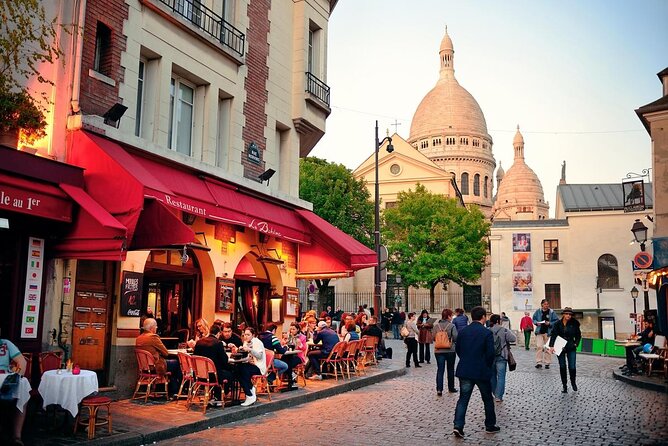
- The route connects Montmartre’s big sights: Sacré-Cœur, Place du Tertre, Moulin Rouge, and the neighborhood vineyards all play a part.
- The puzzles suit mixed-age groups: The challenges are approachable for children from age 8, but adults still have reason to think.
- No phone or download is needed: You receive a booklet, map, answer sheets, pen, clues, and cultural notes.
- The activity is self-guided: You walk independently, with assistance and hints available if a clue stops you.
- Allow the full three hours: Coffee breaks are welcome, but the clock keeps running.
- The price is $41.70 per person: That is reasonable for a private-feeling small-group activity, especially when several people share the fun.
Starting at Anvers with a mystery in hand
The meeting point is in the Anvers area, at 75018 Paris. This is a useful starting place because it puts you at the lower edge of Montmartre, where the streets begin to rise toward Sacré-Cœur and the character of the neighborhood changes as you walk.
You receive a game booklet containing riddles, a map, cultural anecdotes, answer sheets, and the basic materials you need. There is no app to install and no need to keep checking a phone screen. That matters in Montmartre, where the pleasure comes from noticing facades, signs, statues, church details, and small street scenes.
The format gives you a little more independence than a standard walking tour. You do not have to keep up with a group or wait while a guide explains every stop. At the same time, you are not left entirely on your own. Assistance is available during the game if a clue proves difficult, and hints can help you move forward without giving away the whole answer.
The activity is offered in English. The group size can reach 20 people, so it is worth understanding that self-guided does not always mean completely private. Families, couples, and small groups can play together, but the maximum size allows for a larger shared outing.
You can also read our reviews of more tours and experiences in Paris.



Sacré-Cœur and the first clues
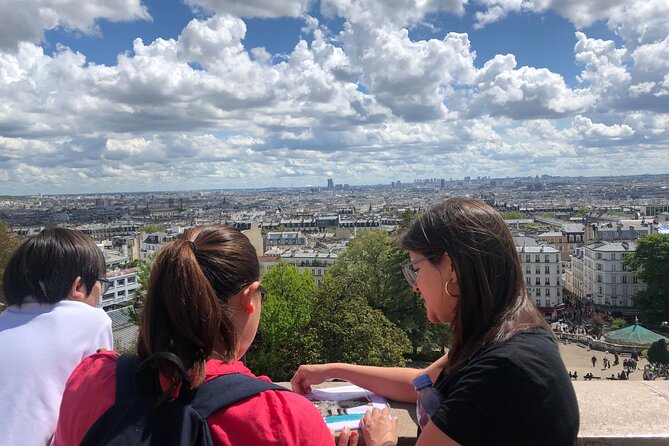
Sacré-Cœur is the obvious Montmartre landmark, but the treasure hunt uses it as more than a photo stop. Expect clues that ask you to observe your surroundings and connect what you see with the neighborhood’s story.
The church sits high above Paris, so this part of the route brings the walking challenge into focus. Montmartre is not difficult in the way a mountain hike is difficult, but it does involve slopes, stairs, and cobbled streets. Comfortable shoes are a practical choice, and the experience is better if you are ready to walk steadily for several hours.
The setting rewards patience. If you rush from one clue to the next, you may solve the puzzle but miss the small architectural details that make Montmartre special. The booklet’s cultural notes help turn those details into part of the game rather than background scenery.
I especially like this format for families with older children. A child who might tune out during a long explanation can instead search for a feature, test a guess, and help the group reach the next answer. The material is designed for children from age 8, and the challenges are described as easy enough for children to join while still giving adults something to discuss.
Place du Tertre and Montmartre’s artistic side
Place du Tertre is one of Montmartre’s most recognizable squares, closely tied to its image as an artists’ quarter. It can also be a busy, highly visited place, so the puzzle gives you a reason to look beyond the general crowd and focus on the details in front of you.
The clues draw on Montmartre’s artistic identity and the people connected with the area. This makes the square more than a quick stop for photographs. You get a sense of how the neighborhood’s artistic reputation fits into the wider story told along the route.
One useful feature is that the game is not built only around difficult logic problems. Some clues depend on observation. Others use reasoning or curiosity. That variety keeps the activity from feeling like a worksheet, and it lets different people in your group contribute in different ways.
If one person is good at puzzles but another notices visual details quickly, both have a role. That is one reason this experience can work well for families or couples with different interests. It is also less intense than an escape-style game. One piece of feedback specifically compared this Montmartre route with a harder Madeleine investigation and found Montmartre more suitable for children.
St. Jean de Montmartre, a worthwhile extra stop
The route passes the art nouveau church of St. Jean de Montmartre. This is an important practical tip: do not treat every clue location as a place to glance at and leave. Give yourself a few minutes to look inside if the church is open and your timing allows it.
St. Jean de Montmartre adds variety to the route. You are not moving only between the district’s famous tourist sights. The church gives the investigation a quieter architectural stop, and its art nouveau design helps show another side of Montmartre.
Because the activity has a time limit, you should decide in advance how much sightseeing you want to add. The game can guide you through the area, but it cannot provide unlimited time for museums, churches, cafés, or browsing. A short visit fits comfortably better than an unplanned long break.
This is where the self-guided format is both useful and limiting. You can choose to pause, but nobody is adjusting the schedule for you. If you spend too long at one stop, you may need to solve later clues more quickly.
Vineyards and quieter Montmartre
Montmartre’s vineyards are among the route’s more distinctive stops. They help move the experience away from the standard sequence of Sacré-Cœur, Place du Tertre, and a view over Paris.
The vineyards connect the neighborhood to its older village character. Montmartre was not always simply a hilltop district folded into a major city. The vineyard stop gives the game a chance to show that local identity through a physical place, not just a paragraph in the booklet.
You may find this part of the route especially valuable if you have already visited Montmartre before. The clues appear designed to lead you through parts of the neighborhood you might otherwise pass without noticing. One participant who already lived in Paris found that the route provided a fuller sense of the area than earlier visits had offered.
That is a strong argument for booking this as a second look at Montmartre rather than only as a first-time introduction. The activity helps organize the neighborhood in your mind: famous church, artists’ square, smaller architectural details, vineyards, cabaret culture, and the streets linking them together.





Following the story toward Moulin Rouge
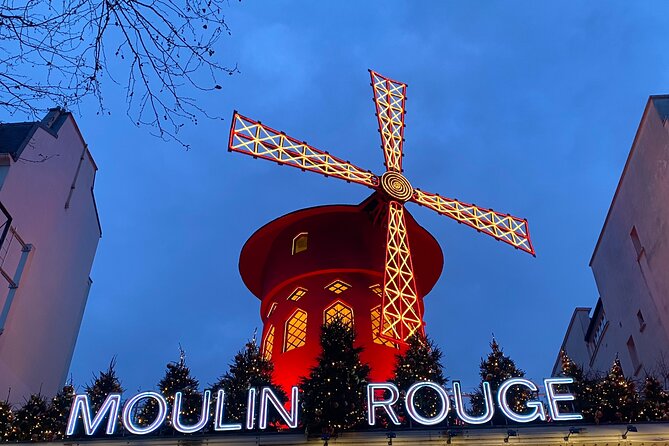
The investigation finishes at the Moulin Rouge, one of Montmartre’s best-known cabaret landmarks. The ending gives the game a clear destination and ties the clues to the neighborhood’s theatrical and artistic character.
The Moulin Rouge is a fitting final point because it represents a different side of Montmartre from Sacré-Cœur and the vineyards. The route begins with the hill and its religious landmark, passes through art and local streets, then concludes with cabaret history and performance.
The ending includes the resolution of the investigation and more stories about the neighborhood. This gives the activity a proper payoff rather than letting it fade out after the last riddle.
There is one logistical detail worth checking before you set out. The experience information describes the investigation as ending at the Moulin Rouge, while the meeting-point details also say the activity ends back at the meeting point. Since those statements do not fully match, confirm the exact finish arrangements with From Paris With Fun when booking. That is especially important if you have a dinner reservation, theater ticket, or transport plan afterward.
How the puzzles feel for adults and children
The game is best understood as a cultural walk with puzzles, not as a high-pressure escape room. Some riddles ask you to inspect something in the street. Others require logic, and some reward curiosity about a local story.
The clues are described as complicated enough to keep adults involved without shutting children out. A group with children aged 10 and 13 found that the young players were not bored, while a family outing with children aged 10 and 5 was also described as enjoyable. The official age guidance is 8 and up, so families with younger children should expect the adults to handle more of the reading and reasoning.
I would choose this over a standard guided tour if your group enjoys working together. You will need to talk, compare ideas, and sometimes accept that the first answer is wrong. That shared process is much of the appeal.
I would not choose it if you want a smooth stream of expert commentary with no decisions to make. The activity asks you to participate. If your ideal sightseeing day involves sitting back while someone else handles the route and explanations, a traditional guided walk may suit you better.
Three hours, a coffee break, and the time limit
Plan on about three hours for the game. It automatically ends after three hours and 30 minutes, wherever you are, so the extra half hour is a firm outer limit rather than an invitation to take your time all afternoon.
You can stop for coffee, which is sensible in Montmartre. Just remember that the game clock does not stop. A short café break should be manageable, but a long meal or extended shopping stop could leave you without enough time to finish the clues.
I would schedule this when your day has room around it. Avoid placing a fixed appointment immediately afterward unless you have confirmed the finish point and allowed extra time. Montmartre’s streets can slow you down, and a puzzle that seems simple may take longer when your whole group is debating the answer.
The activity can take place in any weather according to the description, but the cancellation terms also say it requires good weather. If poor weather causes a cancellation, you will be offered another date or a full refund. Either way, check the status before heading across Paris on a rainy day.
What $41.70 per person gets you
At $41.70 per person, this is not the cheapest way to walk around Montmartre. You can see Sacré-Cœur and Place du Tertre without paying for an activity. The value comes from the structure, the prepared cultural material, and the fact that the neighborhood becomes an interactive game rather than a series of disconnected sights.
The price makes more sense for a family or small group that will use the booklet together. You are paying for a shared activity, not simply admission to a landmark. The included map, answer sheets, pen, riddles, and anecdotes also mean there are no extra equipment costs.
It is a better value if you like independent sightseeing but want more direction than a guidebook provides. It is less compelling if your main goal is a detailed lecture about every church, artist, and street. The activity gives you information in small portions, attached to things you are actively looking at.
With a perfect rating from six pieces of feedback, the experience has received very strong early approval. That is encouraging, but the sample is small, so I would put more weight on the clear pattern in the comments: people liked the route, the well-written clues, the cultural detail, the friendly support from Marion, and the way children could take part.
Who should book this Montmartre activity?
I would recommend it to families with children aged 8 and up, couples who enjoy playful sightseeing, and small groups looking for an alternative to a standard walking tour. It also suits people who have visited Montmartre before and want a new route through familiar territory.
The experience is particularly good for mixed-age groups. One person can read, another can search for a visual clue, and someone else can work out the logic. You do not need every participant to be a serious puzzle fan.
I would think twice if you have limited mobility, dislike uphill walking, or want a completely flexible afternoon. Moderate physical fitness is required, and the time limit means you cannot treat the hunt as a loose suggestion.
Free cancellation is available if you cancel at least 24 hours before the start time. Last-minute cancellations and changes are not accepted for a refund. The activity also needs a minimum number of participants, so a cancellation for that reason offers a different date or experience, or a full refund.
Should you book the Montmartre Treasure Hunt?
Book it if you want to explore Montmartre by doing rather than simply looking. The route combines the big landmarks with less obvious stops, and the riddles give children and adults a shared reason to pay attention.
The strongest part is the balance. It is cultural enough to teach you something, but light enough to keep a family afternoon moving. Marion and the From Paris With Fun team also provide help when a clue becomes a roadblock, so you are not abandoned with a frustrating puzzle.
Skip it if you prefer a guide-led tour, need a fully open schedule, or plan to spend long stretches inside churches and cafés. For everyone else, $41.70 buys a well-organized three-hour way to see Montmartre with a little more curiosity, cooperation, and purpose.
FAQ
How long does the Montmartre Treasure Hunt last?
The game lasts around three hours and automatically ends after three hours and 30 minutes, wherever you are.
Where does the activity start?
The listed starting point is Anvers, 75018 Paris, France.
Where does the activity finish?
The route description says the investigation ends at the Moulin Rouge, while the meeting-point information says the activity ends back at the meeting point. Confirm the exact finish arrangements before booking.
Is the activity guided?
No. It is self-guided and includes a booklet with riddles, a map, answer sheets, cultural anecdotes, and the materials needed to play.
Is a mobile app required?
No. You do not need an app, downloads, or a phone-based game to take part.
What language is offered?
The activity is offered in English.
What age is suitable for the treasure hunt?
The experience is suitable for children aged 8 and up, as well as couples and families.
How many people can join?
The activity has a maximum of 20 participants.
What happens if I need help with a clue?
Assistance is available throughout the game, and you can request a hint if a clue is difficult.
Can I cancel for a refund?
Yes. You can cancel at least 24 hours before the experience start time for a full refund. Cancellations or changes made less than 24 hours before the start time are not accepted for a refund.