REVIEW · ROUEN
Guided Tour of the Historic Center of Rouen
Book on Viator →Operated by Elodie Guide Local · Bookable on Viator
Rouen comes alive in 90 minutes. This guided stroll through the historic center of Rouen is built for first-timers who want context fast, with frequent photo stops and an English-speaking guide. I especially like the small-group feel (up to 16) and the way the guide turns monuments into stories you can actually remember.
One heads-up: this tour is a look-from-the-street style experience. You won’t go inside the monuments, so if you’re craving ticketed interiors, plan that separately.
In This Review
- Key Highlights You’ll Feel Right Away
- Why This Rouen Historic-Center Walk Works
- Price and What You Get for $28.96
- Starting at 4 Pl. de la Pucelle: A Meeting Point That Sets You Up
- Stop 1: Place du Vieux-Marche and Joan of Arc’s Last Moments
- Stop 2: Palais de Justice—Civic Power and Construction Secrets
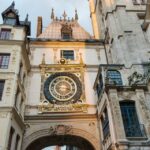
- Stop 3: Gros-Horloge—Walk Under the Big Clock
- Stop 4: Rouen Cathedral Forecourt and the “Four Centuries” Perspective
- Stop 5: Eglise Saint-Maclou and What Life Felt Like
- Stop 6: Aitre Saint-Maclou—Funerals Becoming a Place of Life
- Stop 7: Abbatiale Saint-Ouen and the Monk Legend
- How the Guide Keeps It Interesting Without Overloading You
- What You Should Watch For on Your Walk
- Weather, Pace, and Who This Tour Fits Best
- Should You Book This Guided Tour of Rouen’s Historic Center?
- FAQ
- How long is the guided tour of Rouen’s historic center?
- Is the tour offered in English?
- Where does the tour start and end?
- Do you enter the monuments during the tour?
- How big is the group?
- Is there a mobile ticket?
- What happens if weather is bad or I cancel?
Key Highlights You’ll Feel Right Away
- A tight 90-minute route that covers major Rouen landmarks without dragging
- English guide with Q&A time, so you’re not stuck guessing what you’re seeing
- Photo stops built into the walk (great for your first day in town)
- Joan of Arc stop at Place du Vieux-Marche, right at the historic square area
- Gros-Horloge and Rouen Cathedral views that help you orient the city fast
- A small group pace that makes the anecdotes land instead of rush past
Why This Rouen Historic-Center Walk Works
If you’ve got limited time, Rouen can feel like a puzzle: towers, clocks, half-timbered streets, and big cathedral shapes that look different from every corner. This tour helps you put the pieces together in a simple order. You start with the most dramatic story setting, then move through the city’s civic and clock landmarks, and finish with church stops that show how Rouen’s religious life shaped the neighborhoods.
The best part is that you’re not just “seeing sights.” You’re getting the why behind the walls—construction history, symbolic details, and the local stories that explain why certain buildings matter. That matters because Rouen’s center is so photo-friendly that it’s easy to look, snap, and move on. This kind of guided flow gives you something to carry forward when you wander later.
Also, the route is designed for quick orientation. By the end, you’ll understand where the big monuments sit relative to each other, which makes your self-guided time afterward feel easier.
You can also read our reviews of more guided tours in Rouen



Price and What You Get for $28.96
At about $28.96 per person for roughly 1 hour 30 minutes, the value comes from interpretation, not from paid entry. The tour includes the guide’s historical anecdotes and a good, upbeat pace, but it does not plan to enter the monuments. Translation: you’re paying for smart storytelling and an efficient route.
That’s a good deal if you want:
- context for the major sights
- an easy plan for your first morning in Rouen
- a guide to point out details you’d likely miss on your own
It’s less ideal if your top goal is walking into churches or palaces for the interior experience. Since entry isn’t part of the plan, you may want to budget separately if you decide to return later.
Starting at 4 Pl. de la Pucelle: A Meeting Point That Sets You Up
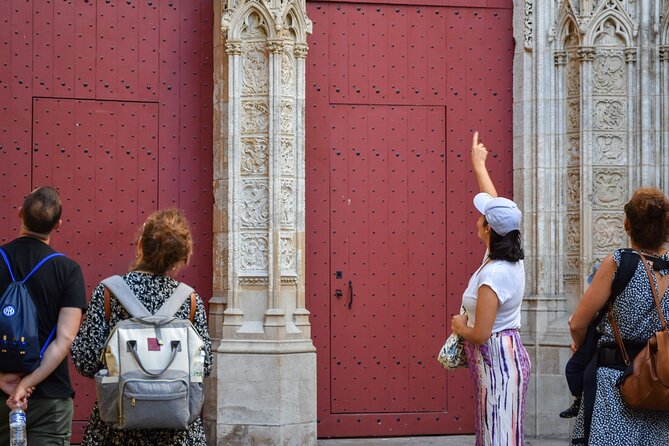
The tour starts at 4 Pl. de la Pucelle, in Rouen’s 76000 area. The start time is 10:30 am, which is helpful because it’s not too early and you still get plenty of daylight for photos. If you’re arriving by public transportation, you’re also in a spot that’s described as being near transit.
I like meeting points like this for one reason: you can usually find your bearings fast. And the tour ends near Saint-Ouen Abbey Church, close to Rouen City Hall—the kind of location that’s convenient if you want to keep exploring on foot right after.
Stop 1: Place du Vieux-Marche and Joan of Arc’s Last Moments
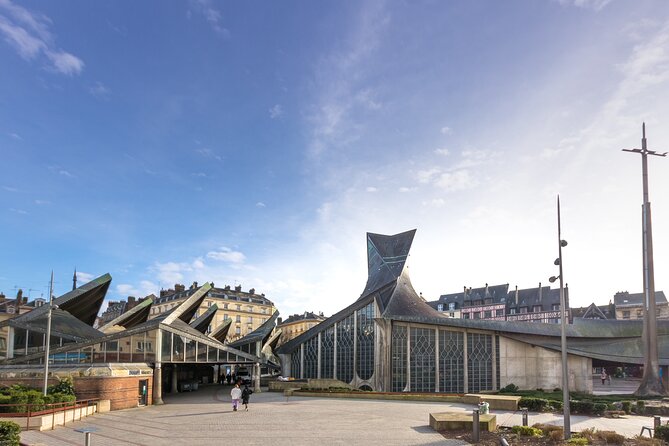
You begin at Place du Vieux-Marche, where the story of Joan of Arc is tied to the square area—specifically around the Joan of Arc stake and the church dedicated to her. This stop is short, so you’ll want to come with at least a basic sense of who Joan of Arc was and why Rouen matters in her story.
Even if you don’t go deep into the details, this location has a strong emotional pull. It also gives you a mental timeline anchor for the rest of the walk. After this, the rest of Rouen’s monuments start to feel connected—civic power, religious power, and the streets between them.
Practical note: this stop indicates admission ticket free, so you’re not juggling extra purchases just to get oriented at the beginning. Use the time to photograph the square area, then listen for how the guide frames the events.
Stop 2: Palais de Justice—Civic Power and Construction Secrets
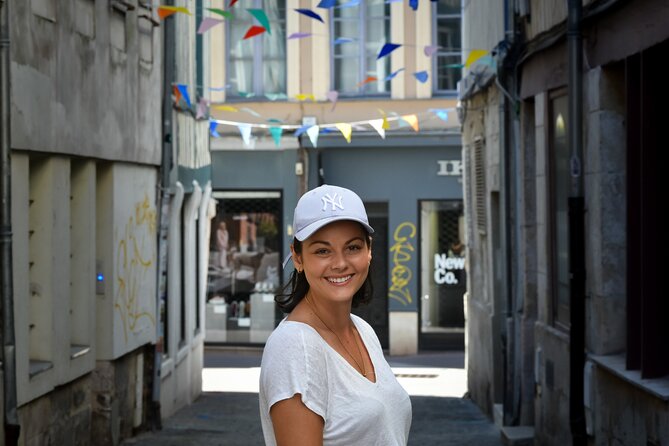
Next up is the Palais de Justice. You’ll admire the Rouen palace building and hear what the guide highlights about its history of construction and the “secrets” tied to the site.
Why this stop works: it shows that Rouen’s center isn’t only about churches. Civic buildings, courts, and power structures shaped the city just as much as religious institutions did. If you’ve been thinking of Rouen as mainly gothic-cathedral country, this is the quick reality check.
This is also a good moment to look for architectural cues—how the building’s massing and style communicate authority. Because you’re not entering, focus on exterior details and the way the guide points out what to notice.
You can also read our reviews of more historical tours in Rouen

Stop 3: Gros-Horloge—Walk Under the Big Clock
Then you reach Gros-Horloge, the famous large clock you pass under. This stop is built for a fun “you can’t miss it” moment. The guide helps you go back in time and read the symbols and meaning associated with the clock.
This is where Rouen’s identity becomes really tangible. A clock like this isn’t only about keeping time—it’s part of how the city displayed knowledge, order, and daily rhythm. It’s also a natural photo stop because you get that classic arch view with the monument dominating the frame.
One tip: keep your phone/camera ready before you arrive under the arch. You’ll likely have a narrow window to photograph clean angles before moving on.
Stop 4: Rouen Cathedral Forecourt and the “Four Centuries” Perspective
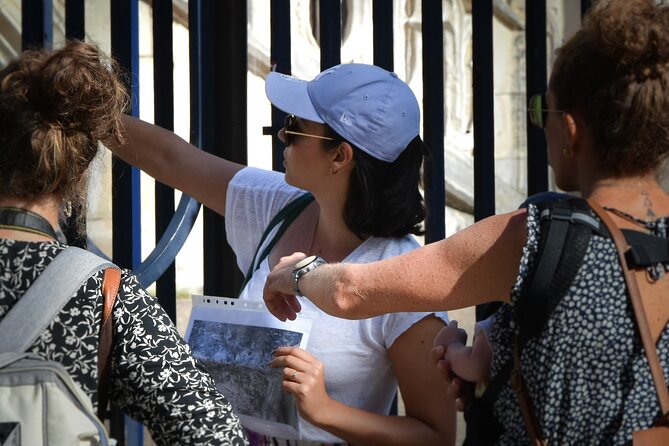
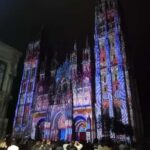
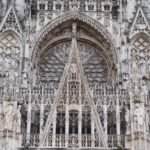
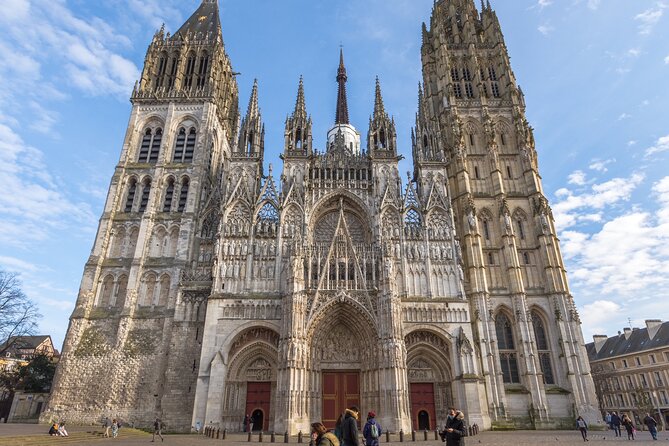
After the clock, the route brings you to Cathedrale Notre-Dame de Rouen. You’ll pause on the forecourt, where you can admire the cathedral’s architecture and get a sense of its long building story—highlighted as four centuries of construction.
This part is especially valuable for first-timers. Cathedral exteriors can look like one uniform style until someone gives you the timeline. When you understand the “why it looks like that” story, you’ll see the differences with your own eyes the next time you’re near the building.
The guide also mentions the “impressionist” connection. Even if you’re not an art history person, this helps you see why Rouen Cathedral became a subject for artists. It’s a cue that the building isn’t just ancient—it also influenced how people later looked at light and form.
No monument entry is planned here, so treat it as a powerful exterior stop for scale and perspective.
Stop 5: Eglise Saint-Maclou and What Life Felt Like
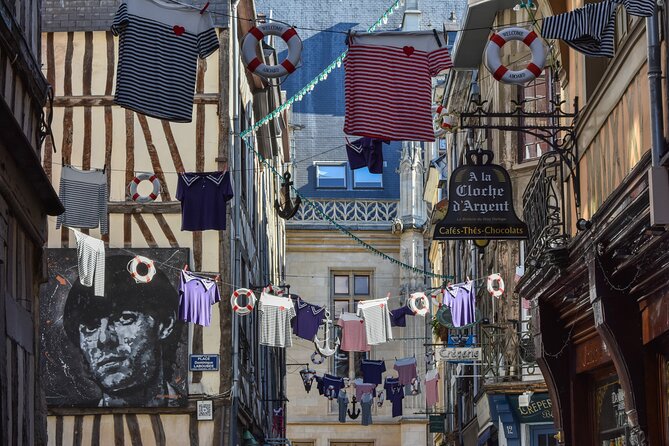
Next is Eglise Saint Maclou, where the focus shifts toward living conditions in the Middle Ages. This is the stop where the tour moves from buildings-as-objects to buildings-as-context.
The church area helps you imagine what everyday life might have been like in Rouen: closer routines, harder realities, and a city that shaped people through its institutions. The guide’s job here is to turn “historic” into “understandable.”
A quick caution: since this stop is short and you’re not going inside, don’t expect a deep interior look. Instead, pay attention to the guide’s explanation and the exterior cues that relate to the theme of daily life.
Stop 6: Aitre Saint-Maclou—Funerals Becoming a Place of Life
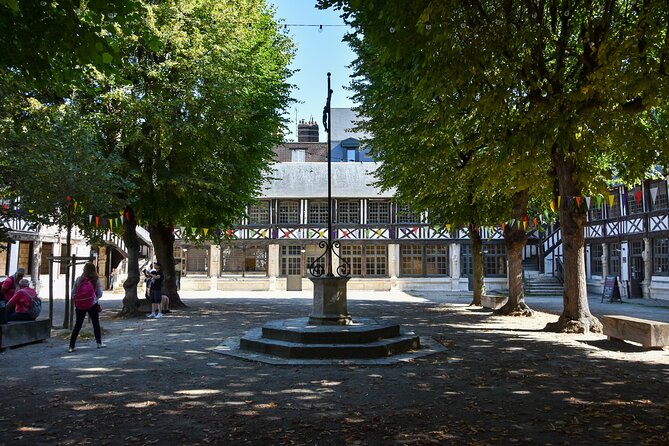
You then reach Aitre Saint-Maclou, tied to the idea that funeral activity gave way to a real place of life. It’s a shorter stop, but it’s a distinctive one because it shows how urban spaces can evolve based on how communities use them.
This is the kind of stop I appreciate because it’s not the biggest, loudest monument. It’s the “in-between” story—how Rouen worked, lived, and changed over time. If you like getting a city’s pulse, this is a good moment.
This stop indicates free admission, so there’s no extra cost pressure. Bring your attention instead of your wallet.
Stop 7: Abbatiale Saint-Ouen and the Monk Legend
The walk finishes at Saint-Ouen Abbey Church (the abbatial church area), with a highlight on the legend of the monk associated with the Abbey of Saint Ouen.
This ending works well because it blends atmosphere with storytelling. You get a final theme-shift: from civic and everyday imagery back into religious architecture, but with a narrative hook (the monk legend) to keep it lively.
The tour ends near Rouen City Hall and is described as about 5 minutes on foot to reach the historic center after the tour ends. So you’re not stranded at the edge of nowhere—you’re positioned where it’s easy to keep wandering.
How the Guide Keeps It Interesting Without Overloading You
A big reason this tour scores so well is pacing. You get short stops—often around 5–10 minutes each—so you’re not trapped in one location. That helps you move through the city and still come away with a clear sense of the main sights.
The English experience also matters. The guide is described as fluent and engaging, and the tour format gives you time to ask questions rather than hearing a monologue and sprinting away. That interactive style helps you fill gaps as they come up—like why one building looks the way it does or what a symbol might refer to.
You’ll also likely appreciate the way the guide gives chronological context. That helps when you’re bouncing between Joan of Arc-era stories, medieval church areas, and later architectural developments. With that framing, your photos won’t just be images—they’ll be bookmarks for what you learned.
What You Should Watch For on Your Walk
Because you’re not entering monuments, the main “game” is noticing details at the exterior stops. Here’s how I’d approach it:
- Arrive with one question per stop. For example: What changed here over time? Why does the location matter?
- Use the photo stops strategically. Don’t shoot everything blindly; pause, listen, then shoot with the story in mind.
- Keep your walking energy steady. The total time is about 1.5 hours, and the route covers several central sites, so comfy shoes help more than you might expect.
The best tours make the city feel simpler afterward, and this one is set up to do that.
Weather, Pace, and Who This Tour Fits Best
This experience is said to require good weather. If weather is poor, you’ll be offered a different date or a full refund. For planning, think of this as a morning walk that works best when the streets are dry and visibility is good for exterior viewpoints.
Group size is capped at 16 travelers, which is a sweet spot. You still feel like you’re part of a group, but it doesn’t turn into a herd. The pace is also a good match for people who want to see plenty of Rouen without spending half a day.
This tour suits you if:
- it’s your first time in Rouen
- you want the “main sights plus meaning” combo
- you’re traveling with mixed interests (architecture, art connections, and stories)
- you like walking tours with an efficient route
It might not fit if:
- you only want monument interiors
- you’re hoping for a long museum-style experience
- you want to stop and linger at each site for a deep self-guided visit
Should You Book This Guided Tour of Rouen’s Historic Center?
If you’re planning just one efficient slice of Rouen, I’d book this. The route hits the big, recognizable landmarks—Place du Vieux-Marche, Gros-Horloge, Notre-Dame de Rouen, and Saint-Ouen Abbey Church—while also giving you context that helps your photos and memories make sense later.
But if your ideal Rouen day is mostly about entering buildings and spending lots of time inside, treat this as your orientation layer, then add separate tickets for the interiors you care about most.
For most first-timers, the structure is the win: you get a focused route, English guidance, and a story-driven walk that sets you up to explore with confidence.
FAQ
How long is the guided tour of Rouen’s historic center?
The tour lasts about 1 hour 30 minutes.
Is the tour offered in English?
Yes, it is offered in English.
Where does the tour start and end?
It starts at 4 Pl. de la Pucelle, 76000 Rouen and ends near Saint-Ouen Abbey Church, at Pl. du Général de Gaulle, 76000 Rouen.
Do you enter the monuments during the tour?
No. The tour does not plan to enter the monuments, though you will stop to view and learn about them.
How big is the group?
The tour has a maximum of 16 travelers.
Is there a mobile ticket?
Yes. The tour includes a mobile ticket.
What happens if weather is bad or I cancel?
The experience requires good weather. If it’s canceled due to poor weather, you’ll be offered a different date or a full refund. You can also cancel for a full refund up to 24 hours before the start time.