
REVIEW · ARRAS
Full-Day Canadian WW1 Vimy and Somme Battlefield Tour from Arras
Book on Viator →Operated by Ploegsteert Sector Battlefield Experience · Bookable on Viator
The most powerful part of this private Canadian battlefield tour is the shift from grand memorials to the ground where soldiers actually fought. At Vimy Ridge, you can look across the Douai plain, enter the Grange Tunnel, walk beside preserved trenches, and then follow the front south toward the Somme.
I like the private vehicle and personal guide, which let you ask questions and spend more time where your interests lie. I also like that lunch and hotel pickup are included. The main drawback is the price, $612.81 per person, and the long nine-hour day, though the cost makes more sense for a small group sharing the private service.
In This Review
- Key points to know before booking
- Why a private Vimy and Somme tour works so well
- Vimy Ridge begins underground
- Cabaret Rouge and the unknown soldier
- Courcelette brings the Canadian story south
- Thiepval and 72,000 missing soldiers
- Lochnagar Crater reveals the force of the first day
- Beaumont-Hamel and the Newfoundland Caribou
- Claude Verhaeghe, Lucas, and the guide experience
- The price, lunch, and private transport
- Who will get the most from this day
- Should you book the Vimy and Somme tour?
- FAQ
- Where does the tour begin?
- How long does the tour last?
- Is this a private tour?
- How many adults are required to book?
- Is hotel pickup included?
- Is transportation included?
- Is lunch included?
- Is the tour offered in English?
- Which sites are visited?
- Can I cancel for a refund?
Key points to know before booking
- The Grange Tunnel puts you below Vimy Ridge, close to the cramped position where Canadian troops waited before the attack.
- The Canadian National Vimy Memorial is only one part of the visit, which also includes a cemetery, trenches, and the visitor centre.
- The Somme portion covers major sites in a compact day, including Courcelette, Thiepval, Lochnagar Crater, and Beaumont-Hamel.
- Claude Verhaeghe is praised for clear explanations and careful organization, while Lucas is also named as a guide for this experience.
- Lunch, transport, and hotel pickup and drop-off are included, so you do not need to build the day around trains or battlefield driving.
- This is best for people who want context, not just a quick photo stop at a famous monument.
Why a private Vimy and Somme tour works so well
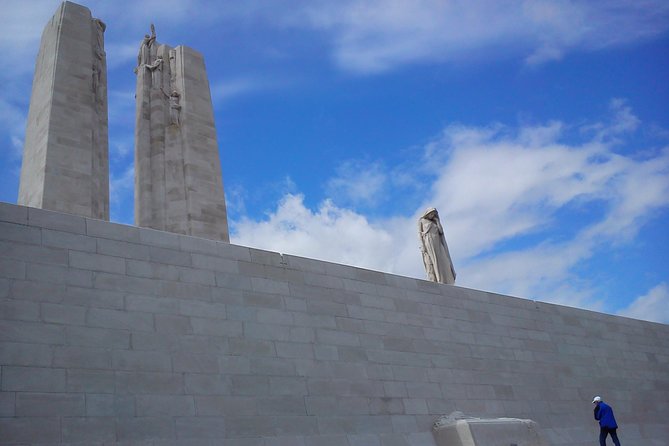
The Canadian National Vimy Memorial is famous for its scale, but the memorial alone cannot explain the battle. The useful part of this outing is the combination of places around it. You see the memorial, then move to the tunnel, cemetery, trenches, and ridge itself. Each stop adds something different.
I find that especially valuable at battlefield sites. A monument can feel remote if you only read a plaque and take a photograph. Here, your guide can connect the land, the military plan, the names, and the human cost. Several hours at Vimy also gives you time to ask about the battle rather than receiving a rushed speech before the vehicle moves on.
The private format matters. Only your group takes part, and the guide can respond to your questions about Canadian units, the front lines, the memorials, or the wider Battle of Arras and Somme campaigns. That is a better setup than a large coach tour if you want a clear explanation of why each site matters.
The tour runs for about nine hours, beginning at 9:00 a.m. It is a full day, not a casual half-day outing. You will cover several sites, walk outdoors, and move between locations by vehicle. Wear practical shoes and bring clothing suited to changing weather, since important parts of the day take place outside.
A few more Arras tours and experiences worth a look

Vimy Ridge begins underground
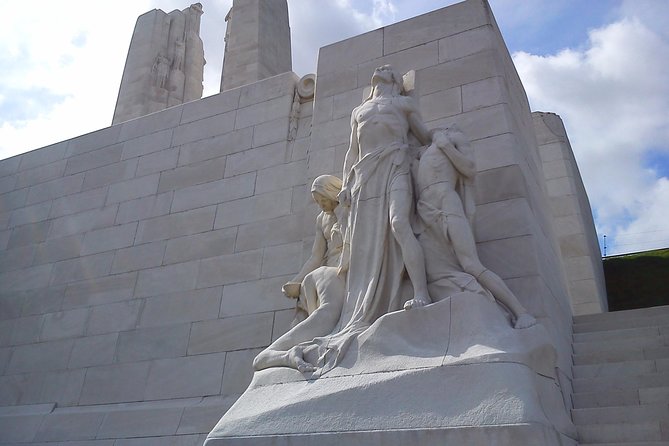
The Canadian National Vimy Memorial receives the largest share of the day, about three hours, and rightly so. You begin near the memorial with a view across the Douai plain. That broad view helps you understand why the ridge mattered. It was not simply a place chosen for a monument. Its height gave military importance to the ground.
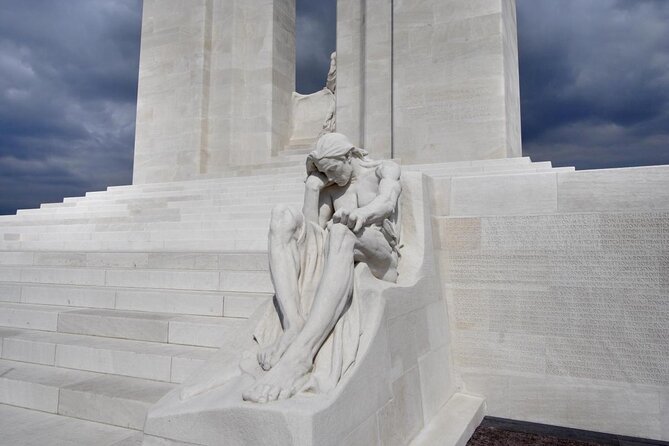
The memorial itself is the visual centre of the visit, but the surrounding area gives it meaning. You spend time at one of the cemeteries on the ridge, see preserved trenches, and visit the newly built visitor centre. These pieces make the stop more than a monument visit.
The Grange Tunnel is one of the most memorable elements. You enter one of the tunnels used by Canadian troops before the battle, where soldiers waited underground for hours. The space helps you picture the physical conditions before an attack: enclosed, tense, and far removed from the open view near the memorial.
Do not expect the tunnel to feel like a polished museum attraction. Its value comes from its direct connection to the battle. Your guide can explain how the underground passages fit into the preparations, while you experience the confined setting for yourself.
The Vimy site is also where the Canadian focus is strongest. If your interest is family history, Canadian military history, or the way Canada’s role is remembered overseas, this is likely to be the emotional centre of the day. The memorial honours the dead, while the cemetery and trenches bring you back to individual lives and military conditions.
The visitor centre adds another layer, and one useful detail is that staff there include Canadian university students from across the country. That connection can make the site feel less distant for Canadian visitors, though the tour remains in English.
Cabaret Rouge and the unknown soldier
The stop at Cabaret Rouge Cemetery lasts about 30 minutes. You see the place connected with the exhumation of the Canadian Unknown Soldier.
It is a brief visit, but it carries a particular weight. The Unknown Soldier represents thousands of men whose identities were lost in the war. Visiting the cemetery where the Canadian soldier was exhumed gives a concrete location to a national symbol.
This is not a long walking stop, so it works well within a busy day. You will not have the same amount of time here as at Vimy, and that is appropriate. The cemetery is a focused pause between the ridge and the Somme sites.
Courcelette brings the Canadian story south
At the Courcelette Canadian Memorial, you spend about 30 minutes on the battlefield where Canadian forces fought during the fall of 1916. This stop helps broaden the story beyond Vimy Ridge.
Vimy is often treated as the defining Canadian battlefield in France, but the Canadian experience did not begin or end there. Courcelette places Canadian action within the Somme fighting. A private guide can explain the different phases and front lines, which is important because the names and dates can blur together during a full day of military history.
The short visit is enough to orient you, but it is not designed for a long independent exploration. If you want to study one unit, trace a relative, or spend time with battlefield maps, tell your guide early. The private format gives you a better chance of shaping the discussion around those interests.
Thiepval and 72,000 missing soldiers
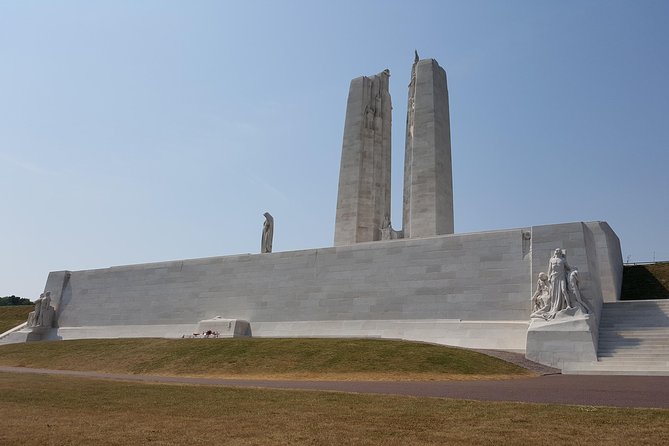
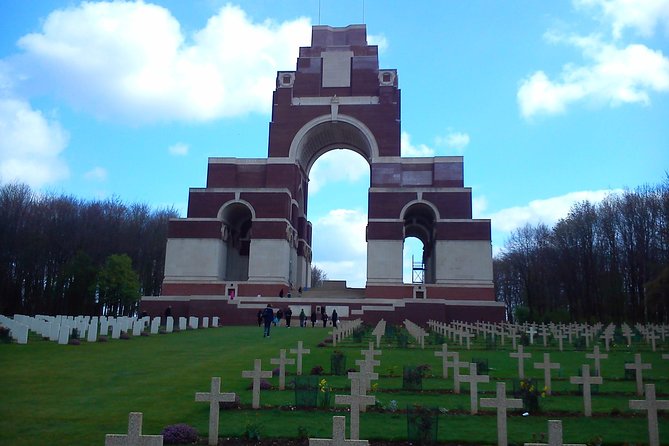
The Memorial de Thiepval is one of the day’s largest and most imposing stops. Built by the Commonwealth War Graves Commission, it carries the names of about 72,000 soldiers who have no known grave.
The scale can be difficult to take in. A cemetery gives you rows of individual graves. Thiepval presents an enormous number of names in one place, reminding you how many bodies were never identified or recovered. I find that contrast important. The memorial is less about one dramatic story and more about the sheer number of missing men.
You have about an hour here, enough time to take in the structure and listen to the explanation without being hurried. The guide’s role matters because a list of names can otherwise become visually overwhelming. With historical context, the memorial becomes easier to understand as part of the Somme campaign rather than an isolated monument.
Thiepval also marks a change in tone from Vimy. At Vimy, the Canadian national story is central. At Thiepval, the focus is broader, with the memorial reflecting the enormous Commonwealth losses of the Somme.



Lochnagar Crater reveals the force of the first day
The Lochnagar Crater is a 30-minute stop. It was created by an underground explosion triggered on the morning of July 1, 1916.
The crater gives you a physical sense of the opening violence of the Somme. Unlike a memorial wall, it is a visible scar in the ground. You can look at the hollow and imagine the force required to reshape the earth before the infantry attack.
This is a short stop, but it adds variety to the day. You move from memorials and cemeteries to a battlefield feature created by military engineering. Your guide can place the explosion within the events of the first day of the Somme, helping you understand why the crater remains such a significant site.
The visit is not a full museum experience, so set your expectations accordingly. Its strength is the site itself and the explanation around it. If you want a long period for reflection or photography, the schedule may feel tight.
Beaumont-Hamel and the Newfoundland Caribou
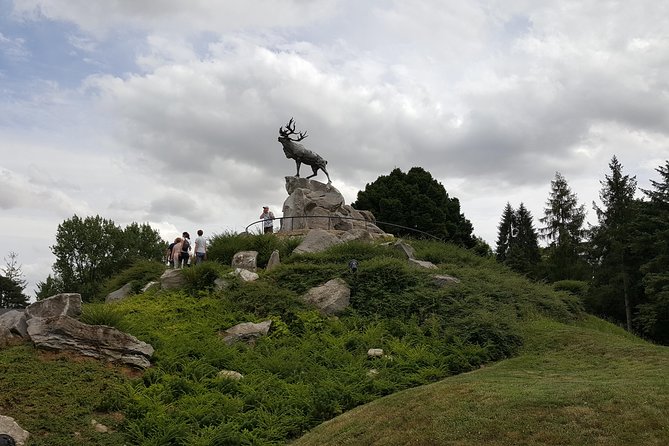
The Memorial Terre-Neuvien de Beaumont-Hamel receives about an hour and is one of the most affecting parts of the Somme section. You stand near the Caribou memorial and walk across preserved battlefield ground from the Allied side toward the German lines.
The route passes near the Danger Tree, Y Ravine, and the memorial to the 51st Highland Division. You also have time to look at the Newfoundland visitor centre. This makes Beaumont-Hamel more active than a simple roadside monument stop. You walk through the terrain and see how the battlefield is organized in space.
The Newfoundland connection gives the site a clear human focus. The Caribou memorial represents the tragic story of the Newfoundland Regiment, and the preserved ground helps you understand the distance between opposing positions. You are not merely hearing that the fighting was difficult. You are seeing the ground over which men had to move.
I would pay close attention here, even if you are less familiar with Newfoundland history. The site connects a specific regiment to the wider Somme campaign, making the military story easier to follow.
The hour should allow a meaningful visit, but it will not cover every detail of the park. The private guide helps because you can ask for the background most relevant to you. If you prefer quiet reflection, say so. The site deserves time without constant commentary.
Claude Verhaeghe, Lucas, and the guide experience
The guide can make or break a battlefield tour. Names associated with this experience include Claude Verhaeghe and Lucas. Claude is described as responsive before the tour, punctual at pickup, pleasant, and good at handling timing and logistics.
The strongest quality is his ability to explain not only dates and facts but also the reasons behind the battles. That distinction matters. You will hear about phases of the war, changing front lines, and the context around Vimy and the Somme. The aim is to make the battlefield understandable rather than handing you a string of disconnected names.
Claude also appears comfortable adapting to personal interests. If you have family questions, a Canadian connection, or a need to understand the broader sequence of battles, raise it when booking or at the beginning of the day. The private format gives that conversation room.
Lucas is also identified as a guide and is described as personable, well organized, and able to communicate memorable facts and historical context. Since guide assignment can vary, it is sensible to confirm who will lead your tour if a particular guide matters to you.
The price, lunch, and private transport
At $612.81 per person, this is an expensive day for one person. The value improves when two or more adults share the booking, since the experience includes a private vehicle, guide, hotel pickup and drop-off, air conditioning, and lunch.
The private arrangement is the main reason to compare this with a cheaper group excursion. You are paying for direct attention, flexible conversation, and transport between sites. You are also avoiding the work of planning a route across several battlefield locations, finding parking, and keeping track of opening points.
Lunch is included, while alcoholic drinks are not. That keeps the day simple, though you should not read the lunch inclusion as a gourmet meal promise. The practical benefit is that you do not need to interrupt the route to arrange food.
Pickup and drop-off are offered at a train station only 50 minutes from Paris. This point deserves careful attention. The experience is based in Arras, but the stated pickup arrangement is not a general Paris hotel pickup. Confirm the exact station and meeting details before you book, especially if you are connecting from Paris.
You must book for at least two adults. Most people can participate, and service animals are allowed, but the day includes walking at outdoor battlefield sites. Anyone with mobility concerns should ask the provider what parts of the route are suitable before paying.
Who will get the most from this day
I would choose this tour if you want a serious introduction to Vimy and the Somme without driving yourself. It suits Canadians with a family or national connection, people studying the First World War, and visitors who want explanations that go beyond memorial inscriptions.
It also works well for a small group with mixed levels of interest. A private guide can answer detailed questions for one person while giving a clear overview to someone new to the subject. That is harder to manage on a large group outing.
I would hesitate if you want a slow, quiet day at only one location. Six stops in nine hours means the schedule is full. Vimy receives the most time, while several Somme sites receive 30 minutes to an hour. The tour gives you breadth and context, not a long independent study of each battlefield.
Plan for an emotionally serious day. The cemeteries, missing soldiers, underground waiting areas, and preserved front lines are not light sightseeing. The guide’s enthusiasm can make the history accessible, but the subject remains difficult.
You can cancel for a full refund up to 24 hours before the 9:00 a.m. start time. Changes or cancellations inside that window are not accepted for a refund, so check your transport plans first.
Should you book the Vimy and Somme tour?
Book it if you want one well-organized private day covering the major Canadian and Commonwealth sites around Arras and the Somme. The combination of Vimy’s tunnel and trenches, Cabaret Rouge, Courcelette, Thiepval, Lochnagar, and Beaumont-Hamel gives you a strong sense of both the personal and military story.
The cost is harder to justify for a solo visitor, but it is more reasonable for two or more adults sharing the private service. I would also book it if clear historical explanation matters to you. Claude Verhaeghe is praised for linking facts, battle phases, and front lines in a way that makes the ground easier to read.
Skip it if you want to spend an entire day at Vimy alone, or if a tightly scheduled nine-hour program sounds tiring. For everyone else, this is a focused and meaningful way to see the battlefields without reducing them to quick photo stops.
FAQ
Where does the tour begin?
The start time is 9:00 a.m. Pickup and drop-off are possible at a train station located 50 minutes from Paris.
How long does the tour last?
The tour lasts approximately nine hours.
Is this a private tour?
Yes. Only your group participates in the activity.
How many adults are required to book?
A minimum of two adults is required per booking.
Is hotel pickup included?
Hotel pickup and drop-off are included, with the stated pickup arrangement available at the specified train station.
Is transportation included?
Yes. The tour includes private transportation in an air-conditioned vehicle.
Is lunch included?
Yes. A light lunch is provided. Alcoholic drinks are not included.
Is the tour offered in English?
Yes. The experience is offered in English.
Which sites are visited?
The route includes the Canadian National Vimy Memorial, Cabaret Rouge Cemetery, Courcelette Canadian Memorial, the Thiepval Memorial, Lochnagar Crater, and Newfoundland Memorial Park at Beaumont-Hamel.
Can I cancel for a refund?
You can cancel at least 24 hours before the experience begins for a full refund. Cancellations or changes made less than 24 hours before the start time are not accepted for a refund.


