REVIEW · PARIS
Seine River Evening Cruise with Music (Drink Options)
Book on Viator →Operated by Vedettes de Paris · Bookable on Viator
Paris at night is best seen slowly.
This Seine evening cruise is a simple, scenic way to take in major landmarks with a built-in music soundtrack and optional history via a phone audio guide. I like that it’s only about an hour, so it fits neatly into a first-night plan, and I also like that you’re on a 100% electric boat. The main drawback to keep in mind: it’s not a guided “talking tour,” so if you want someone narrating every bridge and building, you’ll be happier choosing the daytime guided version.
In practice, this experience is all about atmosphere—night lights bouncing off the water, bridges sliding past your windows, and a playlist setting the mood. You can download the Vedettes de Paris app before you go, but headphones are not provided, and the music can make the audio guide harder to hear for some people.
Value-wise, at about $27.71 per person for the cruise, it can feel like a bargain—especially compared with pricier “landmark dinner” plans. But if you buy the drink upgrade, know it’s handled at the bar (no table service), and your cruise window is short enough that you’ll likely be sipping while you’re still on the move.
In This Review
- Key things to know before you board
- What the Seine River evening cruise feels like on board
- Drink options: when wine or Champagne makes sense
- Your hour on the Seine: landmark-by-landmark route highlights
- Eiffel Tower area: built to impress, then to last
- Russian Orthodox Holy Trinity Cathedral and an American church with Tiffany glass
- Invalides: Napoleon’s tomb from the river view
- Pont Alexandre III: gold-leaf drama and the Franco-Russian story
- Pont de la Concorde: Bastille stones and Revolution symbolism
- Hotel de Salm / Legion d’honneur: architecture with a national badge
- Orsay station: an old railway shell turned art museum
- Pont Neuf: the oldest stone bridge and its 381 unique masks
- Pont Saint-Michel: Napoleon III’s imperial Ns and the Latin Quarter
- Île de la Cité and Notre-Dame: the cathedral’s long build story
- Île Saint-Louis: 17th-century elegance and famous residents
- Hôtel de Ville and the Conciergerie: civic power and prison history
- Louvre area and Place de la Concorde: royal palace to museum to execution square
- Grand Palais, Liberty Flame, and Palais de Chaillot
- Best seats, timing, and using the audio guide without frustration
- Is this the right evening cruise for your trip style?
- Should you book this Seine River evening cruise?
- FAQ
- How long is the Seine River evening cruise?
- Is there a guide on board?
- Are headphones provided for the audio guide?
- What languages are available for the audio guide?
- Can I get wine or Champagne during the cruise?
- Where does the cruise start?
- What if the weather is bad?
Key things to know before you board
- It’s a relaxing music-focused cruise, not a live guided tour
- Audio guide works on your phone, but bring your own headphones for better clarity
- Top-deck seating is limited, so arrive early if you care about views
- Optional wine or Champagne is collected at the bar, with no table service
- A 1-hour ride means timing matters for Eiffel Tower sparkle moments
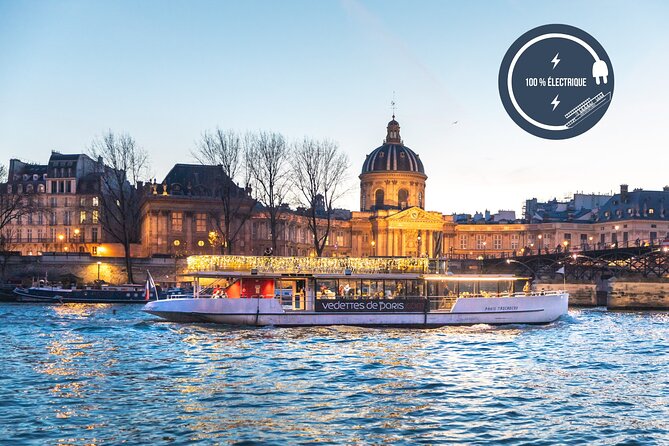
- 100% electric boat keeps things smoother and quieter than older diesel options
What the Seine River evening cruise feels like on board
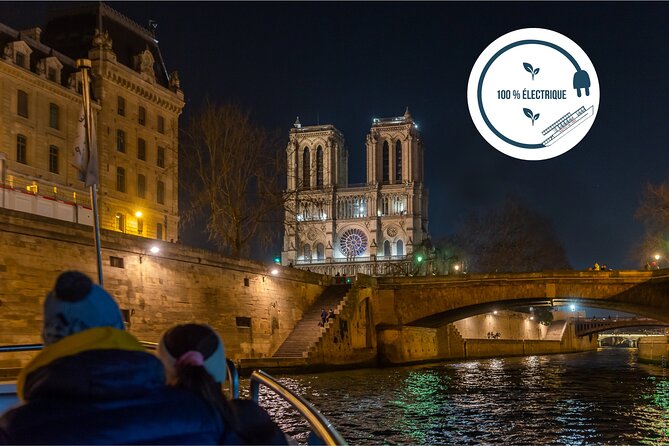
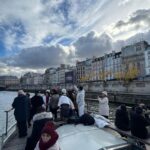
Think of this as a calm nighttime sightseeing hour with a soundtrack. The boat runs with a music playlist (played through speakers), and there’s no guide on board. Instead, you’re encouraged to use the Vedettes de Paris app as an audio guide on your own device.
That setup changes the whole vibe. If you love passive travel—sit, watch, take photos, glance at your phone when you want context—this works well. If you want a person to tell you what you’re seeing and answer questions, this is the wrong format. The experience provider specifically frames evening cruises as musical and relaxing, while guided narration is handled on the daytime cruises.
Practical note: confirmation happens at booking, and you’ll get a mobile ticket. It also helps that the meeting area is near public transport, because you don’t need a complicated shuttle plan to get there.
Group size is another big difference-maker for comfort. The cruise accepts no groups over 14 participants, and the overall maximum is 200 travelers, which can keep things from feeling like a total free-for-all—though the top deck can still fill fast.
You can also read our reviews of more boat tours in Paris

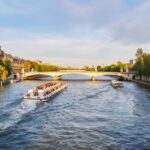
Drink options: when wine or Champagne makes sense
You can upgrade with a drink option (wine or Champagne). If you do, you collect it at the bar, and it’s not table service. You also need to be 18+ to receive alcoholic drinks; minors are served non-alcoholic drinks.
Here’s how I’d judge value for you:
- If you want the classic “glass in hand” Paris moment, the drink option can be worth it because you don’t have to plan a separate stop.
- If you’re picky about what you drink, the bar-and-collect style can feel a bit rushed, since you’re also trying to manage seating, photos, and timing.
A common pattern in feedback: people feel the experience is at its best when they treat the cruise as the show, not the bar as the highlight. In other words, it often pairs better with a nice beverage than with heavy expectations of service.
Your hour on the Seine: landmark-by-landmark route highlights
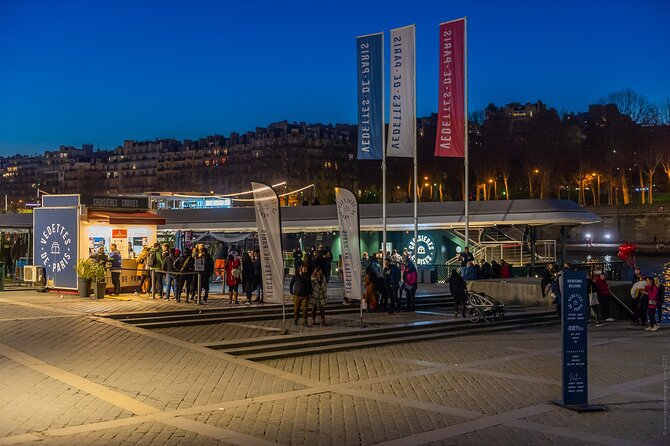
Your cruise glides along some of Paris’s most famous riverfront pieces. The order matters less than what you should notice: bridges are your “connective tissue,” and the major monuments are what give you that full-city feeling.
Eiffel Tower area: built to impress, then to last
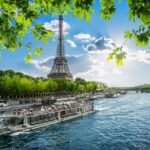
You’ll pass the Eiffel Tower, built by engineer Gustave Eiffel for the 1889 Universal Exhibition. It went up fast for its scale: two years, two months, and five days. At 324 meters tall and about 7,300 tonnes, it was controversial—many Parisians were scandalized by its metal look and height. It was originally meant to last about 20 years, and a radio antenna added in 1903 is credited with saving it from demolition. At night, this becomes the obvious “Paris postcard” moment, but remember: the cruise is only about an hour, so you may not catch every peak light moment.
Russian Orthodox Holy Trinity Cathedral and an American church with Tiffany glass
Next, you’ll see the Holy Trinity Cathedral, tied to the Russian Orthodox tradition, with a center that includes a bilingual Franco-Russian school and a cultural center.
A little farther along is the American Church in Paris, known for its green clock-tower. It’s the first American church built outside the US in 1931, and it has stained-glass windows by Louis Comfort Tiffany—the kind of detail you’ll appreciate even if you’re viewing from the water rather than walking up close.
You can also read our reviews of more evening experiences in Paris
Invalides: Napoleon’s tomb from the river view
You’ll also glide by the Hotel des Invalides, built on orders of Louis XIV as a military hospital for injured officers and soldiers. Today, its royal chapel houses the tomb of Napoleon I—one of the most direct links between Paris’s imperial story and the Seine’s daily scene.
Pont Alexandre III: gold-leaf drama and the Franco-Russian story
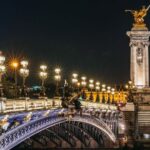
The ornate Pont Alexandre III is a highlight because it’s both decorative and political. It was built for the 1900 Universal Exhibition and to seal the Franco-Russian Alliance. Look for the central Paris coat of arms covered in gold leaf, plus two nymphs representing the Seine. On the opposite side, you’ll see Saint Petersburg’s arms and two nymphs representing the Neva. In evening light, this bridge often looks like it’s wearing jewelry, not stone.
Pont de la Concorde: Bastille stones and Revolution symbolism
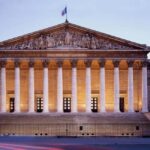
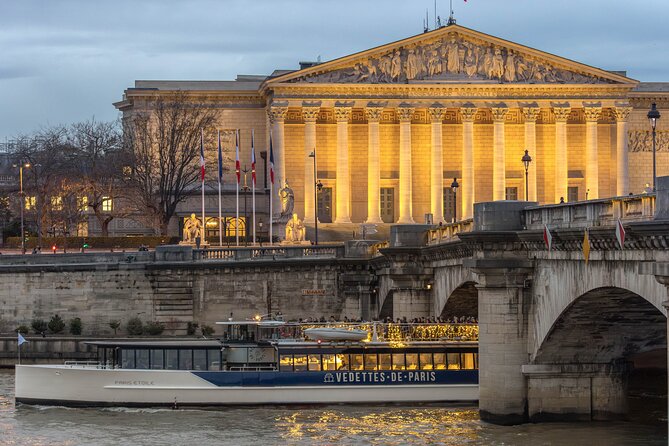
You’ll pass Pont de la Concorde, built using stones from the former Bastille prison, after the prison was stormed in 1789. The bridge connects toward major civic spaces: the Palais Bourbon (National Assembly) on one side and Place de la Concorde on the other. It’s a good moment to notice how the Seine ties France’s political eras together—empires, revolutions, and parliaments all in one waterline.
Hotel de Salm / Legion d’honneur: architecture with a national badge
You’ll spot the green dome of the Hotel de Salm, which later became the Légion d’honneur Palace under Napoleon I. The Légion d’honneur is France’s highest honor. From the river, you get the dome shape and the “institutional” feel more than individual details—but that’s still useful, because it helps you read the city’s landmarks as part of a system, not isolated buildings.
Orsay station: an old railway shell turned art museum
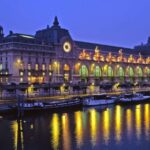
The former Orsay railway station was built for the 1900 Universal Exhibition and originally tied rail travel to the south-west of France. In the 1980s, it was turned into the museum that holds key 19th-century works, including artists like Auguste Renoir, Claude Monet, and Vincent van Gogh. Evening cruising is a nice way to spot the building’s scale before you ever walk into a museum day.
Pont Neuf: the oldest stone bridge and its 381 unique masks
You’ll cross the area of Pont Neuf, which is actually the oldest bridge in Paris. It was the first Paris bridge built in stone with pavements rather than houses lining it. The signature feature: 381 grimacing stone masks, each individually decorated. If you’re into sculpture details, this is one to train your eyes on—though at night and from a moving boat, you’ll catch bits rather than every face.
Pont Saint-Michel: Napoleon III’s imperial Ns and the Latin Quarter
You’ll also pass Pont Saint-Michel, built at the request of Napoleon III, which explains the two imperial Ns on its pillars. This bridge leads toward the Latin Quarter, named because students at the University of Paris spoke Latin there until the 19th century.
Île de la Cité and Notre-Dame: the cathedral’s long build story
Next is Île de la Cité, considered the presumed birthplace of Paris. The island was settled by the Parisii tribe about 300 years before the Common Era, when it was called Lutetia.
Then comes Notre-Dame Cathedral. Construction began in 1163 and finished nearly two centuries later, in 1345. It’s known for its gargoyles and sculpture program, and for its rose window: the Rose du Midi, dedicated to the New Testament and gifted by Saint Louis. In evening light, Notre-Dame reads as “mass and silhouette” more than fine carvings, but the scale still lands.
You’ll also see the statue of Saint Genevieve, patron saint of Paris, sculpted by Paul Landowski—the same sculptor later known for the Christ the Redeemer statue in Rio de Janeiro. The fact that she’s sculpted with her back to you becomes a fun “wait, what?” moment when you spot it.
Île Saint-Louis: 17th-century elegance and famous residents
You’ll pass Île Saint-Louis, known for prestigious areas and former town houses dating from the 17th century—including Hotel Lambert and Hotel Lauzun. Famous residents include Charles Baudelaire and Georges Moustaki. This stretch feels more refined from the water, because the buildings look composed rather than tourist-packed.
Hôtel de Ville and the Conciergerie: civic power and prison history
You’ll see Hôtel de Ville de Paris, seat of the Paris City Council since 1357. Its design takes inspiration from Neo-Renaissance style, and it’s open to visitors on certain days for things like the banquet hall designed as a template of Versailles’ Hall of Mirrors.
Not far from that story is the Conciergerie, built under Philip IV in the 14th century and later turned into a prison. Queen Marie-Antoinette spent her last two months there before being guillotined at Place de la Concorde in 1793. This is heavy history, but seeing it from the river helps it feel embedded in the city’s everyday flow.
Louvre area and Place de la Concorde: royal palace to museum to execution square
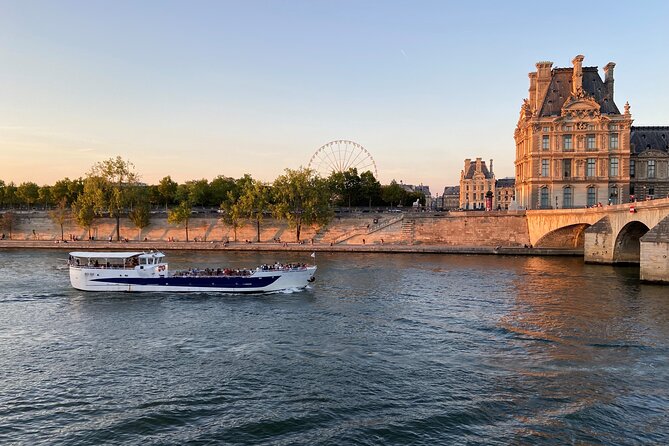
You’ll also glide past the Louvre, originally a royal palace and then turned into a museum in 1793. It’s the largest monument in Paris with more than four kilometers of façades and nearly 14 kilometers of galleries. It’s famously the most visited museum in the world, with about 38,000 works, including the Winged Victory of Samothrace, Venus de Milo, and the Mona Lisa.
Around the bend is Place de la Concorde, where Louis XVI and Marie-Antoinette were executed during the French Revolution. In the center is an obelisk from Luxor, Egypt—about 34 centuries old, brought to France in 1836. Even if you don’t get out to explore, it’s one of the clearest “Paris = layers” points on the route.
Grand Palais, Liberty Flame, and Palais de Chaillot
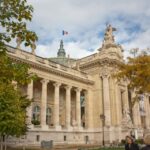
On your right you’ll pass the Grand Palais, built for the 1900 Universal Exhibition. Its glass roof is described as the largest in Europe. Today it’s used for cultural events and exhibitions, and even has uses like fair events and skating—one more reminder that Paris reuses major architecture in clever ways.
You’ll also spot the Flame of Liberty, a gift from the United States and the newspaper International Herald Tribune to France, as thanks for restoring the Statue of Liberty. The sculpture is an exact reproduction of the flame from New York.
Finally, the river view extends toward the Palais de Chaillot on place du Trocadero. Built in 1937 for the Universal Exhibition, it features two Neoclassical pavilions around an esplanade with views of the gardens. Inside are places like the City of Architecture and Heritage, the National Navy Museum, the Museum of Humankind, and the National Theatre of Chaillot.
Best seats, timing, and using the audio guide without frustration
This is where your experience can swing from charming to annoying.
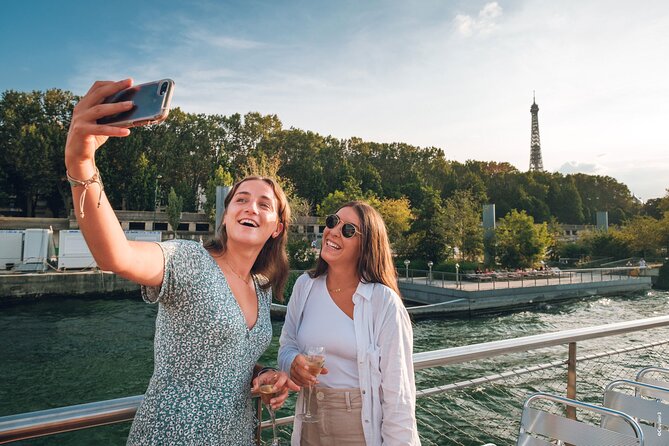
First: the top deck is limited. If you want the best views and easier photo angles, arrive early. The most common practical advice is to show up about 30 minutes earlier so you’re not stuck with a seat that blocks your sightline.
Second: the boat lighting and music mix can be tricky. Some people find the background music loud enough that it makes the downloadable audio guide tough to follow unless you use headphones. Also, don’t assume the audio guide will be perfect on the first try—if the audio doesn’t start the way you expect, you’ll want a backup method (like your own map app) just so you’re never left feeling lost.
What I’d do:
- Download the app before you leave for the pier.
- Bring your own headphones (since headphones are not provided).
- Plan to watch your timing if you’re aiming for a specific Eiffel Tower light moment—your cruise is about an hour, so missing that exact sparkle is possible.
Weather matters too. If it’s cold or rainy, dress for the deck, not for indoor comfort. A 1-hour cruise seems short until you’re outside in wind.
Is this the right evening cruise for your trip style?
This cruise is a strong fit for:
- First-time visitors who want a quick “Paris at night” hit
- Couples who want a relaxed shared activity with optional drinks
- Anyone who prefers seeing first, learning second (using the app when they want)
It’s not the best fit if:
- You expect a guide narrating every landmark in real time
- You hate audio-in-thebackground situations and want quiet, spoken storytelling
- You’re planning a major anniversary surprise and need service details beyond a bar pickup and phone audio
If you want a more “special event” feel, the provider suggests their private option called Riviera Seine for occasions like anniversaries. That’s worth considering if you’re craving something more tailored than a busy evening cruise.
Should you book this Seine River evening cruise?
Yes—with smart expectations.
Book it if you want a low-effort, scenic hour on the Seine with music, landmark views, and the option to add a drink without planning a separate stop. If you’re chasing high-impact details, go early for a better seat (especially on the top deck) and bring headphones so the audio guide is actually usable.
Skip it (or switch formats) if your main goal is a live guide and you don’t want to manage phone audio on a moving boat. For pure atmosphere, though, this is an efficient way to turn your first Paris night into something you’ll remember.
FAQ
How long is the Seine River evening cruise?
It runs for about 1 hour.
Is there a guide on board?
No. There is no guide on board. You can download and use an audio guide app on your smartphone.
Are headphones provided for the audio guide?
No. Headphones are not provided.
What languages are available for the audio guide?
The audio guide app supports multiple languages, including English.
Can I get wine or Champagne during the cruise?
Yes, there is an optional drink option. If you choose it, you collect the drink at the bar (no table service). Alcohol is served only to travelers 18 and older.
Where does the cruise start?
The meeting point is at V75R+HJ7, 2 Port de Suffren, 75007 Paris, France. The cruise ends back at the meeting point.
What if the weather is bad?
This experience requires good weather. If it’s canceled due to poor weather, you’ll be offered a different date or a full refund.