REVIEW · PARIS
Paris Landmarks & Crepes
Book on Viator →Operated by Bonjour Local Tours · Bookable on Viator
Paris reveals itself best on foot, and this half-day route links Bastille, the Marais, Saint-Germain, the Louvre, and the Eiffel Tower in one sweeping walk. You get major sights, small historic corners, a traditional crêperie stop, and a quick Métro ride at the end.
I like the private format, since your group can focus on questions and move at its own pace. I also like the food break, which adds a real Paris habit to a tour packed with monuments. The main drawback is the pace: four hours and many stops mean plenty of walking, with most places seen from outside.
In This Review
- Key Points
- From Bastille to the Eiffel Tower in Four Hours
- Place de la Bastille and the Revolution’s Missing Prison
- The Marais, Place des Vosges, and Hôtel de Sully
- Notre-Dame and the Fontaine Saint-Michel
- A Crêpe Lunch at Place Saint-André-des-Arts
- Saint-Germain-des-Prés and Parisian Café Culture
- Pont des Arts, the Louvre, and Napoleon’s Arch
- Tuileries Garden and Place de la Concorde
- Champ de Mars and the Eiffel Tower Finish
- What the $153.80 Price Buys You
- Who Should Book This Paris Walk?
- Should You Book Paris Landmarks & Crepes?
- FAQ
- How long does Paris Landmarks & Crepes last?
- Where does the tour begin?
- Where does the tour end?
- Is the Louvre Museum included?
- Can I go up the Eiffel Tower during the tour?
- Is lunch included?
- Is this a private tour?
Key Points
- A private route across central Paris: Only your group takes part, with an English-speaking guide.
- Crêpes are included: The half-hour stop at Place Saint-André-des-Arts serves as the tour’s lunch break.
- Strong historical range: You move from the French Revolution at Bastille to Napoleon’s Arc de Triomphe du Carrousel.
- Many sights are exterior visits: The Louvre and Eiffel Tower are viewed from outside, with no entry included.
- A practical final view: The tour ends in front of the Eiffel Tower on the Champ de Mars.
- A guide can make the difference: Simone is praised for being friendly, well prepared, and clear.
From Bastille to the Eiffel Tower in Four Hours
This is a big-picture Paris tour, not a museum visit or a slow neighborhood stroll. You begin at Place de la Bastille and finish beside the Eiffel Tower, crossing several districts and layers of French history along the way.
That makes the route useful early in a Paris stay. You get your bearings quickly, see how the city’s quarters connect, and collect ideas for places to return to later. The tradeoff is simple: you will see many places, but you will not linger long at any of them.
The experience is private, offered in English, and priced at $153.80 per person. That is a serious price for four hours, but it includes a dedicated guide for your group, the crêpe lunch, and a carefully connected route through central Paris. It is most appealing if you value interpretation and convenience more than admission tickets.
The tour averages about 85 days of advance booking, so plan ahead if your dates are fixed. Free cancellation is available up to 24 hours before the start time.
You can also read our reviews of more tours and experiences in Paris.



Place de la Bastille and the Revolution’s Missing Prison
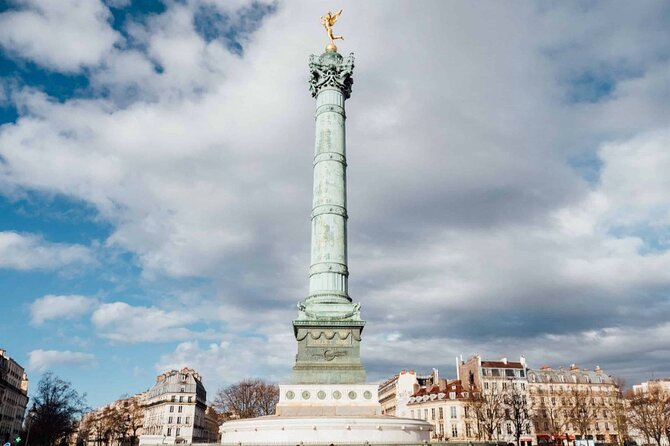
The starting point is Place de la Bastille, where the Bastille prison once stood. Nothing of the prison remains. That absence is part of the story: the fortress was stormed during the French Revolution on July 14, 1789, then physically destroyed between July 14, 1789, and July 14, 1790.
You will spend about 10 minutes here, looking at the square and the July Column. The column commemorates the July Revolution of 1830, not the original storming of the Bastille, a detail that can easily confuse first-time visitors.
Bastille also sits across the 4th, 11th, and 12th arrondissements. The square includes the Bastille Opera, a Métro station, and part of the Canal Saint-Martin area. Since the old railway station was replaced by the opera house in 1984, this is a place where modern Paris sits directly on top of earlier city life.
Do not expect a grand prison interior or a preserved fortress. This stop works through explanation and setting, not surviving stonework.
The Marais, Place des Vosges, and Hôtel de Sully
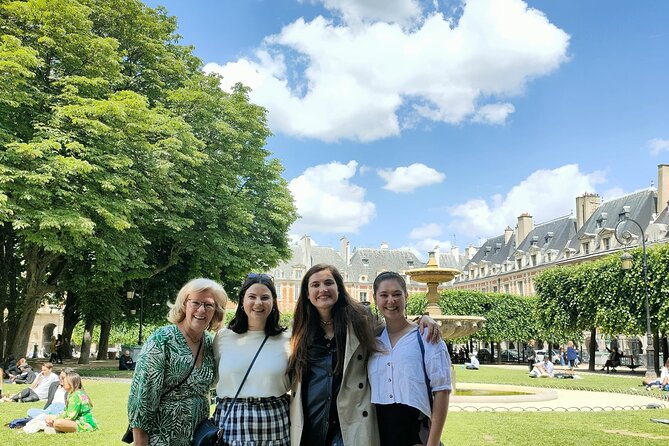
The route then enters the Marais, one of the most rewarding parts of the tour. Place des Vosges gives you a handsome, orderly square with red-brick façades, arcades, and a calm shape that feels far removed from the broad traffic lanes of Bastille.
At 15 minutes, the stop is long enough to understand why the square mattered. Originally called Place Royale, it is the oldest planned square in Paris. It became an expensive address for Parisian nobility in the 17th and 18th centuries, helping shape the Marais as an elegant district.
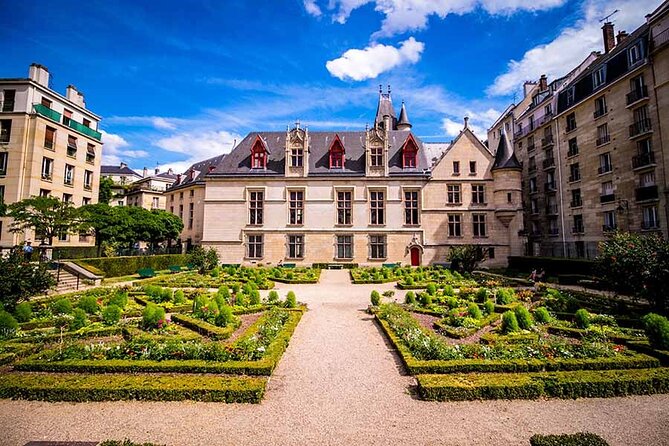
Next comes the courtyard and garden of the Hôtel de Sully. This early 17th-century private mansion is a fine example of Louis XIII style. It now houses the Centre des Monuments Nationaux, the French organization responsible for national heritage sites, and it has been protected as a historic monument since 1862.
I like this pair of stops because they give you more than headline attractions. Place des Vosges explains urban planning and social status. Hôtel de Sully shows how Parisian private mansions were built around courtyards and gardens, with quieter spaces tucked behind busy streets.
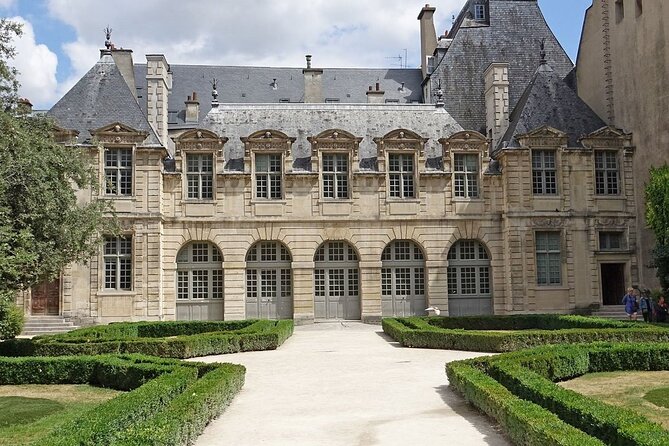
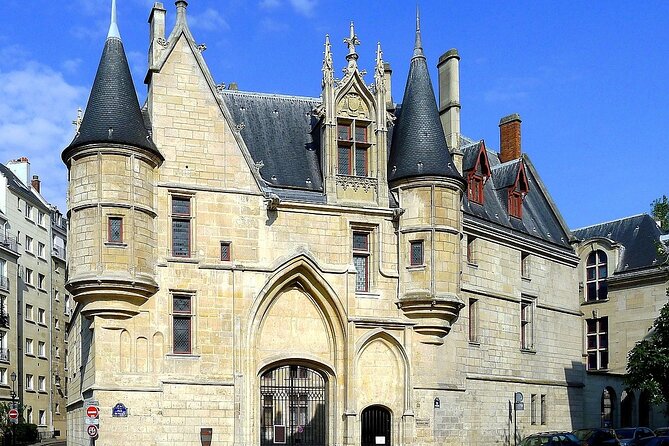
The Hôtel de Sens follows, with about 15 minutes. This 16th-century mansion once belonged to the archbishops of Sens and now houses the Forney art library. It is another exterior-focused stop, but it adds architectural variety and shows how much of old Paris survives in the Marais.
Notre-Dame and the Fontaine Saint-Michel
The tour continues to Île de la Cité and Notre-Dame de Paris. You get about 15 minutes at the cathedral, enough for an outside look and a concise explanation of its importance.
Notre-Dame is one of the finest examples of French Gothic design. Its rib vaults, flying buttresses, rose windows, sculpture, bells, and pipe organs helped define the style. The cathedral is dedicated to the Virgin Mary and sits on an island in the Seine, in the 4th arrondissement.
Since the tour does not list interior entry, plan on seeing Notre-Dame from outside. That is still worthwhile, but it matters to set expectations. If entering the cathedral is a priority, you will need to arrange that separately and allow extra time beyond this experience.
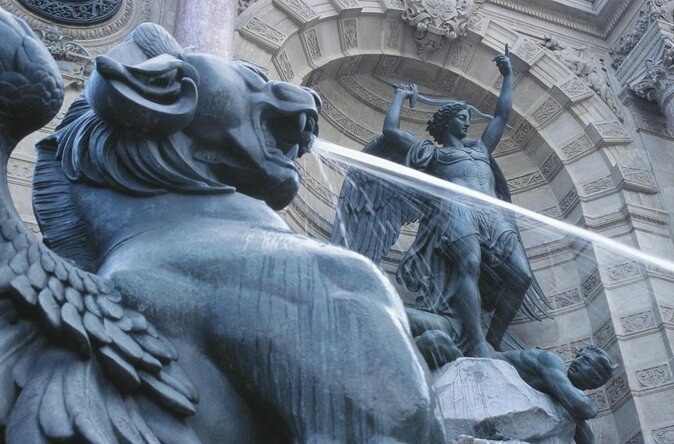
From there, the route reaches the Fontaine Saint-Michel in Place Saint-Michel. Built between 1858 and 1860 during the Second French Empire, the fountain was designed by Gabriel Davioud and has been protected as a historic monument since 1926.
This section gives you a compact lesson in Parisian city design. You move from a medieval cathedral to a 19th-century monumental fountain, with the Seine and central Paris tying the scenes together.
A Crêpe Lunch at Place Saint-André-des-Arts
The food stop is at Place Saint-André-des-Arts, where you visit a traditional French crêperie for about 30 minutes. Lunch is included, which makes this more than a snack break and helps soften the fast pace of the sightseeing.
Crêpes are a practical choice for a walking tour. The meal is tied to everyday French food culture, and the stop gives you a chance to sit down rather than march from one monument to the next. One especially strong piece of praise focuses on the crêpes as the best the writer had eaten, so food is not an afterthought here.
The supplied details do not specify the exact crêpe selection, drink policy, or dietary options. If you have allergies or need a special menu, ask before booking rather than assuming the included lunch will fit your needs.
The location also makes sense geographically. Place Saint-André-des-Arts sits near the Latin Quarter and the Seine, so the meal arrives at a natural midpoint before the route turns toward Saint-Germain and the Louvre.

Saint-Germain-des-Prés and Parisian Café Culture
After lunch, you spend about 15 minutes in the Saint-Germain-des-Prés quarter. This is the Paris of cafés, bookshops, publishing houses, and intellectual life.
The quarter includes famous cafés such as Les Deux Magots, Café de Flore, Le Procope, and Brasserie Lipp. It was also closely tied to existentialist thinkers Jean-Paul Sartre and Simone de Beauvoir in the 1940s and 1950s.
You will not have time to settle into café life during this short stop, but the guide can help you read the district beyond its polished storefronts. Saint-Germain is not simply a place to take a café photo. It connects religious history, art, education, publishing, and modern Parisian identity.
The Church of Saint-Germain-des-Prés receives another 15 minutes. The church began as part of a Benedictine abbey founded in the sixth century by Childebert I, son of Clovis, King of the Franks. Vikings destroyed the original structure, which was later rebuilt and renamed for Saint Germain, an early bishop of Paris.
It is considered the oldest existing church in Paris. That makes this a useful counterpoint to Notre-Dame. Notre-Dame is the better-known Gothic symbol, while Saint-Germain-des-Prés offers a more compact look at the city’s early Christian and monastic past.
Pont des Arts, the Louvre, and Napoleon’s Arch
The walk then reaches Pont des Arts, a pedestrian bridge over the Seine. It links the Institut de France with the central courtyard of the Louvre, once known under Napoleon as the Palais des Arts.
This is one of the route’s best places for a broad city view. You can look along the river, connect the Left Bank and Right Bank, and understand how the Louvre fits into the center of Paris.
The Louvre stop lasts about 15 minutes, but you do not enter the museum. The outside visit lets you see the former royal palace and the scale of the complex. The Louvre began as a fortress in the late 12th or early 13th century under Philip II. Its defensive role faded, and Francis I turned it into the principal residence of the French kings in 1546.
The museum now contains famous works such as the Mona Lisa and Venus de Milo, but those are not part of this experience. If you want even a quick museum visit, book a separate time slot and do not expect to fit it into this four-hour route.
The Arc de Triomphe du Carrousel follows. Built between 1806 and 1808, it celebrates Napoleon’s military victories in the Wars of the Third and Fourth Coalitions. It is smaller than the Arc de Triomphe at the far end of the Champs-Élysées, but the two arches were designed in the same year.
This is a fine example of how the tour moves through different political eras without stopping for a long lecture at each place. Revolution, monarchy, empire, and modern public life all appear within a few blocks.
Tuileries Garden and Place de la Concorde
The Tuileries Garden offers a change of rhythm. After streets, façades, and monuments, you reach an open public garden between the Louvre and Place de la Concorde.
Catherine de’ Medici created the garden in 1564 for the Tuileries Palace. It opened to the public in 1667 and became a public park after the French Revolution. Since the 19th century, Parisians have used it for walks, meetings, celebrations, and quiet rest.
The stop lasts about 15 minutes. That is enough to appreciate the long axis toward the Place de la Concorde, but not enough for a relaxed garden wander. If the weather is good, you may wish to return later and spend more time here.
Place de la Concorde takes another 15 minutes. At 7.6 hectares, it is the largest square in Paris. It sits at the eastern end of the Champs-Élysées, in the 8th arrondissement, and carries some of the darkest memories of the French Revolution.
The square was the site of public executions, including those of Louis XVI, Marie Antoinette, and Maximilien Robespierre. During the Revolution, it was renamed Place de la Révolution. A guide’s context is especially useful here because the square’s grand scale can hide its violent past.
Champ de Mars and the Eiffel Tower Finish
The final section brings you to Champ de Mars, the broad green space between the École Militaire and the Eiffel Tower. The park takes its name from Rome’s Campus Martius and once served as a military drilling and marching ground.
You spend about 15 minutes here before reaching the Eiffel Tower for another 15-minute stop. The tour ends in front of the tower on the Champ de Mars, giving you a clear finish and an easy point from which to continue sightseeing.
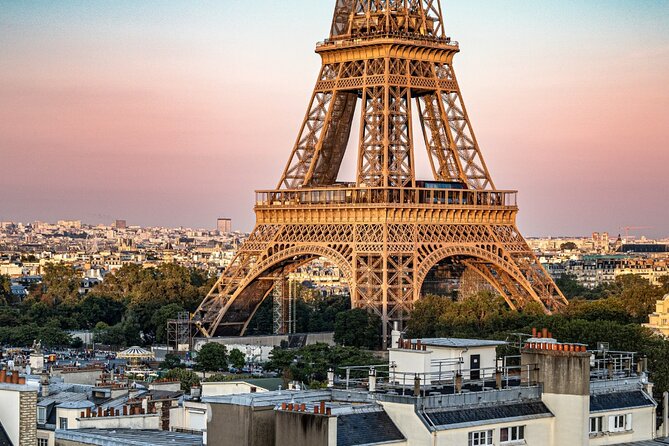
You do not go up the Eiffel Tower. The tour takes you right beside it, but tower admission is not included. This is important if you want views from the upper levels, since you must arrange a separate visit.
Still, ending here works well. The Eiffel Tower was built from 1887 to 1889 as the centerpiece of the 1889 World’s Fair. Gustave Eiffel’s company designed the wrought-iron structure, which was first criticized by some French artists and intellectuals before becoming one of France’s best-known symbols.
The final transfer includes a quick Métro ride to the Eiffel Tower area. The details do not specify the exact station or line, so follow the guide’s instructions on the day. The ride saves time and lets the tour cover more ground than a fully walking route could manage.
What the $153.80 Price Buys You
At $153.80 per person, this is not a budget walking tour. You are not paying for museum tickets, Eiffel Tower admission, or a long meal. Most stops are free exterior viewpoints.
The value comes from the private format, the route planning, the English-speaking guide, and the included crêpe lunch. I would consider it a fair choice for a first Paris visit if you want the city explained as one connected story rather than a pile of separate addresses.
Group discounts may improve the price for larger parties. Since only your group participates, families and friends may find the cost easier to justify than solo visitors. A private tour also gives you a better chance to ask about places that catch your attention.
The strongest praise centers on the guide’s ability to mix major tourist sights with local flavor. Simone is singled out as friendly, capable, and well prepared. That quality matters here because the route depends on interpretation. Without a good guide, some stops would be attractive but brief facades.
Who Should Book This Paris Walk?
I would choose this experience if you:
- Have about four hours and want a wide introduction to central Paris
- Prefer a private guide to a large group
- Want history explained in plain English
- Like walking through districts rather than spending hours inside one museum
- Want an included crêpe lunch
- Need to finish near the Eiffel Tower
- Are comfortable with a brisk schedule and many short stops
I would skip it if your main goal is entering the Louvre, climbing the Eiffel Tower, or spending a relaxed afternoon in one neighborhood. The tour gives you outside views of both major attractions, not admission.
Wear comfortable shoes. The experience links many areas on foot, and one prior description aptly sums up the day as history, food, and a ton of steps. That is not a complaint so much as a useful warning.
Should You Book Paris Landmarks & Crepes?
Book this tour if you want a private, history-focused introduction to Paris with food built in. The route covers an impressive amount of ground, from the vanished Bastille prison to the Eiffel Tower, and it includes quieter architectural stops that you might miss on your own.
The best reason to book is the combination of structure and human explanation. You get the famous names, but also Place des Vosges, Hôtel de Sully, Hôtel de Sens, Saint-Germain-des-Prés, and the Fontaine Saint-Michel. The main compromise is speed, plus the lack of interior access at the Louvre and Eiffel Tower.
For a first or short Paris stay, I think the route earns serious consideration. For repeat visitors who already know the major sights, the private guide and Marais details may still appeal, especially if the crêpe stop and neighborhood history sound more useful than another museum ticket.
FAQ
How long does Paris Landmarks & Crepes last?
The experience lasts approximately four hours.
Where does the tour begin?
It begins at Place de la Bastille in Paris. The provided meeting information identifies the starting point as Place de la Bastille, 75012 Paris.
Where does the tour end?
The tour ends in front of the Eiffel Tower on the Champ de Mars, at Avenue Gustave Eiffel in the 7th arrondissement.
Is the Louvre Museum included?
No. The tour visits the Louvre from outside and does not include entry into the museum.
Can I go up the Eiffel Tower during the tour?
No. The tour takes you next to the Eiffel Tower but does not include going up inside it.
Is lunch included?
Yes. Lunch is included at a traditional French crêperie near Place Saint-André-des-Arts.
Is this a private tour?
Yes. Only your group participates in the private activity. It is offered in English and includes a mobile ticket.